

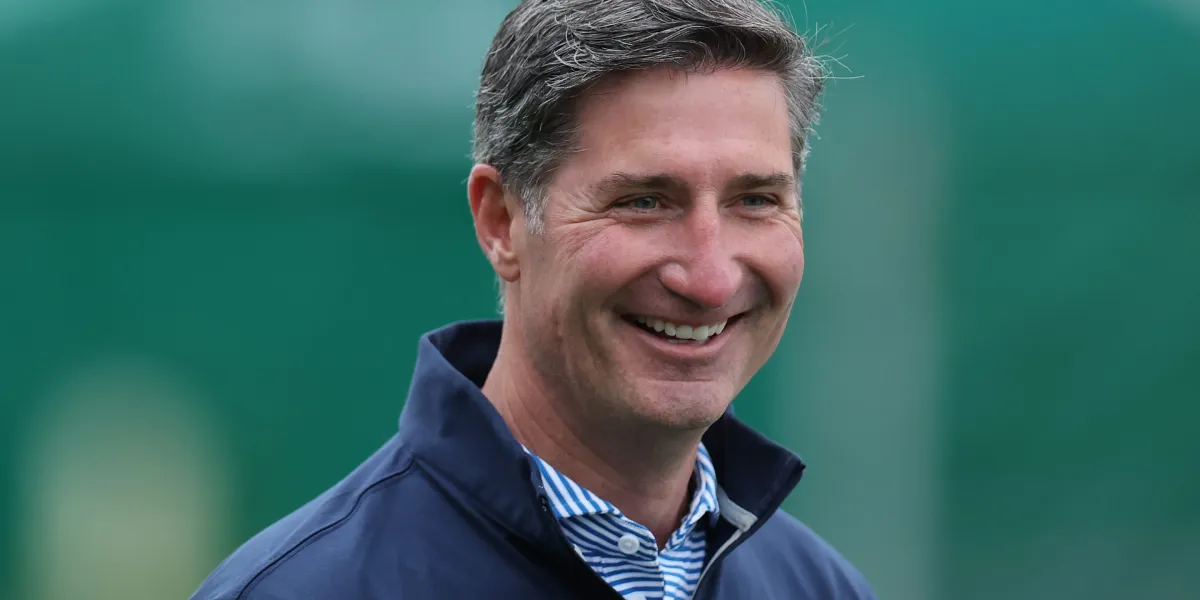
Good morning. Starbucks is heating up. Earlier this week, the coffee store company reported its first U.S. quarterly comparable sales increase in two years, helped by CEO Brian Niccol’s focus on efficient operations, consistency in service, more appealing stores and a streamlined menu that still manages to introduce new items often enough to keep people interested.
“The shine is back,” Niccol crowed on Thursday in Manhattan at his first Starbucks investor day. While even he admits it’s too early to cry victory, he does deserve credit for getting this challenging turnaround off the ground. He did so by offering the troops, from your local barista to his C-suite, something whose absence has sunk comeback attempts by other CEOs: clarity of mission and simplicity.
That discipline extends to Starbucks’ $8 billion international business. Starbucks International CEO Brady Brewer told me that the vast majority of the 20,000 or so new stores it wants to add abroad in coming years will be in those markets where it is already present and thriving, rather than new ones.
Niccol has dubbed his turnaround “Back to Starbucks.” That means going back to what made Starbucks popular in the first place. People like being able to actually sit down and enjoy their coffee? Let’s jettison the seat-free Starbucks locations that existed solely for mobile order pickup. (The company is adding 25,000 seats to its company-operated U.S. stores.)
How about store design? When it comes to creating new store layouts, Starbucks now designs with store workers and not just for them. Starbucks now tests new ideas in five stores in real operating conditions. (We’ve all been at a chaotic Starbucks watching employees bump into each other because HQ gave them an unworkable layout.)
Another example: under Niccol, each store is graded on the five most important criteria, a fraction of the metrics used before: customer experience, performance during peak hours, employee scheduling, product availability, and health and safety.
Niccol has a reputation for succinctly communicating what needs to be done, simplifying processes and making clear what comes next after each step in the turnaround. It’s a playbook familiar to those who saw how he rehabilitated Chipotle Mexican Grill following food safety disasters. He was methodical in how to repair the damage and earn back the trust of customers and workers before going on offense. By the time he was done, Chipotle sales had doubled.
Too many turnaround attempts see a CEO throwing spaghetti at the wall in the hopes something will work, further confusing the rank and file and sapping their confidence in management. When you look at the nascent Starbucks turnaround and the return to form of brands like Ralph Lauren and Bloomingdale’s, you see a common thread: The CEO provides a clear direction, gives frequent updates and “proof” the plan is working, and continually looks ahead to the next step.
“Back to Starbucks reconnects us with our core. It gives us a platform to build the best of Starbucks with clarity, confidence and purpose,” Niccol said. So far, his approach is working.
Contact CEO Daily via Diane Brady at diane.brady@fortune.com
Top leadership news
Apple exceeds earnings estimates
Apple blew out earnings estimates with $143.8 billion in revenue, up 16% year-over-year, driven by strong iPhone sales. Despite that, the company’s stock rose less than 1% in after-hours trading as leaders said little about AI prospects.
BlackRock pushes deeper into alternative markets
BlackRock announced that it will start sharing a portion of the profits from its private markets funds with select senior executives, which could generate multi-million payouts over the next decade based on performance. The move underscores the firm’s push into alternative assets and its strategy to retain and attract top private markets talent.
The emergence of ‘new-collar” jobs
Sue Duke, LinkedIn’s head of global public policy and managing director for EMEA, estimates that “70% of the average skill set of the average job will have changed by 2030.” “New-collar” jobs that mix human skills with AI proficiency, on the other hand, are a bright spot in an otherwise sluggish job market.
The markets
S&P 500 futures are down 1.03% this morning. The last session closed down 0.13%. STOXX Europe 600 was up 0.37% in early trading. The U.K.’s FTSE 100 was up 0.11% in early trading. Japan’s Nikkei 225 was down 0.09%. China’s CSI 300 was down 1.0%. The South Korea KOSPI was up 0.06%. India’s NIFTY 50 was down 0.39%. Bitcoin was at $82K.
Around the watercooler
Landmark crypto bill clears Senate hurdle but Democrats withhold support over lack of ‘gryfto’ rules to prevent Trump family conflicts of interest by Leo Schwartz
Remove Tesla’s non-repeatable profits, and the stock has never been more expensive—now boasting a ‘core’ PE of 632 by Shawn Tully
$38 trillion national debt finds Democratic, Republican supermajority as watchdog sees ‘a major problem for America’s economic future’ by Nick Lichtenberg
Top engineers at Anthropic, OpenAI say AI now writes 100% of their code—with big implications for the future of software development jobs by Beatrice Nolan
Microsoft’s $440 billion wipeout, and investors angry about OpenAI’s debt, explained by Eva Roytburg
CEO Daily is compiled and edited by Joey Abrams, Claire Zillman and Lee Clifford.
