

Oil prices rose this week after Donald Trump declared a “total blockade” on US-sanctioned tankers heading to and from Venezuela, escalating a stand-off with the country’s authoritarian president, Nicolás Maduro.
The US president said in a Thursday interview with NBC that he would not rule out war with Venezuela, and that more oil tankers would be seized. “If they’re foolish enough to be sailing along, they’ll be sailing along back into one of our harbours,” he said.
Washington has already seized the Skipper, a stateless tanker, off Venezuela this month, after the US built up a major naval presence in the Caribbean and launched a campaign of lethal strikes on boats allegedly carrying drugs.
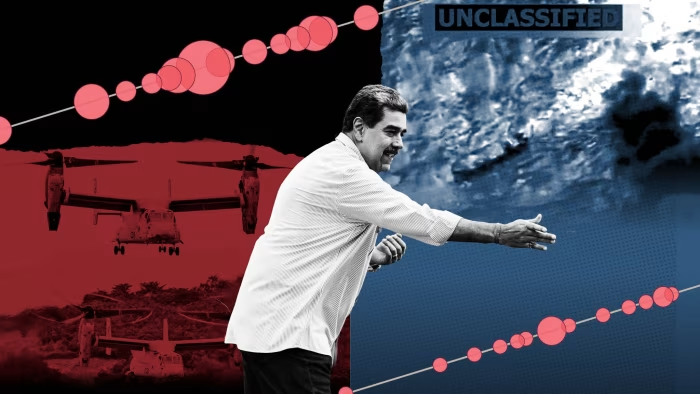
Satellite images and tracking data show a recent build-up of US aircraft in the region, adding to the military presence menacing Venezuela and deterring oil tankers and commercial flights.
The US’s Roosevelt Roads naval base and airfield in Puerto Rico was officially reactivated last month, more than two decades after it was shuttered.
Satellite images from early September showed construction work taking place on its northern taxiway and tents erected near the runway. Images from December 11 show a variety of aircraft, including F-35A Lightning II fighter jets, KC-130 refuelling planes and search-and-rescue aircraft.
The US has also assembled a fleet of EA-18G Growler aircraft, which can detect and disrupt communications networks. Two US F/A-18 Super Hornets were spotted circling the Gulf of Venezuela by flight trackers on December 9.
Two EA-18G Growler aircraft taxi on a runway at Roosevelt Roads naval base © Ricardo Arduengo/Reuters
The aircraft are accompanied by what Trump has called “the largest Armada ever assembled in the History of South America”, as he seeks to pile pressure on Maduro, a revolutionary socialist designated by Washington as the leader of a “narco-terrorist” drug cartel.
The MV Ocean Trader, a former commercial ship retrofitted to become a floating special operations command centre, is also among the group. The USS Gerald R Ford Carrier Strike Group joined the flotilla in November, bringing total US troops in the Caribbean to more than 14,000.
Sentinel 2 satellite imagery from early December shows one vessel close to the Venezuelan coast, which has an appearance consistent with an Arleigh Burke-class guided-missile destroyer. Images from November show other apparent US warships less than 100km from Venezuela, including one with a profile similar to the amphibious assault ship, the Iwo Jima.
Dr Ollie Ballinger, a lecturer in geocomputation at University College London, identified the warships using image-matching technology, with each potential match then checked manually by the Financial Times.
US forces have conducted live-fire exercises in the region and installed a military-grade radar system in Trinidad and Tobago, which is just seven miles from Venezuela’s north coast at the shortest point.
Venezuela’s military has been issuing clips of its army and navy on manoeuvres, but its firepower is a fraction of that of its potential adversary. Military experts say many of the country’s Russian aircraft are in need of maintenance, while Maduro’s mass militia call-ups have largely fallen flat.
“The real capacity of Venezuela’s armed forces is insignificant” compared with the US in an invasion scenario, said José Garcia, a Venezuelan defence analyst. “The US is primed for total dominance in this scenario as Venezuela has no viable conventional response.”
Nevertheless, Kpler, a real-time data and analytics provider, said satellite imagery showed at least one tanker being escorted by what it believed to be a Venezuelan navy escort — a move that analysts suggest could become a flashpoint with the US naval flotilla.
Maduro, who is regarded by the US and many of its allies as having stolen last year’s vote to win re-election, has relied on a “shadow fleet” of tankers to evade sanctions on Venezuela’s oil sector.
Recommended
On December 10, the US seized the Skipper, on which it had previously placed sanctions for allegedly being part of an oil smuggling network funding Hizbollah and the Iranian Revolutionary Guard Corps. It said it would seize the cargo of the tanker, which was apprehended near Venezuela.
That had an immediate deterrent effect on other tankers. Kpler named four vessels — Bella 1, Seeker 8, Karina and Eurovictory — that reversed course following the US action.
The Bella 1 turned around close to the Caribbean islands of Antigua and Barbuda on December 11, while three more changed their courses in the Indian Ocean after leaving Singapore around the same time.
Venezuela exports about 900,000 barrels a day of oil, with Chevron — which has a sanctions-exemption licence — bringing about 150,000 b/d to the US. Chevron has said it is continuing to operate.
About 80 per cent of the country’s crude exports are sent to China via intermediaries, providing a crucial source of dollars for Maduro’s cash-strapped regime.
Venezuela appears to have significant crude oil export capacity on hand: 11 tankers that have previously shipped the country’s oil to locations other than the US have most recently broadcast a position within Venezuelan waters.
With the country’s bolívar currency rapidly shedding its value and dollars scarce on the streets, many Venezuelans are making purchases in cryptocurrencies and on credit. There are fears of a return to the hyperinflation of 2016 to 2022, when shortages of food and medicine were widespread.
Meanwhile, the US has continued to strike vessels allegedly smuggling drugs, killing more than 100 people in a campaign that began in early September.
Amid concerns about the legality of the strikes, the House of Representatives on Wednesday narrowly defeated two Democratic-led resolutions to require Congress to authorise Trump’s Caribbean campaign, one covering the attacks on boats and the other “hostilities within or against Venezuela”.
After vowing more oversight of the US’s military campaign, the Republican chairs of the powerful Senate and House armed services committees have subsequently expressed satisfaction with the US secretary of state and defence secretary’s justifications.
“I am confident that the strikes that have taken place thus far against narco-terrorists . . . were conducted based on sound legal advice,” Senate armed services chair Roger Wicker said on Thursday. “I have seen no evidence of war crimes.”
Maduro has said the build-up is a pretext for his attempted ousting and described the counter-narcotics justification as “fake news”.
“To the people of the United States, we say once and a thousand times: no blood for oil,” Maduro said on Monday, wearing a red Maga-style baseball cap with ‘Yes peace, no war’. “They can’t say we’ve got weapons of mass destruction, chemical weapons or nuclear rockets, so they’re inventing a pretext to create another Afghanistan or Libya.”
Additional reporting by Jamie Smyth in Washington and Alan Smith, Chris Cook, Steven Bernard, Bob Haslett and Jana Tauschinski in London
