

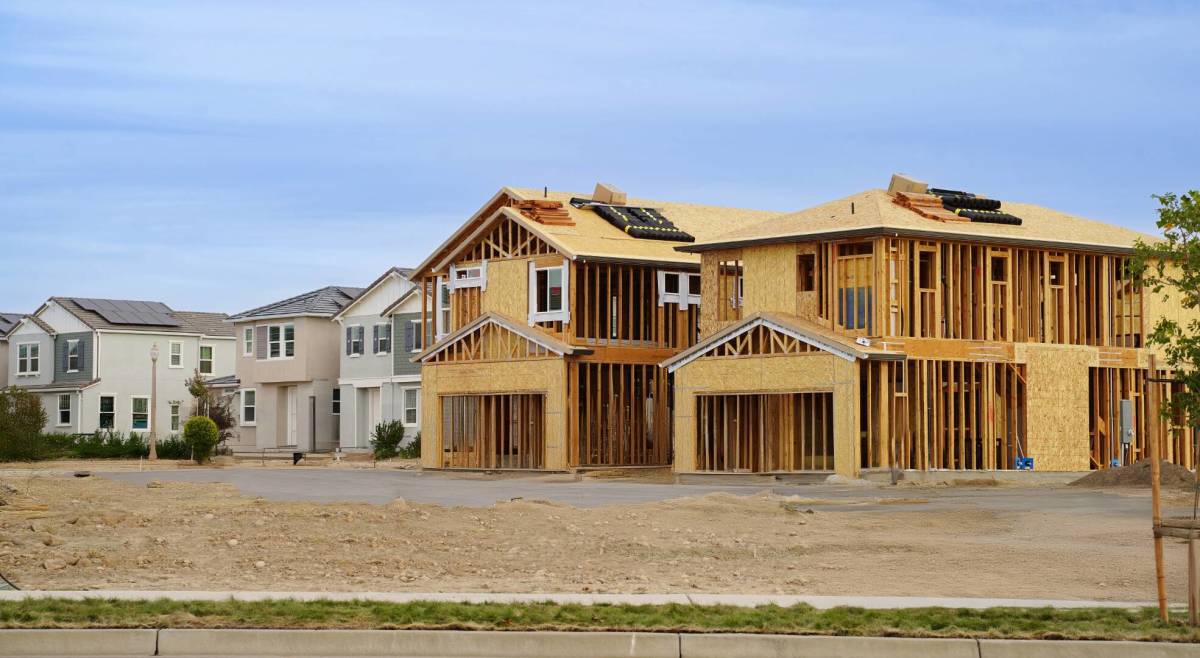
The Federal Reserve gave home buyers, home sellers and builders a gift on Wednesday with its latest rate cut.
How big a break isn’t quite clear, but the move to trim its federal funds rate, its key rate, may act as a top for mortgage rates.
It may be late January before we know for sure, but the path to a better housing market is clearer for now.
Here’s why.
The Fed cut brings the federal funds rate to 3.50% to 3.75%, and Wall Street seems to think another cut will come at the Fed’s January 27-28 meeting. (The rate is what the Fed wants member bank to charge each other for overnight loans to meet reserve rules and is the key U.S. interest rate.)
Related: Redfin forecasts mortgage rates pivot in 2026
At the same time, a new Fed chairman will be nominated early next year to replace Jerome Powell, and whoever takes the job will have Donald Trump right behind him bellowing for still more rate cuts. In fact, the President applauded Wednesday’s move but groused it should have been bigger.
But for anyone involved in housing — be they buyer, seller, real estate broker or property appraiser — the Fed’s rate cut may give bond investors confidence to push yields lower. And bond yields are a far bigger influence on mortgage rates than anything else.
How mortgage market reacted to the Fed
Indeed that happened on Wednesday. The 10-year U.S. Treasury yield fell to 4.155%, not a record but directionally what people want.
And it was 13.6% lower than the 2025 peak of 4.809% on Jan. 2025.
Mortgage News Daily, a financial site that tracks the mortgage market, put the rate on a 30-year mortgage at 6.3%, down from 6.35% the day before. Mortgage rates have hovered around 6.3% to 6.4% since the end of August after peaking at 7.26% in January.
How lower rates affect a home buyer
As a very rough rule, mortgage rates in the United States run about 2 percentage points higher than the 10-year yield. So, if the 10-year yield drops to, say, 4%, you could be looking at mortgage rates hitting 6%, maybe lower.
Here’s what it means for a buyer of a $300,000 home with a down payment of 18%.
That would make the mortgage amount $246,000. At 6.3% now, that would mean a monthly principal and interest payment of $1,523. At 6%, the payment drops to $1,474. If the rate drops to 5.75%, the payment falls to $1,435.
(The number does not include property taxes or insurance or homeowner association fees.)
It may not sound big, but a 5.75% loan means about $87 more in the buyer’s pocket each month — or $1,044 a year.
Let’s go back to October 2023, when mortgage rates were at 8%. Our buyer then might have been looking at a payment of $1,805. So, what’s happened to mortgage rates in the last two years is real.
Related: After Rate Cut, Fed Chair Jerome Powell Credits Automation and AI For Contributing to This “Structural” Boom in the U.S. Economy
Some words of caution
Two issues with rosy scenario:
- Many homeowners who bought during the Covid-19 pandemic financed their homes mortgages at 4% or lower. They’re stuck because they may have to buy a new home with much higher mortgage rate.
- As a nation, the United States is building too few homes because many would-be buyers can’t afford the prices.
No surprise then that businesses that serve the housing market — from builders to carpenters to Home Depot and D.R. Horton — are nervous about the market even with lower rates.
Toll Brothers, builder of luxury homes, described the market as choppy. Home Depot CEO Ted Decker earlier this week said, “We believe that consumer uncertainty and continued pressure in housing are disproportionately impacting home improvement demand.”
But then the Fed announced its rate cut but also said there was disagreement on how much further it should cut rates.
Nonetheless, stocks soared at least for the day. The Dow Jones Industrial Average closed up nearly 500 points, or 1.1%, to 48,058. The Standard & Poor’s 500 Index added 0.7% to 6,887.
The iShares U.S. Home Construction ETF was up 3.2% to $102.17. All of its components moved up as well. But the ETF is still down 1.2% for the year.
And maybe the housing world is too pessimistic. The Mortgage Bankers Association’s says mortgage applications were up nearly 5% in the first week of December. Purchase applications were up 19% from a year earlier.
Related: 17-year-old Mexican chain closes most restaurants after ICE raids
