

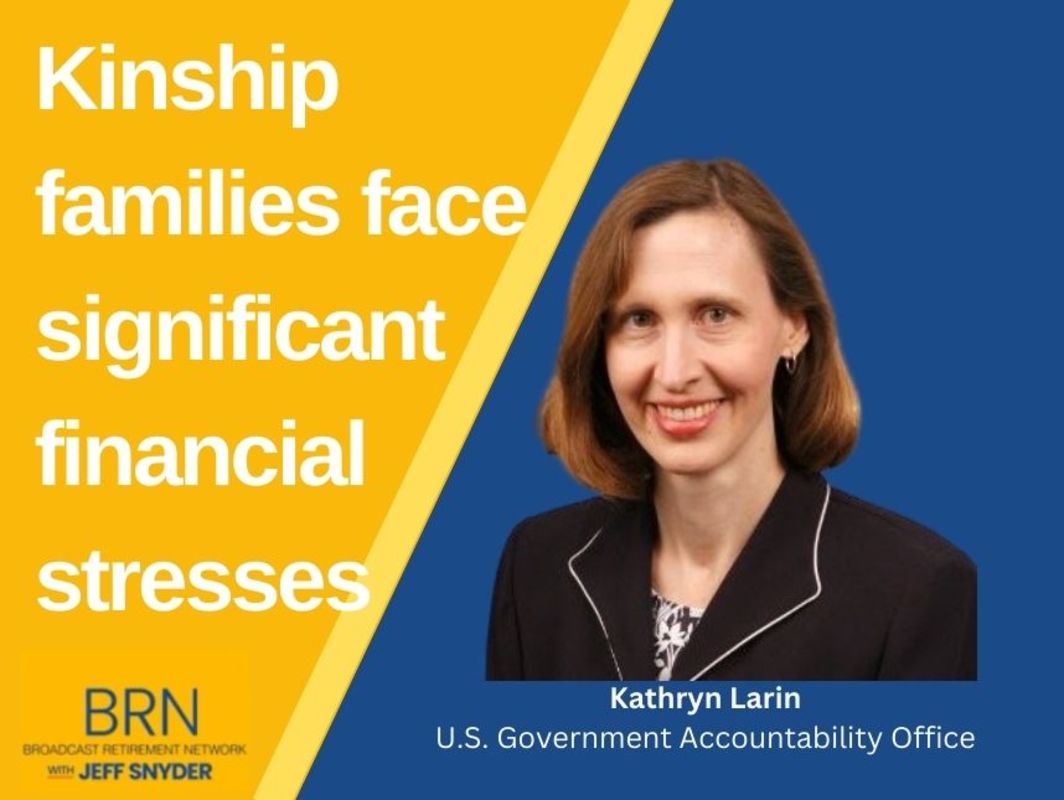
Broadcast Retirement Network’s Jeffrey Snyder discusses the financial stresses of grandparents and foster parents with the U.S. Government Accountability Office’s Kathryn Larin.
Jeffrey Snyder, Broadcast Retirement Network
Well, Kathryn, thanks so much for joining us on the program this morning.
Kathryn Larin, U.S. Government Accountability Office
Thank you so much for having me.
Jeffrey Snyder, Broadcast Retirement Network
And this is, I really enjoy reading and hearing about all the great work that the U.S. Government Accountability Office does. Your organization looks at so many different areas. This one in particular caught my interest because it really focuses on caregiving and a particular set of caregivers.
So many Americans are under a lot of financial stresses and affordability, but this particular group is under a tremendous amount of financial stress. What are kinship caregivers, kinship families?
Kathryn Larin, U.S. Government Accountability Office
Yeah, kinship families are when children live with family members other than their parents. And there are currently 2.4 million children in this country who are living in kinship care families.
Jeffrey Snyder, Broadcast Retirement Network
Yeah, it’s a large group and it has so many, taking care of a loved one is so important, but if you’re a grandparent or aunt or uncle, Catherine, this probably puts a lot of financial strain on people and makes them in some ways choose between their own care and those of their loved one.
Kathryn Larin, U.S. Government Accountability Office
Yeah, if you look at kinship families, what we found is that most children are living with grandparents and older relatives. These are people who are no longer in the labor force. They’re often living on a fixed income.
So as housing prices and food prices rise, it becomes very difficult for these families. Affordability is a real issue.
Jeffrey Snyder, Broadcast Retirement Network
And is this, you know, just in terms of the rationale behind working at this, creating this report, was it, what kind of drove the mechanism behind it? What was the impetus? Is it that there was an interest in perhaps funding or providing the Congress some ideas for future programs?
Kathryn Larin, U.S. Government Accountability Office
Congress has had a long standing interest in how these families are faring and ensuring that they have the supports that they need. And that’s why they asked us to look at what’s going on with these families and what challenges have they faced, particularly since the COVID-19 epidemic.
Jeffrey Snyder, Broadcast Retirement Network
And it seems like post-COVID, I mean, ever since COVID, and a lot of us feel the same way, a lot of strain. I mean, you know, the inflation, affordability when it comes to food. Is that the sense that when you look at the data ever since 2020, February, March of 2020, just that incredible amount of financial pressure and it just really pokes at this particular group?
Kathryn Larin, U.S. Government Accountability Office
Yeah, it’s not only the affordability issue, but also mental health needs of children. That is something that’s really risen to the forefront since the COVID-19 epidemic. Kids who are living with relatives are more likely to have mental health care needs than other children.
And yet at the same time, there’s a shortage of professionals that are available to provide that care. So that’s another big challenge that these families are facing.
Jeffrey Snyder, Broadcast Retirement Network
And especially if you have a younger child, you know, they’re under 18, they’re still growing developmentally, you know, the brain, cognition, everything. Mental health is obviously a very important part, but it could perturb or curb the development of the individual longer term.
Kathryn Larin, U.S. Government Accountability Office
Yeah, absolutely. There are long-term ramifications for not meeting the needs of these children as they arise. And that’s why it’s such an important issue.
Jeffrey Snyder, Broadcast Retirement Network
So after the, you know, this report, I believe goes to the Congress, you report you’re an arm of the Congress, right? And you go to the Congress with the report. What do they hope to do with it?
Is it that they included in a funding bill kind of, in some ways what we’re going through today? What do they hope to use this information for?
Kathryn Larin, U.S. Government Accountability Office
Well, Congress plays a very important role because they fund the programs that can help these families. So there are several different programs that could potentially help these families. Like let’s say foster care.
Very few kinship families participate in the foster care system. And the result is those families don’t get monthly foster care payments. They don’t get that health insurance that comes along with foster care.
They don’t get regular caseworker visits and a caseworker who’s checking in on that family and helping connect them to other programs. So that is one gap that we see with these families. There are a couple of other programs that Congress also funds.
One is called the Kinship Navigator Program for kinship families. And another is the National Family Caregiver Support Program but a lot of families have never heard of these programs and they don’t access those services.
Jeffrey Snyder, Broadcast Retirement Network
It’s interesting. So the program exists. Is there just a disconnect when it comes to the communication and education for these particular families to know that these are benefits?
It sounds like if we just did a little bit better, we collectively as a society did a lot better communicating. These people would have greater access and therefore maybe lower their financial stresses a bit.
Kathryn Larin, U.S. Government Accountability Office
Yeah, that’s absolutely true. And that is why we in the past have recommended that the federal government take more steps to educate states and to raise awareness about these programs and how to connect families to the services they’re eligible for. But the awareness on the part of families is also an important component there.
Jeffrey Snyder, Broadcast Retirement Network
And if someone’s watching that falls into this particular segment of the population, where could they go to access information? I just wanna make sure that people know, do they go to their local state government? Do they go to the federal government both to find information?
Kathryn Larin, U.S. Government Accountability Office
Yeah, the best place to start is their State Department of Social Services or State Department of Human Services. Most of the programs are gonna fall under that umbrella.
Jeffrey Snyder, Broadcast Retirement Network
Well, Catherine, we’ve got about a minute left and I wanna ask you, you’re doing such important, you and the team, I know that it’s a big organization. What other research do you have coming down the pike maybe that either aligns with kinship families or maybe retirement or savings or all the above?
Kathryn Larin, U.S. Government Accountability Office
Yeah, I would have to say all of the above. Particularly in the environment we’re in today, there’s a lot of focus on families that are in need and how can we better meet their needs. So we’re doing a number of different reports looking at a range of programs that help low-income families.
Jeffrey Snyder, Broadcast Retirement Network
Yeah, really important. You know, we gotta step up and help those in need and education is part of it, but also making funds certainly available is part of it as well. Catherine Laron, we’re gonna have to leave it there.
Thank you so much for joining us and we look forward to having you back on the program again very soon.
Kathryn Larin, U.S. Government Accountability Office
Thank you so much for having me.
