

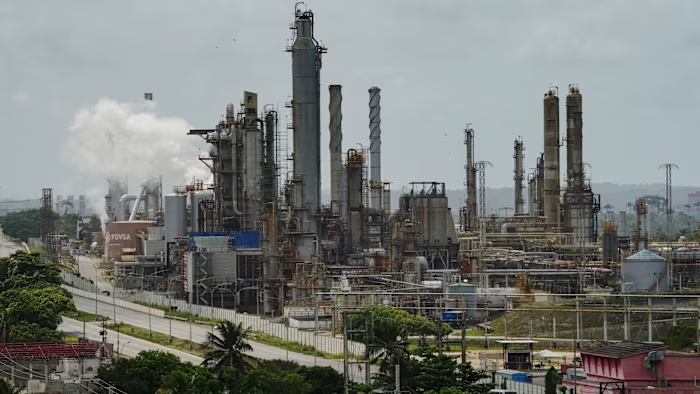
Venezuela’s opposition leader had a simple message for the US energy industry last March: Come and get our oil.
Speaking by video to executives at CERAWeek in Houston, María Corina Machado promised that Venezuela’s oil sector, nationalised in the 1970s and further expropriated under Hugo Chávez in the 2000s, would be thrown open to private capital.
Production would be “fully driven by the private sector”, the assets of state-owned oil company Petróleos de Venezuela (PDVSA) would be auctioned and investors would be protected by new contracts as well as international arbitration and oversight from the IMF and World Bank.
Machado took the same message to financiers last October in Washington, according to Luisa Palacios, the former chair of Citgo, the US refining arm of PDVSA, who is now at Columbia University’s Center on Global Energy Policy. “I’ve seen the numbers, I have seen the plan,” Palacios said.
While Machado now appears to have been sidelined, the prize she offered of Venezuela’s “unimaginably vast” oil wealth is fully in play after the US ousted Nicolás Maduro from power last weekend.
But restoring Venezuela’s oil industry after years of corruption, mismanagement and decay will be neither quick nor cheap. Industry insiders warned it could take years, and tens or even hundreds of billions of dollars, at a time when US oil majors are under pressure from weaker crude prices.
What is at stake?
Donald Trump said a US takeover of Venezuela’s oil industry would generate “tremendous amount of wealth” that could support a new government and compensate US oil companies who had their assets seized under Chávez.
Venezuela holds about 17 per cent of global crude reserves, but production collapsed by more than 75 per cent between 2013 and 2020. The US now pumps more than 10 times as much oil.
Even so, access to Venezuela’s fields would help US majors replenish reserves and provide heavy crude for Gulf Coast refineries that were designed decades ago to process oil from Venezuela, Canada and Mexico, rather than the lighter shale grades produced domestically.
US imports of Venezuelan crude sat at just 135,000 barrels a day (b/d) at the end of last year, down from 1.4mn b/d in 1998. Energy Aspects, a consultancy, estimated US refineries could readily absorb an additional 1mn b/d. Increased flows would also reduce reliance on Canada, whose exports to the US have tripled over the same period.
Control over Venezuelan supply would also allow Washington to squeeze China, currently Caracas’ largest buyer. “We’re not going to allow the western hemisphere to be a base of operations for adversaries, competitors, and rivals of the United States, simple as that,” Marco Rubio, US secretary of state, told NBC’s Meet the Press on Sunday.
Who gains?
Palacios argued the primary beneficiaries should be Venezuelans themselves. “Oil is central to this story, but not necessarily because the US wants to secure oil resources,” she said.
“The way this country makes its living in international markets is by selling oil. With the destruction of the oil industry came the destruction of the economy.”
Reviving exports is essential to restoring fiscal revenues, reinvigorating the economy and slowing the exodus of migrants across Latin America and into the US, an argument likely to resonate within a Trump administration focused on immigration.
Selling oil to the US rather than China would also improve cash flow: much of the exports to Beijing are used to service at least $10bn in outstanding loans.
The rest of the China-bound oil is snapped up by smaller, independent “teapot” refineries, which have benefited from cut price deals and stand to lose out if shipments are diverted elsewhere.
“China’s teapots have been slurping up discounted oil. Good for them. It’s over,” said Bob McNally, president of Rapidan Energy. “Are they going to be happy? No. Do I think it threatens their oil supply? Absolutely not . . . They can get the heavy sour oil from other places.”
Which companies might enter?
Among American companies, Chevron is uniquely positioned. It employs about 3,000 people in Venezuela and operates under a special licence allowing it to export heavy crude to US Gulf Coast refineries.
“There was always a view within Chevron that it would stay in Venezuela because at some point this exact scenario is going to happen,” said a former executive. “They have a very deep knowledge of the patch. They have always got that plan on the shelf, they don’t even really need to dust it down,” the person added.
The appeal is clear: Venezuela’s reserves are large, mapped and carry no exploration risk. Advances in technology have lowered the cost of producing heavy crude, making it competitive with US shale. Analysts say output could rise by up to 500,000 b/d relatively quickly.
Meanwhile, ExxonMobil and ConocoPhillips are seeking a total of $10bn in compensation following the seizure of their assets in the early 2000s.
“It would be premature to speculate on any future business activities or investments,” said a ConocoPhillips spokesman. “We will continue with our collection efforts, which are made in accordance with all applicable laws and regulations.”
Exxon did not respond to a request for comment.
When Darren Woods, Exxon’s chief executive, was asked by Bloomberg in November if he would be interested in returning to Venezuela, the CEO said: “We’ve been expropriated from Venezuela two different times. We have our history there.”
“We’d have to see what the economics look like. So I wouldn’t put it on the list or take it off the list”.
Several other western firms, including Spain’s Repsol, France’s Maurel & Prom, and Italy’s Eni, may also be interested. Repsol and Eni have been lobbying the Trump administration for a special licence to enable them to receive payment in Venezuelan oil for the gas they provide to the country.
What are the obstacles?
The industry’s past weighs heavily. “Assurances on contracts are critical,” Palacios said, noting repeated discrepancies between promises and practice.
Companies will be reluctant to commit capital without clarity on what a new regime in Caracas looks like and that it will not be tempted by expropriations even in the far future.
“It’s just 20 to 25 years ago they were kicked out. So, once burned twice shy. They’ll be cautious,” said McNally. “Nothing’s going to happen overnight. It’s a long and winding road.”
Palacios added that international oil companies would also struggle to partner with PDVSA because of its poor safety and environmental record. “They need to be able to operate in an independent way so they can control their procurement and their operations,” she said.
Finally, she said Venezuela would have to find a route back to sources of international finance after being cut off when US sanctions were imposed in 2017. Venezuela’s high risk might mean “a significant increase” in the cost of borrowing, she added.
The scale of decay is uncertain. Since a 2002-2003 oil workers’ strike, PDVSA has been used as a cash machine for the military, leading to an exodus of skilled staff and crumbling infrastructure, wrote Helima Croft, RBC Capital Markets analyst. Untangling Chinese and Russian interests will also be fraught.
Croft told the FT that “snatching and grabbing Maduro may have been the easy part. The harder challenge is how do you build this country back. Our record on nation-building is anything but spectacular”.
