

Before it became the backdrop to a horrific shooting last week, Minneapolis’s Nicollet Avenue was most famous for its remarkable variety of ethnic restaurants.
German fare has been served at Black Forest Inn since 1965, and in the years since diners have flocked to waves of new immigrant-owned restaurants dishing out Vietnamese bánh mì, Chinese mapo tofu, Greek roast lamb and many other dishes.
But more recently, Nicollet Ave — better known as Eat Street — has drawn a different crowd: armed Immigration Control Enforcement agents, who raided the area this month. It was on Nicollet, diagonally opposite the Black Forest Inn, that Alex Pretti was shot dead from behind by ICE agents on January 24.
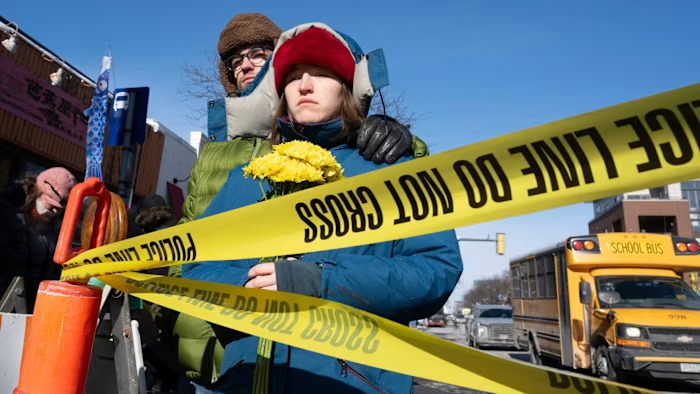
Gina Christ, whose German immigrant father opened the restaurant, has kept the doors open this week not to sell meals but to offer a warm place for the people who have come to lay flowers, light candles or leave notes in Pretti’s memory at a shrine across the street.
“This is emotionally devastating,” Christ said of Pretti’s killing — and of the immigration crackdown he was resisting when he died. “This is a country that the people on this street believe in. And you go from feeling like we are your model citizen, your model story of the American dream, to being . . . inconsequential.”
People leave candles and notes at the memorial near to where Alex Pretti was shot dead © Craig Laaig/EPA/Shutterstock
Pretti’s killing came just three weeks after an ICE agent in Minneapolis shot and killed Renee Nicole Good, a 37-year-old mother and poet. The deadly violence at the hands of masked ICE agents — along with Trump administration officials’ accounts of the Pretti killing, which conflicted with widely shared video evidence — has led to a fierce backlash among Democrats and recent criticism from some Republicans.
Now, with pressure rising in the wake of Pretti’s killing, Trump appears to be attempting a course correction on the immigration crackdown, a signature domestic policy. He has been attacked by members of his own party and has watched the approval ratings of his handling of immigration drop. Even the National Rifle Association took Pretti’s side over the administration’s.
On Monday, Trump said he was sending border tsar Tom Homan to Minnesota, a move that was seen as undermining homeland security secretary Kristi Noem. He is also expected to recall from Minneapolis the top border patrol official, Gregory Bovino.
Some Republicans cheered the prospect of a chastened Bovino, who has gained attention for his double-breasted greatcoat and for personally throwing tear gas canisters at protesters in Minneapolis. He drew criticism for his claim that Pretti had intended to “massacre” federal agents, without providing evidence.
A demonstrator in Minneapolis holds a sign reading ‘BOVINO CIAO’ © Seth Herald/Reuters
Among Bovino’s Republican critics was Zach Duckworth, a Republican state senator in Minnesota and a member of the state National Guard, who spoke out against the border patrol’s use of violence and rough tactics.
“It became clear to me and a majority of others in our state that the tactics, the approach weren’t giving us results that people were comfortable with,” Duckworth said. “I called for a pause and a reassessment and an adjustment of tactics.”
On Monday, as US media reported that Trump was preparing to move Bovino, the president found time to speak with Minnesota governor Tim Walz — Kamala Harris’s running mate and a frequent target of the president’s insults — and Minneapolis’s mayor, Jacob Frey. Trump said he and Walz were “on a similar wavelength”.
Afterwards, Frey said some ICE agents would begin leaving Minneapolis as soon as Tuesday following the conversation with Trump, who had agreed that the current situation could not go on.
Law enforcement officers stand in formation after dispersing demonstrators in Minneapolis © Brandon Bell/Getty Images
After several agonising weeks, Minneapolis seemed to be cooling off. ICE agents in dark vehicles were still cruising the streets, said immigrant rights activists who monitor their activity. But there were few, if any, signs of the violent confrontations of recent weeks.
Yet advocates for immigrants’ rights say they are not letting their guard down. They do not trust Trump and have vowed to continue fighting until the ICE raids end.
“We don’t want [the administration] to lose some of the pressure publicity-wise and then maintain a campaign of terror against our immigrant neighbourhoods,” said Andrew Baumgartner, pastor at the Grace Lutheran Church in north-east Minneapolis.
“We need the violence in the streets to stop, and we need the raids to stop and the abductions to stop and the kidnappings to stop,” Baumgartner said. “Anything that falls short of that is inadequate.”
Will Stancil, a civil rights lawyer and monitor, said he was glad to see the removal of Bovino, who he said “was clearly behind the armoured convoys rolling around tear-gassing whole blocks” in Minneapolis.
But he is unsure that it will mark a meaningful change.
“There are still thousands of ICE agents, so if you are still getting people snatched off the street it’s hard to see how it’s going to feel much better around here,” Stancil said.
On Nicollet Avenue, usually a vibrant place, a sense of mourning pervades the area around the site of Pretti’s death. Some restaurants and shops, like Black Forest Inn, were not open for business after Pretti was killed. But people braved the zero-degree temperatures to leave a note, stand in silence or take a picture.
“It is heartbreaking from the beginning to the end of the story,” Christ says. “Everybody’s worst nightmare is that this ended in murder.”
