

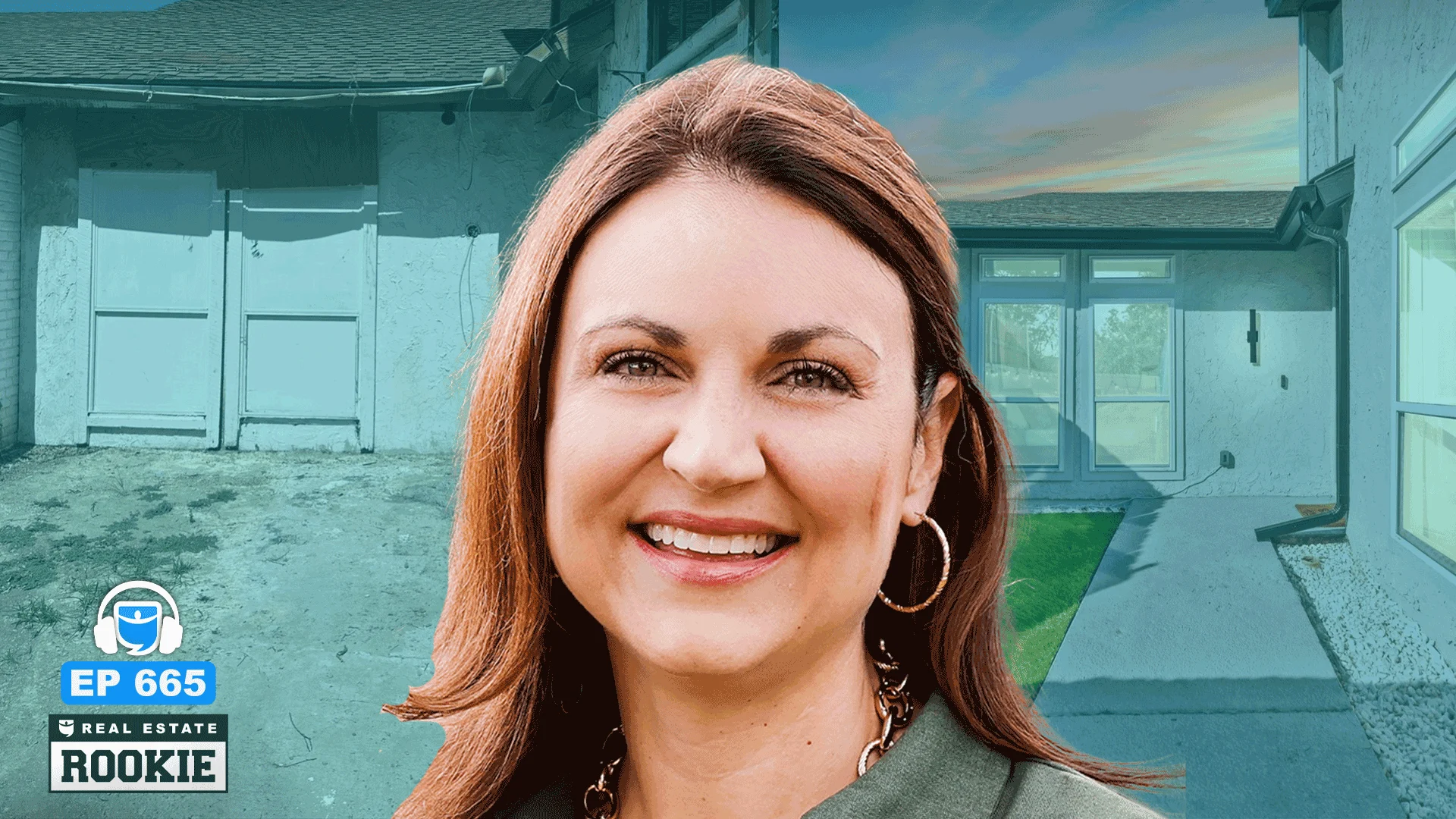
Getting laid off from your W2 job can be a crushing blow, but for today’s guest, it was the push she needed to finally bet on herself. Her first “real” rental property wasn’t the perfect deal, but it didn’t need to be. Today, it cash flows over $25,000 a year and has become her favorite creative outlet!
Welcome back to the Real Estate Rookie podcast! Where you invest is often just as important as the property itself, so when Alex Reeves had the opportunity to buy a run-down rental in a great area of town, she jumped—getting it under contract with only a day’s notice, sight unseen, over FaceTime. Despite going over budget by roughly $100,000, she finished the renovation, furnished the property, and had her listing up in only a few months!
Once a “house of horrors,” this same property now cash flows over $2,000 a month and has 100% five-star reviews on Airbnb. How? Stay tuned as Alex walks you through the entire journey of buying, rehabbing, and renting out this property—the good, the bad, and yes, even the ugly!
Ashley:
Today’s guest did something most investors swear they never do. She bought a short-term rental site unseen over FaceTime while she was literally attending Tony’s conference.
Toni:
And not just any house, this place probably should have come with a hazmat suit. We’re talking a drug using previous owner, cooking in the fireplace, code violations, foundation issues, an old electrical fire, you name it. Most people would’ve run, but Alex said, “Yeah, I’ll take it. ” Now, what she turned it into is even more impressive, especially because she was juggling a full-time job, a toddler, and a renovation that ballooned from 100K to 200.
Ashley:
This is The Real Estate Rookie Podcast. I’m Ashley Kehr.
Toni:
And I’m Tony J. Robinson, and let’s give a big, warm welcome to Alex. Alex, thanks for joining us today.
Ashley:
Thank you so much.
Alexandra:
So excited to be here.
Ashley:
So Alex, you technically became a landlord back in 2020 with your Chicago condo, but you’ve said you’ve never felt like a landlord. What actually changed that identity for you?
Alexandra:
Yeah. So my husband, I had actually just met my husband and we were moving in together and we were living in Chicago. And my property that I had bought there probably five or six years before that was also a dilapidated condo that had nothing had been touched since 1962 when I bought it. So I renovated that condo. It was my primary home for a long time. And then when I moved in with my husband, we turned it into a long-term rental. And so I was essentially an accidental landlord, which is sort of a trend right now of people that had a property and didn’t really quite know what to do with it. And I decided to rent it out and it started doing really well.
I actually rented it in less than a day. So it’s great property, great area of Chicago. It has been cash flowing ever since that point around 800 a month. And so it’s been really good for me. But again, I didn’t really know what a real estate investor looked like. I didn’t think it was me, I guess. And then a few years later, I started working for Steadily, the landlord insurance company, and obviously started to listen to BiggerPockets and listening to you guys as part of my role there. And just stuff started to click for me. The wheel started turning. I started to think about investing very, very differently after that point. And then having the opportunity to just work and learn and then do it also while I’m learning, I think has been just such a really wonderful thing for me.
Toni:
Alex, can we talk a little bit about limiting beliefs? Because you said you had a rental that was doing $800 per month, and that’s a really solid first deal. And I think it’s so interesting to hear you say that even though you had one of the more successful first deals that we probably heard on the show in terms of just pure cash flow, you didn’t quite feel like an investor. What was missing? What wasn’t there or what would’ve needed to happen to make you feel like more of a quote unquote investor?
Alexandra:
I think limiting beliefs, I think that’s such a good word for rookies or for people starting out because I think like many people, I grew up believing, or I grew up having my mom and my family essentially tell me that debt was bad. Dave Ramsey, all of those things that you hear about that, I’ve never carried a balance on a credit card. And then you see people in the media that own buildings and there’s really no in between of who you can identify with. And so definitely I’ve had a corporate job my whole life. I sort of have always had an entrepreneurial spirit, but never had the courage to bet on myself to put myself out there to really think through what that is. So Red Rich Dad poured out as a kid. Actually, my mom had us listen to it in the car on the way to school while we were probably in middle school.
Toni:
I love your mom already. She seemed amazing.
Alexandra:
I know. So I know what it was. A mother. Yeah. Knew what it was, but just had this very overwhelming idea that debt was bad and that you should not essentially invest in things and just get a job, do a really good job, try to excel at that job, and hopefully you’ll get to retire at some point.
Toni:
And the reason I bring up the limiting belief, Alex, because I think what you shared is a common thing that I hear from a lot of both investors who maybe have done one deal and those who are looking to do their first, they don’t yet identify as a real estate investor. And I think that one of the most important, not even decisions, but maybe one of the most important things that I did as I started in the world of real estate investing was that I called myself an investor or I proclaimed that I was going to become an investor before I even had my first deal. And I think it’s like a very small, subtle shift, but I do believe that the most important conversations we have every single day are the ones we have with ourselves. And I just tried to start telling myself like, “Okay, I’m going to do this.
This is going to happen. It’s going to work.” And I think it’s important for all the folks that are listening to hear that because if you’re listening to this podcast and you still have this belief that you don’t have what it takes or maybe that you haven’t been able to bet on yourself yet, it all starts with very small things and one foot in front of the other before you know you’ve got the first deal. But here you are now and you’ve built the portfolio. Now, I know you have a marketing background. You even worked on the Jake from State Farm ad, which we talked about before, which is probably like one of the more well-known kind of marketing experiences in television. But how did those skills, do you think, Alex, translate to helping you as a real estate investor?
Alexandra:
Yeah, I think a lot of it has actually fueled my desire to go into the short-term rental space or the midterm rental space. So my background, worked for large ad agencies my whole career, really big brands, State Farm, Uber, all the brands, all the fun creative stuff, but mainly worked in experiential, so event marketing. And what brings me the most joy, which I’m very clear on my goals in life is I love to create and I love to bring experiences to people that they’ve never seen before or that really surprise and delight them. And that is something that fuels me my regular job and then fuels me with this. So my husband and I, actually when we moved into our primary home about … Okay, so by the way, we moved from a condo in Chicago with a doorman at a grocery store and we never had to leave this beautiful condo that we had.
We hard launched into owning a single family home and had the entire sewer system back up into our house about a month and a half after we moved into this house. So we had to move out. We had to get a midterm rental, which now I know what’s called a midterm rental. It was just like, “I don’t know where to live. We got to find a place to live.” We found out from our insurance, which was great that we were going to get like $7,000 a month to use towards housing. And what could we get with that $7,000 a month, a two bedroom, two bath apartment because people were charging so much money and we live in Plano, Texas, we’re not in California, so much money for these short-term rentals or mid-term rentals, I should say. And then on top of that, the person that we were renting it from had a really tough time allowing us.
We wanted to bring our crib. My son was nine months old at the time. We were like, “Can we move some furniture out of here?” They were so unaccommodating to us. So through that process, I knew in my head there is a market here for people that are super accommodating, looking to have a great experience. How can we go above and beyond what the status quo is for families and specifically for young families and just do better, just do better than what’s available because there was not a lot of people I found in that process that were willing to be a go- giver, as Jesse Vasquez says, and just do the right thing.
Ashley:
Now, before you decided to implement this strategy that you saw this opportunity at, you actually got laid off from your job and that can be really life altering. And you’ve said that moment completely shifted how you saw your future. So what clicked for you emotionally and financially?
Alexandra:
Yeah. And I think honestly, listening to you and Tony has been such an inspiration. So thank you guys so much for what you do, but Tony has a similar story, but I was always a very high achiever and was working for a well-known retail brand and a global role, was working constantly because you have calls with China at 10:00 PM and all kinds of things and very abruptly got laid off because the company, it’s a retail and retail’s not doing well. And so that really changed all that fear I had to start and to invest in myself, that completely changed because I started to really think about all these companies and all this work I’ve done in my career and these people trusting me to spend and manage millions of dollars. Why am I not trusting myself to spend and manage the $100,000 that my husband and I had managed to save up on a property?
And so that fear of the unknown of a company or somebody else being able to take something away from you so quickly, it just lit a fire under me and I just started to say, “Well, why am I not betting on myself? Why am I not trusting myself to know what I can do best? And I know how to market in my regular life. Why would I not be able to market this property and be able to get it rented and filled up?” So it was a huge shift for me.
Ashley:
We’re going to take a short break, but when we come back, we’re going to talk about this house that was bought sight unseen while on FaceTime. We’ll be right back. Okay. So Alex, let’s start about the wildest part of your journey. You bought a house site unseen over FaceTime while you were actually at Tony’s short-term rental conference. So walk us through that moment, that FaceTime call, and what convinced you that it was actually worth the risk to buy this property at Site Unseen?
Alexandra:
This is actually the second house I bought via FaceTime Sign Unseen. Our primary … My mom, when we were living in Chicago, my mom had to come walk the house because it was in 2021 when the houses were just going that same day. So I guess I’m more comfortable with it, but this was a New Western property. I had a New Western, I think for rookies especially, it’s a company that really specializes in basically selling wholesaled properties that you have to buy in cash. You have no inspection. It’s done very quickly. It’s kind of almost like an auction in some ways, but you are buying a property that you know what the disposition price is, so you know what you’re kind of starting at expecting, and then you have to have hard money or cash to buy it, and it’s just kind of like you got to move quick.
So a lot of times I think flippers use it, and then there’s usually some type of ARV estimate in there, as well as what they think the renovation would cost. So I had talked with New Western, I talked with Robert, his name’s Robert, my guy from New Western. I liked him and I trusted him. He was in a contractor. So I had seen a couple properties with him before this, but he called me the night before. I was, like I said, I was at Tony’s conference, called me the night before. He said, “I’ve got this property. It’s coming on, you have to go see it tomorrow at two o’clock.” And it was in the best neighborhood. It was in a neighborhood we could not afford when we moved to Dallas. And so I knew the neighborhood well. It was also in a very specific pocket that if there was … Currently, it can change any time, but currently there are no regulations in Dallas for short-term rentals.
There’s been a lot of legal legal flip-flopping and lawsuits and all kinds of things, but it’s considered a multifamily because it’s a half of a duplex. And so I knew most of the regulations around this area usually exclude multifamilies, which is what I liked about the property too. So it’s a great area, very central to things. The neighborhoods also around the property are older, really well established, homes above one million. So for a midterm rental, especially somebody that was just like us, that maybe has to move out of their house quickly for a renovation, it would be just a great situation for that type of scenario. So that’s why I liked it.
My husband was supposed to go over there, but he got called on a client call. So we were both on FaceTime. We both just barely saw it. He sent me some videos of it, but the price was so good. It was listed at two, I think it was 201 is what it was listed at. And the comps in the area were all above 450. So I was like, there is a lot of need on this bone. And even if we completely screwed up and the recommended renovation cost that they had given us was 100,000. And I was like, okay, it’s probably not 100. It’s probably more like 120, 125. The house was the worst house you can think of. When I think about a house of horrors, it was this house.
It had a small fire in it. There was graffiti all over it. Unfortunately, the owner was not in the best mental situation. She was the owner. The house had so many code violations against it. The city of Dallas, it was another thing. The city of Dallas wanted this thing sold. So there was a lot of interesting things with this property that I was like, “What can go wrong?” There’s a lot of upside to this. So even if everything goes wrong, it’s still not going to outweigh the upside to all the positives of this property. So that’s how I was kind of thinking about it. And I was like, “Time to roll the dice. Scared money, don’t make money. Let’s do this. ”
Ashley:
Alex, I want to go back to this company as in to why did you decide to use a company to find a deal compared to other routes like direct mail or on the MLS?
Alexandra:
I mean, I have a full-time job. And so I’m 43, but at the time I had a three-year-old. And I really thought everything you guys talk about all the time, it’s like, what’s going to bring you joy in this investing process? Finding and knocking on doors or direct … And I actually have experience with direct mail even, but I think that probably scares me more than helps me in it because I don’t like it and there’s a lot of waste with it. So I think this was sort of an easier route for me at least for just finding my first deal. Would I do it again? I probably, knowing now what I knew then, I would do this deal again, but there are other ways. Then now I have more connections to find just straight wholesalers. The financing part of this was so wacky that I think I would have … I wish we would have had a different way, but I still would have done this deal the same way again.
Ashley:
I think that’s a really important key point as to it may not have been the best path or the most profitable path, but it got you started. And you got this, even though you had the condo before, this was like your first investment deal that you were focused on primarily as an investment. And I think sometimes as investors, we get caught up in making sure we’re not spending money, we’re getting the best deal. And even with wholesalers, there’s always like, “Oh, I’m not going to pay a wholesaler an assignment fee.” That’s not fair. They only found the deal. I don’t want to pay them $20,000. Well, sometimes it’s a lot harder to find the deal and negotiate it than you think. And if the numbers still pencil out, it can still be so worth it. That first initial deal doesn’t have to be your golden goose.
It doesn’t have to be the best deal ever, just has to be good enough to make you money, hopefully, and then propel you on your investing journey. And like you said, looking back, you learned a lot of things and you probably would do the same path again because obviously it worked out for you. And in my case, I partnered with someone and I gave them a lot of meat on the boat. I gave up a lot of equity, a lot of cash flow for them to be part of the deal, but I do not regret it. I probably wouldn’t do it again right now because I know so much more and I know I bring more to the table, but getting started, having that one person trust me, it was so worth it to not worry about that I’m doing everything to maximize every single dollar and I’m getting the best deal ever out of this.
Toni:
Ash, let me ask, do you have a new restaurant out by you in Buffalo?
Ashley:
No, I had never heard of it before. I mean, maybe, but I had never heard of it before.
Toni:
Yeah, maybe they’re more like a Midwest, West Coast thing, because we have New Western out here as well. And even when I was in Oklahoma City, New Western was out there also. But I guess what I’ve found, and again, every market’s probably a little bit different, but because they’re such a big kind of machine, I found that a lot of times their deals, to Alex’s point, they either go really, really fast or the ones that don’t go that fast or the deals that no one else wanted, so they’re usually not all that great. So I think for all the rookies that are listening, New Western’s great because it’ll at least kind of give you some form of deal flow, but I do think there’s a lot of value in finding the kind of smaller wholesale operations because A, they typically have a smaller buyer’s list, so you’re competing with less people, and then B, there’s a little bit more flexibility on the terms of closing.
I’ve worked with wholesalers where I was able to do a full inspection because we had that relationship. So if you can source maybe the smaller players in your market, it might be an easier way to get started for Ricky. And we had Dominique Gunderson on, she’s been on a couple times now, but her entire strategy was just like going to local meetups and finding the wholesalers that were doing deals there and just meeting as many of them as she could. And that’s where she gets the majority of her deals from now is from those wholesalers. So just word of caution or not word of advice, I guess, for the Rickies that are out there.
Alexandra:
That’s what I would do if I did it over again, is now I have more wholesaler connections that have actually met through this process and this deal. And I would probably just go directly to the wholesalers I’ve known and met over the time.
Ashley:
Another easy way, if you’re like me and very introverted is just Google, sell my house fast in Buffalo, New York, and you’ll get all of the wholesalers websites that come up and you just, instead of wanting to sell your house to them, you say you want to be put on their buyer’s list too.
Toni:
Now, Alex, you had a reno budget. You said that they had told you initially 100, but then you said, “Hey, let’s shoot for 125.” Did you actually hit that number of 125?
Alexandra:
No, we ended up with furniture, which is a different story because I got a lot of stuff on online auctions, which I highly recommend. That is the biggest rookie tip I would give to anybody is see if there’s any online Amazon return auctions that you can buy literally a whole house of stuff on, but we were all in around $200,000.
Toni:
Okay. I want to go back to 200K because that’s obviously more than what you had projected. But tell me about this Amazon online auction. I haven’t heard of this before, someone who furnishes a lot of properties.
Alexandra:
Yeah, I mean, there’s two I would mostly use. So hybrid.com, if you go there, there’s all kinds of auctions on there. And then auction hub Texas, which is obviously I’m in Dallas, which has a lot of building material auctions. So anytime somebody returns something to Home Depot or Lowe’s or sometimes even Costco, they have Costco auctions on there, that stuff does not get restocked. It goes to on a pallet and gets sold off for pennies on the dollar. And then these are the auction sites that they then take that stuff, disassemble it in a warehouse, you go get a box truck like my husband and I rented and you go pick up a bathtub and a whole bunch of other stuff for a quarter of what you would pay at Home Depot for it. It definitely is like the time, money balance. So do you have more time or do you have more money?
Because it definitely takes a lot more time. But at that moment, we were really sweating bullets with the amount of money that we were burning onto this renovation. And so we were like, “What can we possibly do to cut some costs?” Probably the best one I found was a … And I also met a ton of fun people along the way, and that’s the joy you have to find in some of this. But I met a guy who had bought a warehouse, bought a building, and it was filled to the brim with light fixtures. So it had been a lighting company, I believe, beforehand, and they were high-end light fixtures. And so I bought the entire house, all the lighting, beautiful designer light fixtures for 20 bucks a piece, just all kinds of things that I was able to save money through that and really kind of elevated the property, honestly, more than I would’ve if I would’ve just stuck with, I don’t even know, Home Depot and Amazon or Lowe’s or wherever you buy things.
Ashley:
You can’t even buy a standard boob light for $50 or $20 anymore.
Alexandra:
I love the hunt of it too. I think that brings me joy.
Toni:
So I’m on the high bid website and I would encourage all of our rookies to at least go check it out because there’s categories of virtually everything. There’s sporting goods, normal toys, that seems normal, consumer electronics, but then there’s also boats and aviation, construction and farm, real estate even. This is pretty cool. I’ve never bought anything from an auction, so I have to go and check that out. But let’s go back then, Alex, to the actual rehab itself. So you budgeted 125, it still ballooned to 200. Where were some of maybe the gotchas that kind of pushed the budget up?
Alexandra:
Yeah. So part of this, I’ll start at the beginning. The condition of the house, like I said, was very, very rough. The first day I walked in, it was filled to the brim. So she was essentially kind of a hoarder. And we spent $6,500 in trash removal and dumpsters throughout the level, the time of the process. So immediately we got in there. We closed and I drove over there to meet the junk removal guy because time was a really big factor in all of this. So the initial walkthrough really after we had removed the dunk and I could see it, there were fleas everywhere. I had to go home and put on my rubber boots and truly should have had a hazmat suit, honestly, in there. The previous owner had been cooking out of the fireplace. And so the smoke from that was just in all of the insulation, all of the drywall.
We could have saved some of it, but we just made the decision of just it’s a short-term rental. If there’s any type of scent there, people will complain. So that was a pretty big whopper of just removing all of the drywall and all of the insulation. The HVAC system and then all of the duct work all had to be replaced as well. Some of that was due to the fire and then some of it was just damaged again from cooking in the fireplace. And then there was a sunken living room, which I work in insurance. I know all about liability and people love to sue. And so that was something that I just knew couldn’t stay. And so we had to get an engineer and figure out how to fill in the sunken living room, which again, as a rookie, I was like, “Oh, you just throw some concrete in there and that’ll be fine.” No, that is too heavy for the foundation.
And so we had to went through several different ways of thinking about it, but what we ended up doing was filling it in with sandbox sand, like the really fine sand that my kid plays with, rebarb, and then you fill it in mostly with that, and then leveling it with a two-inch layer basically of concrete. Maybe it’s thicker than that. I can’t remember. But that was the recommendation from the engineer so that it didn’t just, I guess, be too heavy for the rest of the house and it could all balance out. We also had to do 20 beams for the foundation. We had to add those. That was six grand. That was nothing compared to everything else. So it was one thing after another. We replaced about 80% of the electrical. The house, it was like we completely just rebuilt the house and there was really nothing that could stay.
And I knew the house was bad, but I didn’t know it was that bad. So those were some of the bigger ticket items.
Toni:
I want to talk about budgeting and absorbing those costs. But before I get to that, Alex, I think just hearing everything that you just listed, that is a very heavy rehab job. And you worked in marketing and advertising, so it’s not like you have a background in construction. Does your husband work in a trade or related field?
Alexandra:
Oh, no. He’s in sales and yeah.
Toni:
Neither of you have this wealth of knowledge when it comes to construction management. How the heck did you figure out executing on all those different things? Who was your kind of guiding hand here? Was it the contractor who was kind of like your right hand? Were you working directly with subs and you guys were just like YouTube university trying to figure it out? How did you not get overwhelmed and how did you identify what actually needed to be done?
Alexandra:
I really, honestly, to start with, I think what gave me the most confidence is that I’ve worked on events before. And so I know what a project and a budget looks like. I know I’m very used to managing a budget and using spreadsheets and all of the above. A couple things here. So I did buy, I think it’s James Daynard’s book on estimating rehab costs. Okay. So I use that. A balance J Scott. J
Toni:
Scott.
Alexandra:
Jay Scott. I’m sorry. J Scott bought that. You guys told me to buy that, bought it. So I started there and we had done the renovation on our primary home, which we was paid for by insurance. And so I had a little bit of understanding. We had a general contractor. I did get three bids, know all about the three bid brought process and trying to compare and negotiate, know that from my day job. So I tried to do that as much as possible just upfront. But once we decided to go with Carliff from Golden Builders, who I would plug, because she was honestly just emotionally really there for me. She was our general contractor. I liked that she was female. She worked with all of our subs, really organized everything really, really well. That I would say not to be just completely biased, but I’ve never worked with a contractor as organized as she was.
And I do think having a female of some of those types of things I think sometimes helps. She was super organized with the timelines and got me everything that I needed. So that was super rare. It was also in my day job in advertising, you get to pick two of the three things, speed, good, cheap. And so we chose speed and we chose good. We did not choose cheap. And I kept having in my head this idea that every day we’re not open, that’s $200 in Airbnb rent that we could be obtaining. And so I just kept that in my head as I was just like, how can we get this done as quickly as possible? We had holding costs, we had, which I’ll talk about in a second, the juggling of our borrowing against our IRAs. And so I had to get it done quickly.
And so she really helped with the timeline and with managing all of these very large things. Was she cheap? No. No, not at all. So that’s just the trade-off that we made.
Toni:
And what about the actual funding piece? I mean, because you went over budget by 80 grand, give or take. What was the mix of cash and other funding sources you used to actually get through the rehab?
Alexandra:
Yeah. So we really had to figure this out as we went along. And I would say that that is is the biggest piece of advice that I would’ve given to myself at the beginning of this, if I could go back and say, “It’s going to be okay.” So I’m 43, my husband is 46 and we’ve been working in the corporate world. We have sizable IRAs, 401ks. We got all the retirement stuff for somebody that has not been investing in real estate. And so at the end of the day, I was just like, “You know what? If we absolutely have to break the glass and cash out one of these things, we’ve got it. ” But it turns out we didn’t have to. We just juggled it all. So we started originally with hard money, which I know Ashley, you’ve said that you do not like hard money.
And I do not like hard money either now after this process because I don’t like the draw process. The draw process is not in your favor. We had to basically, you get reimbursed. So I thought they were just going to write us a check for $100,000. If you do private lending like I would do next time, that’s what happens. But you have to wait for the inspection and I couldn’t do multiple things at the same time. Carla needed like … She needs a check for like 20 grand a day or 30 grand. I was like, “This is literally, I’m giving you a car right now.” So I was like, “How is this going to work?” So we pulled up HELOC on our primary home, which was about $55,000, which anyway, that’s another story because I should have appraised for a lot more, but it didn’t, but that was fine for what we needed.
So we pulled a HELOC, we used that cash and I pulled it all out. I was like, “I need all of this cash right now.” So pulled it out and then we did use some of that to then pay and get access to the hard money, which we had to do in draws afterwards. Then we took a loan against my husband’s 401k, which was about $33,000, which is probably the best tool that I didn’t know about until I had to know about it because all of the interest just goes back into his retirement fund. So he was going to be contributing last year anyway to it, might as well use that money and then all the interest that we’re paying, which is, I don’t even know, I think maybe 8% or something like that. So if you’re already going to be contributing 8% to your 401k, you might as well borrow that money, use it if you need it, and then you’re paying yourself back.
And so there’s literally no downside to using that. So that was 33,000 of it. And then as we were kind of shifting all this money around for the hard money and for just sort of temporary, we first borrowed, you can borrow, I’m not a CPA, I’m not a whatever, but you can borrow money from your IRA as long as you pay it back within 60 days. So we borrowed $50,000 from my IRA and then we borrowed another $50,000 from my husband’s IRA to pay back mine originally. So this 50,000 was sort of like floated for four months. And then because I knew we just have to get to the refinance. We just have to get this thing appraised and do the refinance and then we can pay all this back and get it figured out. So I was just trying to get to that end game, which I knew I could get to if we opened on November 1st and had everything set for that.
So that was the juggling of it all. But all of this was just information that I honestly learned and started asking questions of our financial advisor, our financial, the establishments we have our money in and just started asking questions. I really didn’t know that we could do any of this before I started.
Toni:
Alex, I would think that there were maybe some folks listening whose heads are spinning a little bit with all the different moving pieces you guys have going on with this deal. And even more so, like Dave Ramsey is probably like shaking in his boots right now, hearing all that’s going on right now. How did you not feel fearful about what would happen if this doesn’t work out the way that we want it to? Because I think that’s what holds a lot of people back is they can read the books, right? They read the book on estimating rehab costs, they can find the contractor, they can even find the deal, but they stopped because they have this fear of what if it doesn’t work out the way that it’s supposed to? So with all these kind of different plates you guys were spending at the same time, was there any fear around what happens if this doesn’t work?
Alexandra:
There was a crippling fear to the tune of, I actually lost 15 pounds without doing anything because I was so scared the entire time. I was not sleeping. I was super scared. But you know what I kept going back to, and I’ll give a big shout out to my friend Sarah Weaver who is in the MTR space. I saw her speak at an event. It was my very first event I’ve ever went to and really identify with her. We have a lot in common personally, but she talked about stepping into that fear and just owning the fear. And it’s almost like an anxiety tool where you’re just able to look at it for what it is and say, “This is a fear I have, ” basically. And just saying, at some point you have to make a decision in your life and you have to say, “I’m going to step into this and I’m going to live my life being a little bit of fearful and having a little bit of that anxiety, but I know that I’m going to bet on myself.” And there was a lot of that self-talk.
And I said to my husband at the beginning, “I believe in you. I believe in me and I believe in us on this. ” And we just kept saying that to each other over and over and over again. But yes, it was absolutely the scariest thing I think I’ve ever done in my entire life because the whole thing, it could have appraised for way less than we thought it was going to. We could have, I don’t know, the whole … We were also, the previous owner was still sort of hanging around the neighborhood and actually at the very beginning of the project came back and broke a … Or I don’t even know. I don’t know who it was. I’m not going to assume it was her, but I’m assuming it was somebody affiliated with her, broke all the windows and got … Yeah, because we cleaned this place out and I think somebody was mad about that.
So there had been drug activity at the house. There was just all kinds of stuff that I was afraid of, kind of constantly afraid was going to happen. Once we put all this drywall back up, was this whole house going to get burned down one night? So all of that stuff definitely kept me awake at night. But like Sarah said, at some point you have to step into that fear and just bet on yourself and go for it. And I just kept saying that to myself. So appreciate her and her that advice.
Ashley:
We also love Sarah and I think she’s a phenomenal speaker and also investor. I can definitely resonate with that fear though. That was one of the things that stopped me from getting started and we always say time, money, experience or knowledge, and then just that fear, like having the courage to actually take action. And I just thought like all these worst case scenarios. And one thing that always helps me is like, okay, what is it that I’m afraid of? What will happen if that happens and how would I have to solve it? So now I have a plan in place like, okay, the roof flies off. I’m having reserves in place to make sure my tenants are put up at a hotel. I’m contacting my insurance company and I’m putting in a claim and I’m having the roof rebuilt and now I have a new roof.
One thing that I’ve started to realize with guests on the show and just other people I’ve met in my life, and you seem like one of these people, I’m going to put you in this box. Laura Sides that we had on as a guest is another one. We have no real estate experience, no construction experience or anything like that, but you’re willing to make the phone calls and you’re willing to take action upon action until you solve the problem or figure it out. And I had this aha moment recently when I’m purchasing a house and the owner is in assisted living and I’ve been dealing with his daughter. She has no real estate background. She doesn’t work now. I don’t know if she did at any point what her background is, but I know nothing with real estate or construction. We had some things that we wanted corrected in the inspection.
Within a day, she had four different vendors lined up, scheduled, and will be at the house next week and everything will be repaired and completed. And I’m thinking like, “Wow, I’m really slacking. I can’t even move that fast on things.” But it was just like she makes a decision, she takes action, she gets it done. And I think that is a more valuable tool than to actually have construction experience or a knowledge that you’re actually willing to take the time to figure out and make the phone calls to actually get something done.
Alexandra:
Yeah. I think to me, it’s just all project management and anybody that has any type of adjacent role in project management can do a large renovation. I think as long as you’ve got some type of understanding of, this is what this person told me, I’m going to get a couple more quotes, I’m going to compare that, I’m going to see if that tracks, and then I’m going to move forward with one of them.
Toni:
So Alex, you go through this renovation that would’ve scared 99% of rookies away, but it turns into a short-term rental that you’re actually running. So we want to hear about what that experience has been like right afterter from today’s show sponsors. All right, we’re back here with Alex and we heard the story of how she found the deal, the ups and downs of renovating it, and now we’re here of what happens when it actually goes live. So I guess really quickly, Alex, how long did the full renovation take?
Alexandra:
So we started June 28th and we finished the first week of October. So the renovation itself to rebuild this whole house took a little bit more than three months, which was miraculous.
Ashley:
Yeah. For how extensive of a rehab you had to do?
Alexandra:
Yes. Then the more miraculous thing with two full-time jobs and a three-year-old, my husband and I, we took control of the property the first week, end of the first week of October and November 1st I hit go live on Airbnb. And so it was three weeks to get it furnished, designed, all the little touches, closet rods, hooks, all those things in about three weeks, which was, it literally almost killed me, but we did it.
Ashley:
So now the question that everyone’s wondering is, what is the numbers? Did this end up being a good deal? So your purchase price, your rehab, what did it appraise for and what do the cashflow numbers look on it now?
Alexandra:
So we were all in around like 410 or so, give or take a little bit. And the day before the appraisal, I did not sleep. I was prepared. So I had a full six page document of every single upgrade that we had made on the renovation also. And that was advice that I had probably picked up from this podcast or one of the BiggerPockets podcasts was you need to be at the appraisal, the walkthrough with the appraiser, you need to present yourself as the owner, not an investor, and you need to have everything documented, which I did. And they took the information. And so I was sweating bullets. We both were, because we knew it needed to appraise … Our number was, it needed to be appraised for basically 460 or more for it to kind of all make sense for us. And that was the realistic number.
There had been one other property. We actually waited for the appraisal a couple more days because there was one other property that had just sold. And so we were waiting for that to sell before we did it too, which was also highly helpful for us. So it did appraise for 475. So we were able to get all our money back out and be okay basically with all the loans and everything we had taken out. Not all of our money we didn’t get out, but we were able to pay off all the loans and do what we needed to do with that appraisal. So that was one key. And then now where we’re sitting now … So we just passed a year, our gross revenue for the year was right around 62,000, and then our operating expenses were around 36. So basically we’re netting around $25,000, which is exactly what I had expected and anticipated when I had run the numbers originally.
So it wasn’t this screaming deal. I really didn’t need it to be. I just needed it to not bankrupt us. And it’s done pretty well. And it’s for the most part, it’s been really full. We had a six-month midterm stay almost right off the bat from us exactly like our avatar, exactly who I wanted it to be. It was a family with four kids that had an insurance claim and then lived in the neighborhood. And so that told me exactly what I needed to know, which was I was right. I was right. And I knew this was going to be a great place for people that were displaced from their homes in the neighborhood. And most of the short-term stays after that, which have been anywhere between two and four days are mostly just people visiting their family in the neighborhood. And it’s really stayed consistently fulfilled with that type of thing.
It’s not necessarily in a location where people who are just coming to visit the Dallas area, which there’s not … I’m a little biased because I don’t think there’s a lot to do here, but I guess there’s enough to do here, but it’s people coming to visit their families, and that’s what we built the house for.
Toni:
And you said, Alex, you guys gross somewhere around like 65, I think you said?
Alexandra:
Yes, around 62. Yeah, yeah.
Toni:
62. So somewhere in the 60s range, and you guys are all in at 410. So that means you’ve got a gross yield, or I’ve heard people use different terms. So basically, if you divide your revenue, by your purchase price, you’re at about almost 16%. And what I usually encourage folks is you want that number to be somewhere between 15 and 20. If you’re at 20, it’s like a screaming good deal. 15 is a good baseline. So this is a really, really solid first deal for you because you’re right in that sweet spot. And I think even more so, and I would assume that you guys have learned so much on this deal that anything that comes after this is going to feel like a walk in the park because you guys did so much on this first deal. But I want to talk, Alex, a little bit about the actual experience of running this short term/midterm rental.
And obviously you’re a marketer focused on experiences and I’m sure you bring that into hospitality. What kind of things have you leveraged from your day job that you brought into your short term rental that might make you a little bit more unique as a host?
Alexandra:
Yeah, it’s so fun to host because I work for Steadily, I work from home for the most part, and the ability to connect with people and be there for them, whether it’s just like them visiting their family and doing something really fun and extra for them. So I almost always go, and I know I need to probably delegate this out, but I love doing it. I go over there and I leave them a personal note and I usually leave some type of gift. So depending on what they are coming for. So if they’re coming for a cousin’s or a nephew’s second birthday, I’ll leave them some balloons or I’ll go pick up a $5 muffin situation from the grocery store that’s like across the street from the property. And so I’ll always go do something like that for them. And it just really brings me a lot of joy because a lot of people will always, they’ll write notes.
We have 100% five star reviews, which I’m very, very proud of, super host, all the things. Honestly, because of that, we just hosted a woman for two weeks that was recovering from a cancer, a breast cancer surgery. And a good friend of mine just went through a battle with breast cancer. And so that was so meaningful because she lives far away. It was so meaningful for me to be able to be there for this woman. I went and got her extra ice. I left flowers for her. I coordinated extra with a company that delivered a recliner specifically for people who are recovering from that surgery. And so I just get a lot of joy from it. Apart from money, it is a true creative outlet for me. The family that came in and stayed, the very first one that we stayed, it was around Christmastime and I went and got gingerbread cookie making kit.
All of this stuff costs $5 to $10. And Ashley, I know I’ve seen that you do a lot of similar things. It does not take much to really exceed someone’s expectations. And it brings so much joy to me personally to be able to do that.
Ashley:
Yeah, I definitely prefer to set the bar low and then to exceed expecting it. Well, Alex, thank you so much for joining us today. We really appreciated having you on. Where can people reach out to you and find out more information?
Alexandra:
Well, you can follow us on Instagram. Our continued real estate journey at the Real Estate Reeves is our Instagram handle. Our next trick of our sleeve is we’re hoping to do a live and flip next year. So we’re actually about to go look at a property right now to potentially buy for a new primary and then turn our primary into a rental property. So that’s our plan.
Ashley:
Great. Well, we’ll have to have you back on when you complete that live and flip. Thank you. I’m Ashley. He’s Tony, and thank you guys so much for joining us for this episode of Real Estate Rookie.
Help us reach new listeners on iTunes by leaving us a rating and review! It takes just 30 seconds and instructions can be found here. Thanks! We really appreciate it!
Interested in learning more about today’s sponsors or becoming a BiggerPockets partner yourself? Email [email protected].
