

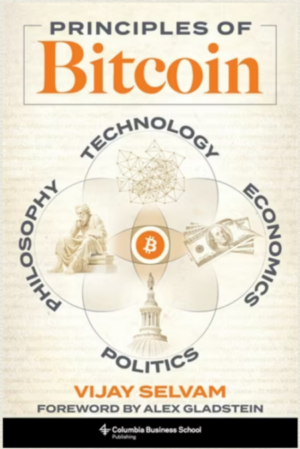
Principles of Bitcoin: Technology, Economics, Politics, and Philosophy. 2025. Vijay Selvam. Columbia University Press.
Decentralized finance continues to evolve. The relative novelty of a digital asset and means of exchange — bitcoin is, after all, a mere sixteen years old — seems to be an unending source of fascination across all strata of society. The mystery and enamorment of the digital currency will likely increase given the heightened attention accorded it from the current American presidential administration, whose proclivity toward less regulation would warrant, demand even, a more nuanced understanding of its multifaceted nature. Bitcoin sits at the axis of technology, economics, politics, and philosophy. Governments, policymakers, economists, information technology professionals, and risk officers will all welcome the author’s rigorous analysis and lucid explication. CFA® charterholders and those aspiring to be will find the treatment of the subject matter a bit different from more conventional valuation processes accorded public and private markets. Then again, bitcoin is anything but conventional.
A skeptic by nature, a trait the author attributes to his métier of law, Vijay Selvam was educated in more traditional concepts of asset valuation to which bitcoin does not lend itself. Yet he brought a deep understanding of complexity to his work with real estate structured products and derivatives, whose performance was the proximate cause of the Great Recession. His involvement in 2008 with the creation of a bailout arrangement for a Wall Street bank in the midst of the debacle left him cynical. Bitcoin made its first appearance shortly thereafter as an alternative to the wreckage of centralized finance recently visited upon economies across the world.
The author’s self-awareness of a cognitive bias against bitcoin and toward conventional finance led him to the realization that a basic reference work on the subject was lacking. Principles of Bitcoin offers a multifaceted evaluation of bitcoin in an attempt to place its reputation and notoriety in a thoughtful context. To understand bitcoin is to understand the ascent of money through the interrelationships between economics, politics, technology, and philosophy. It is as much about unlearning traditional concepts of asset valuation as it is about modifying one’s approach to understanding this new thing.
Bitcoin’s inventor, Satoshi Nakamoto, anguished over how best to describe bitcoin. Cracking its recondite nature requires the use of first-principles thinking, a disassembly of the subject matter into its fundamental components, and a development and progression of one’s understanding of concepts. Indeed, this holistic approach is central to the book and helps shed light on bitcoin’s true purpose and mechanics.
The technical discussion spans five chapters and at times can appear complex, though the author endeavors to make it accessible through numerous references to philosophy, technology, and literature. One may view bitcoin as a scarce digital commodity in some ways akin to gold, whose path-dependent nature and inextricable link to the internet make it a robust asset. Bitcoin’s technology employs cryptography, distributed systems, and economic motivations to produce a digital asset that is robust to the risk of double-spending and transparent on a public ledger. Proof of Work (PoW) ensures a form of decentralized agreement. Bitcoin technology accords it distinct traits of scarcity, divisibility, portability, verifiability, durability, resistance to censorship, and unconfiscatability. Its first-mover status and recognizability, coming on the heels of the global financial crisis, afford it an advantage that would be tough to replicate, let alone beat.
Against the backdrop of monetary history, which has seen (hyper)inflation and currency debasement, and given that some governments weaponize money against their citizenry, bitcoin would appear to be a safe harbor. It is pseudonymous and knows no borders. It is able in many instances to escape confiscatory risk. It has the potential to serve the unbanked millions in far-flung corners of the world where conventional financial services don’t reach. Bitcoin’s decentralized architecture makes any attempt by governments to proscribe it difficult, if not impossible. Its transnational and apolitical features would also appear to address the issue that erstwhile French president Valéry Giscard d’Estaing termed the US dollar’s exorbitant privilege, or transactional hegemony, over other currencies. The author argues for bitcoin as a global reserve asset.
As a new arrival on the financial landscape, bitcoin has suffered, and will continue to suffer, from malign perception and skepticism, unquestionably a time-honored ritual in the history of finance. That cash and gold have been employed in criminal activity does not make them inherently flawed as instruments of value. Similarly, several well-publicized incidents where bitcoin has been used to nefarious ends need not sully its reputation. Indeed, financial institutions have been implicated in money laundering schemes by orders of magnitude greater than the digital currency.
A separate and interesting topic is bitcoin’s interaction with the environment. Here, the author seeks to dispel misperceptions regarding bitcoin’s environmental unfriendliness, arguing that its production can work to facilitate a more efficient transition toward sustainable energy sources. He adduces numerous examples of countries using bitcoin to pursue energy-friendly solutions.
Principles of Bitcoin is at once reportorial and editorial. The writing is clear, the references rich. While it does evidence a bias in favor of bitcoin, Selvam’s compendium informs and educates. Readers would do well to approach the subject matter with intellectual curiosity and patience. Though coverage of the topic from many perspectives has been extensive, these are nonetheless early days. You don’t know what you don’t know. Through this work, Vijay Selvam endeavors to close that gap.
