

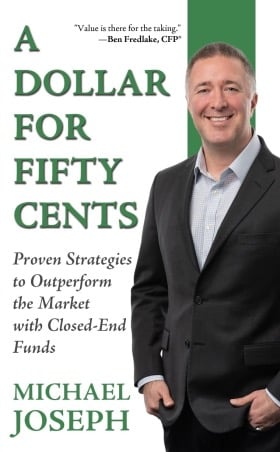
A Dollar for Fifty Cents: Proven Strategies to Outperform the Market with Closed-End Funds. 2025. Michael Joseph. IW$ Press
Closed-end funds (CEFs) are “chronically mispriced by the market,” writes Michael Joseph, CFA, but for investors hoping to capitalize on that inefficiency, “simply buying a closed-end fund trading at a discount isn’t enough.” Just picking the funds with the deepest discounts to net asset value (NAV) or the highest yields, adds Joseph, is a “recipe for disaster.”
He further cautions that investing in a CEF in hopes that an activist investor will swoop in and close the gap between NAV and market price is “risky” and “speculative.” Furthermore, says the Deputy Chief Investment Officer at Stansberry Asset Management, purchasing a CEF when it is initially offered is “irrational.” He also points out that when the Fed aggressively raised interest rates in 2022, several leveraged municipal bond CEFs’ valuations were slashed nearly in half.
By thus dispelling expectations of easy money, the author of this 89-page book corrects any misapprehensions that might be induced by his title, A Dollar for Fifty Cents. That phrase also appears in a subheading of a section recounting how Warren Buffett and Charlie Munger’s purchase of 20 percent of the shares of Source Capital after the 1969-1970 market downturn drove the CEF nearly 50 percent below the value of its underlying assets.
Buffett and Munger ultimately doubled their money, but as Joseph remarks in an understatement about discounts to NAV, they “aren’t always as steep as 50%.” In a fairer representation of the actual opportunity set, he cites research showing that the best CEF strategy is to buy at a 20 percent discount, with the objective of selling when the discount narrows to 15 percent.
A Dollar for Fifty Cents is written to be accessible to nonprofessional investors but provides information and insights that can benefit professionals who are not already intimately familiar with CEFs. Joseph summarizes the extensive literature on what academics view as the puzzle of why any CEF would ever trade at less than the value of its holdings. He discusses the comparatively recent emergence of CEFs with specified termination dates. That structure is designed to ensure that holders can cash in at the NAV at a time known in advance, but Joseph notes that the termination dates “can often be extended for a variety of reasons.” He also informs investors about free screening sites that can aid CEF selection. Helpful, too, are his warnings about funds with names that do not accurately describe their actual holdings, as well as the misleading distribution rates shown on some CEF factsheets.
As for the book’s subtitle, Proven Strategies to Outperform the Market with Closed-End Funds, Joseph references several studies that found superior returns for CEFs. Readers hoping to see a contemporary, attested, index-beating management record built exclusively on CEFs, however, will be disappointed. They must settle for the statement of foreword writer Rich Bello of Blue Ridge Capital that his firm “achieved great returns” and “invested in more than a few CEFs.”
Many money managers would agree, though, that closed-end funds can play a constructive role in investment portfolios. One important application is providing diversification within an income-focused portfolio that also contains assets such as bonds, preferred stocks, and REITs. CEFs that increase their distributions over time help income-focused investors to keep pace with inflation despite substantial allocations to fixed-income securities. Investors pursuing such a strategy will benefit greatly from Michael Joseph’s balanced account of CEFs’ virtues and pitfalls.
If you liked this post, don’t forget to subscribe to the Enterprising Investor.
All posts are the opinion of the author. As such, they should not be construed as investment advice, nor do the opinions expressed necessarily reflect the views of CFA Institute or the author’s employer.
Image credit: ©Getty Images / Ascent / PKS Media Inc.
Professional Learning for CFA Institute Members
CFA Institute members are empowered to self-determine and self-report professional learning (PL) credits earned, including content on Enterprising Investor. Members can record credits easily using their online PL tracker.
