

Yves here. This post gives a useful overview of the profile of subsidies provided by China’s government, not just national but also local. Despite the headline focus on industrial subsidies, the authors also show the level of disaster relief and social welfare subsidies, and counter-intuitively, agriculture gets the biggest subsidies in aggregate.
By Shuhui Xiang, PhD candidate Geneva Graduate Institute, Xinran Yin, and Yuan Zi, Assistant Professor in Economics Geneva Graduate Institute. Originally published at VoxEU
China’s industrial policy has become a central flashpoint in global trade debates, yet systematic evidence on what China actually does remains scarce. This column reveals five key findings from a new database covering China’s WTO subsidy notifications from 2001 to 2022: (1) direct fiscal support stabilised around 0.8% of GDP after 2008; (2) China is an active subsidy user with striking policy persistence; (3) FDI-promoting subsidies have declined while industry-specific and innovation-focused support has risen; (4) wealthier, more open provinces provide more local subsidies; and (5) agriculture dominates by value while manufacturing subsidies are modest. These patterns reveal how China’s subsidy strategy has evolved from attracting foreign capital towards technological self-reliance.
China’s rise as a manufacturing powerhouse has been accompanied by persistent debates about the role of government intervention (e.g. Aghion et al. 2015). While certain policies, such as tariffs and FDI regulations, are well documented, systematic evidence on China’s broader industrial subsidy landscape has remained elusive. This gap matters: subsidies are among the most direct and powerful tools governments use to shape economic activity, and understanding China’s approach is essential not only for trade and development policy, but also for debates on geopolitics, industrial competition, and technology security.
In a recent paper (Xiang et al. 2025), we address this gap by digitising and analysing China’s official subsidy notifications to the WTO from 2001 to 2022. This represents the first systematic, non-estimated dataset of Chinese industrial subsidies based on authoritative government sources. The database covers 1,256 unique programmes – 260 at the central level and 996 at the local level – including direct financial appropriations, grants, interest-discount programmes, and tax incentives. After cross-checking notifications against original domestic documents, we document five findings.
Fact 1: Subsidies Incidence Has Expanded, but Direct Fiscal Support Stabilised
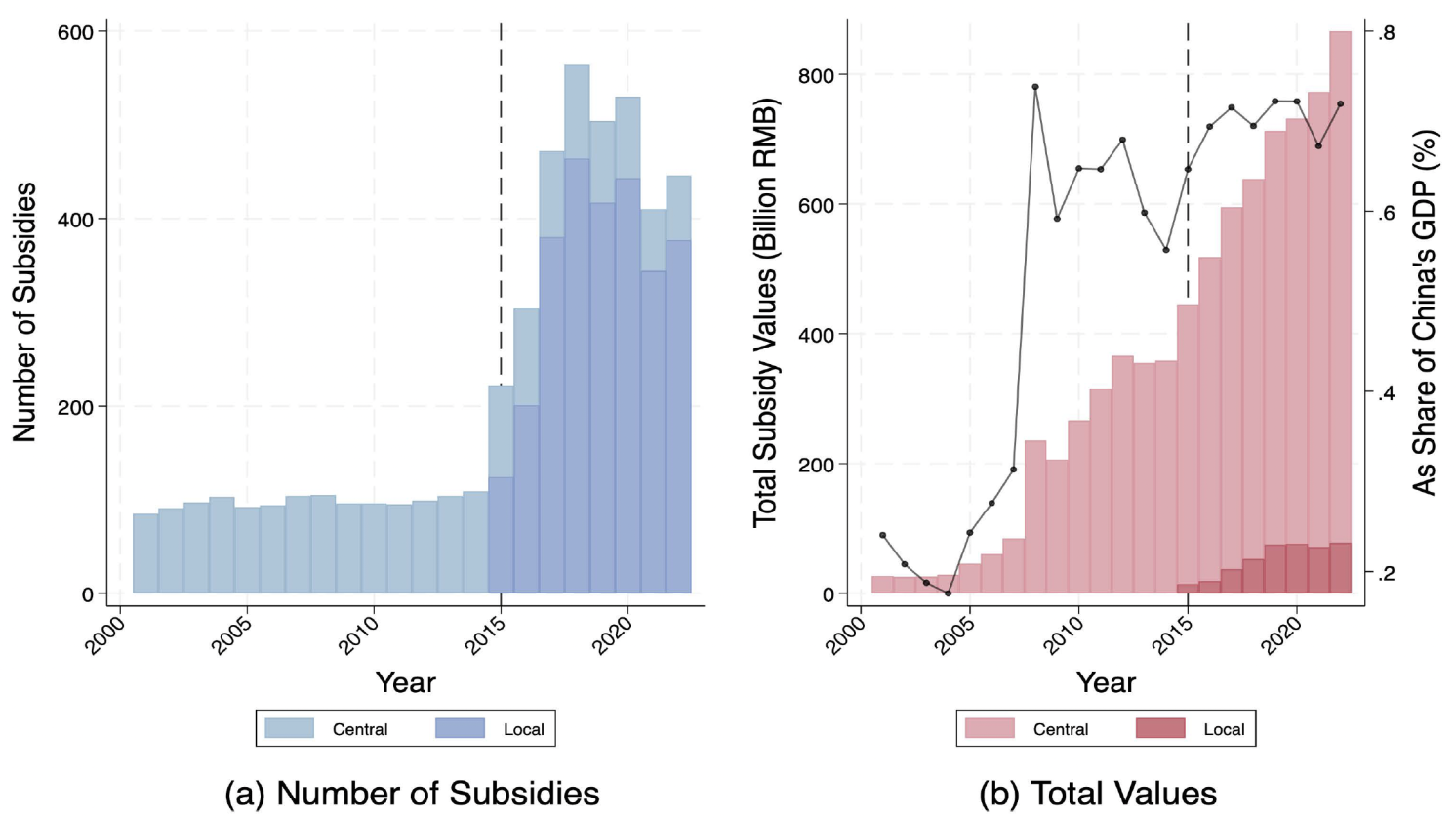
China’s subsidy incidence has increased over time, with the number of active programmes rising from 85 in 2001 to 446 in 2022. However, the post-2015 jump largely reflects a change in reporting methodology, as China began including sub-central programmes following an EU request – though local subsidies amount to only a fraction of central government support (Figure 1a).
More telling is the trajectory of subsidy values, as shown in Figure 1b. Direct fiscal support rose sharply after 2004 – coinciding with a major expansion of rural support policies – peaked around 2008, and has since stabilised at approximately 0.8% of GDP. This figure aligns broadly with OECD estimates and suggests that while China remains an active user of subsidies, the scale of direct budgetary support has not continued to escalate.
Figure 1 Annual trends in Chinese subsidies
Note: Panel (a) reports the yearly count of central and, from 2015 onward, local subsidies. Panel (b) shows their total value, with the line chart indicating subsidy values as a share of GDP (right axis).
Fact 2: China Subsidizes More Than Its Development Level Predicts, with Remarkable Policy Persistence
As shown in Figure 2a, comparing subsidy notifications across WTO members reveals a notable pattern: plotting the number of subsidies against GDP per capita in 2019–2020, China (and the US) employs far more programmes than its income levels would suggest.
While some less developed countries may underreport their subsidy practices, even more notable is the persistence of Chinese programmes visualized in Figure 2b. The average central subsidy programme lasts more than ten years, with approximately 10% persisting for 20 years or longer. This durability reflects a long-term strategic approach where subsidies function as sustained investments rather than temporary interventions, pointing to strong institutional commitment and policy continuity across political cycles.
Figure 2 Duration and number of subsidies
Note: Panel (a) plots the number of subsidies against GDP per capita in 2019, with variables shown on a logarithmic scale and axis labels reported in levels. Panel (b) plots the duration of Chinese central subsidy programs active between 2001 and 2022.
Fact 3: From FDI Promotion to Technological Self-Reliance
The objectives of Chinese subsidies have shifted markedly over two decades. As depicted in Figure 3, programmes promoting foreign direct investment accounted for nearly 10% of central government subsidies in 2001 but declined to just 3.3% by 2022. Conversely, industry-specific subsidies more than doubled, rising from 7.9% to 16.3% over the same period. Innovation and technology have consistently received a sizeable share of subsidies.
Figure 3 Changes in objectives, 2001 vs 2022
Note: Panels (a) and (b) report central government subsidy incidence in 2001 and 2022, respectively. Percentages indicate each objective’s share of total subsidies for the given year and government level.
This reallocation reflects China’s strategic pivot from trade and FDI liberalisation towards technological self-reliance and industrial sovereignty. Viewed in this light, the earlier openness to foreign investment may have been an intermediate stage rather than an end in itself. The timing and scale of this shift both responds to and helps explain intensifying trade and technology tensions with Western economies.
Fact 4: Wealthier, More Open Provinces Subsidize More
The data also allow us to examine sub-central subsidies reported since 2015. In Figure 4, we find that wealthier and more trade-oriented provinces provide significantly more local government support. This pattern suggests that local subsidies may reinforce rather than reduce regional disparities within China. It mirrors broader fiscal disparities, as the richest regions spend several times more per capita than the poorest.
Figure 4 Number of subsidies and local government indicators
Note: Panel (a) plots average number of subsidies (2015–2022) against average GDP per capita (2010–2014), and Panel (b) against trade openness across 31 provinces. Both variables are shown on a logarithmic scale with pre-log axis labels.
Fact 5: Agricultural Subsidies Dominate by Value
Finally, Figure 5 suggests that measuring subsidy by count versus value yields a very different picture. By programme count, scientific research, agriculture, and manufacturing are the most frequently subsidised sectors. However, the value distribution tells a different story. Agriculture dominates, receiving nearly 40 trillion RMB over 21 years – approximately 47% of total funds. Construction ranks second, reflecting China’s emphasis on infrastructure investment.
Figure 5 Subsidies by sectors
Note: Panel (a) reports each sector’s share of the total number of subsidies, and Panel (b) reports each sector’s share of total subsidy value.
Notably, direct manufacturing subsidies are relatively modest, both in total value and per-programme terms. On average, a manufacturing subsidy is less than twice the size of one for R&D and under 1/20th the size of one for agriculture. China’s decentralised, small-scale support for manufacturing contrasts with perceptions of large-scale ‘big push’ interventions. This pattern aligns more closely with recent research emphasising incremental approaches to technological upgrading (Juhász et al. 2024) and flexible policy toolkits (Bloom et al. 2019).
Conclusion
Our analysis of China’s official subsidy notifications reveals a more nuanced picture than typically portrayed in policy debates. While China is indeed an active user of industrial subsidies, direct fiscal support has stabilised since 2008. The strategic focus has shifted decisively from attracting foreign investment towards promoting domestic innovation and technological capabilities. Manufacturing subsidies, contrary to common perception, are relatively modest and decentralised.
These findings carry implications for both trade policy and development economics. For trading partners concerned about Chinese subsidies, the data suggest focusing on the evolving objectives rather than just the scale of support. For developing countries looking to China’s experience, the evidence points to sustained, flexible approaches rather than one-off interventions.
We hope this database, along with other recent efforts (Juhász et al. 2022, Fang et al. 2025), will enable further research on industrial policy, including comparative analyses with other countries and systematic evaluations of subsidy effectiveness.
See original post for references
