

Yves here. As is so often the case with articles by Paul Rogers, while the piece below makes some interesting observations, the way he has approached the topic is frustrating via its peculiar framing and omissions. But the subject is important so perhaps readers will indulge me and treat this offering as a critical thinking exercise.
Let me make two observations to get the ball rolling. One is that nowhere does Rogers mention that the US military is bloated and underperforming. Brian Berletic has regularly described how it is built for profit and not purpose. Russia is currently beating the US plus the rest of NATO all by its little lonesome in Ukraine. Russia is also ahead of the US in many critical weapons systems, such as hypersonic missiles, air defenses, signal jamming, and drones. China has the biggest shipbuilding industry in the world. And critical parts of the US forces, such as its navy, are poorly configured. For instance, Alexander Mercouris explained how the US navy is extremely thin on the classes of carriers like corvettes and frigates that would be needed if the US is serious about trying to police and interdict rogue tankers.
Second is the bizarre presumption that Trump’s military hypertrophy scheme is to help with the midterms. This is yet another vanity project, since Trump is addicted to intimidation, and secondarily an exercise in pork. Even if he were able to sell a hefty increase in war spending, it would have to be in the next budget, which means no practical effect until after the midterms.
In addition, whether we have midterms at all is open to question. Trump just told the New York Times that there is no limit to his power, save his warped sense of morality, and annoyingly and unfairly, sometimes the courts. Trump also genuinely believes that the only way he would lose is if the election were stolen. Ergo, that makes it OK for him to pre-emptively steal.
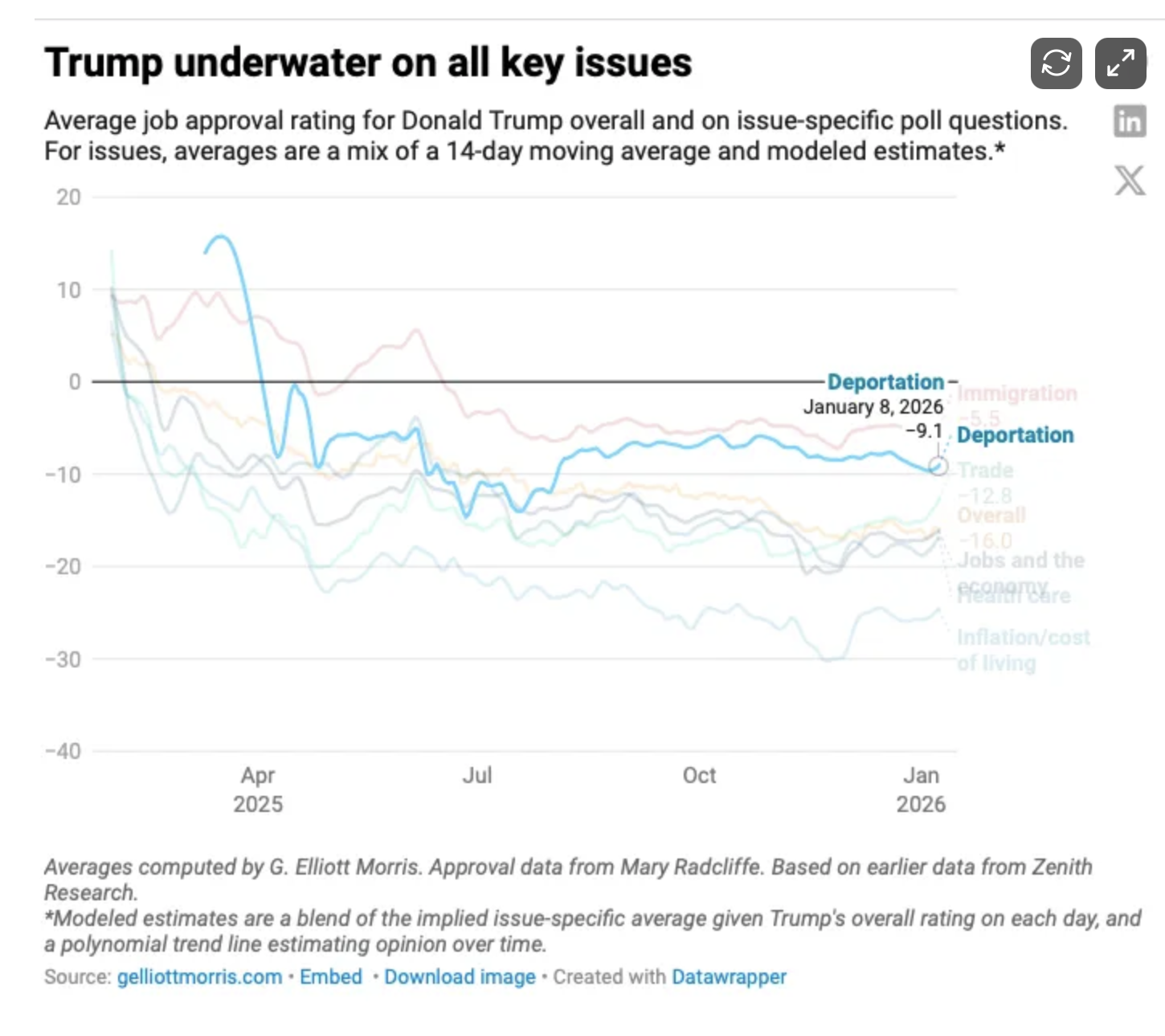
Polls and informal indicators, like Twitter now having more anti than pro-Trump comments despite its algos boosting otherwise, show that Trump’s approval continues to slide. Political scientist and money-in-politics maven Tom Ferguson recommends G. Elliott Morris as a pollster who avoids the common pitfalls. One of his fresh pieces is on the question of ICE but it also has a chart on Trump generally:
And on ICE:
Americans have turned sharply against ICE in Trump’s first year back as president, and say the agency too often resorts to violence. More Americans than ever now say the agency should be abolished.
Needless to say, abolishing ICE is a radical measure; given how popular immigration reform once was, this level approval of elimination (as opposed to say, wanting only reform) is striking.
And that’s before getting to the James Carville one-stop analysis: “It’s the economy, stupid.” Trump has just tossed out a bunch of schemes for addressing the affordability crisis, like a Fannie/Freddie mini QE to lower mortgage rates. We plan to address them soon but for the most part, they look as well thought out and likely to work as the Trump plan to increase oil production in Venezuela.
So it is not hard to imagine that the ICE raids are to create enough domestic upheaval to justify imposing martial law in states with nasty uncooperative blue cities, or some other measure that badly skew or prevent voting. I hate to even have to treat this as a serious possibility, but Trump’s insatiable ego and love of violence makes this all too possible a scenario.
IM Doc’s comments on this line of thinking:
There is a reason that the Founders had utmost in their mind the last 100 years or so of the Roman Republic. I am talking about the era of the Cataline, the Brothers Gracchi, Sulla, Marius, Pompey, Cicero and eventually Julius Caesar. Some of the issues we face are hauntingly familiar. Some of them are a bit different. Some of our issues are so alien to the Roman world that they would have been greeted as LOL by the Romans – as in how can you be that stupid as in exporting debt across the world instead of importing booty.
Nevertheless, the entire 100 or so years of the fall of the Republic as opposed to the several hundred years beforehand – was basically each side while in power meticulously and permanently altering political, cultural, and economic ( or all 3) NORMS and TRADITIONS that had been in place since the beginning. At first with just one or two things disrupted, it was not really noticeable…..toward the end it was clear to all just how different things were than a generation ago.
The average Roman by the time of Julius Caesar felt like an alien in an alien world. We have been doing the same since WWII and arguably WWI. All at the same time, the elite began to become much more brusque, brutish, aggressive and ugly towards one another. And eventually this all ended in catastrophic blood shed. Look around.
In addition, some of the very same side effects faced by the Roman Republic interestingly are all around us today – unbelievable deference to celebrities and celebrity culture, the wanton sexual acting out, intense violence in sports, the insane income equality, the increasing serfdom of the populace, the intensely aggressive and constant war posturing of the entire population….. I can go on and on.
The Founders knew these stories by heart – and tried to place fail safes in the founding documents and ideals. It has stood up pretty well – but even as it did in Rome – it cannot be expected to continue forward with partisans on all sides trashing it every chance they get. Trump, the brute, the berserker, is but the natural progression. And the Dems just welcomed him in – I am sure 1000 years from now, people will be shaking their heads contemplating the placement of a dementia patient as his opponent. This is why I know in my heart that this is going to be completely alien for Americans going forward. And indeed, we may very well have suspended elections. My big concern is “the twist” will actually be something absolutely dreadful that we never saw coming. The other joker that has to be seriously examined is the fact that any number of world leaders can lay waste to the entire Earth with the push of a button. That is a joker that is new to humanity and one we do not even begin to have the morality to deal with.
By Paul Rogers, Emeritus Professor of Peace Studies in the Department of Peace Studies and International Relations at Bradford University, and an Honorary Fellow at the Joint Service Command and Staff College. He is openDemocracy’s international security correspondent. He is on Twitter at: @ProfPRogers. Originally published at openDemocracy
The president this week unveiled his proposal to increase the defence budget by almost 60% by the 2027 fiscal year, after three weeks of lethal US operations in Nigeria, Syria, Venezuela and the Caribbean and Pacific littorals.
An increase of this kind, up from $901bn this year, suggests a White House making preparations for major war – a scenario that Trump has said the world must be prepared for.
Announcing the plan on his Truth Social platform after the US military’s kidnapping of Venezuelan President Nicolás Maduro, Trump said we are in “very troubled and dangerous times”.
Trump added that the spending increase “will allow us to build the ‘Dream Military’ that we have long been entitled to and, more importantly, will keep us SAFE and SECURE, regardless of foe.”
What the US president intends needs to be put in the context of what the Pentagon has been doing over the past three weeks.
The seizure of Maduro, as well as the assault on the Venezuelan capital, Caracas, and three other Venezuelan states, was a huge operation involving 150 US military aircraft and a large Special Forces contingent.
Damage on the ground was considerable, with 32 Cubans and 24 Venezuelans reported to have been killed, according to officials in both countries, although Venezuelan interior minister Diosdado Cabello put the losses much higher, at more than 100 people.
The attacks also did substantial damage to the country’s communications and power supplies. Since then, Trump has made clear that Venezuela’s role now is to supply the United States with oil and to buy US goods in return. Either it becomes a client state of the US, or it will be subject to further attack.
Trump’s attempted regime termination in Venezuela may have taken the US to a new level of militarism, but it also tells us how the ten months to the mid-term elections will likely pan out.
Media attention has focused on Venezuela over the past three weeks, but it has been far from the US’s only target. The US military has used lethal air power in at least four other conflicts across three continents, including a series of airstrikes against Islamist paramilitaries in northern Nigeria on Christmas Day.
Trump has said the attack was in response to the persecution of Christians in Nigeria, even telling The New York Timesthis week that more attacks will follow “if they continue to kill Christians”.
While there is little evidence to support this claim, it is a message likely to play well among US evangelicals, especially Christian Zionists, on whom Trump depends for votes. In practice, the security impact was minimal, and a week later, paramilitaries attacked Kasuwan Daji market in Niger Province, killing at least 30 people and abducting many more.
Meanwhile, US Southern Command forces continued a four-month campaign of attacks on small boats in the Caribbean and Pacific littorals, claimed to be transporting drugs from Venezuela to the United States. Attacks on 31 December killed five people, bringing the total since early September to 114 deaths across 35 attacks.
Still within the same three-week window, US Central Command carried out what it described as a “massive strike” against ISIS in Syria, attacking over 70 targets using strike aircraft, attack helicopters and artillery.
US forces were also involved in attacks against al-Shabaab Islamist paramilitaries near Jilib in central Somalia, the latest in a series of US operations across the country.
Furthermore, the Pentagon is expanding its operations to track and board oil tankers, particularly those transporting oil from Iran and Venezuela to Russia.
Beyond all this, Trump is allowing Netanyahu in Israel to act with impunity in Gaza, while pushing ahead with a huge new settlement construction programme in the Occupied West Bank and East Jerusalem.
This renewed emphasis on foreign interventions gives the lie to claims of a presidency seeking to avoid foreign wars. The reverse is true, and Trump appears utterly convinced that he can act with impunity in his efforts to make the US the world’s most powerful state.
Moreover, the scale of the Venezuela attack sends a clear message to Latin American countries about what Trump is willing to do. It also fits into a wider strategy of signalling power to China, a particular target of the Venezuela operation.
China is currently involved in some 600 joint projects with the Caracas government and has around $70bn invested in the country.
Within the depths of the Trump administration, there will be recognition that the US is in economic decline relative to the rise of China, particularly in its relations with the Global South. Where it is not in decline, however, is military power, with a burgeoning defence budget and a worldwide network of more than 750 military bases across eighty countries.
Partly because of this, Trump’s success in Venezuela gives him the confidence to go further, making him more willing to threaten regime change in Cuba, Mexico, Colombia and, of course, Greenland.
There is a further factor over the next ten months. For Trump’s MAGA movement to stay on track, Republicans must retain control of both Houses of Congress. Yet they already face serious problems in the Lower House, where all 435 seats are up for election in November, and polling suggests a potential loss of control.
Trump also faces deep domestic tensions in an increasingly polarised country, with the angry reaction to the killing of Renee Nicole Good by ICE agents in Minneapolis being only the latest example.
More generally, for most Americans, the state of the economy is making life worse, not better, unless they are among the minority benefiting from recent tax changes. At the same time, cuts to federally funded programmes in social security, health and other areas are becoming increasingly visible.
In such circumstances, selected foreign wars over the coming months would serve as powerful demonstrations of the supposed greatness of Trump’s America and could help MAGA in its moment of need. That is an added reason for political leaders in Cuba, Mexico, Greenland, Denmark and elsewhere to view the months ahead with trepidation.
