

“Argentina has become the centrepiece of the United States’ strategy for Latin America”: US Treasury Secretary Scott Bessent.
ON Sunday (Jan 25), a Boeing C-40 Clipper belonging to the US Air Force landed in Ushuaia, Argentina’s — and the world’s — southernmost city under a blanket of near-total secrecy. Argentina’s Ministry of Foreign Affairs was silent on the matter and the local Tierra del Fuego government, run by a self-declared opponent of Javier Milei’s, said it had been kept in the dark.
On the same day, at least two private flights departed from Buenos Aires’ San Fernando airport to Ushuaia. Again, no details were provided. The information blackout has local authorities on high alert, especially given the timing of the visit. Just two days earlier, the Milei government had formalised a 12-month administrative takeover of the port of Ushuaia, citing financial irregularities and the diversion of public funds.
From Página 12 (machine translated):
[Rumours] are circulating about a possible agreement between Presidents Javier Milei and Donald Trump to cede control of the port of Ushuaia to the United States, which has a strong interest in installing an integrated naval base in the capital of Tierra del Fuego that will serve as a gateway to Antarctica.
The Boeing C-40 Clipper, which operated under the call code RCH (Reach), a characteristic designation of the US Air Mobility Command, is not a conventional transport aircraft.
The 737-700C, often described as an “office in the sky”, is equipped to transport senior military commanders and government officials. Hence all the speculation about the people who flew to Ushuaia.
There are those who suggest that a high-level delegation from the Pentagon or the State Department arrived in the country, although due to the cloak of secrecy maintained by the libertarian government there is no official information about the flight occupants or the activities they carried out in the capital of Tierra del Fuego.
The first official press release was provided on Monday by the US Embassy in Argentina. In a brief statement, it said:
“A bipartisan delegation of members of the US House of Representatives’ Energy and Commerce Committee is visiting Argentina. The delegation’s visit includes meetings with government officials and key stakeholders to discuss the degradation of natural environments, mine and waste management permitting, critical minerals processing, and public health research and medical safety.”
Argentina’s Milei government will be nothing if not obliging; Milei’s obsequious behaviour toward Trump is by now so legendary that it has become the stuff of Saturday Night Live sketches.
Hicieron una imitación de Milei en el programa Saturday Night Live y la sacó baratísima. Está bañado y hasta habla de corrido. Debe ser la primera persona en la historia que su parodia es mucho más digna que su persona real jajsjsjpic.twitter.com/3yHdI6oLY1
— Arrepentidos de Milei (@ArrepentidosLLA) January 25, 2026
Meanwhile, the real Milei clown show continues. A few days ago, the president (again) took to the stage to sing 80’s rock classics, this time accompanied by Fátima Florez, while forest fires raged in Patagonia and Buenos Aires Province. The fires have been burning for a whole month yet Milei is still to visit any of the affected sites.
The public backlash has been fierce.
“Patagonia is burning, the fire brigade members are exhausted and there is a complete lack of resources (NC: a direct result of Milei’s chainsaw austerity),” thundered Juan Grabois, leader of Union for the Homeland (UxP). “There is total indifference to this tragedy and the president, instead of taking measures, is fooling around in Mar del Plata.”
“SINVERGÜENZA”
Por la reacción de millones de argentinos al ver que Milei se fue a cantar a Mar del Plata, mientras la Patagonia es arrasada por el fuego. pic.twitter.com/gwMuiD8umU
— Tendencia en Argentina (@tendenciahoy) January 28, 2026
Milei’s alleged sell-off of Ushuaia is even more controversial. According to a report by Radio Universidad, Milei has offered the US control of the port in exchange for a place on President Trump’s Gaza peace board exempt of the standard $1 billion membership fee. The deal was apparently brokered on the side lines of the WEF’s annual meeting in Davos.
It was an offer that Trump could not refuse. As we discussed previously, Ushuaia’s location is of clear strategic value to the US:
On the one hand, it is on the doorstep to the Antarctic, with its vast stores of unexplored and unexploited resources, including the largest freshwater reserve on the planet… On the other hand, [it’s right next] to the Drake Passage, a wide waterway connecting the Atlantic and Pacific Oceans between Cape Horn (the southernmost point of South America) and the South Shetland Islands off Antarctica. If the US could control both the Drake Passage and the Panama Canal, it would control the two bi-oceanic passages on the American continent.
The deal has been some time coming. Since Milei came to power in December 2023, Ushuaia has been visited by two US SOUTHCOM commanders, Laura Richardson and Alvin Hosley. In 2024, Milei travelled 3,000 kilometres to meet up with General — someone of lower rank to him — to announce the establishment of a joint naval base that would allow Argentina and the US to control this key entry point to Antarctica.
El “anarco”capitalista de Milei no es más que un títere. Acaba de anunciar una base militar de Estados Unidos en Argentina. Mientras grita “Viva la libertad, carajo” vende su país. pic.twitter.com/cRoKpd45wy
— Fonsi Loaiza (@FonsiLoaiza) April 5, 2024
[Translation of tweet: “The anarcho-capitalist Milei is nothing more than a puppet. He just announced a US military base in Argentina. While he shouts ‘long live freedom, carajo’ he sells out his country.“]
US is establishing a naval base at Ushuaia, south Argentina
Approved by US/Israel client Javier Milei while Biden was in White House
Will cement US dominance of South Atlantic and Antarctic
US client regime in London already has huge airbase on nearby Malvinas (Falklands) pic.twitter.com/T9i81mLjnU
— Matt Kennard (@kennardmatt) January 12, 2026
While the Ushuaia deal may have been in the pipeline for some time, it’s only now that most Argentines are learning about it. And many are not impressed. During Milei’s recent visit to Mar de Plata, crowds of people lined the streets chanting “la patria no se vende” (the country is not for sale”).
Milei quiso hacer un “Tour de Agradecimiento” en Mar del Plata y la gente fue solo para cantarle LA PATRIA NO SE VENDE. A sus votantes les da vergüenza votar a este engendro y se quedan en sus casaspic.twitter.com/UfcLsbeOJD
— Arrepentidos de Milei (@ArrepentidosLLA) January 27, 2026
The legal secretary of Tierra del Fuego, which is governed by the leftist Peronist opposition, Emiliano Fossatto, told Radio 10 that the visit had “generated a lot of noise and a lot of insecurities”, adding that the “geostrategic location of the port of Ushuaia should not to be taken lightly.”
The government’s takeover of the port comes in the middle of the cruise season, heightening political tensions between the central government and the province of Tierra del Fuego, Antarctica and South Atlantic Islands, reports the Buenos Aires Herald:
The government of Tierra del Fuego, Antarctica and South Atlantic Islands said it will take legal action against the takeover of the port.
“There is a significant infringement on the province’s autonomy,” officials in Governor Gustavo Melella’s administration said.
Sources in the provincial government told the Herald’s sister title Ámbito that they are working on “the best legal strategy for the Provincial Ports Directorate to regain real and concrete autonomy.”
“It will be a strictly legal strategy. We are going to court,” they confirmed in comments to the outlet.
“The Centrepiece of US Strategic Interest”
As readers may recall, US Treasury Secretary Scott Bessent arranged a pre-election bailout of Milei’s government and Wall Street hedge funds invested just a few months ago. On Sunday, the same day the US military plane landed in Ushuaia, Bessent confirmed the US’ strategic interest in Argentina:
“Argentina has become the centrepiece of the United States’ strategy for Latin America.”
That strategy appears to involve keeping Milei’s government and Wall Street hedge funds invested in Argentina financially whole while at the same time ensuring that Argentina’s strategic resources and geolocation are put to the benefit of Washington and Tel Aviv.
Those resources include vast deposits of natural gas and lithium. For most Argentineans, however, the Argentine economy continues to zombify, as Freddie Ponton reports for 21st Century Wire:
According to a report from Martín Rapetti, the economic director of Equilibra, an economic analysis centre in Argentina, economic activity has been effectively stagnant since the beginning of 2025, with output levels nearly identical to those of the third quarter of 2023, before Milei assumed power. After a historic collapse during the first phase of adjustment in 2024, the economy rebounded temporarily, albeit mechanically—and then suddenly stopped.
In reality, what has been marketed as “reactivation” by Milei’s spin doctors, is little more than a partial rebound from a self-inflicted shock followed by paralysis.
Recent official data analysed by Reuters underscores just how fragile Milei’s so-called recovery really is. In November 2025, Argentina’s economic activity contracted, marking the first monthly decline in months, with manufacturing, commerce, fishing, and construction all posting losses, a reminder that even the macro indicators used to sell stability remain volatile and easily reversible.
Still, the gap between the official narrative and lived reality is not a misunderstanding. Rather, it is the logical outcome of Milei’s economic model—a project engineered to stabilise macroeconomic variables and reassure creditors, while leaving the majority of the population suspended in permanent adjustment.
Next Up: Chilean Cobalt and Rare Earths
On the other side of the Andes, in neighbouring Chile, the US is also making moves. The US Ambassador to Chile Brandon Judd recently called the cobalt and rare earth supply chains from Chile as “essential for US national security”.
On January 20, the diplomat posted a tweet from his official X account expressing his support for the efforts of the Chilean Cobalt Corp. (aka C3) to resume cobalt extraction, arguing that this “benefits the relationship between the U.S. and Chile and generates good jobs with good salaries for the Chilean people.”
Las cadenas de suministro diversas y seguras de cobalto y tierras raras son esenciales para la seguridad nacional de EE.UU.
Reanudar las operaciones de extracción de cobalto en Chile por parte de C3 beneficia la relación entre EE.UU. y Chile y genera buenos empleos con buenos… pic.twitter.com/z5bZ1W7KjD
— U.S. Ambassador to Chile (@USAmbCL) January 20, 2026
The ambassador’s tweet, accompanied by a photograph of him in a meeting with executives of the firm, comes after the signing of a letter of intent from C3 to acquire up to 100% of a rare earth deposit in November 2025. As an article in El Ciudadano notes, the statement is a clear indication of Washington’s strategic and priority interest in these critical minerals, which are fundamental for the US’ technology and defence industry:
This unusual statement by a diplomatic representative, which explicitly links a sovereign country’s resources to US national security, marks a clear intention to influence and accelerate specific extractive projects in Chilean territory, framing them in a narrative of bilateral benefit.
However, as we’ve seen in Argentina, the benefits will be for the very few — namely those closely tied to the national government as well as those closely tied to Trump and Bessent’s immediate circle. The article in El Ciudadano appears to confirm this:
While the ambassador exerts public pressure, other companies with projects in Chile are deepening their ties with key figures in the Republican Party. According to an investigation published by Resumen.cl, the mining company Aclara Resources – which seeks to exploit rare earths in Penco – has entered into a strategic alliance with Louisiana Governor Jeff Landry, a political figure closely aligned with Donald Trump. In an official company video, its CEO, Ramón Barúa, met with Landry to discuss collaboration on mineral separation technologies, a project the governor supported for its potential to “strengthen the U.S. rare earth supply chain.”
The Resumen.cl investigation highlights that Landry is not only a Republican militant close to Trump, but also a military veteran and former police officer who has advocated for tough security policies, and who currently serves as the Trump administration’s special envoy for Greenland, territory designated as vital to U.S. national security. Trump himself has endorsed Landry, saying he understands how essential Greenland is to such security. This context significantly politicizes the alliance with Aclara, inserting the Chilean project into a broader and militarized geopolitical agenda.
These coordinated moves – direct diplomatic pressure and business deals with the Republican political environment – reveal a comprehensive strategy by the Trump administration to secure access to and processing of rare earths and cobalt, using Chile as a key supplier. The narrative of U.S. “national security” and “local benefit” clash with the environmental and sovereignty concerns that these projects generate in local communities, creating a complex scenario of economic dependence versus strategic autonomy for Chile.
When the president elect José Antonio Cast takes office in a few weeks’ time, it’s fairly obvious what he will do: align Chile as firmly as possible with the US and Israel. In a previous visit to Washington, in December 2021, Kast, then merely a billionaire far-right presidential candidate, met with then-US Senator and now US Secretary of State Marco Rubio. After that meeting, Kast said:
“We were able to address different issues of international interest that should be very interesting for what the future of Chile may be.”
Here’s Trump commenting on Kast’s electoral triumph late last year as well as the broader rightward shift taking place across Latin America — a trend the Trump administration is helping to facilitate by threatening voters in the region with economic disaster if they choose the wrong candidate or party, as has already happened in Honduras and Argentina:
“Justo ahora me entero que en Chile también ganó el candidato que apoyamos, que tampoco estaba puntero y terminó ganando fácilmente, así que ansío mostrarle mis respetos pronto”
Donald Trump sobre el triunfo de Jose Antonio Kast pic.twitter.com/O5NFa8naGb
— Ripperdoc (@R1pper_Doc) December 15, 2025
Kast is already preparing the ground for a much closer relationship between Chile and Israel, as we reported in our recent post, The (Attempted) Israelisation of Latin America.
If, as expected, Kast shifts Chile’s allegiances towards Israel, it will mean that a long strip of nations in South America, from Ecuador in the north to Argentina and Chile in the south, will be fully aligned with Israel — and fully on board with its genocide in Gaza. As the map below, by Yousef Ibrahim, a member of the US Anti-Zionist Political Action Committee (Azapac), makes clear, “South American Israel” is already taking shape.
🇮🇱🇦🇷 BIBI IS HEADING TO SOUTH AMERICA!!!
According to Israeli Channel 14, PM Netanyahu is planning a visit to Argentina soon.
This could kick off a new wave of normalization across the region under the 'Isaac Accords' – modeled after the Abraham Accords.
Argentina, under…
— DD Geopolitics (@DD_Geopolitics) January 4, 2026
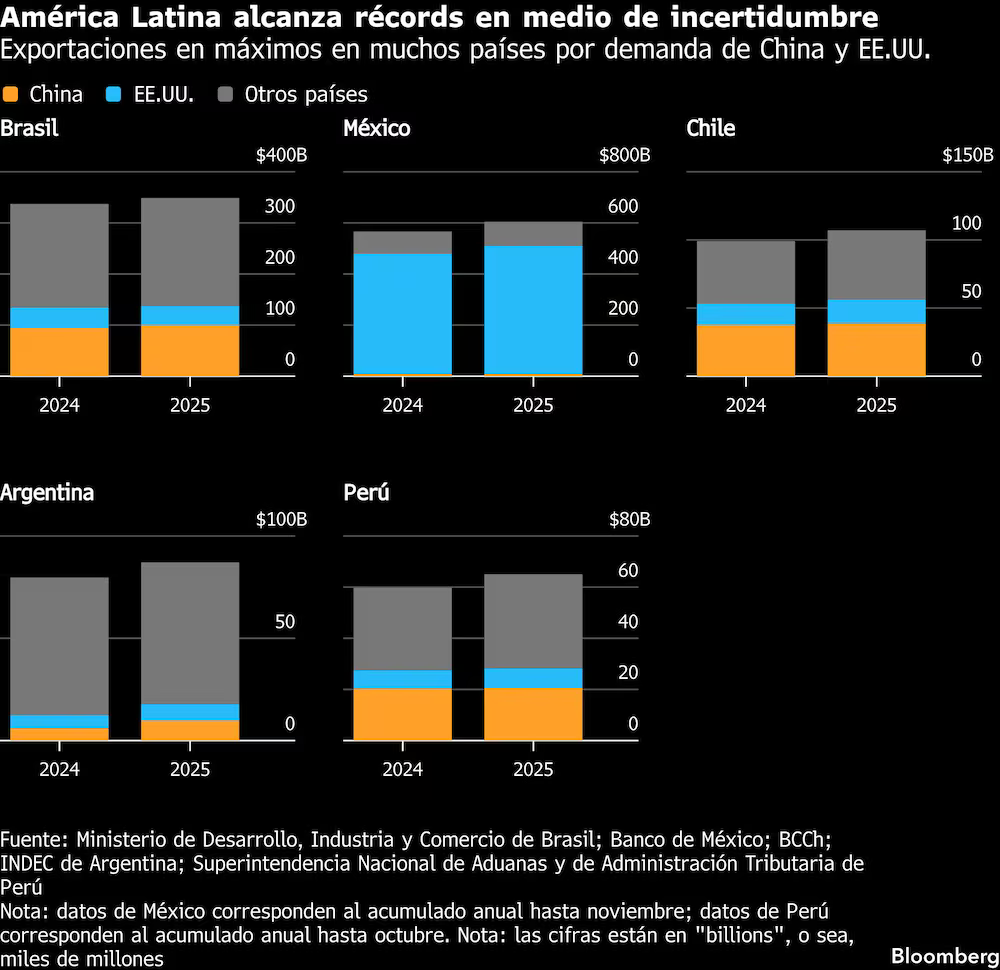
However, while the Trump Administration invokes the so-called “Donroe Doctrine” to claim total dominion over the American continent and its resources, the economic reality is far more complex. As Bloomberg Linea reports, South America’s massive — and growing — trade with China were crucial in cushioning the blow from Trump’s tariffs (machine translated):
Argentina, Brazil and Chile recorded historic export figures in 2025, driven by demand from China and the region’s ability to redirect trade flows.
Last Tuesday, Argentina announced that its shipments abroad in 2025 were the second highest in its history. The statement followed data from Brazil and Chile, which this month reported that their exports reached record highs last year.
The figures for Mexico and Peru are also likely to reveal historic results.
Exporters are benefiting from improved logistics, the ability to redirect shipments to emerging markets, and most importantly, deeper ties with China. The world’s second-largest economy is monopolizing the region’s commodity exports, such as soybeans, copper and iron ore.
“Last year’s strong export performance looks contrary to what might be expected, given the controversy over tariffs, but it was due to a combination of factors, including rising prices, volumes and geopolitics,” said Andres Abadia, chief economist for Latin America at Pantheon Macroeconomics. “The region’s major exports should remain relatively resilient.”
Latin America has burst onto the front lines of global geopolitics, as the Trump administration aggressively seeks to exert its influence throughout the Western Hemisphere. If we talk about trade, the reality in most countries in the region is that China is more present than ever.
Even Milei, the US and Israel’s most strident ally in the region, can’t imagine life without China. Just days ago, the Argentine president reiterated the importance of Chinese trade to the Argentine economy — just hours after meeting with Trump at Davos:
In our opinion, China is a great trading partner… If you look at China’s weight in the world, you will understand that I have to trade with China.
As the Bloomberg graphic above shows, Chile’s economy is even more dependent on trade with China. In his first meeting with Brazil’s president, Luiz Inácio Lula da Silva, just a couple of days ago, Kast stressed the importance of deepening Chile’s diplomatic and economic ties with Brazil, Latin America’s largest economy and a very close ally to China.
NC reader Tim D raised a couple of interesting points in the comments thread to a previous article on Latin American dependence on Chinese trade, and the unlikelihood of the US being able to supplant it:
A big problem with Trump’s plan is that the US doesn’t make the goods that average South Americans want to buy, and even if the US was able to provide goods through purchasing them from China and/or Southeast Asia for resale to South America, it would be inflationary. A second big problem is that the US can’t replace China as a market for raw materials, until it has the factories that require them. Imagine the transition, South Americans lose jobs because they can’t sell to China, then they experience inflation because they are cut off from the world’s most efficient manufacturer. It will be hard for pro-American governments to stay in power when that happens.
Admittedly, it remains to be seen whether China can keep up its current pace of purchases of Latin American goods given the deflationary forces it is grappling with (which Yves discussed in detail on Wednesday). But one thing is clear: there’s no way the US’ broken economy could plug the resulting holes.
China has been a vital bulwark for Latin America against the economic chaos and disruption caused by Trump’s war on global trade, as the Bloomberg Linea article notes. Which is why all the talk of the US dominating Latin America’s economy for the foreseeable future is so unhinged: even if they were able to pull this off, it would destroy the region’s national economies (not that Washington would give much of a family blog).
In the Caribbean, meanwhile, the gangster imperialism is off the charts…
The US has embargoed Cuba for 65 years.
We quit buying their sugar & let Big Sugar destroy the Florida Everglades.
Cuba fought to free Angola from apartheid South Africa & sends doctors worldwide.
Let’s end intervention & normalize relations with Cuba. pic.twitter.com/sTSEPOIqlC
— Oliver Larkin for Congress (@OliverALarkin) January 29, 2026
