

“Sanctions are becoming the preferred weapon of the United States and some allies – not because they are less destructive, but because the toll is less visible.”
In a recent paid speech for Maryam Rajavi’s People’s Mujahedin of Iran (MEK), former New York Mayor and Trump ally Rudy Giuliani said the quiet part out loud regarding the true intent of US sanctions on Iran — to sow economic desperation among the local populace, and in turn spark a nationwide revolt against the government:
People from Iran have now had enough. The sanctions are working. The currency is going to nothing. They are where Russia was, they’re where Poland was. We see signs of young men and women saying, ‘give me some food’. We saw a sign of a man trying to sell his internal organs for 500 American dollars — probably a fortune in Iran today. This is truly pitiful. These are the kinds of conditions that lead to successful revolution.
During a paid speech for Maryam Rajavi’s MEK cult, Rudy Giuliani celebrated claims that US sanctions had forced Iranians to sell their organs in the street pic.twitter.com/HyMqYEsQsy https://t.co/DalqJorGmb
— Max Blumenthal (@MaxBlumenthal) January 11, 2026
The US and Israel’s goal is clear: to topple the Islamic Republic of Iran and impose in its place the son of the former Shah, Reza Pahlavi, who hasn’t even visited Iran since 1978. It is their second attempt to implement a regime change in the country in just seven months.
🇮🇷 “When was the last time you were in Iran?”
Reza Pahlavi: “It was July of 1978. I’ll be there soon.“ pic.twitter.com/cTyDvg0NIO
— Lord Bebo (@MyLordBebo) January 11, 2026
As Giuliana gloats, the goal of US-led sanctions, combined with the forced devaluation of the Rial (as discussed in detail by Alastair Crooke on Judging Freedom), is to break public support for the Iranian government by making the country’s economy scream. SSince his return to office, President Trump has escalated US sanctions on Iran seven times, according to Wikipedia. The recent chaos in Iran also has the added bonus of distracting from Israel’s ongoing genocide in Gaza and attacks against Lebanon.
This is beyond horrifying.
New data shows Israel has killed over 680,000 Palestinians in Gaza.
Among them:
• 380,000 infants under 5
• 99,000 children over 5
That’s 479,000 children murdered by Israel.
Israel isn’t “defending itself.”
It is wiping out Palestinian life. pic.twitter.com/TFntu6OYX6
— Censored Humans (@CensoredHumans) January 12, 2026
The US has maintained a sanctions regime against Iran since the Iranian Revolution in 1979. In the first year of his first term, Trump reinstated the full gamut of US sanctions against the country with the stated goal of applying “maximum pressure” on the government in Tehran to try to compel it to renegotiate the 2015 nuclear accord.
Again, the main goal was not to hurt the government in Tehran directly but rather to make things much worse for the Iranian people in the hope they would rise up, as then-Secretary of State Mike Pompeo bragged on CBS. Again, it didn’t work out that way, despite causing further immiseration in the country.
In 2019, then-Sec. of State Mike Pompeo bragged that, as a result of US sanctions, “Things are much worse for the Iranian people.” pic.twitter.com/S2npdp9or3
— Aaron Maté (@aaronjmate) January 12, 2026
For its part, the EU has also intensified its pressure on Iran’s economy and currency with 10 packages of sanctions since October 2022. One of the main reasons cited for the EU’s escalating sanctions on Iran is the regime’s “widespread, brutal and disproportionate use of force by the Iranian authorities against peaceful protesters”, which is kind of ironic given the growing crackdown on peaceful protest in EU Member States.
The EU’s chief diplomat, Kaja Kallas, is now talking about imposing another round in response to the Iranian government’s crackdown on recent protests — protests that were fuelled primarily by the economic sanctions. As is well documented, economic sanctions predominantly affect the general citizenry of the targeted nation, particularly the poorest and most vulnerable. It’s also worth noting that the EU is yet to impose any sanctions on Israel for its genocide in Gaza.
The UN has also played its part. In September, just three months after the 12-Day War between Israel and Iran, France, Germany and the UK invoked a “snapback” mechanism under UN Security Council Resolution 2231 that restored the sanctions that had been suspended since the 2015 nuclear deal. The restored measures include a conventional arms embargo, restrictions linked to Iran’s ballistic missile programme, targeted asset freezes, and travel bans.
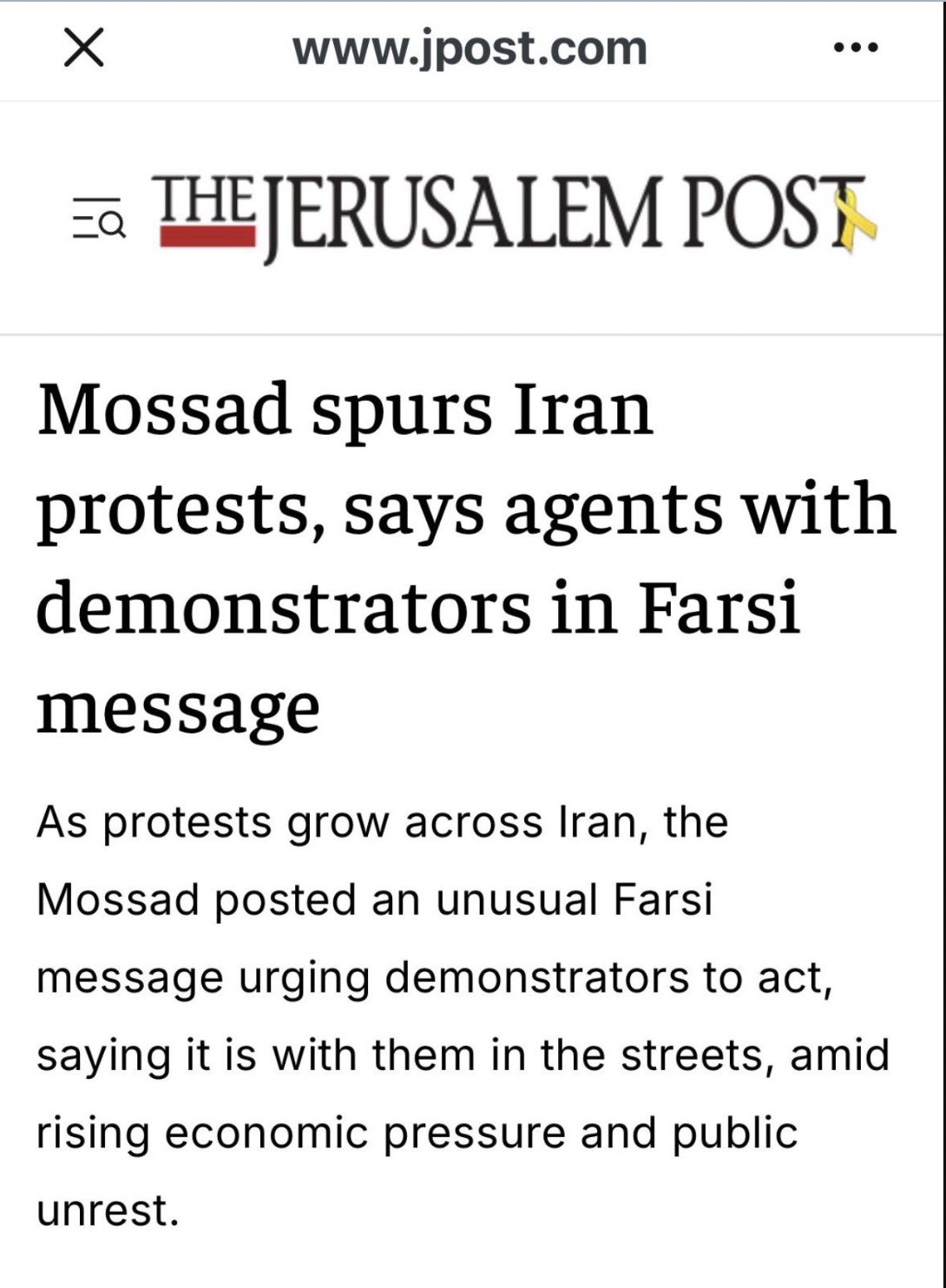
The result, as Giuliana rejoices in the above clip, has been a gradual strangulation of Iran’s economy and the destruction of its currency. This, in turn, has triggered nationwide protests, some of which have turned violent — with a little help, of course, from the CIA and Mossad and their Iranian and foreign assets.
For those pretending the violent riots in Iran are not Mossad‑CIA‑orchestrated, this is a direct quote from Mike Pompeo, former CIA Director:
“Happy New Year to every Iranian in the streets. Also to every Mossad agent walking beside them…” pic.twitter.com/dRZqHzrH56
— sarah (@sahouraxo) January 11, 2026
While European governments and media have been pulling out all the stops to paint the protests in Iran as a grassroots uprising, Israeli media and analysts are openly admitting Mossad’s role in fomenting the violence.
However, despite Israel’s best efforts, the protests appear to be dying down. On Judging Freedom, Alastair Crooke cites an Israeli security expert who grudgingly concedes that cracks are yet to appear in the regime’s government mechanisms or its two armies, the Regular and Revolutionary Guard. Nor are the protests taking on a larger dimension. Also, Pahlavi is failing to guide the uprising, as Khomeni did from exile in Paris during the Islamic Revolution.
The government in Tehran is also apparently using military jammers to successfully black out Elon Musk’s Starlink and has swept up many of the Mossad’s handlers and network.
I was expecting Israeli airstrikes Wednesday (like 12 June) or Friday (after New York market close is customary), but if Iran gets through tonight peacefully, I will call this round a win for Iran.
In the meanwhile Iran swept up the Mossad handlers and network, killed all… https://t.co/dn5v3xzADC
— Kathleen Tyson (@Kathleen_Tyson_) January 10, 2026
Another country that has been on the sharp edge of US sanctions and is once again facing the threat of regime change is Venezuela. The first round of sanctions went into effect under the Barack Obama administration in 2015, which designated Venezuela as an “unusual and extraordinary threat to the national security and foreign policy of the United States”. It is a reminder that the imposition of US sanctions are as bipartisan as support for Israel.
Donald Trump added more sanctions in 2017 before turning up the dial again in 2019. The measures included an embargo on the oil industry, Venezuela’s main source of revenue. Washington also grabbed Venezuelan national assets such as its gold held at the Bank of England and Citgo, a U.S.-based oil refining, transportation and marketing company valued at $13-billion, which was recently sold to New York vulture capitalist and ultra Zionist Paul Singer.
These measures significantly shrank Venezuela’s national coffers, making it nearly impossible to provide essential services such as health and food. Trump’s then-Secretary of State John Bolton candidly admitted to the Washington Post that the overarching goal of US sanctions was to cause massive economic pain to the general populace, even if it meant sparking a mass exodus of Venezuelans, including to the US:
Ahead of Venezuela’s election, John Bolton admitted to the Washington Post that he knew that the Trump admin’s crippling sanctions and coup attempt against Venezuela would destroy its economy and force millions to flee:
“There was no doubt the sanctions, along with the general… pic.twitter.com/woW7cVYlf3
— Aaron Maté (@aaronjmate) July 29, 2024
The Western Media’s Role
While government insiders like Bolton and Giuliani occasionally admit the real intent behind US-led sanctions — i.e., to make the economies of adversarial nations scream so much that it triggers a popular revolt against the sitting government — the human cost of Western sanctions is often downplayed, if not totally ignored, by the mainstream media.
A perfect case in point: in August 2024, Lancet Global Health published the first study to examine the effects of sanctions on age-specific mortality rates in cross-country panel data across most countries, using methods designed to address causal identification in observational data. The authors analysed the effect on health of sanctions using a panel dataset of age-specific mortality rates and sanctions episodes for 152 countries between 1971 and 2021
The study’s findings were shocking: broad economic sanctions, often depicted as a less violent alternative to war, are responsible for an estimated 564,000 deaths each year – most of them children under the age of five. In some years, the death toll was more than a million. With the notable exceptions of Bloomberg, the Los Angeles Times and Al Jazeera, most legacy media in the West did not even touch the story.
A cursory search of the BBC News website brings up nothing. Same goes for the Financial Times, the New York Times, the Washington Post, El País and Le Monde. Even the two main Western news agencies, Reuters and the Associated Press, didn’t bother covering it.
In other words, one of the world’s most respected medical journals had published a study showing that sanctions imposed by the US and EU since 1970 are associated with an estimated 38 million deaths — several times more than those killed in direct conflict — and most Western media had simply chosen to ignore it. As Yves might say, quelle surprise!
The study’s findings were covered by a smattering of alternative media outlets, including People’s Dispatch, The Cradle, Counterpunch, Common Dreams, and Progressive International. From The Cradle:
The research analyzed data from 152 countries over a 10-year period and found the mortality toll of sanctions to be comparable to that of armed conflict.
Authored by economists Francisco Rodriguez, Silvio Rendon, and Mark Weisbrot, the study underscores the devastating impact of sanctions on public health and essential infrastructure.
By targeting key economic sectors such as finance and energy, sanctions restrict access to critical imports like medicine, food, and parts for water and electrical systems, causing widespread suffering without the visible devastation of bombs and missiles.
The US, which imposes more sanctions than any other country, has increasingly turned to these measures as a tool of foreign policy. While often justified as a nonviolent means of pressuring adversaries, experts argue that the resulting human cost is anything but peaceful.
“Sanctions are becoming the preferred weapon of the United States and some allies – not because they are less destructive, but because the toll is less visible,” Weisbrot wrote in a commentary for the Los Angeles Times. “They kill silently, without the political cost of war.”
🆕 US prefers sanctions "not because they are less destructive than military action, but more likely because the toll is less visible"
"They can devastate food systems and hospitals and silently kill people without the gruesome videos of body parts in tent camps and cafes" pic.twitter.com/iTlo26wgqy
— Just Foreign Policy (@justfp) July 24, 2025
The case of Venezuela illustrates the lethal impact of sanctions. After the US imposed sweeping economic restrictions in 2017 and further escalated them under the administration of US President Donald Trump, the country plunged into a historic depression. Between 2012 and 2020, Venezuela’s economy contracted by 71 percent – three times the depth of the Great Depression in the US – with tens of thousands of deaths directly linked to the sanctions, according to multiple studies.
It’s not as if the destructive power of US-led sanctions was not already known. In the ’90s Bill Clinton’s Secretary of State Madeleine Albright was famously asked whether the deaths of half a million Iraqi children due to the widespread malnutrition, lack of clean water, and shortages of medicine and electricity caused by US sanctions were “worth it”. She said they were.
More recently, a 2019 study by Jeffrey Sachs and Mark Weisbrot estimated that US sanctions had killed as many as 40,000 Venezuelans in one year alone, from 2017 to 2018. That was before Trump escalated them further.
However, the Lancet study provides a chilling insight into the global death toll from four decades of US-led economic war against the Global South. But it does not include the last four years. As the economic anthropologist Jason Hickel writes, the collective West’s use of sanctions against the Global South is, if anything, intensifying:
For instance, when the popular socialist Salvador Allende was elected to power in Chile in 1970, the US government imposed brutal sanctions on the country. At a September 1970 meeting at the White House, US President Richard Nixon explained the objective was to “make [Chile’s] economy scream”. The historian Peter Kornbluh describes the sanctions as an “invisible blockade” that cut Chile off from international finance, created social unrest, and paved the way for the US-backed coup that installed the brutal right-wing dictatorship of Augusto Pinochet.
Since then, the US and Europe have dramatically increased their use of sanctions. During the 1990s and 2000s, an average of 30 countries were under Western unilateral sanctions in any given year. And now, as of the 2020s, it is more than 60 – a strikingly high proportion of the countries of the Global South.
Now, the US has its sights set once again on the long-standing thorn in its side, Cuba, which has faced a continuous US embargo for 65 years, and somehow managed to survive, albeit barely. The aim of of the US’ embargo was clearly set out in a 1960 memorandum: “to weaken the economic life of Cuba . . . [to deny] money and supplies to Cuba, to decrease monetary and real wages, to bring about hunger, desperation and overthrow of government.”
The US has long achieved all of those aims apart from the overarching one: the overthrow of the Cuban government. Now, the Trump administration seeks to starve the already struggling island nation of all energy by cutting it off completely from its largest supplier of oil, Venezuela, as well as perhaps even lesser sources such as Mexico.
“…THERE WILL BE NO MORE OIL OR MONEY GOING TO CUBA – ZERO! I strongly suggest they make a deal, BEFORE IT IS TOO LATE. Thank you for your attention to this matter.”- President Donald J. Trump pic.twitter.com/bHEIysJ7q1
— The White House (@WhiteHouse) January 11, 2026
BBC Lending Cover
Whether the US will be able to achieve this aim given it clearly doesn’t have total control of Venezuela’s oil supply, time will tell. Tankers are still leaving the country in defiance of Trump’s orders. Meanwhile, the BBC is helping to give the Trump administration cover for its blatantly illegal actions against both Cuba and Venezuela, through its selective use of language.
I’ve just made this complaint to the BBC about their report saying that the US had intercepted another tanker that was carrying “embargoed” oil.
“You used the word “embargoed” to describe oil from Venezuela. You don’t tell your viewers that this is a US unilateral embargo.
1/3
— Kevin Courtney (@cyclingkev) January 11, 2026
especially if it was oil going to Cuba. Because the US embargo of Cuba is voted down regularly at the UN general assembly. Your use of this word is in accurate and shows a bias in your reporting. Please correct it and do tell me what you are going to do about my complaint.”
3/3
— Kevin Courtney (@cyclingkev) January 11, 2026
For years, most of the world’s nations, including long-standing US vassal states like all EU member states, the UK, Japan, South Korea, Australia and Canada, have demanded an end to the US embargo of Cuba. Only the US and Israel consistently vote against the resolution. In 2024, they were totally alone.
One of Marco Rubio’s first acts as secretary of state was to impose sanctions on Cuban medical missions, one of the last sources of foreign currency for the nation’s government, and many of the African and Latin American governments that use them. As we noted at the time, seeking to prevent some of the world’s poorest countries from availing of the medical assistance provided, often free of charge, by Cuba’s medical missions was a new low, even for the US.
As Helen Yaffe wrote for Jacobin, while Cuba exports doctors and nurses, the US exports sanctions. One saves lives, the other kills millions.
