

Yves here. Your humble blogger had started a broader post, in part triggered by proof of Trump’s increasing power-madness, confirmed by a fresh, must-read New York Times interview, but found it required more internal processing of the events of the new year. But sadly there are plenty of pressing alternatives to discuss, such Russia’s latest rain of blows on Ukraine.
But to continue briefly with the introductory observation: Trump seems to genuine believe no one, including Russia, can constrain him, Putin appears to be digesting that Trump’s extreme need to dominate and his casualness about risk and violence requires even firmer shows of force. As we’ll soon discuss, the Oreshink attack in Lvov, which destroyed not just Ukraine’s but Europe’s largest gas depot occurred in parallel with strikes all over Ukraine, which are likely to be even more consequential.
But having introduced the Trump interview, these sections show that his disregard for the notion that there are constraints on his power:
In his conversation with The Times, Mr. Trump sounded more emboldened than ever. He cited the success of his strike on Iran’s nuclear program — he keeps a model of the B-2 bombers used in the mission on his desk; the speed with which he decapitated the Venezuelan government last weekend; and his designs on Greenland, which is controlled by Denmark, a NATO ally.
When asked what was his higher priority, obtaining Greenland or preserving NATO, Mr. Trump declined to answer directly, but acknowledged “it may be a choice.” He made clear that the trans-Atlantic alliance was essentially useless without the United States at its core.
Even as he characterized the norms of the post-World War II order as unnecessary burdens on a superpower, Mr. Trump was dismissive of the idea that the leader of China, Xi Jinping, or President Vladimir V. Putin of Russia could use similar logic to the detriment of the United States. On topic after topic, he made clear that in his mind, U.S. power is the determining factor — and that previous presidents have been too cautious to make use of it for political supremacy or national profit….
On the domestic front, Mr. Trump suggested that judges only have power to restrict his domestic policy agenda — from the deployment of the National Guard to the imposition of tariffs — “under certain circumstances.”
But he was already considering workarounds. He raised the possibility that if his tariffs issued under emergency authorities were struck down by the Supreme Court, he could repackage them as licensing fees. And Mr. Trump, who said he was elected to restore law and order, reiterated that he was willing to invoke the Insurrection Act and deploy the military inside the United States and federalize some National Guard units if he felt it was important to do so.
Now to the latest Russian pounding of Ukraine:
‼️🇺🇦 A total blackout in Kyiv and its suburbs: authorities don’t know when the power will be restored
▪️The moment of the power outage was caught on camera. There’s no electricity in the capital itself, as well as in the Borispol and partially in the Brovary districts.
▪️DTEK…
— Zlatti71 (@Zlatti_71) January 9, 2026
massive attack by “Geran” on Kiev has begun. The first wave of approximately 30 drones is entering the city. In total, over a hundred attack drones are approaching the Kiev region. pic.twitter.com/EKr901dgbV
— Sprinter Press (@SprinterPress) January 8, 2026
Ukraine had the largest total underground storage system in Europe: 31 bcm across multiple facilities, with the Bilche-Volytsko-Uherske site being the single largest at over 17 bcm.
Russian Oreshniks wiped it out this evening. pic.twitter.com/X0o6FQTDyC
— ₦₳V𝚜𝚝é𝚟𝚊 🇷🇺 ᴢ (@Navsteva) January 8, 2026
Update 7:45 AM EST. From a post by Scott Ritter that went live after ours launched:
The use of the Oreshnik is always a major escalation not fully appreciated by those who casually encourage its employment. It is only the second time in history that an intermediate range nuclear-capable strategic missile has been used in combat (the first was the initial use of Oreshnik back on November 21, 2024.)
This time, the Oreshnik struck a target close to the Ukrainian-Polish border. The signal this attack sent to NATO nations is clear—Russia has the ability to strike NATO nations with impunity using non-nuclear conventional weaponry. NATO has no ability to defend against such an attack.
It was interesting that Russia opted to fire the Oreshnik from the Kaputin Yar missile test facility. Russia and Belarus recently announced that an Oreshnik-equipped brigade was put on combat duty at a base in Belarus. But the attack did not originate from this unit.
Russia has indicated that it is fielding additional Oreshnik-equipped brigades. Kapustin Yar is a location where the combat equipment of the Oreshnik missile system is married with the personnel operating it for the final training and technical preparation necessary before a unit can be deemed combat ready. The recent Oreshnik launch on Lvov may have been an operational training event repurposed for the purpose of sending a message to the west.
This was not a launch from a strategic asset that has been placed on combat duty.
This was an operational training event.
There is a difference.
Russia once again appears to be sending a message to the west that it seeks to limit escalation.
This time the camel got a bloody nose.
The next time—if there is a next time—the camel may not survive.
The wee problem is that Trump is incapable of recognizing when acts of force are carefully calibrated. And his team is such a bunch of rank amateurs that even if anyone at an operational level understood, the higher-ups would similarly be unwilling to listen.
Back to the original post:
Confirming the immediate impact on Lvov, Larry Johnson wrote:
Lvov deputy Igor Zinkevich reported that in the Lvov region, the stoves in the kitchen are barely burning, the boilers have gone out and won’t light up – there’s no gas pressure.
As Simplicius pointed out:
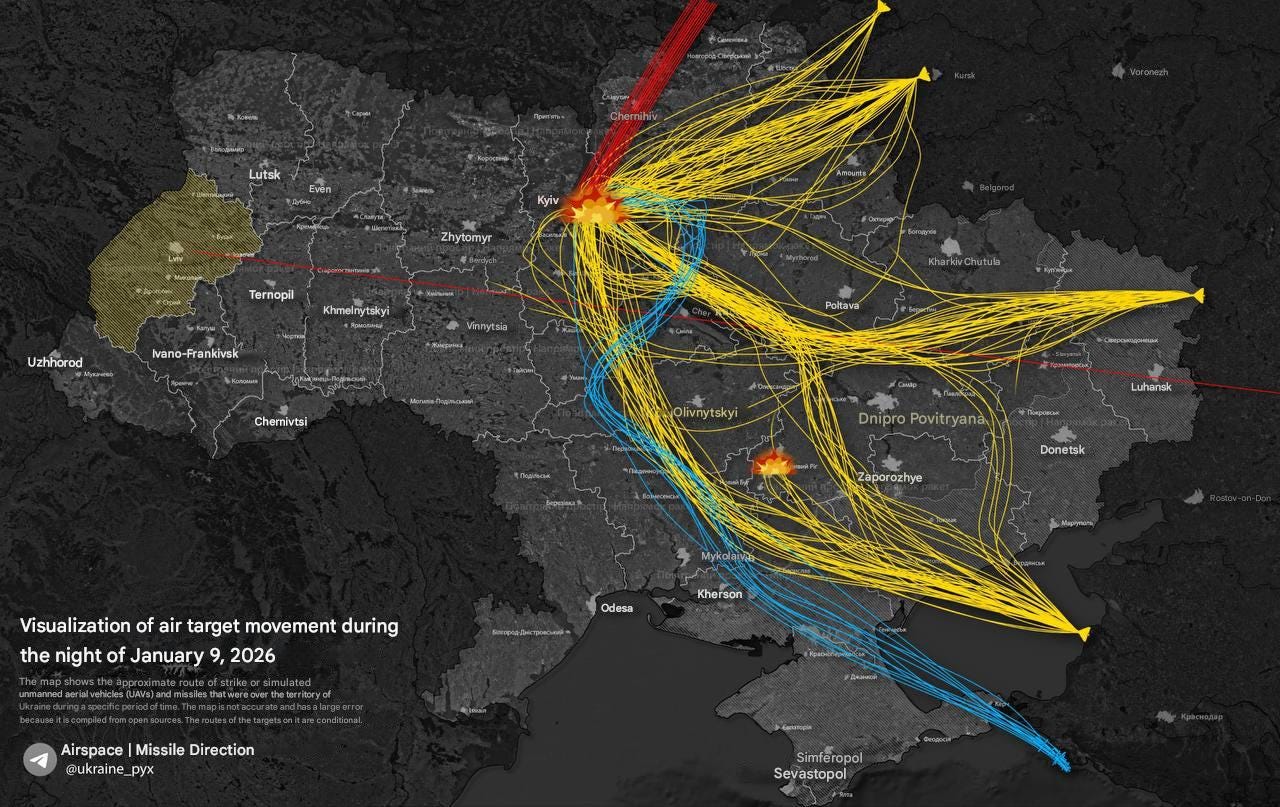
Though Oreshnik stole the show, the much larger attack on other Ukrainian cities was in reality far more devastating, with Kiev’s thermal power plants said to be violently hit by Russian strikes as various Ukrainian cities experienced major to total power outages.
💥— Large-scale missile-drone strikes on the energy infrastructure in Kiev have taken place, resulting in damage to 3 x Power Plants: TPP-4, TPP-5, and TPP-6.
Acc to local monitoring channels, up to 12 Ballistic Missiles, 25 x Caliber Cruise Missilies and around 200 x Drones took part in the attacks
After a wave of missile attacks, Kyiv is experiencing serious problems with electricity, water supply, and heating. There are communication outages. Problems on the railway have also begun, but they were already observed yesterday, they have just worsened now.
The even bigger story is the fact that Dnipro and Zaporozhye—both cities of nearly one million people, have reportedly been without power for days….
One Russian channel writes on the attacks on Dnipro and Krivoy Rog in particular:
A clearer picture is gradually emerging of the attacks in Dnepropetrovsk and Krivoy Rog. Judging by the nature of the damage, it’s no longer just about knocking out a generation, but rather about a targeted attack on distribution facilities.
At the current stage, it’s clear that Russia has managed to gradually, with relatively limited resources, create localized but persistent and noticeable power outages. Moreover, the change in approach and the redistribution of attack resources to a specific region disrupt (at least temporarily) DTEK’s usual maneuvering and backup schemes. For the central industrial region along the Dnieper, the existing mechanisms are gradually becoming insufficient.
Dnepropetrovsk is a good training ground in this regard. Due to its importance, the city has a complex, multi-redundant power grid designed precisely to bypass damage and redistribute flows. If prolonged outages can be achieved here, it means that the approach is working and can be scaled.
In the future, this opens up the possibility of turning energy attacks into a “on-demand” deployment tool – disconnecting specific regions without the need for massive fire campaigns, as has been the case, say, over the past three years.
The key question here is not whether this can be done, but the race for speed. On the one hand, there’s a well-honed mechanism for attacking power grid nodes, on the other hand, there’s emergency services that used to take a week or two to restore power. Who will be faster and more resilient in this confrontation will become clear soon.
“Military Chronicle”
BREAKING:
Another horrific video of “Oreshnik” hitting Lvov, Ukraine tonight pic.twitter.com/GFAD3Q1bM7
— Megatron (@Megatron_ron) January 8, 2026
And to more tweets:
Big fire illuminates night skies in Lviv region after Russian Oreshnik strike of Europe’s largest underground gas storage facility. I saw such skies as child in Western Ukraine after gas pipeline explosion dozens kilometers away. There are reports of big gas pressure drop in Lviv… pic.twitter.com/8ofd11pxpB
— Ivan Katchanovski (@I_Katchanovski) January 8, 2026
‼️🇷🇺 The Oreshnik IRBM strike on Lvov. Video shows the MIRV warhead (conventional) re-entering the atmosphere at Mach 15+. https://t.co/wRoEnS1hal pic.twitter.com/MtNzeM0DVw
— Spetsnaℤ 007 🇷🇺 (@Alex_Oloyede2) January 8, 2026
By Andrew Korybko, a Moscow-based American political analyst who specializes in the global systemic transition to multipolarity in the New Cold War. He has a PhD from MGIMO, which is under the umbrella of the Russian Foreign Ministry. Originally published at his website
These are Ukraine’s attempted assassination of Putin right before New Year’s, France and the UK’s official plans to deploy troops to Ukraine if a ceasefire is agreed to, and the US’ seizure of a Russian-flagged tanker in the Atlantic.
The Russian Defense Ministry confirmed on Friday morning that the Oreshniks were used for the second time ever after several were fired at targets in Lvov Region. Reports indicate that the Stryi gas field and gas storage facility were among those that were hit. The first time that the Oreshniks were used was in November 2024 after the US and UK allowed Ukraine to use their long-range missiles for strikes deep inside of Russia. Three recent provocations were arguably responsible for their second-ever use.
The confirmation above explicitly mentioned that Ukraine’s attempted large-scale attack against Putin’s residence in Russia’s Novgorod Region right before New Year’s was what prompted this retaliation. About that, it was assessed that “The CIA Is Manipulating Trump Against Putin” after he flipflopped from believing Putin’s claim that this attack was an assassination attempt to believing the CIA chief’s that it supposedly only targeted a nearby military site, so this can be interpreted as Putin’s retort to Trump.
Moving along, even though the Russian Defense Ministry didn’t mention any other recent provocations as being responsible for their country’s second-ever use of the Oreshniks, it can be reasonably argued that Putin probably had two others in mind too when he gave the authorization for this latest strike. These are France and the UK’s official plans to deploy troops to Ukraine if a ceasefire is agreed to as well as the US’ seizure of a Russian-flagged tanker in the Atlantic. Each are provocative in their own way.
Putin himself warned as recently as September that Russia would deem Western troops in Ukraine “legitimate targets for destruction.” Although “SVR Revealed That British & French Troops Are Already In Odessa” later that same month, that’s not comparable to the conventional deployment that those two committed to. Even more concerning, Witkoff backed their plans, thus possibly making Russia wonder whether the US might reverse its official position that Article 5 won’t extend to NATO troops in Ukraine.
As for the third provocation that Putin probably had in mind when he authorized Russia’s second-ever use of the Oreshniks, the US’ seizure of a Russian-flagged tanker in the Atlantic carried the painful optics of the first extraterritorially imposing its domestic law on the second. If Russia didn’t send a strong message afterwards, however indirect and asymmetrical, then the US might be emboldened to seize more of Russia’s “shadow fleet” elsewhere across the world including in the Baltic and Black Seas.
These last two admittedly speculative motives behind the latest Oreshnik strike explain why targets in Lvov Region were hit instead of others anywhere else across Ukraine. Russia arguably wanted to show France, the UK, and their shared US patron that it’s capable of swiftly hitting targets within NATO without detection if the need arises. This could occur if an unprecedented crisis follows the first two’s planned troop deployment to Ukraine or the US’ hypothetical seizure of more Russian ships does the same.
Putin is almost pathologically averse to escalating in Ukraine due to the risk that it could spiral out of control into World War III so it’s significant that he just authorized the second-ever use of the Oreshniks in spite of that. He didn’t even do this after Ukraine’s “Operation Spiderweb”, which Trump might have known about in advance, targeted Russia’s nuclear triad last summer. This shows how seriously he’s taking Ukraine’s attempted assassination of him and probably the other two provocations too.
