

Soon after the Supreme Court dropped its IEEPA decision Friday morning, I wrote up a post on who the IEEPA decison Winners were. Today, as promised, we review the losers. Spoiler alert: there are a lot of them.
In broad strokes, the winners were the large companies that filed for refunds or sued the US, the dollar, consumers, the separation of powers, the US Constitution, and the Supreme Court. The losers are a bit more nuanced: some are obvious, many are not.
My analysis of who won and who lost is based on both the immediate reaction to the tariffs being found unlawful, and the longer-term results of this case. As always, the world is complex and not black-and-white, with much nuance to be found.
Let’s jump right in:
LOSERS
• Consumers: On Friday, my immediate reaction was that US consumers would have a lower tariff burden. But the President added a 10% (150-day) global tariff, and then raised it over the weekend to 15%.
15%. This regressive Trump Tax will be borne by every consumer on a wide range of imported foodstuffs, manufactured parts, and finished goods. It is much less of a victory than I originally believed due to the latest tariffs POTUS imposed.
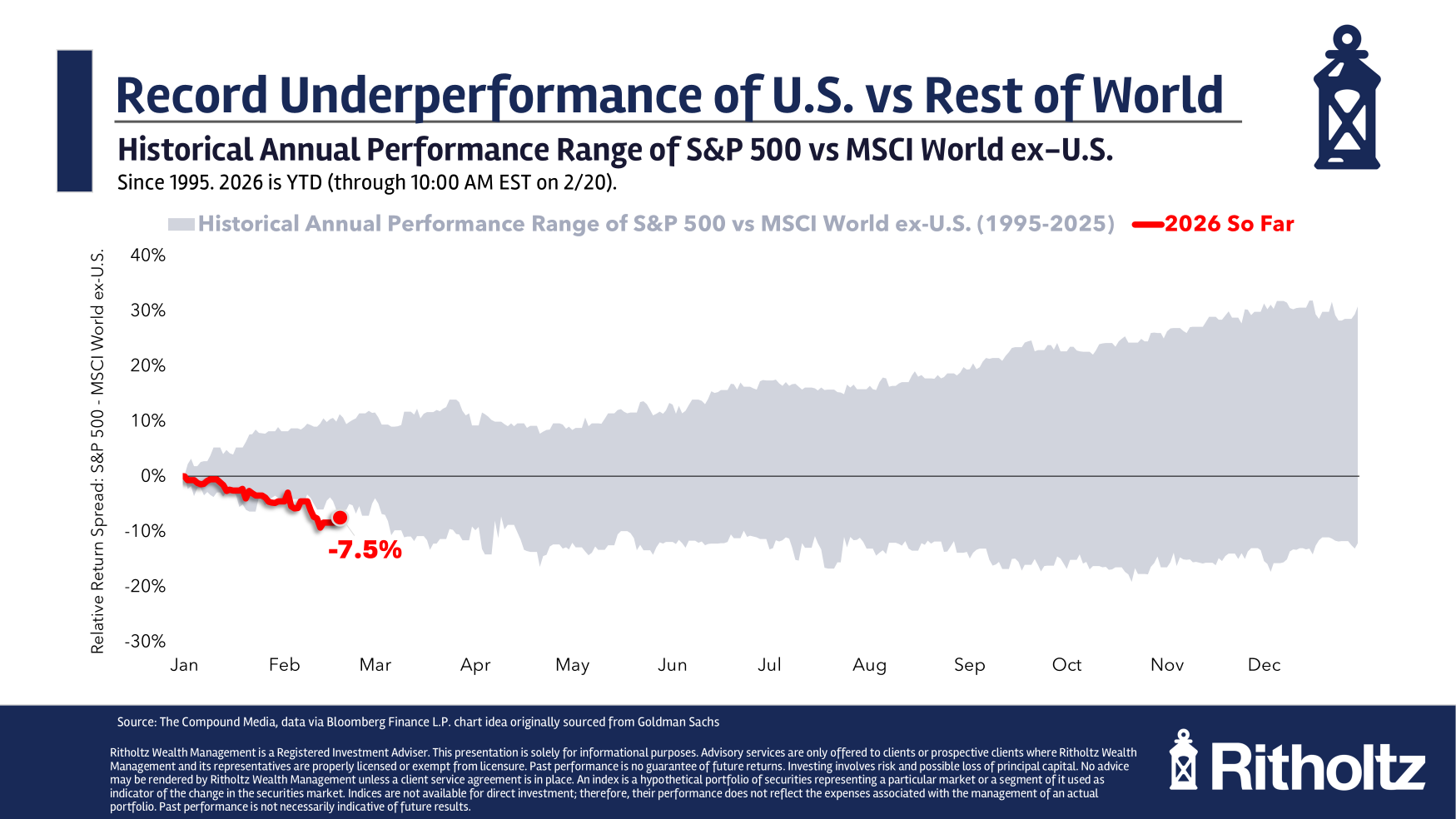
• U.S. Equities: What should have been a clear victory for US equities has turned into a muddled mess. (See chart at top). Blocking the president’s power to arbitrarily tariff any country any amount is a significant win; it was offset by the President’s immediate use of Section 232 to impose 10% 15% tariffs for 150 days. While Markets rallied right after the decision, they reacted negatively to the president’s actions over the weekend.
¶ Commodities (especially Gold & Silver): If the dollar was the big winner Friday, then anything priced in dollars is the loser. As noted, 2025 – just like 2017 before it – was a bad year for the dollar What’s been driving the dollar lower has been frustration from our trading partners, the repatriation trade, and a spreading concern that the United States is no longer the reliable ally it once was.
• Domestic automakers: Ford and GM have seen their stocks rise over the past year, but they have been underperforming the industrials and the broader market lately. Aluminum & Steel tariffs have made their cars more costly; other non-IEEPA tariffs1 affecting automobiles were not before the Court.
• Bonds & Deficits: If you believe that the bond market does not like unfunded spending, then it’s hard to see how bonds are not at least modest losers post SCOTUS decision. Tariffs are taxes that raised nearly $200 billion. While nobody here wanted a VAT tax, it did affect government revenues.
On a related note, in the first year of his second term, President Trump added $2.25 trillion to the national debt. His claim was that tariffs would help balance the budget, notwithstanding the Constitution – and that claim is no more.
….I am a Tariff Man. When people or countries come in to raid the great wealth of our Nation, I want them to pay for the privilege of doing so. It will always be the best way to max out our economic power. We are right now taking in $billions in Tariffs. MAKE AMERICA RICH AGAIN
— Donald J. Trump (@realDonaldTrump) December 4, 2018
Tariff Man: Trump has largely defined his presidency by promoting the benefits of tariffs. Alongside tax cuts and deportations, it is this administration’s signature policy. It’s not surprising that the Supreme Court’s rejection has sparked a wide range of reactions. At one end, Hakeem Jeffries called the tariff ruling a “crushing defeat for the wannabe King”; at the other, U.S. Trade Representative Jamieson Greer described tariff policy as “unchanged.”
The truth lay somewhere in between.
It was a frustrating defeat for POTUS, one that led him to lash out at Justices, Democrats, trading partners, and others. (Tomorrow night’s State of the Union address could become unhinged). Regardless, it was a significant loss with consequences that have yet to be fully determined.
• Tariff benefits:
The other thing we learned was that none of the promised benefits of tariffs have materialized:
“It’s the most beautiful word in the dictionary, and it’s my favorite word. It will make our country rich. Tariffs cost Americans nothing, it’s not going to raise our inflation. If I’m going to be president of this country, I’m going to put a 100%, 200%, 2,000% tariff. We’re going to generate hundreds of billions in tariffs; we’ll become so wealthy we won’t know how to spend that money.” 2
Every economist not named “Navarro” had previously forecast this…
• Foreign Policy: The single biggest hammer the president had has been taken away: His ability to single out specific countries and then impose unlimited tariffs (100%) is no longer.
The NYTimes blew this one: “They Did Deals With Trump to Get Lower Tariffs. Now They Are Stuck.”
A naïve headline that is laughably wrong. Nobody who was strong-armed into a deal based on unlawful tariffs is going to honor those deals. (Good luck enforcing them in the court of international trade).
Oh, and Trump immediately violated the trade deals he cut with these new global tariffs he announced Friday and Saturday.
These deals will be slow-walked, empty-gestured, let-me-get-back-to-you, and ultimately ignored.
• Congress: While the Constitution, the Supreme Court, and the separation of powers were victors on Friday, the subtle loser in our system was Congress. They had the ability – indeed the obligation – to push back on the executive branch’s power grab. The failure to stand up to the President’s overreach was a self-own. Their timidity allowed the bully to take what was rightfully theirs: the power to tax.
• Sycophants: There are numerous people who have thoroughly embarrassed themselves throughout the tariff regime3 but one stands out above them all: Brett Kavanaugh.
I could criticize Gorsuch’s concurring opinion as an unneeded performative treatise running 46 pages, only to ultimately agree with Chief Justice Roberts.4
But really, it is Kavanaugh whose dissent will be remembered. It fell somewhere in between embarrassing and sycophantic, fluffy and nonsensical.5 He spends 61 pages telling President Trump he won: “Although I firmly disagree with the Court’s holding today, the decision might not substantially constrain a President’s ability to order tariffs going forward, because numerous other federal statutes authorize the President to impose tariffs and might justify most (if not all) of the tariffs at issue in this case.”
Then Kavanaugh – and let me remind you, this is a sitting Supreme Court Justice, and not a junior lawyer in State or DOJ – helpfully lists the alternative statutes (Section 232, 122, 201, and 301 of the Trade Act) as a roadmap for the administration to use to reinstate tariffs in other ways. (Which they did)
The supposed intellectual heir to Scalia brand of conservatism was revealed as neither. Legally incoherent, intellectually indefensible, and blatantly partisan, Kavanaugh did not write a dissent, but rather, a very long op-ed, or if you want to be less charitable, a loyalty oath dressed up in judicial robes. It will likely haunt the rest of his judicial career.
Previously:
Winners & Losers of SCOTUS Decision Striking Down Tariffs (February 20, 2026)
__________
1. Passenger vehicles, Light trucks, Medium‑ and heavy‑duty vehicles, and buses are all covered by a separate Section 232 tariffs, as are auto parts, including engines, transmissions, key electrical components, etc.
2. A few assorted dates of quotes:
The word tariff is the most beautiful word in the dictionary” -2018
“[They]will make our country rich” -2019
“Tariffs cost Americans nothing.” -2019
“The word ‘tariff’ to some people, and not very smart people, but to those people tariff is a dirty word. To me it is not a dirty word, it’s the most beautiful word there is.” Sept 15, 2024 (KNTV‑13, Las Vegas interview):
“It’s not going to raise our inflation.” -2024
“To me the most beautiful word in the dictionary is tariff. And it’s my favorite word.”-2024
“If I’m going to be president of this country, I’m going to put a 100%, 200%, 2,000% tariff. They’re not going to sell one car in the United States.” -2024
“The higher the tariff, the more you’re going to put on the value of that piece, those goods, the higher people are going to pay in shops.” -2024
“Tariffs are going to make us rich as hell, it’s going to bring our country’s businesses back that left us.” -2025
“We’re going to generate hundreds of billions in tariffs; we’ll become so wealthy we won’t know how to spend that money.” -2025
3. Lots of sycophants deserve at least a footnote:
Robert Lighthizer: U.S. Trade Representativewho was the key architect and executor of Trump’s tariff strategy
Peter Navarro: The one economist in the country who thought this wasa good idea.
Kevin Hasset: The uniquely unqualified adviser, who, despite multiple sources that correctly identified consumers as shouldering the burden for the Trump Tax, threatened NY Fed researchers for using data toshow the same. Thus, the author who wrote Dow 36,000, the most embarrassing financial book ever written, has another bit of ignominy to add to his resume.
4. Gorsuch: “Whatever else might be said about Congress’s work in IEEPA, it did not clearly surrender to the President the sweeping tariff power he seeks to wield.” WTH dude, 46 pages for THAT?
5. I don’t want to spend too much time on the structural issues with Kavanaugh’s dissent, but here are 3 problems.
1) He simultaneously argues the president has this power under IEEPA, but that the major questions doctrine shouldn’t apply in foreign affairs, and even if the court disagrees, the president has alternative authorities that make the decision moot. That’s not a coherent jurisprudential position — it’s kind words to an upset client.
Second, 61-pages?
Third, and most damning is that Kavanaugh, who supposedly is committed to judicial restraint and textualism, advocates in his dissent for (a) maximally expands executive power against the clear weight of the statutory text, (b) gave explicit political cover to route around the ruling,
