

“One thing is geopolitics, another is trade,” said Milei. “I’m not going to break commercial ties with China”.
In recent years, one of the US’ main policy goals toward Latin America has been to halt China’s growing economic influence there. This policy began in earnest during the Biden Administration, as senior US officials started pressuring Mexico to reduce its trade with China. Mexico’s AMLO government eventually buckled under that pressure in April 2024, and imposed hundreds of new tariffs on Chinese goods.
As we reported in our article, “Mexican Economy Faces Its ‘With U.S. Or Against U.S.’ Moment“, the growing deployment of protectionist measures in Mexico, primarily at the behest of the US, was eliciting rare criticism in the Mexican business press. One editorial likened Mexico’s relationship with the US to a marriage, in which “there is no room for a Chinese lover.” It also warned that Mexico’s main trading partner is becoming “increasingly possessive”.
At around the same time, then-SOUTHCOM commander, General Laura Richardson, was doing the rounds of neo-con think tanks like the Atlantic Council and the Aspen Institute, talking about the need to shut out China and Russia from Latin America’s vast treasure trove of mineral and energy resources, using “aggressive means” if necessary.
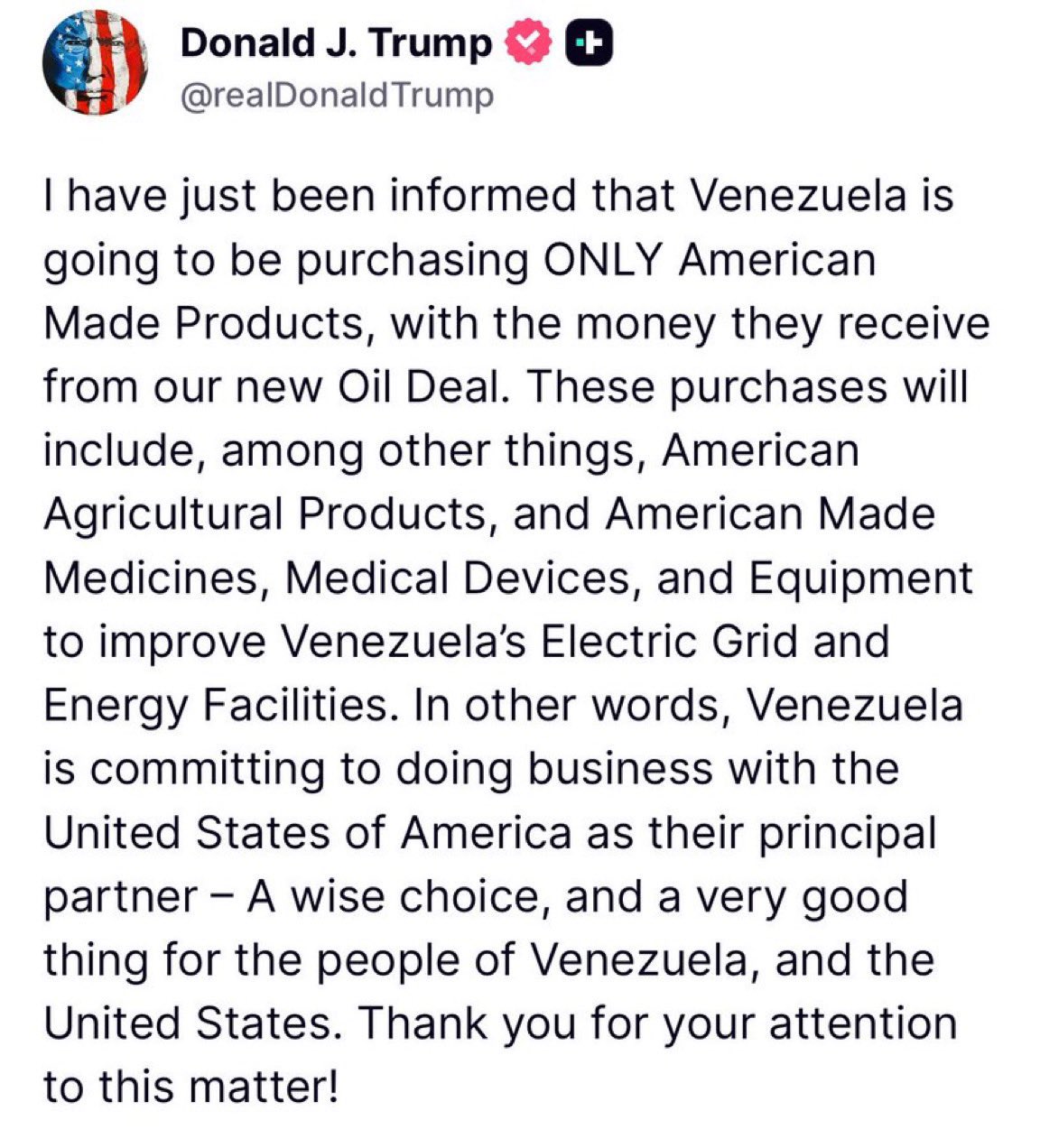
Now, the Trump administration is taking this approach to a whole new level that involves trying to strong-arm Venezuela into cutting all ties with China, its biggest trade partner, Russia and Iran, and in so doing destroy what remains of its shrunken economy. It is also proposing to control the sale of Venezuela’s oil, having the proceeds deposited in US banks, and then forcing Venezuela to use what remain of those funds after the US has taken its cut, to buy US goods.
Trump’s Impositions Will Implode Venezuela
The Trump administration has told Venezuela that it must expel representatives from China, Russia, Iran, and Cuba and sever economic ties with them before being allowed to increase oil production.
In addition, he warned that 30 to 50… pic.twitter.com/u4gD1eYKiH
— Patricia Marins (@pati_marins64) January 7, 2026
“Plata o Plomo?”
This is actually worse than the “plata o plomo” (silver or lead) deal Latin American drug cartels are famed for offering in their shakedowns of government officials, since the US is not even offering Venezuela any silver, just lead. Put simply, if the Venezuelan government doesn’t allow the Trump administration to seize control of all its oil, the US will keep seizing its ships, attacking the country, and kidnapping, or even killing top Venezuelan government officials.
Trump’s new National Security Strategy (NSS) may assert a Trump Corollary to the Monroe Doctrine, which seeks to “restore American preeminence in the Western Hemisphere” and keep the Hemisphere “free of hostile foreign incursion or ownership of key assets.” But nowhere in that document does it mention anything about forcing countries in the region at gunpoint to cut ties with any and all US adversaries or give up control of their resources to Washington.
Instead, it talks about (emphasis my own):
- Accelerating efforts to “roll back outside influence in the Western Hemisphere by demonstrating, with specificity, how many hidden costs — in espionage, cybersecurity, debt-traps, and other ways — are embedded in allegedly ‘low cost’ foreign assistance,… including by utilizing U.S. leverage in finance and technology to induce countries to reject such assistance.”
- “Mak[ing] clear that American goods, services, and technologies are a far better
buy in the long run, because they are higher quality and do not come with the same
kind of strings as other countries’ assistance… The choice all countries should face is whether they want to live in an American-led world of sovereign countries and free economies or in a parallel one in which they are influenced by countries on the other side of the world.”
Venezuela, and by extension, all countries, are now being shown what it means to be living as a “sovereign country” and “a free economy in an American-led world” — by being attacked, having their head of state kidnapped, their resources plundered, and then being told to cut all ties with their other trade partners, and then spend all their remaining funds on “higher quality” US goods — all at the barrel of a gun.
“A Wise Choice”
In the words of Donald J Trump, “Venezuela must commit to doing business with the United States of America as their principal partner — A wise choice, and a very good thing for the people of Venezuela, and the United States.”
Media outlets are already suggesting that the Trump administration’s militarised shakedown of Venezuela will impose serious limits on China’s influence in Latin America. From the Wall Street Journal article, “Maduro’s Capture Threatens China’s Ambitions in Latin America”
The takedown of Maduro throws a wrench into Xi’s regional political calculus, raising questions about the next direction for Venezuela as an oil supplier—and as a reliable needle in Washington’s side. It could weaken the underpinnings of Beijing’s other regional philosophical bedfellows, including Cuba and Nicaragua, and make China more cautious about throwing around its economic and diplomatic heft.
“Recent events in Venezuela are likely to weigh heavily on how regional leaders think about next steps and external partnerships,” said Margaret Myers, director of the Asia & Latin America Program at the Inter-American Dialogue, referring to both China and the U.S. Beijing might have trouble capitalizing on regional concerns about U.S. overreach, she said, because China is “no longer viewed across parts of the region as an economic lifeline or stabilizing external partner.”
This is apparently news, however, to the US’ most servile vassal state in the region, Argentina. As readers may recall, its government was bailed out by the US Treasury with tens of billions of dollars in credit swaps just a few months ago — all to ensure that the Milei government did not suffer a humiliating defeat in Argentina’s mid-term elections.
In an interview on Tuesday, President Javier Milei gushed about Trump’s removal of Maduro, saying that Trump is “redesigning the world order” and advancing against what he described as “murderous socialism.” However, when asked about China, Milei said his government was not prepared to break ties with the Asian giant. From Buenos Aires Herald:
[T]he libertarian leader clarified that, despite Argentina’s geopolitical alignment with the United States, his government will not break its trade ties with China.
“Trump is redesigning the world order, no longer thinking in terms of globalisation to pass onto geopolitical terms and part of that discussion is to end murderous socialism, whether it calls itself Venezuela, Cuba or Nicaragua,” said Milei in an interview with streaming channel Neura.
Argentina’s President highlighted the strength of the bilateral relationship between Buenos Aires and Washington and said that his government’s stance had been defined before he took office.
“There is a reordering and it is clear that some players are better positioned than others. We adopted a clear stance before being elected; our geopolitical alliance was part of our electoral platform,” he affirmed.
He has “always” spoken of a “geopolitical alliance because commercial questions run parallel,” argued Milei.
One of the reasons Milei gave for not breaking ties with China was that the US itself has very deep trade ties with the Asian giant. The money quote from the interview: “One thing is geopolitics, another is commerce”.
These words clearly betray Milei’s rather flawed understanding of how the world works, especially when it comes to geopolitics. One need only ask Europe’s energy-starved households whether geopolitics and commerce exist in separate realms, as Milei seems to believe.
So, on the one hand, Milei just a few months ago begged Trump for a bailout, which he duly received, while on the other he expects Trump to have no problem whatsoever with Argentina continuing, or even expanding, its trade with China, even as Trump himself is telling Venezuela to sever all ties with China, Russia and Iran, or else.
Milei’s magical thinking is truly something to behold. He seems to believe he is in a geopolitical alliance with Trump — an alliance that will be beneficial to both him and his government, if not Argentina as a whole. Nothing could be further from the truth.
“Milei Had Better Watch Out”
Washington will presumably be sending its economic hitmen to Buenos Aires to remind Milei of his obligations, if it hasn’t already. The Trump administration has already warned about the financial, trade and aerospace agreements Argentina has signed with China. As Guillermo Moreno, a former secretary of domestic trade under both president Kirchners, put it in a recent interview, “Milei had better watch out” (translated by yours truly):
They’re coming for you… It’s clear you’re making a huge mess of things. They told you to end the swap with China, you played dumb, and you keep spending dollars on Chinese manufacturing, Chinese textiles, everything Chinese. You’re misguided, Milei, you’re pursuing a pro-China economic policy.
The dollars the United States sent were spent in China. Just as they didn’t allow Maduro to sell his abundant and cheap oil to China, it’s even less likely that US Treasury Secretary Scott Bessent will want the dollars he sends to end up in China.
Morena may have a point: as readers may recall, Trump’s MAGA base were already incensed by Bessent’s bailout the Argentine government, which they saw as an indirect bailout of Argentine farmers and (more correctly) Wall Street insiders. How will they respond if they find out that much of that money has been spent on Chinese imports?
The biggest irony of all is that Milei has aligned Argentina as firmly as possible with the US and Israel, even going so far as to apply to become a “global partner” of NATO, months after cancelling Argentina’s membership of the BRICS-plus alliance. It also offered to send weapons to Ukraine while pledging total support for Israel’s genocidal war crimes in Gaza. Milei was also one of the first world leaders to express support for Trump’s kidnapping of Maduro.
Meanwhile, on the question of China he was anything but complimentary — at least before becoming president. In an interview with Bloomberg in late 2023, when still on the campaign trail, Milei referred to the Asian nation as an “assassin”:
“We do not make pacts with communists… I would not promote relations with communists, nor with Cuba, nor with Venezuela, nor with North Korea, nor with Nicaragua, nor with China… People are not free in China, they can’t do what they want and when they do, they get killed. Would you trade with an assassin?”
It turns out that Milei as president most definitely would, for one simple reason: necessity. China is Argentina’s second largest trade partner after Brazil, purchasing just one-fifth of all Argentine exports. It has also provided an $18 billion swap line to the Argentina, which Milei’s cash-starved government has maintained.
By September 2024, after nine months in office, Milei had a very different set of words to describe the Chinese government.
“China is a very interesting business partner,” he said in an interview on Sunday. “They do not demand anything, the only thing they ask is that they not be bothered.”
In others words, general non-interference — the diametric opposite to how the US has traditionally engaged with its Latin American neighbours. Milei was also seemingly impressed by Chinese efficiency, saying: “We had a meeting with the ambassador (Wang Wei) in June, the next day they unlocked the swap.”
Plus, the Argentine economy, which continues to hang by the finest of threads, needs all the money it can get hold of, including from China, which is presumably why Milei recently authorised the state-owned airline China Eastern Airlines to operate the Shanghai-Buenos Aires route, with a duration of 25 hours. If any of this money stops coming in, Argentine’s broken economy will need another US-sponsored bailout.
🚨JUST IN: Argentina records FIRST NEGATIVE Foreign Investment Inflows in 20 YEARS.
Milei is a Psyop. pic.twitter.com/P547ouRcCd
— Spencer Hakimian (@SpencerHakimian) January 5, 2026
The US Is Losing The Economic Battle
The reason why all this is important is because if even the US’ most servile vassal state in Latin America is unwilling to reduce, let alone sever, its trade ties with China, what chance does the US have of cutting China out of the equation in Latin American countries that are far more aligned with China, Russia and the BRICS?
As we’ve been arguing for a number of years, there is no way that the US can supplant China as a source of trade or investment in Latin America. This was a fact that even the FT admitted in its 2024 article, “The US is losing the battle for Latin America to China”.
The US is incapable of building infrastructure projects on the scale of the Chinese, and certainly not at the speed or cost. The fact that while Xi Jinping celebrated the opening of Peru’s Chancay sea port in 2024, the Biden Administration offered Peru’s government nine Black Hawk helicopters for a $65mn anti-drug programme spoke volumes: while China offers to build infrastructure, the US offers more weapons.
Now, all the Trump administration has to offer is straight-up imperial gangsterism and piracy — and that is unlikely to achieve much of anything, apart from further alienate the US from its neighbours and perhaps spark new wars in the US’ direct neighbourhood, with all that that entails. In one of her posts yesterday, Yves discussed in detail some of the myriad reasons why that is the case, including the most basic rule of all: possession being nine-tenths of the law:
There may be oil loaded on tankers contracted by Chevron at the docks where the oil has not yet been paid for where Venezuela may decide not to block their departure.2 But Chevron, right after the Maduro capture, issued a statement that effectively said it was mindful of the risk to the security of its 3,000 employees in Venezuela. They would be subject to arrest and prosecution if Chevron were to violate its agreements with the Venezuela government and make off with the oil.
And pray tell, how does oil not yet on board get loaded for export without the cooperation of Venezuela dock workers? Staff at the well heads? Venezuela has plenty of cards if it chooses to play them.
Venezuela is even less able to cut its ties with China than Argentina, for the simple reason that China is by far its largest trade partner. It has also helped the country weather the last decade of ever-tightening US economic sanctions — sanctions that have killed tens of thousands of Venezuelans* as well as played a key part in fuelling the migration of millions more — all by design.
Venezuela’s new government, like most governments on the planet, knows the US is not remotely agreement-capable. Also, China’s form of trade is far more mutually beneficial than the US’. Trump’s militarised shakedown of Venezuela is the ultimate illustration of this fact.
As US and European oil companies gather at the White House today to discuss how to divide Venezuela’s spoils, Venezuela’s acting President Delcy Rodriguez’s words last night suggest that her government continues to thumb its nose at the US’s diktats. As with Argentina, agreeing to Trump’s conditions would amount to economic — and by extension, political — suicide:
[I]t should… be noted that economic and trade relations between the United States and Venezuela, for example, are neither extraordinary nor regular.
71% percent of Venezuelan exports are concentrated in eight countries. And of that 71%, 27% is destined for the United States of America.
Venezuela’s economic relations are diversified across different markets around the world, just as our geopolitical relations are diversified. And that’s how it should be. It’s the right thing to do to diversify relationships. And Venezuela should have relationships with all the countries in this hemisphere, just as it should have them with Asia, Africa, the Middle East, and Europe.
Those who have excluded themselves from relations with Venezuela are those who have lent themselves to aggression against our country. It hasn’t been Venezuela and that’s why I’ve said that Venezuela is not at war. Venezuela is a peaceful country that was attacked by a nuclear power. That’s the difference.
“We are an energy powerhouse. We are. It has brought us tremendous problems because, as you know, the energy voracity of the North wants our country’s resources. And we had denounced all the falsehoods that drug trafficking, democracy, and human rights were not the issue. They… pic.twitter.com/rJmfC7xBRn
— Camila (@camilapress) January 8, 2026
