

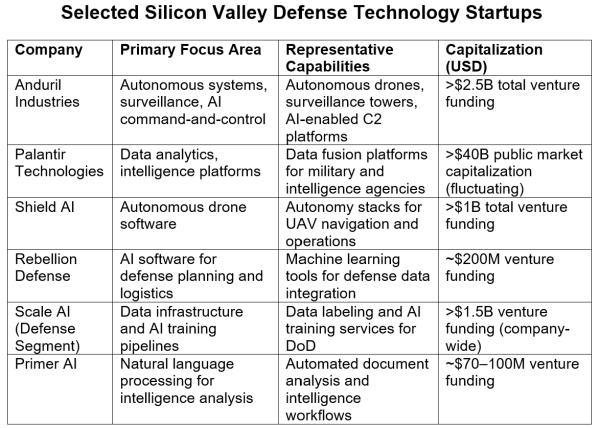
Silicon Valley has recently discovered defense as a growth market. Venture-backed firms now promise to “disrupt” military procurement, accelerate weapons development, and modernize a Pentagon widely portrayed as bureaucratic and technologically stagnant. Political leaders, journalists, and defense reform advocates have embraced this narrative with remarkable enthusiasm. Yet the underlying premise is deeply flawed. Defense systems development is not a software engineering problem, and military procurement is not a venture-backed startup challenge. The venture capital model is structurally misaligned with the requirements of strategic defense systems engineering. Worse, Silicon Valley’s simplified narratives exploit weaknesses in technical and institutional capacity within U.S. political leadership, encouraging a belief that complex governance and strategic problems can be solved through technological acceleration alone.
The rise of Silicon Valley defense startups represents a new phase in the evolution of the U.S. military-industrial complex. The traditional Cold War model was state-centered and institutionally disciplined; the post–Cold War period saw consolidation among large defense contractors and procurement capture. Today, a Military–Industrial–Venture Complex (MIVC) is emerging, in which venture capital incentives and startup ideology increasingly shape strategic defense capability development.
Defense procurement is an institutional problem, not a software problem
Modern military systems are not isolated products. They are institutional architectures embedded in doctrine, training, logistics, alliances, and legal frameworks. Procurement challenges arise not merely from technical difficulty, but from the need to integrate systems across services and allies, ensure decades-long sustainment and upgrade pathways, maintain cybersecurity under adversarial conditions, and preserve escalation control and civilian oversight. These constraints are structural and political, not merely engineering bottlenecks.
Weapons systems must interoperate with legacy platforms, coalition partners, and command-and-control infrastructures that evolve over decades. Logistics and sustainment often dominate lifecycle costs, requiring industrial base stability, skilled labor pipelines, and global supply chains resilient to adversarial disruption. Cybersecurity and electronic warfare introduce continuous adversarial adaptation, meaning that no system can be considered secure in a static sense. Finally, weapons systems operate within legal and political frameworks that constrain their use and impose accountability requirements, particularly in democratic societies.
Treating defense procurement as primarily a software and device deployment problem collapses governance into product design. This category error obscures the institutional architecture that makes modern military power possible and creates the illusion that technological acceleration can substitute for institutional reform. It cannot.
The venture capital model versus defense system requirements
The venture capital model prioritizes rapid iteration, valuation growth, narrative dominance, and exit within a decade. Startups are encouraged to deploy minimum viable products, gather user feedback, and iterate in production. Failure is tolerated and even celebrated at the portfolio level; most startups fail, and the few that succeed generate returns for investors. This model is optimized for consumer markets and internet platforms, not for lethal systems operating under adversarial and escalatory conditions.
Defense systems operate under fundamentally different constraints. Reliability under contested conditions is essential. Doctrinal integration, training, and interoperability must be established before deployment. Lifecycle governance spans decades, with upgrades, maintenance, and sustainment embedded into long-term planning. Failure can result in loss of life, unintended escalation, or strategic catastrophe. There is no portfolio diversification for a failed missile defense system, a compromised command network, or an autonomous platform malfunctioning with disastrous consequences. Thus, the venture capital model—move fast, test in production, iterate—cannot be safely imported into defense systems without undermining strategic stability. The structural misalignment between venture incentives and defense requirements is not incidental; it is fundamental.
The technological magic wand narrative
Silicon Valley defense startups present a seductive simplification: bureaucracy is the primary obstacle, and rapid technology development can remove institutional friction. Artificial intelligence, autonomy, and information warfare are framed as substitutes for planning, doctrine, and governance. Procurement reform is achieved through development acceleration, and acceleration is equated with modernization. This narrative is simple, optimistic, and politically convenient.
U.S. political leadership often lacks basic systems engineering, procurement, and deterrence literacy. Members of Congress, senior executive officials, and political appointees are rarely trained in large-scale systems integration or strategic stability theory. This knowledge deficit creates a vulnerability. Venture-backed founders and investors fill the vacuum with simplified narratives that reframe institutional and strategic challenges as engineering problems solvable through venture-backed innovation.
This is a destructive simplification. Governance problems are redefined as product design problems. Strategy is replaced by dashboards and demos. Institutional reform is deferred in favor of technological acceleration. The result is defense policy disorientation: technological promises outpace institutional comprehension and governance capacity.
Anduril as a case study in venture/defense misalignment
Anduril Industries exemplifies the structural misalignment between Silicon Valley venture incentives and defense systems development. Founded by Palmer Luckey after his financial success at the virtual reality startup Oculus, Anduril leverages venture capital funding and Silicon Valley engineering culture to position itself as a disruptive defense contractor. The firm’s rhetoric frames defense modernization as a startup acceleration problem: legacy contractors are slow, bureaucrats are risk-averse, and venture-backed startups can deliver capabilities faster.
Anduril has pursued contracts and partnerships through entities such as U.S. Special Operations Command, the Defense Innovation Unit, and border security agencies, positioning itself as both a rapid prototyping partner and an operational technology supplier. Yet Anduril’s portfolio—surveillance systems, autonomous platforms, AI-enabled command-and-control software, and logistics tools—maps directly onto the military kill chain. These are not consumer applications or productivity tools. They are components of military decision and execution architectures with serious implications for escalation control, civilian oversight, and international stability.
The modular privatization of the kill chain fragments accountability and governance. Surveillance, targeting, command, and logistics become proprietary platforms controlled by private firms with venture incentives. Civilian oversight mechanisms were designed for state-owned or prime-contractor systems operating under established procurement and audit regimes, not for rapidly iterating startup platforms whose codebases, training data, and operational assumptions are proprietary. The structural implications for escalation control and democratic accountability are profound.
Palmer Luckey, Oculus, and technological legitimacy
Palmer Luckey’s credibility as a defense entrepreneur rests on his role in Oculus, the virtual reality startup he founded and sold to Facebook in 2014 for approximately $2 billion in cash and stock. The acquisition was widely portrayed as transformative and established Luckey as a paradigmatic Silicon Valley visionary. For venture investors and the technology press, Oculus was a canonical success: a young founder, rapid scaling, and a high-profile exit to a platform company seeking the next computing paradigm.
The strategic reality was more ambiguous. Facebook’s subsequent multibillion-dollar investment in virtual and augmented reality failed to produce a mass-market computing platform. Despite extensive capital expenditures and sustained corporate commitment, VR remained a niche market, and Facebook, later Meta, incurred persistent losses in its Reality Labs division. Oculus did not become the successor to smartphones that its early narrative promised. Its primary success was financial and symbolic rather than platform-defining.
Luckey departed Facebook in 2017 following a political controversy related to his support for a pro-Trump online political group. The episode highlighted cultural and political fissures between Silicon Valley’s dominant corporate institutions and a cohort of founders who increasingly framed technology in civilizational and geopolitical terms. After his exit, Facebook’s strategic narrative around immersive computing evolved, and its later “metaverse” initiative failed to generate the anticipated commercial traction.
The Silicon Valley halo effect
Oculus thus functioned less as a durable technological platform and more as a venture-capital halo generator. Luckey converted that halo into strategic legitimacy, founding Anduril with elite venture backing and rapidly gaining access to Pentagon procurement channels and defense policy discourse. In Silicon Valley’s mythology, a successful exit serves as proof of visionary competence across domains, including those far removed from consumer electronics. The Oculus episode illustrates how venture narratives manufacture strategic authority, even when the underlying technology fails to achieve its promised systemic transformation.
Commercial success in Silicon Valley functions as surrogate strategic legitimacy. Venture backing, unicorn valuations, and media narratives become epistemic credentials for participation in national security discourse. Consumer technology achievements are conflated with strategic competence, and founders are treated as polymath strategic authorities. This success halo increasingly displaces institutional military expertise and strategic planning practices that developed over decades.
Venture incentives and escalation risk
Defense startups increasingly provide AI-enabled dashboards, data fusion platforms, and autonomous systems that mediate military decision-making. These proprietary systems shape perception, compress decision cycles, and amplify action bias. In strategic contexts, friction and deliberation are often stabilizing. Rapid, algorithmically mediated decision pipelines increase the risk of miscalculation and inadvertent escalation, particularly under adversarial conditions where data integrity and system reliability cannot be assumed.
The Pentagon’s growing dependence on venture-funded systems introduces risks because the incentives of venture-capital-funded startups are not aligned with strategic stability. Software architectures and data models embed assumptions, priorities, and blind spots. When these systems mediate strategic perception, private design choices become public strategic reality. This is not merely a procurement issue; it is a structural governance vulnerability.
Domestic militarization and the collapse of governance boundaries
Anduril’s deployment of surveillance and autonomy technologies at U.S. borders illustrates the spillover of military technologies into domestic governance. The distinction between foreign and domestic security erodes as battlefield technologies migrate into civilian contexts. This mirrors the erosion of Title 10 and Title 50 boundaries in U.S. military and intelligence operations, contributing to a broader condition of war without boundaries, geographically, institutionally, and legally.
Military technologies deployed domestically raise constitutional, civil liberties, and democratic accountability concerns. Venture-backed firms supplying these technologies operate under commercial governance structures, not public law constraints. The privatization of surveillance and enforcement infrastructures represents a structural shift in state power, mediated by venture capital.
The Military–Industrial–Venture Complex
The Cold War military-industrial complex was state-centered, bureaucratic, and politically constrained. The post–Cold War era saw consolidation among prime contractors and procurement capture. Today, a Military–Industrial–Venture Complex is emerging: venture-funded, ideologically driven, and self-promoting. Strategic authority is migrating from public institutions to private capital, with market valuation and founder prestige substituting for democratic oversight and institutional vetting.
Venture capital increasingly functions as a shadow defense planning apparatus, shaping capability development according to financial narratives rather than strategic doctrine. Founders and investors increasingly articulate civilizational and geopolitical narratives that justify rapid militarization and technological acceleration. This ideological fusion of techno-utopianism and militarism represents a new elite consensus, largely insulated from democratic deliberation.
Conclusion
Defense innovation is necessary, but venture capital startups are not a substitute for strategic institutions and governance frameworks. Silicon Valley’s technological magic wand narrative encourages political leaders to believe that engineering can replace governance, doctrine, and institutional reform. Speed without governance accelerates instability. The militarization of Silicon Valley may therefore increase geopolitical risk rather than enhance security. The United States faces not a shortage of technology, but a shortage of institutional capacity and epistemic humility to govern it.
The challenge is not to slow technological innovation, but to rebuild institutional architectures capable of governing it. Without such architectures, the Military–Industrial–Venture Complex risks becoming a destabilizing force in international politics, accelerating escalation dynamics while hollowing out democratic accountability. In that sense, Silicon Valley’s entry into defense is not merely an economic development; it is an institutional and strategic transformation with potentially profound consequences.
