

Conor here: I guess the oysters aren’t going to save us.
By Mykal Bailey, a senior at Howard University with reporting interests in environmental justice and agricultural science. Originally published at Undark.
Kevin McClarren, the general manager of Choptank Oyster Company, has been raising and selling oysters out of Dorchester County, Maryland, since 1999. Distinguished by its Choptank Sweet oysters, the company, McClarren says, is one of the oldest and largest of the more than 470 commercial shellfish operations working in state waters.
In Maryland, where the oyster population exceeds 12 billion, the filter-feeding bivalves are known for their briny taste and distinct texture. But environmentalists have come to appreciate them for a different quality: their ability to remove nitrogen and phosphorous — nutrients that, in excess, can fuel harmful algae blooms, threaten aquatic ecosystems, and render waterways unsafe for swimming. A single adult oyster can filter up to 50 gallons of water per day. For every million oysters growing in the watershed, it’s estimated that as much as 1,470 pounds of nitrogen and 154 pounds of phosphorous are sequestered from the region’s waterways each year.
Years ago, the state of Maryland adopted a plan to capitalize on those environmental benefits. Under the Water Quality Trading Program, established in 2018, farms, sewage and wastewater treatment plants, and stormwater treatment facilities could earn credits by implementing certain management practices that reduced nitrogen, phosphorous, or sediment loads within the Chesapeake Bay watershed. They could then sell those credits on a state-run market to companies or municipalities looking to offset their own nutrient emissions to meet permit requirements or sustainability goals. For the oyster fisheries that later began participating in the program, this meant allowing them to claim and sell credits for the nitrogen and phosphorous they extracted from the watershed with each harvest.
The idea was to create opportunities for farmers like McClarren “through market-based approaches” to take advantage of their environmental assets, in order to “unleash the full strength of markets,” said Greg Allen, a former environmental scientist at the U.S. Environmental Protection Agency’s Chesapeake Bay Program Office.
But McClarren has yet to earn or sell a single nutrient credit on the state market. And he is not alone.
According to a registry maintained by Maryland’s Department of the Environment, there have been just three trades involving oyster aquaculture over the program’s lifetime, and none since June 2020. Oyster farmers have been slow to participate, and would-be buyers of nutrient credits even slower. The vast majority of nitrogen and phosphorous credits generated through oyster farming have languished on the market unpurchased.
Although Allen continues to see the nutrient credit market as a valuable incentive for the private sector to commit to environmental conservation, others like Kurt Stephenson, a professor of agricultural and applied economics at Virginia Tech, say the performance is emblematic of many of the challenges facing similar programs nationwide.
Nutrient credit trading has become “a bit of a parlor game among certain people,” said Stephenson. “If you’re thinking about financial returns through a trading program,” he later added, “it’s just not a lot there — and I don’t think it will be.”
***
The Chesapeake Bay watershed — a region that encompasses nearly all of Maryland, large swaths of Pennsylvania and Virginia, and portions of Delaware and New York state — has long been plagued by high nitrogen and phosphorous levels from sources including agricultural operations, stormwater runoff, and wastewater facilities. Those nutrients ultimately empty into the Chesapeake Bay, the nation’s largest estuary, where they can fuel algae blooms that deplete oxygen, block subsurface sunlight, and create dead zones that threaten aquatic life. Officials often have to close parks to recreational swimming due to algae that can be harmful to humans.
To address these kinds of problems, the EPA established what’s known as the Chesapeake Bay Total Maximum Daily Load. Adopted in 2010, it called for Chesapeake states to reduce the watershed’s nitrogen and phosphorous loads by 25 percent and 24 percent, respectively — to 185.9 million pounds and 12.5 million pounds annually — by the year 2025. Maryland’s Water Quality Trading Program was one of several initiatives that were launched to help achieve those reductions.
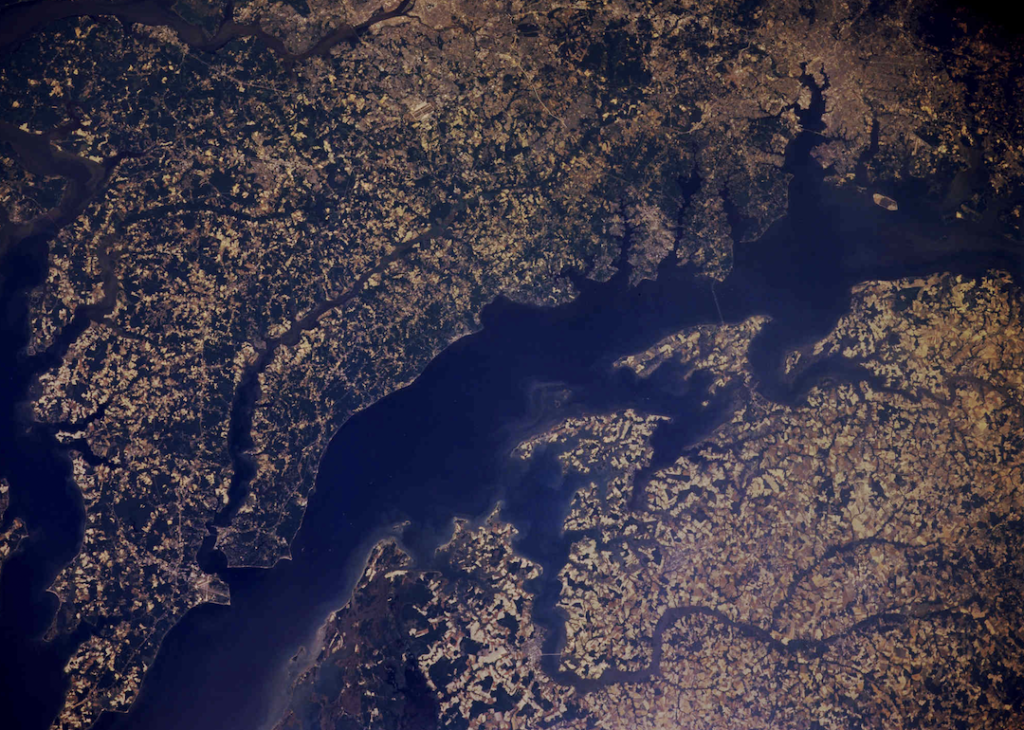
A 1991 satellite image of the middle portion of the Chesapeake Bay. The watershed encompasses nearly all of Maryland, large swaths of Pennsylvania and Virginia, and portions of Delaware and New York state. It has long been plagued by high nitrogen and phosphorous levels from sources including agricultural operations, stormwater runoff, and wastewater facilities. Visual: NASA/Flickr
The concept behind the Maryland program isn’t new: Similar trading systems have worked in the past, said Allen. He cited as an example the Acid Rain Program, a cap and trade system the agency established under the Clean Air Act in 1995 to reduce emissions of sulfur dioxide and nitrogen oxides. “It exceeded all of our expectations and basically fixed the problem,” said Allen. “And it fixed the problem without a whole lot of public agency funds being used to fix it.”
But Maryland’s Water Quality Trading Program has struggled to take off. According to the state registry, the three trades involving oyster-generated credits — all made during 2020, the first year oyster credits were certified — amount to a small reduction of 111 pounds of nitrogen and 12 pounds of phosphorous.
Even considering credits generated by means other than oysters, the environmental impacts of Maryland’s program appear slim compared to the EPA’s initial goal for the watershed. The sum total of trades logged in the state registry for phosphorus and nitrogen — 84, including oyster-generated credits and those generated via farming, stormwater treatment, and wastewater treatment practices — amounts to the removal of about 107,000 pounds of nitrogen and 19,000 pounds of phosphorous over the past seven years.
“It’s like an engine that you’re trying to start,” Allen said. “And maybe it’ll start for a minute and it’ll” — he imitates a sputtering engine — “and then it dies.”
Allen attributed the disappointing performance to a shortfall of demand to buy credits. Indeed, roughly 90 percent of the nutrient reduction credits certified through the program have languished on the market without a buyer, according to the state registry.
A view down the pier at Choptank Oyster Company, located on the Choptank River in Dorchester County, Maryland. Visual: Kevin McClarren
For Choptank Oyster Company’s McClarren, however, one key problem is that the state hasn’t effectively communicated the details of the program to the oyster farmers who are critical to the market’s success. He sees water quality trading as a potential buoy in an increasingly competitive oyster farming industry — and a lifeline for his local waterways. “My kids swim in the river. I fish in the river. We crab in the river,” said McClarren.
“If you spend time on the Choptank River,” he added, “you want it to be a better river.”
But McClarren, whose company has yet to participate in the state market, says the steps required to claim and sell credits remain a mystery to him. “You spoke more to me about it than any other organization,” McClarren said. “So we are kind of in the dark.”
***
In 2020, Eric Wisner, who owns and operates an oyster business on Maryland’s Eastern Shore, became one of the first oyster farmers to successfully claim nitrogen and phosphorus credits for an oyster harvest. Wisner recalled that, to certify his credits, he submitted monthly harvest reports that had to be corroborated with the Maryland Department of Natural Resources. He wasn’t expecting to receive a windfall from the program, he said. “I was just happy to try to be one of the first participants on getting the ball rolling, to make it get out there, and make people aware of it.”
But Wisner is unsure what ultimately became of his credits. The state’s ledger shows that Wisner’s credits — certified in February 2020, and amounting to 170 pounds of nitrogen and 28 pounds of phosphorus — went unpurchased. According to an email from Jay Apperson, deputy director of the Office of Communications at the Maryland Department of the Environment, “all nutrient credits used for permit requirements must be generated in the same year the permitted entities need them.” Credits don’t expire “and in some rare cases can be used for a permittee to address violations from prior years,” he noted.
Environmental economists have explored and debated the merits of water quality trading programs since the programs started to be explored in the 1980s. A 2009 fact sheet circulated by the World Resources Institute asserted that nutrient trading programs “could make it possible to achieve Bay restoration goals faster and at lower cost.” Meanwhile, groups such as the Center for Progressive Reform, a nonprofit research and advocacy organization, warned that water pollution trading was untested on a large scale, and that a poorly designed market “could actually facilitate an increase in pollution with each pollution credit traded.”
For Virginia Tech’s Stephenson, it’s little surprise that Maryland’s nutrient credit trading market, and similar programs around the country, are stalling. In an email, he wrote that water quality trading programs, in the way they are typically implemented, “have yet to make a significant contribution to addressing the nonpoint source challenge.” Unlike pollutants that flow from a single, traceable origin (e.g., wastewater treatment plants), a large share of nutrient runoff originates from sources that are difficult to track, making it a significant problem.
“Market-like incentives can be created by other means than just nutrient trading,” Stephenson explained in an email. “For example, public sector agencies [c]an implement ‘pay-for-performance’ or ‘pay-for-outcomes’ programs where the agencies buy nutrient reductions based on selecting providers who can do it at the lowest possible cost.” He noted that such programs would be akin to a nutrient credit trading market that had only one buyer: the government.
“I strongly believe that market-like incentives have an important role to play in environmental policy,” Stephenson wrote. “My concerns with ‘nutrient trading’ have been focused on the way some programs have been implemented and some more [ambitious] claims of what can be accomplished.”
***
Today, nutrient levels in the Chesapeake watershed remain stubbornly high. Annual nitrogen and phosphorous loads have more than doubled EPA targets in some recent years, according to data from Chesapeake Progress, a website that helps track progress toward the goals and outcomes of the Chesapeake Bay Watershed Agreement. Maryland can, however, claim at least one win: According to an EPA evaluation, in 2023, the state failed to meet target reductions for nitrogen but did meet the target for phosphorus loads.
It remains unclear just how cost-effective the water quality trading program has been compared with other policies the state implemented. Gregorio Sandi, chief of the Maryland Department of the Environment’s Watershed Restoration Division, told Undark that while he couldn’t recall precisely how much funding had been allocated to the program over its lifetime, he estimates that personnel costs in the initial years of the Water Quality Trading Program were between $90,000 and $100,000 annually. In the years since 2020, he said, those costs are about half.
Sandi said that, given the circumstances, he feels the water quality trading program has met expectations. The program’s planners envisioned that wastewater facilities would be some of the larger buyers of credits, he said, but by the time the program launched, many of those facilities had upgraded their nutrient reduction technologies and no longer needed the offsets. Other factors — geographic limitations on who can buy credits from whom, the department’s own reluctance to directly connect sellers with potential clients, the disruption of the Covid pandemic — added to the difficulty of getting the program to take off, Sandi said.
As Sandi explained it, when buyers didn’t materialize, farmers felt spurned, their excitement gave way to frustration and disinterest, and the program lost some of its credibility. He said he and his team are hesitant to make another attempt at invigorating the market, lest farmers end up in a situation that is “more of the same.”
“We haven’t heard from anybody” since the pandemic, Sandi told Undark. “Nor have we gone out to the organizations that we contacted in the past to promote the program.”
In an emailed statement to Undark, Sandi wrote that “Maryland is a leader in improving water quality and oyster restoration because we are willing to try innovative solutions. We’re taking a broad, all-hands-on-deck approach — from wastewater upgrades to tree planting to stormwater improvements. The trading program is just one tool in the toolbox.”
When Allen spoke with Undark toward the end of 2024, he said he believed in the potential of the program, though he admitted “something big” would have to occur to create a sufficient demand for credits. He told Undark he planned to meet with a science and technical advisory committee to workshop ideas to rev up the idling market.
“Even if we only come out of it with a refreshed list and just a few of those things, few of the roadblocks and knowledge gaps that we can go after and fill in, well, that’s just taking a few more steps in that direction.”
“We just need to refresh our understanding, so that’s what we’re doing next, at least in the group I work with,” Allen added.
Allen has since retired from the EPA, and the agency’s plans for next steps are unclear.
The workshop took place last summer, after Allen left. In an email, a press contact for the EPA noted that a report based on the workshop is underway and stated that until it’s released, the agency “cannot comment on the implementation of any potential recommendations.”
