

In This Article
While real estate is often described as the best way to build wealth, it can also be one of the fastest ways to lose it. Making a good investment often comes down to location. Choose well and ride the equity wave to financial freedom. A poor choice, conversely, can leave you in a money pit.
Today’s investment decisions involve more than employment, crime, and future development. Insurance shocks, climate risk, and utility costs can erode net income and the potential for appreciation. Aggregating county-level data from researchers such as ATTOM and the First Street Foundation highlights counties where seemingly attractive investments may conceal significant risks.
According to ATTOM‘s analysis of 594 U.S. counties, particularly vulnerable counties are diverging from the usual boom and bust suspects. The analysis took into account four risk factors:
- Foreclosure activity
- Unemployment rates
- Home affordability
- Share of underwater properties (mortgage balances at least 25% above market)
California Has Some Perilous Counties
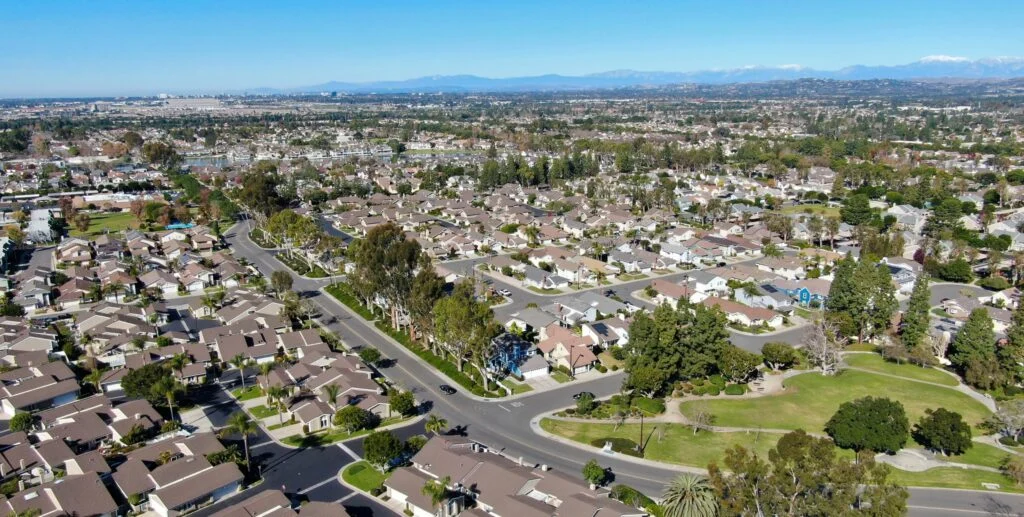
The riskiest market with a population over 1 million is Riverside County, California, with 2.4 million residents. It ranks 29th out of all the markets analyzed nationally. Here, buyers spend nearly 66% of their average local wage on homebuying costs. With a Q4 median home price of about $600,000, it’s almost twice the national median. Foreclosure filings were filed on one out of 811 properties, twice the national rate.
Nationally, a typical homeowner spends just under one-third of their yearly income on homebuying costs, and 1 out of every 1,274 homes is in the foreclosure process as of the fourth quarter of 2025. Around 65.7% of the 364 counties analyzed by ATTOM in its January 2026 Affordability report required more than one-third of a buyer’s salary to buy a home.
The takeaway here for investors is clear: If you can’t afford to invest in an expensive market with ease, don’t bother. Taking on debt and high leverage, despite appreciating home prices and prestige homes, will land you in a world of trouble. It’s just not worth it.
San Bernardino (fourth riskiest large county, 49th overall) is also unstable, with one in every 777 properties receiving foreclosure filings and buyers spending over 54% of their wages on home costs.
Other California counties in jeopardy include Fresno and Contra Costa, which have high unemployment rates.
“Affordable” Cities Come Stacked With Risk
Compared to West Coast counties, Philadelphia County is relatively affordable, but a shocking 8% of owners there are underwater on their mortgages, with a foreclosure rate triple the national average.
Philly is known as being an investor-heavy city. As of 2023, large corporate investors owned 8.8% of single-family rentals, and in specific distressed neighborhoods, investor-purchased homes accounted for 20% of sales, according to the Philadelphia Federal Reserve Bank. The heavy investor presence has squeezed out owner-occupants. The homeownership rate fell from 57.5% to 52.4% between 2005 and 2023.
It’s a classic red flag for investors. Would-be landlords from nearby New York and New Jersey flooded the city, lured by the prospect of cheap housing and decent rents, giving scant regard to employment or the large number of investor-owned properties, which destabilized the neighborhood’s character. When the labor-intensive travails of managing these properties—chasing up rents, evicting tenants, performing repairs—became too much and their cash flow projections went up in smoke, they let the properties fall into foreclosure, killing their own credit and further undermining the neighborhood.
Louisiana Leads Southern Poor Performers
Seven of the 10 counties with the highest underwater rates were in Louisiana, according to ATTOM’s Q2 2025 data, led by Rapides Parish, where 17.3% of the homes were owned far more than the property was worth. Other Southern bad performers were Dorchester County, South Carolina; Charlotte County, Florida; and Kaufman County, Texas.
Florida Is Filled With Investment Landmines
Florida is sliding into “no-go” terrain for entirely different reasons: 16 of the 50 U.S. counties most at risk of falling home prices are located there, more than in any other state. Its riskiest markets are Charlotte County on the Gulf Coast and St. Lucie County.
Realtor.com senior economist Joel Berner, commenting on the findings, said, “Many Florida homeowners unknowingly bought at the peak of the market following the intense run-up in prices of 2021 and 2022 and are now in danger of seeing their home value decrease as the market continues to soften.”
ATTOM’s 2026 foreclosure report ranks the state among the top five for foreclosure rates (No. 1 is Indiana), with over 4,500 properties in foreclosure as of February, indicating significant market stress for investors. Unlike many other regions, much of Florida’s risk comes from increased insurance costs and climate events, both of which can drive up expenses and diminish investment returns or home values.
You might also like
First Street Foundations’ 12th annual “Property Prices in Peril” report predicts that Florida and Texas will experience the largest property value declines in the country, mentioning Broward, Duval, Miami-Dade, Pasco, Hillsborough, Palm Beach, and other pricey enclaves as being particularly susceptible to climate-related price drops, as insurance costs are driven higher.
“The traditional drivers of real estate value—location, economy, and amenities—are being transformed by a new calculus that must account for long-term environmental vulnerability,” the First Street Foundation report stated.
Cash Flow Crunch: Falling Rents
As another key risk metric, investors must consider falling rents. Rising insurance costs and foreclosures, combined with lower employment in many areas, put pressure on rental incomes as landlords struggle to cover expenses. ATTOM’s 2026 Single-Family Rental Market report states that in more than half the tracked counties, rents for three-bedroom homes dropped between 2025 and 2026. When rents stagnate or decline while acquisition costs rise, net yields fall, and investors find it harder to maintain positive cash flow.
Additionally, high-cost coastal counties in Florida, California, Tennessee, and Virginia have seen their rental yields fall to 3% to 4%.
Final Thoughts
Cash flow analysis is less straightforward now. Comparing properties across counties requires weighing foreclosures, taxes, employment, wage growth, and insurance, since similar-looking properties can have very different outcomes.
One overriding theme that has emerged is that investing in the Midwest and Northeast, with nine of the 50 safest counties in Wisconsin and others in states such as Minnesota and Ohio, appears to be a safer proposition.
Add interest rates as another wild card to the proposition, and it’s possible to make an argument for investing in an area where cash flow is less on paper, based on cost and rental income, but other factors, such as foreclosure rates, employment, and climate, make for a more stable environment. If the purchase is facilitated in an all-cash scenario with an eye toward refinancing when rates drop, the long-term outlook could be better despite the lower short-term cash-on-cash return.
