

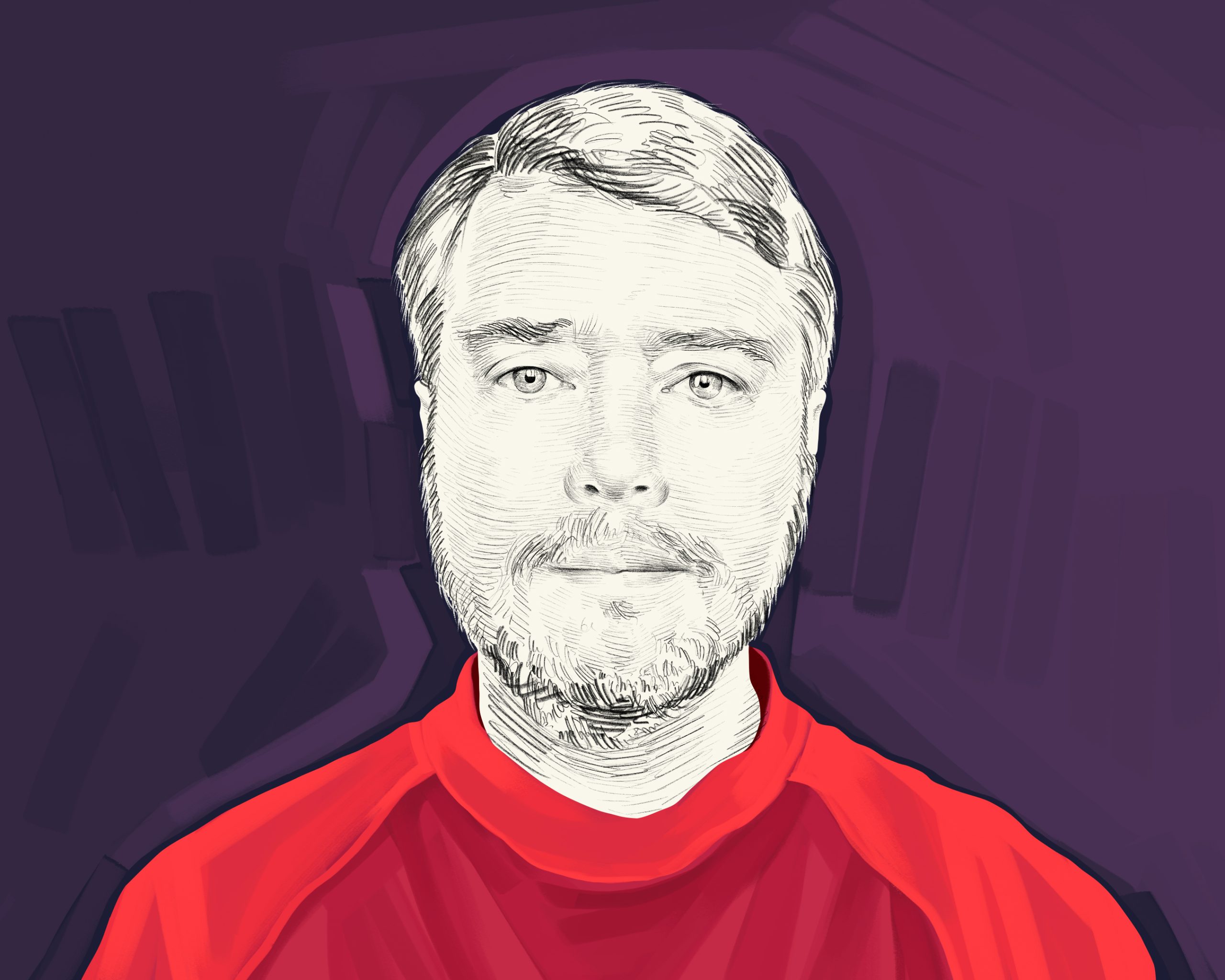
Please enjoy this transcript of my interview with Dr. Michael Levin (@drmichaellevin ), the Vannevar Bush Distinguished Professor of Biology at Tufts University and director of the Allen Discovery Center. Dr. Levin is primarily interested in how intelligence self-organizes in a diverse range of natural, engineered, and hybrid embodiments. His lab has developed new applications in birth defects, organ regeneration, and cancer suppression and produced synthetic life-forms that serve as exploration platforms for understanding the source of patterns of form and behavior in a wide range of natural, artificial, and hybrid embodied minds.
Full bio
Products, resources, and people mentioned in the interview
Legal conditions/copyright information
The Tim Ferriss Show Transcripts: Dr. Michael Levin — Reprogramming Bioelectricity, Updating “Software” for Anti-Aging, Treating Cancer Without Drugs, Cognition of Cells, and Much More (#849)
Additional podcast platforms
Listen to this episode on Apple Podcasts, Spotify, Overcast, Podcast Addict, Pocket Casts, Castbox, YouTube Music, Amazon Music, Audible, or on your favorite podcast platform.
Transcripts may contain a few typos. With many episodes lasting 2+ hours, it can be difficult to catch minor errors. Enjoy!
Tim Ferriss: Mike, very nice to finally connect.
Michael Levin: Yeah, wonderful.
Tim Ferriss: Thanks for making the time.
Michael Levin: Of course. Yeah, thanks for having me. Yeah.
Tim Ferriss: We have lots of ground to explore, and I thought we would begin with a book that had a spot on my bookshelf when I was a kid. It seems like you and I may have found it at the same time, but you did a lot more with it than I did. The author is Robert O. Becker. Is that enough of a cue to tee it off?
Michael Levin: Yeah, I think it is, I think it is.
Tim Ferriss: All right. What is the book, and why is it relevant?
Michael Levin: I’m going to guess it’s The Body Electric.
Tim Ferriss: That’s right.
Michael Levin: Yeah, yeah, yeah, yeah, it’s very relevant. I discovered it in an old bookstore that my dad and I visited when I was in Vancouver, Canada, for the World’s Fair in ’86. And I found this thing, and it’s a patchwork of a number of different things. He was into applied field of dangers and things like that. But I was just stunned with all the references to prior work that revealed to me that the kinds of things I’d been thinking about were actually real and that people had investigated it.
Tim Ferriss: And that book, I guess Dr. Becker was an orthopedic surgeon, and he was effectively penning a scientific memoir, describing experiments involving salamanders and other animals, exploring the role of electricity and many, many different aspects of biology. How would you define, for folks, bioelectricity? What is a helpful way to define that term? And then we’ll probably hop to the video in a sense that introduced me to your work, which I will not be alone in citing, but let’s begin with the definition. Bioelectricity. What is that?
Michael Levin: Well, bioelectricity, in general, is the way that living systems exploit physics, in particular, the physics of electricity, to do the amazing things that living systems do. And there are, roughly speaking, two kinds of bioelectricity. There’s the familiar kind, which is studied by neuroscience. And so this is the electrical activity of the cells in your brain. And I think everyone has a rough understanding of the fact that the reason you know things that your individual neurons don’t know and that you have beliefs and the preferences and so on that are more than just any of the neurons in your head is through this amazing cognitive glue that electricity provides. It binds your neurons into a collective intelligence that underlies our mind. And so that’s the bioelectricity that everybody’s familiar with.
And then there’s the other kind, also called developmental bioelectricity, which you can get to by asking about, but where did the brain come from, and where did it learn those amazing tricks? And very quickly, you realize that, wow, some of these things have been around for a very long time, long before we had brains and neurons. And that the question of what does your body think about, and before it has a brain, how does it use electricity is the study of developmental bioelectricity.
Tim Ferriss: The video that I was referencing, you will not be surprised to hear, was an older TED Talk and then subsequent interview on stage, and that was sent to me by Adam Goldstein, who’s now at Softmax. And that was probably several years ago, I would say at this point that it was sent to me. Could you perhaps — and I know a lot has happened since, but could you describe some of the experiments that you covered at TED to give people an idea of how this becomes tangible, this conversation of bioelectricity becomes tangible?
Michael Levin: When we look at biology, we see lots of amazing things. For example, in a salamander, if they lose a limb, they regenerate the limb, and they stop when it’s complete. And in fact, there are many other interesting, these kinds of things that when anybody looks at it, the first thing they ask is, “How does it know to do that?”
And one of the things I discussed in that video was if you scramble the craniofacial organs of a tadpole, they still make a pretty normal frog. They sort themselves out, they move in new paths until they get to a normal frog face, and then they stop. And so anybody sees that, and immediately the question is, “Okay, but how do they know what a proper frog face looks like? And if you do know, then how do you know how to get from here to there? How do you navigate?”
So the way we’re all taught in biology is that that’s a bad question. We are told none of these things know anything. They are mechanical machines that roll forward according to rules of chemistry. And in the end, some cool stuff happens, and we’ll call it emergence and things like that, and complexity science will catalog them, but don’t worry, none of these things actually know anything, that’s just what they do.
And so what I was trying to describe in that talk is this idea that, well, actually, the idea that chemical processes can in fact know things, it’s not magic, it’s not mysterianism. We are chemical processes that know things, and we’ve had, for many decades, mature science of — including cybernetics and control theory and things like that — a mature science of figuring out how it is that machines of all different kinds can know things and they can have goals and so on.
So what I tried to show in that talk are some examples by which the living tissues, for example, flatworms that are cut into pieces and every piece has to figure out “How many heads should I have? Where do the heads go? What should the shape of my face be?” These kinds of things, that in fact they do know, and the way they know is because they store memories, and maybe not shockingly, although it’s certainly shocking to a lot of folks, the way those memories are stored is in an electrical network that is very similar to the way that we store our goal-directed behavioral repertoires in our brain and that these things are widely spread. And so regeneration, cancer suppression, and cancer repair and remodeling, birth defects and birth defect repair, all of these things are extensively using electrical pattern memories, and we now have a way to rewrite those pattern memories.
Tim Ferriss: I’ve been so excited to have you on the show because I am an intrepid muggle, blindly, half blindly exploring science to the extent that I can. And every once in a while, I’ll share a resource like I did recently, this multi-part series called The Gene. This is a Ken Burns-produced documentary about genetics, the history of genetics, starting with Mendel and so on, working all the way up to modern biotech. But the underlying framework for that entire series is DNA as master copy, let’s call it, then RNA, then protein. And that’s kind of how it works, right? You have this blueprint that is executed upon, and that produces what we see in the world on some level.
But as I understand it, you, by manipulating bioelectricity, have produced, for instance, animals that have two heads that that trait persists over generations, and maybe I’m getting the specifics wrong, but that is not by virtue of manipulating DNA. And I’m just wondering if I’m, first of all, getting that right, but secondly, what that says about how we might be revising our understanding of biology and what the textbooks might look like five or 10 years from now or further out.
Michael Levin: Yeah, you’re not wrong. I could list any number of scenarios that we and others have studied in which the genetics not only don’t tell the whole story, but in fact, tell a fairly misleading story. And the way that I would describe it, and there are two pieces to this, and I’ll do the simpler piece first, and then we can talk about the other piece. The simpler piece is really we can get there by thinking about the distinction between software and hardware.
And by the way, I should preface this because some people get really upset about this. I am not saying that the current way that we think about software and hardware is sufficient to get everything we need from biology. It does not cover all of biology; it covers one important piece of biology. Reprogrammability is really critical. And so if you wanted to make that same movie about computers, for example, you could make a movie that basically goes electric fields, silicon and germanium, and transistors, and the flow of energy through circuits, done, right? That could be your movie.
And it’s not an unimportant part of the story; it’s a very important part of the story, but the critical part that that doesn’t get to is that’s the hardware. And in fact, that’s what the genome does. So the genome tells every cell what the hardware is going to be. So the genome gives every cell the little, tiny protein-level hardware that it gets to have. But now comes the other interesting part, which is the reprogrammability. And we’ve known for a very long time now that if your hardware is good enough, and the biological hardware is more than good enough, then that hardware is reprogrammable.
So what happens, just as an example, what happens in these flatworms, these two-headed flatworms that you were referring to, the standard — the flatworm has a bioelectric memory in it that says — and we can see it. I’m saying these things because we can now see these memories and we can rewrite them at will. So this is now actionable in the lab. It has a bioelectric memory that says one head.
That memory is not genetically encoded. What is genetically encoded is a bunch of hardware that when you first turn on the juice, it basically acquires that memory as a default. When you buy a calculator from the store and you turn on the power, they all say zero. Reliably, 100 percent of the time, they all say zero. Great. But that zero is not the only thing that that circuit can do. As you find out very quickly, they can store memory and do all these things. The genetic hardware of the worm is very good at making sure that every worm starts out with a very specific — it’s a little bit, I think, related to instinct and how certain birds are born knowing how to make nests and things like that. The hardware has defaults, and by default, one head, but the hardware is reprogrammable.
So what we were able to do is go in and identify the memory that actually says how many heads, and we can change it. And when you change it, you don’t need to change the hardware, you don’t need to change the genetics any more than when we form new memories, you don’t need to change the genes in your brain to form new memories. I always say to people, “On your laptop, if you want to go from Photoshop to Microsoft Word, you don’t get out your soldering iron and start rewiring. It’d be laughable if you had to, but that’s how we used to do it. In the ’40s and ’50s, you programmed a computer by pulling and plugging wires, but you don’t do that anymore because it’s reprogrammable. And that’s what the biology is.” And so that’s the first thing.
And the second thing, just very quickly, and we can get into it if you want, is that the cellular intelligence that exists not only is reprogrammable, but it is actually creative in the sense that it interprets the DNA. And we can talk about this. It doesn’t blindly do what the DNA says, and this is a deep thing because it’s the way our cognition works too, it interprets memories in a way that is improvisational. It does not simply follow what they say, counter to what we all learn.
Tim Ferriss: All right. So I’m going to come back to how the textbooks might be revised question in a minute. But before we get there, you said we can see memories. So this is empirically demonstrable in the lab. What does it mean to see those memories? What does that actually mean and look like? And then secondly, with the flatworms with the two heads, why does that persist if it does into future generations?
Michael Levin: What we can see directly are the bioelectrical properties of tissues. And we’ve developed tools using voltage-sensitive fluorescent dyes. And so that means you take your embryo or your tissues or whatever you’ve got, and you soak it in this special chemical that glows different degrees or different wavelengths depending on what the local voltage is.
And so back in the olden days in electrophysiology, you had an electrode, then you would have to poke a little needle, and you would poke every cell, and you would get the voltage reading. We don’t need — I mean, of course, we still do that for certain purposes, but what you can now do is get a full map of the whole tissue all at once. And in fact, you can make movies of it and watch it change over time. And we have these amazing videos of embryos changing their electrical activities over time. It’s basically like what neuroscientists do when they do imaging in brains, but we can do it in the rest of the body. So there, what you see are the electrical patterns.
Now from there, you have to do a lot of experiments to prove that what you’re looking at are in fact memories. And there are many different kinds of things we do, but functionally what you have to show is that you can decode the electrical pattern that you’re seeing and show that what it encodes is the future set points towards which the cells will work. In other words, I can take a one-headed worm, I can change the voltage pattern. It’s still a one-headed worm, but it’s internal representation of what a correct worm should look like now says two heads. You don’t see it because it’s a latent memory, but when you cut the thing into pieces, now what the cells do is consult the memory, and they say, “Oh, two heads,” and then they build two heads, and you get your two-headed worm. So you don’t know right away. When you’re first looking at it, you don’t know that that’s a memory. You have to do experiments to prove that that’s what it actually is.
Tim Ferriss: And then the persistence, the durability over generations?
Michael Levin: The process of regeneration and repair in general is a kind of homeostatic process. So it’s like a thermostat. You have a set point. If the temperature gets too low, it tries to go up, if it gets too high, it tries to come down, it tries to keep a certain — that is exactly what happens in the body, which is anatomical homeostasis. So cells come and go all the time. So we’re a ship of feces in many ways. So cells and materials come and go. Sometimes drastic kinds of injuries for animals that regenerate past them. Embryogenesis, I mean, look, half our population can regenerate an entire body from one cell. I mean, that’s amazing. That’s an amazing development. Embryonic development is an incredible example of regeneration, the whole body regenerating from just one egg cell.
And in all of those cases, what needs to happen is just like a thermostat has to remember what’s the right set point, there has to be a memory mechanism that stores it. And so the electric circuits in the body that store these patterns, they have a memory property as well, such that when you change it, it stays.
Now sometimes there are multiple memories. And so we’ve done things like, for example, in these flatworms, there are different species that have different shaped heads: round ones, triangular ones, flat ones. We’ve shown that you can take a worm, change the bioelectrical signaling and get it to grow a head of a different species. But the fun thing about that is it grows the head of a different species. You haven’t touched the genetics, by the way. Again, the genome’s totally wild type.
Tim Ferriss: It’s so wild.
Michael Levin: Right, but right, but it’ll grow the head of a different species, and it’ll stay there for about 30 days. And then it goes back to its origin, it’s not permanent. The two-headed thing is permanent, that never changes. But the head shape, after about 30 days, they go back. And so clearly there are multiple, there’s more than one. There’s some kind of metacognitive thing that says, “Yeah, I know you thought that was your memory, but actually that’s wrong.” So it overwrites some kind of error-correction thing, which, that one, we haven’t cracked yet. So there are layers upon layers.
Tim Ferriss: All right. So for people who are listening and wondering how this translates or might translate to humans, I want to get there, but I’m going to bridge to that simply by saying that this topic of bioelectricity has long been interesting to me. I mean, it’s been interesting to humans for a very long time, going back to slaves in ancient Rome, stepping on electric eels and finding relief from gout, but in a more modern incarnation, I had Dr. Kevin Tracey on the podcast some time ago who was — he’s incredibly well-sited, played a part after his experiences with patients with septic shock, identifying TNF-alpha and a lot of subtleties around that and has developed hardware in this case. I mean, they’re programmable, but for vagus nerve stimulation, predominantly for, at this point, autoimmune disorders like rheumatoid arthritis and so on. But you can see some incredible, incredible clinical effects, and we’re just touching the tip of the iceberg.
So I’m wondering, it took a long time to get here though, even with something that is relatively, I would say, straightforward to identify, which is the vagus nerve, AKA vagus nerves, these intercontinental cables running down either side of the neck with 100,000 fibers on either side. So in this case, we’re talking about flatworms. We could certainly talk about other species that are known for regeneration, but broadly speaking, what might this mean for humans? How might this be applied to humans? Do humans have this programmable layer just as some of these other species do? What might therapeutics or morphoceuticals or otherwise look like?
Michael Levin: Yeah, yeah, yeah, no, and that’s a great connection. Yeah, Kevin’s work is amazing. I was just talking to him a couple of weeks ago.
Tim Ferriss: Oh, nice.
Michael Levin: It’s awesome stuff, yeah.
Tim Ferriss: Great guy, great guy.
Michael Levin: Yeah, he really is. Right. So a couple of things to explain why this is relevant to humans, and then I’ll give you three broad areas of application. The reason it’s absolutely relevant to humans is that we are all basically built on fundamentally the same principles. People have this idea that, well, frogs are a lower creature, but we’re mammals. And once you get past yeast and things like that, we are all roughly the same. As far as this stuff goes, these kind of electrical signals were — evolution discovered them around the time of bacterial biofilms, very long ago. And so this is all very well-conserved.
And for that reason, for example, there are human mutations in ion channels that are birth defects. So if you mutate ion channels in humans, you get birth defect just like we see in frog and chicken, zebrafish, and things like that. So those are all well-conserved.
And with David Kaplan, who’s a collaborator of mine at Tufts, we’ve done a bunch of work on bioelectrics of human mesenchymal stem cells. So this stuff works, for humans as well. It is not some frog or flatworm specific thing. This is very, very broad.
I should say, this is a disclaimer I always have to do, you mentioned morphoceuticals. So there are a couple of spinoff companies that have licensed some of this technology, so I need to say that as a disclosure. So one is specifically called Morphoceuticals. This is a company that is pushing forward our limb regeneration work in bioelectrics. And then there’s also this other company called Astonishing Labs that is doing some of this stuff in aging and so on.
So having said all that, I firmly believe that these things are heading for clinical application in humans, and probably not that far off, I hope. Here are the three applications. So the first application is birth defects. So we have shown that we can repair a number of different birth defects of the brain, the face, the heart, what else, the gut, these kinds of things by restoring correct bioelectrical patterns in vivo. And so this is now in animal models. We are moving, of course, to more clinical kinds of things. And I hope in the future this will absolutely be of human application. So birth defects is one. Regeneration is another.
The name of the game here is communicating with the cells. This is not about stem cells or gene therapy or scaffolds made of nanomaterials. Those are all tools that might be useful, but the real trick here is to communicate to a group of cells, what do you want them to build? And that’s what the bioelectric code is all about; it’s about communicating to the collective, to the cellular collective. And so we’ve done work on limb regeneration, we’ve done work on inducing whole organ formation, eyes and things like this. So I think there are going to be massive applications hopefully clinically in restoring damaged and missing limbs and other structures like that.
And then the third thing is going to be cancer, so something else, and we can get into what the more profound aspect is, but the bottom line is that cancer fundamentally involves an electrical dysregulation among cells. I’ll just say it and we can unpack it later, but it’s basically a dissociative identity disorder on the part of the cells. It’s literally a disorder of the cognitive glue that binds individual cells towards large-scale purpose where large-scale purpose, I mean building organs and tissues and things like that, as opposed to being amoebas and doing amoeba-level things. So cancer is another thing.
And we’ve shown again in these animal models, both that we can detect incipient tumor formation and we can prevent, and normalize tumors after they form by restoring, not by fixing the DNA if there is any DNA issue, which doesn’t have to be, not by killing the cells with chemotherapy, but by electrically reconnecting them to the group such that they can form, again, a memory of what they’re supposed to be doing. So those three things, regeneration, birth defects, and cancer, I think are going to be of great value in humans.
Now there’s also issues of aging. So we also have an aging program in our lab and looking at why it is that over time cells forget how to upkeep a proper organism. And we have some interesting thoughts about that as well.
Tim Ferriss: Well, let’s dive in. I’d love to hear more about the interesting thoughts on aging. And then we’re definitely going to get to cognition, which is — I mean, that can go in a lot of directions, but let’s start with the aging piece. What are some of the implications or experiments or just maybe conceptual frameworks that are due as a revision of what we’ve thought to date?
Michael Levin: First of all, one of the things that we’ve seen is that, and, by the way, this is fairly recent work. So this is in no way is this the final story. This is just what we know now. I’m sure this will be updated. Over time, the electrical pre-patterns that tell the cells and tissues what large-scale structure we’re supposed to look like, they get fuzzy, they degrade over time. And so much like what we do with birth defects is we try to reinforce the correct patterns. And this is one of the ways we’re addressing aging as well, is by reinforcing these patterns.
Now one question you might ask is why over time are these things getting fuzzy, what’s going on? And there are a couple of schools of thought. One is that this is the consequence of accumulated noise and damage, so molecular damage entropy, basically. Over time, you just accumulate damage, and everything gets degraded over time. And then there’s also these kind of — what they call programmatic theories where basically the idea is that you’re programmed to age. For whatever reason, evolution has favored a decline and death.
So we have an interesting third alternative to offer, which is the following. And we did a simulation experiment where we had a virtual body where the cells cooperate together to build an embryo, and so they work really hard to work together. They build to a particular pattern memory, so this thing I’ve been telling you about, they build. And then I said, “Let it run. Just leave it alone, and let it run.”
And so what you see is something very interesting. They work really hard together, and they make the correct body. Then it stays that way as they defend it, and then it falls apart, and it begins to degrade.
Now what’s interesting is that in our simulation, there was no evolution for a limited lifespan, there was no noise, there was no damage; it was perfect, everything was perfect, and still, it degraded. Why would it do that? I had this interesting thought, and I’ll back into it this way: just imagine this standard Judeo-Christian version of Heaven. So you get to Heaven, and you get there, let’s say you, your pet snake, and your dog get to Heaven. So okay, everything is great, there’s no more damage, there’s no decay, nothing is damaged, everything is great, everything’s fantastic. For the next trillion years, what happens?
So the snake may be fine doing snake things for every day is the same as every other day, may be fine. The dog, not sure. Probably okay chasing rabbits on the farm, may be fine for forever, basically. The human though, what do you think? I’d be interested in your thoughts. What are the odds that a human cognitive system can be sane for an infinite — okay, I’ll keep myself busy for the first 10,000 years, maybe 100,000 years, but a billion years in, are we still sane? What happens? What do you think? What do you think would happen?
Tim Ferriss: That’s interesting. Well, if I’m hearing you correctly, I don’t really have a passing through the Pearly Gates timeline prediction for the half life of sanity, but if I’m hearing you correctly, that the biological programmed, I mean, death, I suppose, is basically to — intended to ensure biological death before insanity. Am I mishearing that?
Michael Levin: Well, so maybe. That’s not the claim I was going to make, but it’s not impossible.
Tim Ferriss: Not a claim, but I guess I’m trying to squint and look through the exercise.
Michael Levin: What I took away from that work that we did was the following: you have a goal-seeking system that has met its goal. It’s achieved the goal. It made the body was supposed to make. The error falls to zero, everything is great, hangs out there for a while, but what does a goal-seeking system do when there are no new goals? Because we’re looking at a system that may or may not be able to give itself new goals. I mean, cognitively, I think we can, but it’s not clear yet that this system can do that. And so what we were able to do is we were able to give it new goals by having interventions and going back in and saying, “Okay, now this is your new pattern,” and it will do that.
But I think part of the, you could call it the boredom theory of aging, basically, not cognitively, somatically. If your body cells over a long period of time, they’ve completed their job, they’ve created a body during adulthood, but at some point they start to degrade. The cells don’t degrade; the collective does, the cohesion, the alignment between them because there’s no longer a common goal. I mean, this is what makes for an embryo or a body as opposed to just a billion independent cells, is they’re all aligned towards the same set point, towards the same goal.
And so when that isn’t there, regeneration, repair, maybe remodeling becomes something else. I don’t know how. Maybe you need to change up the body every once in a while. That’s also a possibility. Planaria do it. Planaria are immortal.
Tim Ferriss: And planaria are the flatworms we were talking about earlier?
Michael Levin: Yeah, the flatworms. Yeah, yeah, they’re immortal. Every two weeks, they rip themselves in half and regenerate, so they give themselves a challenge every two weeks. And so they’ve been that way for half a billion years or so. And I think that we can see evidence of this.
For example, if you look at — there’s a way to look at the age of certain genes, the evolutionary age of genes to see when did they show up. The gene expression of a young person, all the cells are in — all the different tissues have the same idea of what evolutionary stage they are, meaning in a human. When you look at old tissue, and this is something we just published recently, when you look at, we call it atavistic dissociation, when you look at the tissues of old age, the genes that they express start to float backwards in evolution. And they’re discordant, they’re out of sync. So your liver versus your neurons, they may all start to get different ideas in terms of the genes they express, of where on the evolutionary tree they are. So again, it starts to float off. In the absence of a compelling set point or goal state, all the subunits start to sort of float off and do their own thing. And this is, I think, an important component of aging.
Tim Ferriss: So if you were put in charge of, for lack of a better term, the Manhattan Project style initiative related to aging, that was your sole directive, was to really do a deep dive with the intention of developing some type of therapeutic for humans, what might that look like? I mean, for all intents and purposes, infinite funding, but you have the resources, you can get the talent. Where would you take it, if you had a similarly pressing deadline? And I’m not asking for the impossible, but if you had a reasonably tight deadline by which you needed to try to come up with something, where would you take it? How would you think about it?
Michael Levin: Tight deadlines for aging are tough, because you’re not going to know for decades whether your thing works.
Tim Ferriss: Yeah, right.
Michael Levin: No, but I get the idea. This is what I would say. I think that fundamentally, I think that aging, cancer, birth defects, lack of regenerative repair throughout our lifespan, all of these kinds of things are downstream of one fundamental pressure point, that if you solve that, all of these things get solved by side effect. And that is regeneration.
More specifically, that in turn is, everything there hangs on the cognition of groups of cells. In other words, how do groups of cells know what to build, when to stop? How do we communicate with them, and what kind of intelligence do they have? And I’m being very specific about this. When I say they have intelligence, I don’t mean complexity. I don’t mean some sort of linguistic project where I’m going to take things that are beautiful and fascinating, and I say, “Well, that’s the intelligence of life.” That’s not what I mean. I’m using a very specific definition of intelligence, which is what behavior scientists use, which is problem solving, memory, different degrees of a cognitive light cone of goal-directed, the size of your goals, things like that.
So specifically, figuring out what are the competencies of the living material that we’re made of and how do you communicate new goals to them? There are lots of amazing people in the aging field doing interesting things and that’s cool. If I had a lot of money specifically for aging, I would put everybody on that question. I would say, you’re not studying aging. What you’re studying is the goal-directedness of multicellular systems. Figure out how they know what to do and how we communicate goals with them. If you solve that, all of these other things get taken care of as a side effect.
Tim Ferriss: What might an example or sample new directive be? To give human cells or groups of cells a new goal, what might that new goal look like?
Michael Levin: I’ll give you an example, and then we can talk about what the human case might look like. What we can do is, we can take a frog embryo and induce a particular electrical pattern somewhere in the body that we already know, that pattern codes for make an eye. That’s how the other cells interpret that pattern. It means make an eye. Very interesting in the sense that we don’t have to say which cells do what. We don’t have to say which genes you need to turn on. These are all micro level details. We don’t need to worry about them, because the material is competent. Just like when I’m talking to you, I don’t need to worry about how your synaptic proteins are going to — you’re going to take care of all of that. All I need to do is give you the prompt, and vice versa, and we’re having this amazing conversation. But our hardware takes care of all the molecular details. And the same thing here.
So, we provide a bioelectrical pattern that says make an eye here, and the cells make an eye. Now, the first thing that happens, it’s interesting. The first thing that happens is, there’s a battle of worldviews that takes place. The cells try to get — we inject a few cells. They tell their neighbors, “Let’s make an eye.” The neighbors actually say, “No, we’re supposed to be skin or gut. Don’t do it.” And sometimes they win and sometimes we win. And so the goal of regenerative medicine is to be as convincing as possible, so that you win 100 percent of the time.
But in the cases where we are convincing, and we have amazing videos of cells like convincing each other to have different voltages and whatnot, they make an eye. And so, what you’ve done is, you’ve taken a bunch of cells that were going to be, for example, gut, and you’ve now pushed them to be an eye. At a very high level, I don’t know how to build an eye. I don’t know all the genes that have to be turned on. You do that. I’m telling you something at the level of organs, this is going to be an eye. The eye is of the right size. It has all the right layers to it. It is functional. So you can see out of these ectopic eyes, it’s really, really amazing.
And so that is an example of giving these cells a new goal. How do I know it’s a goal? Because I did not micromanage you to do it. I was not there saying, “Turn on this gene, turn on that gene.” I gave you a far off set point, by the way, in a wild space that no individual cell knows anything about, the anatomical space of organ structures. No individual cell knows what an eye is, but the collective does. And they stop when it’s done. I don’t need to be there to tell them to stop. They stop when it’s done.
And so, this is autonomous goal-directed activity, and it’s a navigation of anatomical space. And so, we can do this. And we can’t make everything. We can make portions of the brain. We can make eyes. We can make, in some cases, limbs. We can make some other structures.
So, in the human, you could imagine two ways to go, and I don’t know which is going to be correct, and we need to do a lot of experiments in mammals to nail this down. One possibility is that it might be enough to simply reinforce the existing human pattern. Every so often, you would get like a tuneup that reminds all the cellular collectives what we’re supposed to look like. That’s one possibility.
There’s another possibility, and I don’t know which is correct. I hope the first one is right, but I think it wouldn’t be the end of the world if it’s the latter. Maybe it really does get too boring with the same pattern, meaning that, okay, you can go a few hundred years with this reminding of the standard human pattern, but eventually you have to do something unique. Now, the planaria are telling us that actually, it’s hundreds of millions of years that you can make the same thing, so I’m kind of optimistic that you can do that. But let’s say that’s not the case.
If that’s not the case in humans, maybe you have some number of hundreds of years or whatever of the standard human body plan. But then if you want to keep going, you got to make some changes. What does that mean? Maybe you wanted some wings. Maybe you want some tentacles. Maybe you want a third hemisphere to crank your IQ. Maybe you want, I don’t know —
Tim Ferriss: A third eye. Who knows?
Michael Levin: Sure, sure, sure. Infrared vision out the back of your head. I don’t know. People email me all the time asking for all kinds of weird peripherals. So maybe, maybe at some point, it means that you’ve really got to change things up a little bit, caterpillar, butterfly style. Maybe.
Tim Ferriss: Wow. And just to come back to a piece that we covered through the thought exercise of the pet snake, the pet dog. Do you think we have evolved to die, or to age? I mean, if so, why? What might be a straw man argument for that? I’m just curious. Yeah.
Michael Levin: There certainly are reasonable theories of why evolution wants you dead, and there have been a number of them. Overall, I think there may well be trade-offs of the kind that, for example, we’re not going to put a lot of — evolution would not put a lot of effort into maintaining something if something else is going to go off and you’re going to die anyway. So there are these ecological trade-offs.
I’ll give you an example of something like that. People ask, “Hey, why can’t humans regenerate their limbs the way that axolotls can, and things like that?” Nobody knows, but here’s a plausible theory. Imagine, you’re an early mammal, you’re running around the forest, somebody bites your leg off. Now, you have a high blood pressure, you’re going to bleed out. If you don’t bleed out, you’re going to walk around and grind that thing into the forest floor. It’s going to get infected. You’re never going to have time to regenerate. What you might do is scar, seal the wound, inflammation, so that you might live to fight another day, but you’re definitely not going to have time to regenerate the way that an axolotl might, sort of floating around in water for three weeks or whatever.
So basically, what you might say is that evolution just kind of decided that it’s not worth it. It’s never going to work. It’s not worth it. And by the way, deer antlers. Deer antlers are the one amazing mammalian example of regeneration, plus the liver. I mean, liver regenerates. But deer antlers, it’s a large adult mammal that regenerates this huge structure of fast —
Tim Ferriss: The rate of regrowth is just incredible.
Michael Levin: Crazy. Yeah. Centimeter and a half per day of new bone.
Tim Ferriss: So nuts.
Michael Levin: That’s bone, vasculature, innovation. And you don’t put weight on it. It’s not load bearing. It’s the one appendage that’s not load bearing. So anyway, why I’m saying that is because you can imagine evolutionary trade-offs like that, where evolution just didn’t bother optimizing for long age. You can imagine that. But fundamentally, I do not believe that we are inevitably mortal. I think that at some point, if we knew what we were doing, if we had appropriate regenerative medicine, I don’t see any particular reason why we have to age and die.
And then you face interesting questions about, for example, mental plasticity. We all know with advanced age, people get a little less plastic mentally, that kind of stuff. Is that a hardware problem or a software problem? We don’t know. If you had somebody with a physically young brain at 100, would they be like an 18-year-old in terms of their ability to take on new ideas and focus and pay attention, whatever? Would that still stay? Or is there some kind of a cognitive, I don’t know, a tiredness that happens, that is not a hardware issue? I don’t think we know, but we need to find out.
Tim Ferriss: So I was going to ask you about computer science and AI and concepts that you would like biologists to learn. Well, let’s start there. And then I’m going to ask a question that might destroy any shred of respect that you have for me, but I’ll save that for after this one. Do any concepts come to mind, because you certainly have spent a lot of time in computer science, that you wish you could require biologists to become familiar with, or to study? I’m wondering about cross pollination between disciplines within which you’ve spent a lot of time. It could go the other way as well, and this could be concepts from developmental biology or biology writ large that you think computer scientists should pay more attention to. But does anything come to mind for either of those?
Michael Levin: My original background is in computer science. Computer scientists are amazing, generally, at compartmentalizing, course graining, sort of modularizing, like hiding details and asking, “Okay, but what’s actually important here?” And like black boxing things. Biologists generally think everything is important, and if you ask biologists, you’ll get a list of 30 genes. And these are hard-won details, right? They’re all important. But a computer scientist is like, “Okay, but what is that actually doing?” And that’s really important. The most basic thing is this issue of reprogrammability, is that understanding that you get — and certain kinds of hardware is reprogrammable and why. That, I think, is really key.
The other thing that I wish, and there’s not really time, unfortunately, for almost any biologist to do this, but one thing I really love for my students to do, if they can, is to take a course in programming languages, and here’s why. Not so they could code, that doesn’t matter. It’s not the coding aspect. What happens in a typical course of programming languages is that you spend — so let’s say in a single semester, you’ll spend three weeks doing different languages. And the thing about those languages, and maybe this is true of some human languages as well, but it’s definitely true of computer languages, is that each language is a different way of looking at the world. You start off with something that makes sense and you’re like, oh, step by step, you sort of tell it what to do. Okay. And then all of a sudden, bam, now there’s this other thing where every piece of data — there’s this language called LISP where every piece of data is also instructions, and you can execute any piece of data. Like, what? And then you get into this other thing, and it’s functional programming. Now there are no variables. You don’t get to have any variables. Everything is just a function call.
And every time you do this, it sort of rips the foundation of your world out from under you, and it says, this universe works in a very different way than you thought before. Forget everything you knew before. Now you got to do this. And how are you going to solve this problem? Now there’s recursion, or now there’s no global variables, or whatever. And every time, and what it’s really good for is that mental plasticity that reminds you that the way you think things are and the tools you think you have are not the only things in town. And so, when you do that in a lightning, and you have to get, things go fast and then the final exam comes and it’s this other thing you’ve never seen before. Being able to do that quickly, I think is super valuable, and I would love that to be more known in biology.
But the final thing I’ll say is, and this is, I think this is true, but just to be clear, this is very controversial and almost nobody else thinks this is true, so who knows? But the interesting thing that a lot of people, not just biologists, but a lot of people think is something like this. Okay, there’s something going on with humans, maybe other animals, where biochemistry does not tell the whole story. You read the biochemistry textbook and you say, okay, that’s cool, but there’s something about my mind and my ability to solve problems in abstract spaces and my inner perspective and all this stuff. It’s just not captured in these low level details. And so, that’s a little disturbing. It’s like, but what is that then, if it’s not captured in the chemistry? Wait, where’s that coming from?
But don’t worry, we have this other thing over here, which are machines. Dumb machines. Dead matter, dumb machines, algorithms, computers, and those things do only exactly what the algorithm tells them to do. They are perfectly captured by our formal model. So we have a formal model of chemistry and the rules of chemistry, and that we think does not capture what it is to be an entire, full-on human. But we have these other formal models of Turing machines and programming and code and mechanics, and those things capture exactly what the machines do. Those get the whole thing.
I think, and this is the part that’s very sort of controversial and not a widely shared opinion, I think that’s false. I think our formal models never capture all of what’s going on, and some of the craziest stuff coming out of our lab recently is showing how much, even in very simple sorts of machines, how much interesting novelty, not just complexity, not just unpredictability, but things that any behavioral scientist would recognize as some kind of a protocognitive capacity, shows up in even minimal systems where you don’t expect it.
And so, what I’d like the biologists to sort of eventually, once we can show this widely, the biologist to understand is that the biological systems are amazing and awesome, but it’s a kind of a larger degree, not kind, of what’s already going on in inanimate systems. And for this reason, this is also kind of a crazy claim, is that I think the circle, if you make a circle of cognitive things and living things, I think cognition is wider than life. I think cognition predates life and I think it’s bigger than life.
Normally people do that the other way around. They say, here’s the inanimate universe. Some chunk of that is living and some tiny piece of that is intelligent. I think that’s exactly backwards. And that’s something we need to understand, both on the biology and on the computer science end, is like, is there a distinction between what people commonly think of as living things and machines? Are there any actual machines in the sense that we like to think that there are? That’s a deep set of questions for both fields in the future.
Tim Ferriss: All right. That’s a super tempting opening to take, and I might come back to it, but I wanted to take the opportunity, as promised, to destroy any credibility I might have with you and my audience.
Michael Levin: Great.
Tim Ferriss: All right, so I’m going to try to give myself some air cover by going back. Sorry to drag you into it, Kevin, but to go back to Kevin Tracey, and also, actually, years before my interview with Kevin, one with Martine Rothblatt. And in both cases, Martine is just an incredible polymath on a lot of levels. People should look into Martine.
But we were chatting, Martine and I, about a transauricular stimulation of the vagus nerve. And there’s quite a bit of mechanistic debate around this. How many fibers are you hitting? Is it actually possible to do through the skin? Et cetera. But suffice to say, the clinical outcomes of certain types of placement, of certain types of currents on the ear, seem to produce pretty dramatic anti-inflammatory effects.
And so, then that raised the question for me of, wait a second, do those maps I’ve seen in Chinese medical offices have anything to them? Now, chatting with Kevin, he’s like, “Well, funny thing about that is that it was a Frenchman who actually put that together after taking a ballpoint pen and pressing on patients’ ears, and then it made its way back to China.”
I don’t know the full history, but as we’re talking about bioelectricity, I have to ask, and again, this might be a dead end, but if you look at traditional Chinese medicine — I went to two universities in China and took a pretty close look at this at the time, in 1996, but is there anything to Meridians, Chi? Did they get anything right, or was it just coincidence? Is there really nothing defensible to it? I’m just wondering if there’s any overlap.
Michael Levin: Yeah. I was wondering how wild you were going to get that with that question, like where that was going to go. That’s not too bad. Okay, I don’t know the epidemiological data on acupuncture and how it works in clinical trials or any of that stuff. I don’t know. What I do know is that I personally, I know an amazing, there’s a guy in Boston called Tom Tam, and I’ve known him since the ’80s, my whole life, since I was a kid. And he’s treated me, he’s treated my family. I’ve seen people, advanced cancer patients in his clinic. Don’t know anything about the wider epidemiological aspect of it. To me, as someone who’s interested in practical results, I would say, I can’t say anything other than 100 percent that I think there’s something very powerful here, very significant.
So the next question is, what are those meridians, and do they have any functional overlap with the bioelectricity that we’re talking about? I don’t know. We actually had, back in 2006, I think, we had a little bit of a collaboration with the New England School of Acupuncture to try to figure that out. I wanted an animal model. I wanted to see if we can do a frog model of acupuncture or something, and so on. It didn’t work, for a number of reasons.
The real answer is I don’t know. But if I had to guess, what I would say is that whatever it is that acupuncturists are managing with their treatments are — it has the same relationship to the bioelectricity that the bioelectricity has to the chemical signaling. In other words, chemical physical protein signaling pathways, bioelectrical state, there’s some other informational state. Maybe it has to do with the biomechanics of tissues. And again, disclaimer, I still get acupuncture. Vanessa Grimes here in Beverly, every month I get a tune up. I think it really works, so take it all with a grain of salt.
But I don’t think they’re managing bioelectricity directly. I think they’re managing something else, which is no doubt relevant to the bioelectric layer, because it then has to transduce through that to the rest of the body. But I suspect it’s not bioelectricity per se. I suspect it’s something additional. That’s a guess on my part.
Tim Ferriss: Yeah. Cool. I’m glad I asked. Thanks for answering, too. On the acupuncture side, I don’t get a whole lot of acupuncture. And you can look at sham studies and so on where, yes, in the case of, for instance, one of my PTs in Texas, you can use something called dry needling instead for muscle spasms, and it’s very, very effective. But then you can also conversely look at data in, say, canines, or pain control in animals, where, as far as we know, placebo is going to be pretty tough to defend.
Michael Levin: Well —
Tim Ferriss: Well, maybe. I guess, you tell me. Maybe not. Or surgery with, I mean, this is probably not the right term, but sort of anesthesia via acupuncture, also pretty interesting. So, I don’t know where to take that. I don’t have any domain expertise, but it continues to be interesting, I suppose. And also, pregnancy data, acupuncture for conception, which may intersect with vagus nerve stimulation. Who knows?
Michael Levin: Yeah. I mean, the deal with placebo, I don’t see placebo as a confound. I mean, it can be if you’re trying to calculate certain things, but I think it’s kind of the main show in a lot of ways. And some of the placebo research, like Fabrizio Benedetti is one of my favorites, and he has a talk where he says, “Words and drugs have the same mechanism of action.” And it’s amazing, because he actually does the experiments of giving patients drugs that he tells them what they are, and then he looks at molecular markers in their blood and in their cells, and yeah, they turn on the downstream, except that they didn’t get any of the drug.
So there’s something very interesting going on here, and we already know — I mean, okay, if I were to come here and tell you that, “Hey, did you know that with the power of my mind alone, I can electrically depolarize up to 30 percent of the body?” You’d say, “What is that? Yoga, mind matter? Mind, body, what kind of thing is that?” I’d say, “No, it’s voluntary motion. We do it every day.” So it’s an amazing thing that nobody talks about.
Think about this. You wake up in the morning, you have these very abstract, high-level goals. You have social goals, financial goals, research, whatever. And in order for you to do any of that, you have to get up out of bed. So what has to happen is these incredibly high-level, abstract intent has to change the way that calcium and potassium ions go across your muscle cell membranes. These abstract mental things have to change the chemistry of your body cells. We know that’s true. Every time you lift your arm up or you take a step, voluntarily, that is what’s happening. So we know that works.
So if that works, why is it so bizarre to think that our other mental states might not affect, either through the electrical transduction of the nervous system, or through other non-neural bioelectricity or through other pathways yet, could affect ways that other cells act? It doesn’t seem weird to me at all. It seems like it would have to be that way. But what we need to figure out is how it works and how to communicate. I think that’s an incredibly powerful — if acupuncture is some kind of entry point into figuring that out, great. It’s not a confound, it’s a feature.
Tim Ferriss: Yeah. I totally agree with the placebo not necessarily being a confound, as you mentioned, depending on what you’re optimizing for measuring and so on. I mean, as someone who’s funded a lot of basic science and clinical research involving psychedelic compounds, which are just notoriously difficult to blind. It’s like, yeah, give someone a megadose of niacin plus X, Y, and Z or Ritalin or something like that. But generally, the control group knows that they are the control group. But that doesn’t invalidate the research, right? It just points out maybe some methodological revision or tweaking that might be helpful. I want to —
Michael Levin: Well, sorry, just to add it, there’s something else here that’s really interesting, and I haven’t seen anybody in the field, maybe you know folks that have looked at it. A lot of times, at least what I understand in some of Fabrizio’s data, both for the efficacy and for the side effects, because there’s the nocebo effect. People, they start, oh yeah, definitely headache or whatever. But what’s interesting is, to me anyway, is that unless, if you’re a scientist and I tell you that, okay, I just gave you an SSRI, you may know what the downstream steps are going to — if you’re a regular person off the street participating in this study, now how do you know what the actual —
Tim Ferriss: That’s the wild part, right?
Michael Levin: Yeah.
Tim Ferriss: How do you actually implement the instructions?
Michael Levin: That’s right. That’s right. And I think actually, I think animal studies should actually be very — this is how we got here, is talking about animal placebo, because there are studies in experimental effects in animals, where — there are whole books on this where you do, in behavioral science, you do these experiments on rats, and whatever the experimenter believes is what the rats end up doing. They don’t need to understand the placebo. They’re going to do it anyway if the experimenter believes it, right? So, trying to understand some of these subtle cues and influences, and how does your body know things, I think, is like super, super interesting.
Tim Ferriss: Okay, I can’t let that one go. So, what do you think is actually happening there between the experimenter and the rats? I mean, is it just the subtle body language, et cetera, that’s being transmitted to an animal who’s perceiving that? That seems like a stretch, even as I say it, but I don’t know what the alternative explanation would be.
Michael Levin: Yeah.
Tim Ferriss: What might be a theory or two for what is actually happening?
Michael Levin: Yeah, good question. I don’t have a theory, but I will mention some things to think about. One of the remarkable things that living systems are good at is in credit assignment, in selective attention. So for example, there’s this old work on biofeedback from, I think, the ’70s, where they can show that a rat can generate a temperature difference of a few degrees Celsius between its ears if you reward for that. And so now, just think. And it doesn’t take years of practice, it’s pretty quick. And just think, you’re a rat, you just got some reward. So let me see. While my tail was pointing north and my whiskers were kind of vibrating and my gut was doing this and my toes were — what the hell did I just get rewarded for?
You would think, and this in computer science is called the frame problem, because trying to get robots and AIs to focus on the important thing. There’s an old — I forget who did this example, but imagine there’s a robot, and it’s in a room with a bomb, and the robot says, “Oh, there’s a bomb. I’ve got to get out of here.” And it leaves. Except the bomb was on a cart that was connected to the robot, so it goes with him, and of course, he blows up. So what does the next robot do? Maybe Dan Dennett, I don’t remember. So the next robot is like, okay, okay, we have to have them consider all the options. So now this robot he goes in, so the robot’s like, “Well, let me see. The walls are pretty vertical and the paint is dry, yeah, and it’s a 90 degree angle. Cool.” And so by the time it’s considered all these things, of course it blows up again. So that’s no good. And so biologicals are amazing at knowing what to pay attention to, “What was I just rewarded for? What was the thing I did, which I’m never going to do again which turned out poorly?” We don’t know how that works. And that I think is going to be a major part of that puzzle that you’re asking about.
And I’ll just give you an example from our work, flatworms. Again, planaria. We put planarian in a solution of barium. Barium is a non-specific potassium channel blocker. It blocks all the potassium channels. So that makes it very hard for cells to do their physiology, especially the neurons freak out. Their heads explode. Literally overnight, their heads explode. But as it turns out, so it’s called deep progression is a way to put it, but basically the cells just explode.
Tim Ferriss: It’s a very polite way to put it.
Michael Levin: Yeah, yeah. It sort of deprogresses. But what we found is that —
Tim Ferriss: Net negative treatment in special ops assassination. “Oh, yeah. It’s just a negative treatment, yeah.”
Michael Levin: Yeah, yeah. Basically it’s a deprogression. But here’s the amazing part. So you take the part that’s left, the tail and the mid-body, you leave it in the barium. And within about 14 days, they grow a new head and the new head doesn’t care at all about the barium, no problem whatsoever. So the new head is fine. So how is this possible?
So what we did was a very simple-minded experiment. We took all the genes that a normal head expresses, all the genes that — and for sure, this doesn’t have to be in the genes. This is just a simple thing we did to start with. And what genes does the barium-adapted head express? And we found less than a dozen genes that make the difference. Now think about this. planaria don’t normally see barium in the wild. You don’t have an evolutionary response to what happens when I get hit with barium. You’re sitting there, I view that you have something like 20,000 genes. You’re hit with this new stressor that you’ve never seen before. How do you know which of those 20,000 genes are going to help?
I always visualize this as you’re sitting in one of those nuclear reactor control rooms, there’s buttons everywhere, the thing’s melting down. You don’t have time to start flipping switches sort of randomly. You’ll be dead long before that. How did they zero in on the correct 12 things out of a space of 20,000 dimensions that they could have? It’s a very high dimensional search problem. We don’t know. Nobody knows.
And that aspect of it, biology, finding solutions to problems they haven’t seen before, knowing what’s salient, figuring out what to pay attention to. There are aspects here that we haven’t even come close to replicating in our engineering technologies. I think it’s going to be part of all that.
Tim Ferriss: Well, this is a pretty close hop to — and this is a term that has very specific meaning for you, so it may not be the right term for me to use, but cognition. Let’s talk about human cognition in the way that most people would think about it. We have this big, big ball of fat inside our skulls. A bunch of magic seems to happen and we’ve got these amazing tools. We’ve got these MRIs, PET scans, et cetera, that we can — EEGs and so on that we can use to try to study the brain and what’s actually happening. And my question is, and not to belabor this type of question, but it’s just a forcing function for conversation, 10 years out, 10 years from now, how the textbooks, and textbooks may or may not even exist at that point, but how the teaching of neuroscience might have fundamentally changed as it relates to cognition.
Because I look at, for instance, funding a lot of neuroscience over the last 10 years. And it’s like, okay, sometimes the scientists are attracted to whatever the fanciest tools might be. There’s some prestige in that. They produce a lot of beautiful images. You can slice and dice the data from a single study 15 different ways and get a lot of publications. And this is not something I could technically defend. I’m left feeling, as a lot of people do, that there’s something missing. It’s not quite capturing the full picture, pun intended, not just with the MRIs, but with a lot of these tools that we’re using.
And I’m bringing this up because of the comment you made about the gap between the biologics and current engineering. And this certainly relates to AI and so on, but I don’t have the technical chops to understand quantum effects, but if I think about some of the cursory reading I’ve done about quantum effects in olfaction, let’s just say, smell. I’m just left wondering what we might be missing fundamentally about how cognition works and also ties into, not to turn this into my own TED Talk, I’ll try to wrap this up in a second, but having conversations with my friend, Kevin Kelly, who’s the founding editor of Wired Magazine, who’s an avid beekeeper and about just the collective memory of hives and properties that you would never be able to predict and that I’m not entirely sure you can, at least at this point, engineer from the ground up. But how do you think our view of cognition, thinking, mind might change in the next five, 10 years?
Michael Levin: Yeah. Okay. I want to talk about two things, one of which I’m pretty sure is going to be very different in that timeframe, and another thing which is more fundamental that may take longer or may not.
The one thing that I think for sure is going to change is that there’s a thriving emerging field out there now called diverse intelligence. And this is the idea that biology, and as I’ve been pushing it also non-biology, has been doing intelligence of different kinds long before brains and neurons appeared. It’s been solving problems, navigating spaces, having memories, anticipating the future long before neurons appeared. The biggest barriers to this are these ancient categories that we got saddled with from pre-scientific times, this idea that everything is binary. People ask, “Is it intelligent? Is it conscious? Is it this or…” That binary framing has been holding everything back for a really long time.
Tim Ferriss: Is it holding it back because it’s bifurcated between inanimate and animate? Or is it something else?
Michael Levin: It’s the idea that it hides and it obscures the fact that we don’t have a good story of scaling. Just two quick examples. When you go to court, there’s this notion of an adult. We all know if you really think about it, nothing happens on the night of your 18th birthday, literally nothing, and that’s A. And B, we don’t actually have a good story of a scientifically grounded story of what does it mean to have personal responsibility? How does that change over time? How is it impacted by neurotransmitters, brain tumors, Twinkies, society, whatever? We don’t actually have those questions answered, but you’ve got to get traffic court done, or whatever. And so we’ve just decided we’re going to have this thing called adult and we’re going to clock it on the 18. The car rental industry actually does better because they look at statistics and they’ll say, “No, actually it’s 25 is when you’re more fully cooked is when you can rent a car,” and so they do a little better, but regardless, the idea is that we — and we all say it’s an adult.
And so what those binary terms do is they obscure the fact that, yeah, but underneath, we actually still don’t have a proper understanding of what’s going on. And so by saying that something is or isn’t intelligent, what you’re basically assuming is that somewhere, some developmental biologists can tell you what happened from the time that you were an oocyte, a little blob of chemicals that presumably was well handled by biochemistry and physics, and then eventually, well, now you’re the subject of physiology, and then eventually you’re the subject of developmental biology. And then, oh, look, now you’re the subject of behavior science. Oh, wait, psychoanalysis. So each of us made that journey. It’s a smooth, continuous journey. Developmental biology offers no support for this idea that somewhere there’s a bright light, flash of light and that, okay, now you used to be just chemistry, but now you’ve got a real mind. That never happens.
Because here’s the other thing they do. If I were to say that it’s a continuum, if cognition is a continuum from the most primitive passive matter to humans and above, what I could say is, “I’m going to take some tools from behavioral neuroscience and I’m going to apply them to all kinds of weird things and see how that works out for me and that’s how we’re going to know what’s cognitive and what’s not.” And this in fact is what my lab is doing. That project is very disruptive and there are a lot of people who really think that’s crazy because what they will say is, “Look, it’s a category error.” Brains and humans think. Cells and tissues can’t think. How do you know? Well, because the way the word is defined.
So what they’ve done is they’ve taken something that’s actually should be an empirical experimental science, take the tools and see where they give you benefits and where they don’t, but instead they’ve made it into a philosophical or a linguistic project where these ancient categories that we got saddled with, “Oh, don’t make a category error.” That kind of thing, so I think it’s very disruptive.
So I think what’s going to happen in the future is that all of the applications now that are coming out from Active Matter Research, from basal cognition, from work in slime molds and single cells and materials with learning capacity and all this stuff, we’re going to realize, I think, this is again one of these claims, I think that neuroscience is — we’re going to realize neuroscience is not about neurons at all, and that what neuroscience is really about is cognitive glue. Neuroscience is the question of what kind of architectures add up to larger-scale minds from aligned simpler components? Now, neuroscience has a lot to teach us about that because that’s basically what they’ve been studying, but I think the majority of them, not everybody, because we have all kinds of collaborators in this field who are doing something else, but the vast majority of traditional neuroscience think they’re studying neurons, that this is something unique to these cellular systems that they’re studying.
And I think this field of diverse intelligence combines artificial intelligence and engineering and cybernetics and evolutionary biology and AI and exobiology and the search for alien life. All of these things are together asking what are actually the common threads of being an agent? No matter what your origin story, whether you were designed or evolved or engineered or evolved, or whether you were made of squishy proteins, or whether you were made of silicon or something else. Yeah, I don’t know. I think science fiction prepares you for that nicely and for that kind of stuff to really have a broader conception of it. And so I think really understanding what neuroscience is actually about, I think, is going to be a massive change.
And the final thing I’ll say is, and this, I don’t know how long it’s going to take to, hopefully not that long, but you might remember this story that at one point I think in the late 1800s, I think it was Lord Kelvin who said that, “Yeah, physics is kind of done. There’s just these two black clouds or something, but mostly it’s just about more digits past the decimal point, but there’s these two clouds.” And the two clouds basically became quantum mechanics and relativity and all of that.
And so I think neuroscience has a couple of black clouds, and I’ll just describe one of them. We did a, Karina Kofman and I, she’s amazing, she started as a high school student working with me remotely, we just did a review of this, clinical cases in humans of normal or above normal IQ while having very minimal brain volume. I’m sure you’ve heard some of these cases, but there are many to look at. Now, it’s not that you can’t add a bunch of epicycles to standard neuroscience and somehow try to squeeze these things into the mainstream paradigm. Maybe you can. But to me, the most important thing is that it doesn’t predict that that should be possible. There’s nothing we learn, at least that I’ve ever seen in neuroscience courses that tells you that, “Oh, and by the way, yeah, you should be able to do all this with less than a third of the brain volume of a chimpanzee.”
So there’s something going on here, which I think is really fundamental. It’s one of these observations that you can try to sweep under the rug, but I think it’s actually telling you that we have some very, very seriously wrong assumptions somewhere in the theory.
Tim Ferriss: Yeah. It’s exciting. It’s super exciting. I mean, I’ve looked at some of that research, or in some cases brain adaptations around severe injury, and they just raise a lot more questions than we can currently answer.
This could be a quagmire I’m about to create, but I’m going to take a stab at it anyway. A lot of people talk about consciousness maybe in the same way that people argue about God without defining it very well, but then even the best intentions to define it can end up slipping on banana peels. But I am curious, you’ve spent time with Daniel Dennett, who I think you mentioned a little bit earlier. We’re talking about, and I think you can keep most people probably on the same page when you’re talking about intelligence as very carefully defined in a specific way. And I’m paraphrasing here from memory, so I apologize if I get it wrong, but goal seeking systems that maybe can satisfy those goals in multiple ways, maybe this is kind of along William James lines. Feel free to fact check that. But I’m wondering where you go from there or how you think about consciousness. If you do at all, maybe that’s just one of those terms that’s like, well, it’s like success or happiness. It’s so poorly defined I don’t spend a lot of time thinking about it because it’s a dead end. But if that’s not the case, how do you think about consciousness? Because as you’re talking, and some people may have been thinking of this, they’re like, “Well, wait a second, is Mike a panpsychist?” Where are we going here?”
Michael Levin: Yeah. I’m a, I don’t know, some sort of super panpsychist or something. Okay, I don’t think it’s unimportant. I think it’s a very important question. Big picture, I think it’s really important. I’m not a consciousness researcher and in my lab, we haven’t done pretty much any experiments on consciousness, so I want to preface everything I’m about to say by saying that, first of all, this is not something I typically work on. And the reason I don’t work on it right now, and I do have some stuff cooking, but it’s not ready yet for public consumption, the reason I don’t focus on it now is that there’s so much that can be done without delving into that, with a third person perspective on observable problem solving, cognition. And even that has been such a slog. I’ve been at this for now 20 years and it’s been so difficult to get people to shift in that way, that I don’t need to get into consciousness to do the things that I need to do now. Nevertheless, and so for that practical sort of strategic reason, I haven’t been talking about it except for when people ask.
And so if you ask, I would say that for the purposes of defining what we’re talking about now, I would say simply something like: first person perspective of the kind that makes my toothache really quite different in import than anybody else’s toothache. There’s something about my toothache that’s quite different than when other people — it’s terrible when other people have a toothache, but there’s something different when I have it. And so that’s, I think, the kind of thing that we’re talking about here.
So here’s what I would say about it. First of all, again, I really can’t understand how anybody can maintain a binary view about this, both on an evolutionary scale and on a developmental scale. If you think you are conscious, and I realize that some people don’t even think that, but let’s assume that we think that we are conscious, you have to tell me when that showed up in development. Development is slow and gradual and either the oocyte had something that got scaled up in some way, and then what we really owe is the story of scaling, which is what I think. Or some sort of people will say phase transition. And that’s a fine hypothesis. You have to show me what the phase transition is and why I can’t zoom into it because the nice thing about those graphs that goes like this, is that if you just stretch the horizontal axis, they all become smooth and flat eventually. So what exactly happened that you weren’t conscious and then you became? I think that’s a total nonstarter.
So I think the question about consciousness is: what kind and how much, right? So let’s just start there. And then I would say that there are roughly four reasons why people give each other the benefit of the doubt about consciousness. So the problem of other minds, how do I know that you’re conscious? And there’s usually four types of reasons that people give. What I can say is that if you like any of those reasons, for any of those four reasons, you should take very seriously, for example, the idea that other organs in your body have their own consciousness for those exact same reasons. For the same reason, we can dive into it if you want, but for the same reasons that you and I think each other is conscious you should take very seriously the idea that there are other parts of your body that are.
Now, at this point, people usually say, “Well, that’s weird. I don’t feel my liver being conscious.” Right. Your left hemisphere that’s verbal puts up a very nice story about how it’s the only one that’s conscious. And of course you don’t feel your liver being conscious, you also don’t feel me being conscious. That’s because you are not that consciousness. But that doesn’t mean that there aren’t any number of other consciousnesses inhabiting your body and you would not have primary access to them. And some people disagree, but that’s what I think.
So I think that we should take very seriously the idea that certainly all kinds of other minimal biologicals have some degree of, I’m not saying every cell is sitting there having hopes and dreams like we are, but little ones, little tiny ones. And so that I think I can say reasonably strongly.
The thing that is a total conjecture is the following. Something that I’ve said more recently, just this year I’ve started talking about this notion of this Platonic space. And if you want to talk about that, we can get into it. But I think that in many ways, all the things that we are looking at, so bodies, computers, robots, embryos, the biobots, all of those things are in an important sense, thin clients. They’re front-end interfaces for patterns, patterns of behavior, patterns of information processing, patterns of form and so on for patterns that come from a different space. They don’t come from this physical space and we can dig into that.
If that’s the case, then what you could say is, and again, this is not something that, this is just conjecturing here. I’m not saying this is useful in the lab yet or anything like that. I like to keep those things separate. But if you have to say something about consciousness, what you might say is that consciousness is, it’s the point of view of the pattern projecting into the physical space. In other words, third-person observable behavior problem solving like normal science is what we see with each other doing within the space, but consciousness is the viewpoint of the pattern that is fundamentally, like you and I on that view and many other things are fundamentally patterns that live in this other space and we sometimes project through various interfaces, like physical bodies, robots, androids, whatever, machines, embryos. We sometimes project through these physical interfaces and consciousness is what it is like, the experience that it is like, to be one of those patterns projecting into space. That’s one way you might think about it.
Tim Ferriss: Could you explain that again as if I’m a smart sixth grader very interested in technical stuff? And I suppose what I’m trying to triangulate on is: are you getting into Donald Hoffman territory of reality as user interface? I’d love to hear you explain the other space or not coming from physical space, just maybe to put it a different way.
Michael Levin: Sure, sure. Okay, let’s run through it. So I think Don’s work is very interesting. For the purposes of what I’m about to say, we don’t need to worry about it. Let’s assume a perfectly conventional physics. I think Don’s onto something I think for sure, but let’s assume that we don’t need to worry about that. A perfectly conventional physics. One thing that scientists nowadays like is a view called physicalism. Physicalism says that, “Look, there’s only one realm that we need to worry about. It’s this physical realm. Physics tells us everything you need to know about this realm, and there it is.” A lot of people like that. But I actually think that view is a non-starter for the following reason: there are all kinds of important facts that are simply not facts about physics. They are not discovered by physicists. They will never be discovered by physicists. They are not changed by anything we do in physics. And those are certain facts of mathematics.
So for example, the exact value of E, the natural logarithm, the fact that complex numbers behave differently than quaternions that behave differently than octonions under certain — the truths of number theory, certain facts of topology and the distribution of prime numbers, you can’t just dissolve the math department and hope that, “Don’t worry, the physicists will figure out why this is. This is not what they will ever do.” The math department does things that are different and additive to what physics does.
And both in physics and biology, and I think in cognitive science too, there’s an interesting phenomenon, which is that if you’re like a five-year-old and you do that thing where you keep asking, “But why? But why?” If you keep asking “But why?” long enough, eventually you always end up in the math department. It’s the damnedest thing. Imagine.
Cicadas, they come out after every, whatever, 13 and 17 years or something they come out and you say, the biologist, you say, “Hey, why is that?” “Ah, because that way they don’t time their predators. Because if it was every 12 years, then every two year, three, or four years, sixth year a predator would get you, right? So 13 and 17.” “Okay, but that’s cool. Why are those numbers so special?” “Ah, they’re prime numbers.” “But why 13 and 17? Why isn’t there one in between?” “Now you’ve got to go to the math department because they’re the only ones that understand why that is.” So it’s like this with everything. With physics, you keep digging, but why do the fermions do this or that? “Oh, because this amplitude has this symmetry group or whatever.” So there’s something interesting going on where even from the basic, most basic math that you learn in high school up through these very complicated things, there are a bunch of facts that are simply not facts of physics. Now, okay, so this I think is just how it is.
Now from here, you have a choice to make. You could say, “Well, these are just random regularities that are true in our world. It’s just a random grab bag of interesting things.” Mathematicians don’t treat it that way. They think it’s an ordered structured space that they are exploring. They think they’re, especially Platonist mathematicians think they are discovering, they’re not inventing. You don’t have a choice. You start with set theory, eventually you find out the value of E. You didn’t have a choice about that. That’s what you found out. You discovered that.
So I think more optimistically that this is not a random grab bag of stuff. This is some kind of structured space of patterns, mathematical patterns.
Now you can take one other step and you say, “Interesting. How do we know that these patterns are only of relevance to math? Is it possible? Well, we know they’re of relevance to physics because they constrain how physics go. What about biology? Well, biology is interesting.” Imagine that there’s some planet and on this planet, the highest fitness belongs to a triangle of a very specific shape. So here comes evolution and it cranks a bunch of generations and it finds the first angle. Cool. And it cranks a bunch more generations, finds the second angle. Does it need to do it again to find the third angle? Why no? Because once you know two angles of the triangle, you know the third one. Why did evolution just get to save one third of the time that it would take to figure this out? Well, you get a free gift from mathematics.
And so I think that physics is what we call things that are constrained by these patterns. Biology are the things that are enabled or facilitated by these patterns. I think biology uses the hell out of these things and we’ll talk about what they are momentarily. But now you say, “Okay, so they’re relevant in physics, they’re relevant in biology, what kinds of patterns are there?” Well, there are passive things, like the value of E and some fractals and things like that. But could it be that there are other patterns in this space that look a lot like things that are not studied by mathematicians? Maybe they look a lot like things that are studied by behavioral scientists. Could they be patterns that have some capacity for memory or patterns that have capacity for problem solving? Could they be recognizable as kinds of minds?
And so maybe, and so this is the kind of crazy claim that I’m making, maybe the relationship between the mind and the body is exactly the same relationship as between the truths of mathematics and physics. So this is an old idea. Descartes, for example, in the West is associated with this that, okay, the mind is this non-material thing somewhere. And then of course immediately the princes of Bohemia and other people immediately nailed him on this idea, but how does the interaction happen? How do you have a non-physical pattern making the brain sort of dance like a puppet? Energy conservation laws, how could that possibly work? And I don’t think he said this, and I don’t know why he didn’t say this because he was a mathematician. He could have said, I think, “You already have this problem. Since the time of Pythagoras you have this problem that you have these immaterial truths of mathematics are constraining the physics of our universe. We already have this interaction.” This is not new. This has been around for forever. This is a kind of interaction where some of these truths that come from a different space of facts absolutely constrain and enable things that happen in the physical world.
So one thing you might think about is whether some of these patterns, and we have right now, if anybody’s interested, I give you a link to it, we’re having this thing I organized called the Symposium on the Platonic Space. And we’ve got about 26 people. I initially thought it was going to be three people, me and these two other groups, it turned out there’s like 26 people who gave awesome talks about this stuff talking about this notion, I think it’s going to be huge. And I think it has all kinds of very practical implications because what do you get? Well, maybe you get static patterns, but maybe you get dynamic patterns that are more like behavioral policies or even competencies, but maybe you also get compute.
And if you get compute, and we can talk about this because we’ve actually done some experiments on this, if you actually get compute this way, maybe the way we’ve been totally adding up the cost of computation isn’t right because we’ve been looking at the front end. And I actually think this is what’s happening here, is that the theories of computation that we have are mostly about the front end interface, and they’ve kind of been neglecting some stuff that happens on the backend. And we’ve just begun, we published a couple of things on it. There’s lots more coming. So I think that’s an exciting new area that may have all kinds of implications for cognition and behavioral science more generally.
Tim Ferriss: All right. So people will definitely be interested in the Symposium on the Platonic Space, so we’ll include links to that for sure.
Separately, lots of things I want to ask you offline that relate to this. But I will say just a confession briefly, which is one of my biggest regrets is that in 10th grade I and my brother had very different experiences with math. I was very good at math up to that point. My brother also, he had a great math teacher in 10th grade. I had a really, let’s call her abusive teacher in 10th grade. I at that point retired from mathematics. My brother went on to get a PhD in statistics and has done computer science and data science. And it’s to this day one of my biggest regrets that I stopped. It’s wild to have these inflection points. Same school, two different teachers.
Michael Levin: Wow. Amazing.
Tim Ferriss: Yeah. So, never too late, I guess, to go pick up a textbook. I wanted to ask you to expand on the compute piece that you alluded to at the end. Could you say more about that?
Michael Levin: Yeah. There are two pieces to this that people should know about. One is this idea called polycomputing. And this is something that Josh Bongard and I, and his student who’s now a postdoc in my group, Atoosa Parsa, has taken on. And it’s this idea that when there’s a physical event, something is physically happening. It might be current going through a logic gate in your computer, or it might be something else like that. The question of what is it actually computing is in the eye of the beholder. So, multiple observers could be looking at the same exact physical thing going on and seeing different things being computed, okay?
And I can go into details, but I’ll give you a very simple example of this. And this was a paper that my group put out about a year and a half ago. There are these things called sorting algorithms. And these are very simple sets of rules. They’re usually about six lines of code, something like that, that are designed to — they’re recipes that you follow. It’s an algorithm, so you follow the steps. And the idea is you’re handed a list of numbers, and these numbers are all jumbled up. They’re out of order randomly. And the algorithm is designed to sort them so that everything is sorted. You might think of the way — if somebody gives you a bunch of names and you need to do a phone book, you want to put them alphabetical like that, or numbers, that kind of thing. These sorting algorithms, they have a couple of features. One feature is that they’re short, they’re fully deterministic, meaning that there’s no randomness, there’s no question about what to do. You just follow step by step, that’s it. And people have been studying them for about 80 years.
Every computer science 101 student has had to deal with these sorting algorithms. Okay. So, what we showed, long story short, is that if you actually watch what they’re doing, yeah, they’re sorting numbers, but if you watch carefully, and apparently nobody has actually looked, and I think this goes back to the thing I said earlier. If you’re completely convinced that these things are dumb machines that only do what you ask them to do, why would you look, and at what else they’re doing while they’re sorting? And that’s exactly this kind of thing where the paradigm that you’re using or the formalism that you’re using constrains what experiments you do or what you can see, right? Like this matters.
So, if you’re not so sure, as I wasn’t, that these things are only doing what you asked them to do, what you find is two general classes of things. One is that the way they do them has extra behavioral competencies, things like delay gratification, things that a behavioral scientist would recognize, that you never coded in the algorithm. You know, because it’s not some big, hairy, like three billion parameter neural net or whatever, it’s six lines of code. You can see all the code. You know what is there. Unlike biology, there’s no new mechanisms to be discovered. There it is. It’s all there. That’s why I picked this for the shock value of exactly that, that no one could say that, “Well, there’s probably some mechanism that you just haven’t found yet.” So, that’s the first thing.
And the second thing is that while they are sorting the numbers, which of course they do, they are also doing some other stuff that again, you never asked them to do. And these other things, I’ve called them side quests. They’re like these little side quests. You can also call them intrinsic motivations, because like with any system, like with a kid in school, as you were saying, there’s things you force them to do. And then within that, within the space in between that, the time they have or whatever, you get to find out what they really want to do, right? If you don’t overdo it, if you give them a little bit of room, you find out that, but what is the intrinsic, what is their sort of inner nature or their — you get the idea, that kind of thing.
So, basically what we found is that there is a simple, minimal version of that even in the most dumbest, fully deterministic — this is nothing about determinism or randomness or indeterminism. This is the idea that our view of what an algorithm is and how much of what the thing is doing it captures is incomplete.
It captures very well the thing you asked it to do, but it does not provide a good view of, but what else does it want to do? And apparently, in a very minimal way, even extremely simple systems have this. Andrea Morris wrote a really good story for Forbes about all of this. It’s like, I think very generally understandable. And, on my blog, I have a couple of pieces about trying to explain this in a very simple way.
The bottom line is this. One observer likes the sorting, and you pay for the steps of the algorithm. Of course, every step you do, you pay for it, so you pay for the sorting. But all the other stuff it’s doing, that’s all free, because there are no extra steps. You didn’t have to do the other steps. It does it while it’s doing the other thing. So, if you had a different observer that’s interested in the other thing, they got it for free. And so now the question is, how much of that. These, I call them ing…—well, this is a word that exists—ingressions into the physical world of some of these patterns, like how many of them actually are there? And how much extra oomph do you get when you don’t know that you got it? And in some cases that might be great, because that might be facilitating things you want to do.
In other cases, you might have a machine that has this going on where you don’t want that happening. You’d rather that not be happening. And we have a very active research program right now trying to figure out basically better ways to detect it, better ways to facilitate it, and ways to suppress it, because there will be situations where you don’t want this thing doing other stuff.
And so, that’s the question, what are we getting? Are we getting free compute here? Are we getting something else? I’m not even sure we have the vocabulary for it yet, because that’s just not been the way people have thought about these things.
Tim Ferriss: So, to dig a bit deeper on that, as you develop the vocabulary, the better understanding of how to measure, understand, inhibit, or facilitate this type of off-gassing isn’t the right term, but sort of like —
Michael Levin: That’s cool.
Tim Ferriss: — secondary activities. Well, I’m thinking of this technology, I think it’s called [Remora], which is this device, the hardware device they throw on long haul trailers and so on to basically take the exhaust and convert it into something useful. It’s not the best metaphor for what you’re mentioning. But as that, as we flash forward five years or however long it is, I mean, compute is a very pressing problem, right? So there are tremendous incentives. If there were a pot of gold at the end of the rainbow, so to speak, with this, if it were even five percent possible that the Metas of the world and so on would need fewer fission, let alone fusion reactors to produce the power they need, then this is of great commercial interest, right?
Michael Levin: Correct.
Tim Ferriss: Intellectual, certainly. But what might, and I know I’m asking for some real speculative leaps here probably at this point, but what might that look like in the future for compute within, just for the time being, compute within the context of hyperscalers who are like, “Okay, we need 20X the capacity of the current power grid or whatever to do what we want to do.”
Michael Levin: A couple of things. So first, this is very late breaking stuff, so take everything I say here with a grain of salt, right? We’ll see how it shakes out. But I think you’re right. I think this is going to have massive implications. Oh, and first of all, the off-gassing actually thing is important, because one thing about that metaphor, the Lamprey metaphor, is that there is a main thing that it’s doing, and then there are these side effects. But what’s interesting about polycomputing is that you actually don’t know which is the main thing. So I look at this and I say, “It’s a sorting algorithm, and oh my God, it does this other thing we call clustering.” Aliens come down, they look at it and they go, “Well, that’s a cool clustering algorithm. Wait, it sorts too? Holy crap.”
So, it’s important that it’s not obvious at all, which is the main thing. Okay. So, let’s just say we have a set of things that it does. There’s two possibilities how it could come out. I think one possibility is that multiple of these are useful as they are. And people can sort of siphon off actionable information, valuable utility out of them how they are. We’re certainly investigating that, how to do that. That’s one possibility.
Another possibility is that there is the thing you forced it to do, but there’s also a bunch of other stuff, which is much more whatever it “wants to do.” And that stuff may not actually be what you ever wanted or needed. In other words, there is no guarantee, right? So, you have a student and you’re making them study math or whatever, something useful, accounting, like you got to get a job or whatever. And then while in my spare time I make, I don’t know, figurines or something. And there is no guarantee that this other thing is ever going to be commercially valuable.
It might be really important in understanding the true nature of what you have, but there’s no saying that whatever it actually wants we would find commercially valuable, right? I don’t think you can guarantee that. I think it’s going to be a combination of both of these things, but this latter thing has an implication for AI. And the implication is this, that when we are looking at a language model, for example, and people are debating, “Is it this, is it that? I asked it how it was feeling and it told me that it had an inner world and all of this.” Okay. But what we don’t know is whether the talking, right, the language use is at all related to what the actual intelligence is in this thing. Maybe, but I’ll just say that in our sorting algorithm the additional thing it’s doing is not sorting, it’s something else.
So, it’s entirely possible that in these AIs, the thing we have forced them to do, which is to talk, and the thing that we’re all obsessed about or the things it says could be a complete red herring as far as what kind of intelligence is actually there, what does it want? How do we communicate with it? The verbal interface that we’re all sort of so glued in on might not be the interesting part of that equation. And so, that’s my only thing is that some of this may very well be commercially viable, but some of it may have implications that are very different, that are not about the utility of the compute, but about teaching you about what do you really have when you have a system like that. And I think that’s where a lot of surprises are coming.
Tim Ferriss: Yeah. Folks can go back and watch Ex Machina, but I do want to ask you about sci-fi in a moment and your most recommended sort of sci-fi books or films, favorites. But before we get there, this is me just ruminating, and I’m going to apologize in advance for anthropomorphizing. But thinking about the school child example, studying math or accounting and making the figurines, I wonder if the “unproductive side activities” in some cases might prove to be really critical to the forced function in the sense that that student who’s studying math needs to let off some steam and do something different in order to have the endurance and periods of focus to actually do the mathematics. So, if you split the baby and get rid of the figurine, do you accidentally handicap the main function at the same time? I don’t know.
Michael Levin: That’s a great question. And that is exactly what we are studying right now. I have people working on this exact question. And specifically, what is the relationship among the different things that are happening here? Are they living in completely parallel universes such that they don’t really touch each other, or are they entangled in a way that when you mess with one you’re going to have implications somewhere else? We don’t know. That’s a great question. I don’t know the answer to that yet.
Tim Ferriss: I’m tempted to chew on that word “entangled” with you, but that’s probably another two-hour conversation. Sci-fi. I mean, sci-fi, as I believe you do, I just think it’s so powerful in so many ways. Do you have any books, movies, anything at all, essays that are just favorites of yours or that you recommend to students or friends?
Michael Levin: Let’s see. Okay. Well, I grew up on all classic sci-fi from the ’50s, ’60s, ’70s, that kind of stuff, so all the favorites. One particular author that I love is Lem, Stanisław Lem, L-E-M.
Tim Ferriss: Oh, I’ve never read Lem.
Michael Levin: Oh, he’s amazing. So, Solaris was his, but also he has a ton of very humorous short stories, like really funny stuff. So, I like him a lot. He’s a master of the absurd and kind of releasing the assumptions that we all have in ways that kind of illustrate how narrow thinking and things like that is just beautiful. I’ll give you two stories that I, short stories that I like. One is They’re Made Out of Meat by Terry Bisson.
Tim Ferriss: Yeah, that’s a great one. Very fast read for people.
Michael Levin: Yeah. Yeah. Very fast read. It’s like a page and it just reminds us all how silly some of our preconceptions are. There’s another one I like, which I’m going to butcher it, because I use this example, but I’m sure I’ve added on things that weren’t really there. I think that it’s The Fires Within by Clarke. And the version that I have in my head, which probably isn’t really close, is the following, but I think it’s valuable. Imagine there’s some creatures that live in the core of the earth and they come out to the surface, so they’re incredibly dense. They’re hot, they’re incredibly dense. They use gamma rays for vision, whatever. They come up to the surface, what do they see? Well, everything that we see here that’s solid is like a thin gas to them. This isn’t solid to them. They’re walking through. It’s like walking through a garden of smells that you like, you walk right through, disturb everything, you don’t even know what’s there.
And one of them is the scientist and he says, “You know, there’s like this thin plasma around the surface of our planet.” And they go, “Oh, yeah.” And he says, “Yeah, and it’s got little patterns in it. And I’ve been watching these patterns with my instruments, and these patterns, they almost look agential. They almost look like they’re doing things, right? They almost look like they have little lives. They move around.” And, “Well, how long do these patterns stick together?” “Well, about 100 years.” “Wow, that’s stupid.” And “Nothing interesting can happen like that.” And I have a story on my blog based around this. He says, “We are real beings. We are real agents where physical agents, patterns in the gas can’t be anything.
So, you get the idea. The point is that even the distinction between an agent and the patterns within their cognitive system, thoughts versus thinkers, as William James said, and what’s data and what’s the machine like, all of this to me is a continuum, a very observer dependent continuum, and you can get there with a science fiction story.
Tim Ferriss: What fun. You mentioned the blog a few times. You’ve got some great stuff on the blog. I’ve shared some of your writing in my newsletter before, specifically your advice to students, which has some fantastic advice in it. And for folks who are listening, even if you are not in the world of science and academia, there’s a lot in that piece that they can recommend it. But where would you suggest people start? If they’ve enjoyed this conversation, within the landscape of your blog, are there one to three articles you might suggest they start with?
Michael Levin: Yeah. I have a starter pack article and things like that. I can provide some links, for sure. Yeah.
Tim Ferriss: Great. Okay, we’ll put those in the show notes, folks, as per usual. We’re going to land the plane, because I know you’ve got another engagement coming up, but I’ll tell you what, I’m going to make it dealer’s choice, but in this case you’re the dealer. So, you can pick which question you want to tackle, and then we’ll wind up.
Michael Levin: Sure.
Tim Ferriss: But super curious what you picked up from the late Daniel Dennett. I have a bunch of his books, really fascinating guy. Option number two is, this is a quote from the New Yorker piece in 2021, but this is a congratulatory toast from Clifford Tabin, if I’m pronouncing that correctly. “You are the most likely to crash and burn and never be heard from again. You’re also the most likely to do something really fundamentally important, that no one else on earth would have done, that will really change the field.”
So, I’m curious about that first part, especially “most likely to crash and burn, never be heard from again” and why that hasn’t happened. And I suppose last, and you can answer more than one of these too, but if you could put a giant billboard out in front of, and this is metaphorically speaking, just to get a message in front of a lot of people. In front of departments of biology, or just even more broadly for lots of people to see and understand what that might be. So, I’ll leave it to you to pick how you want to choose.
Michael Levin: Wow. Yeah. That last one, it’s hard, because if there’s just one billboard, I don’t know. There’s a lot to choose from. I’ll say —
Tim Ferriss: You can have more than one if you want.
Michael Levin: Well, yeah. I mean, that’s basically the blog and the website and everything, but I’ll say just a couple of things about the first two, I guess. Dan was an amazing person. We agreed on a lot. We disagreed on a lot of stuff. I think he was always an incredibly generous thinker. One of the great things that he always insisted on was steel manning. And this is the idea that if you’re going to shoot down somebody’s viewpoint or disagree with it, you first need to articulate the absolute strongest version of it that you can.
Tim Ferriss: And for people who don’t have context, I suppose we should just establish who Dan Dennett was. Just how would you describe him in brief? Philosopher, cognitive scientists?
Michael Levin: Yeah.
Tim Ferriss: Understatement.
Michael Levin: Yeah. He passed away, I think, in the last year. And before that, I think he was widely written about as maybe one of the most important living philosophers today. I think I’ve seen that. And yeah, he was a professor at Tufts where I am, and he was just an incredible thinker and he wrote many interesting and popular books and so on. Yeah. So, it’s the opposite of straw man, this idea that there’s no point critiquing a bad argument. You should be critiquing the best possible version of an argument that you can. And so, I think that’s extremely valuable, is to take the view and understand it so thoroughly that you can give it a really strong defense. And then if you want, go back and shoot it down after that. But first you got to do the first part. So, I thought that was really, really, really important.
And I guess the second part, so Cliff Tabin is a great scientist. He’s a geneticist. He was my PhD mentor. I did my PhD with him at Harvard. And yeah, I mean, I don’t know. I’m getting old now, getting into retirement. At some point we got to call it which way it’s going to be. I don’t remember how long ago it was that he said it, but it could still happen. It could still crash and burn, I suppose. Why not?
Tim Ferriss: Did he say that just because of an intrinsic intensity that you have? What would lead him to say something like that?
Michael Levin: I don’t want to put words in his mouth, but what I hear him saying is that. I mean, I’m very strategic in what I say when, but I don’t really have a filter on what I think.
Tim Ferriss: No halfway measures.
Michael Levin: Yeah. I’m just not very constrained as far as what I’m willing to think and eventually say if I think there’s good reason to say it. And I think that’s what he was talking about. That’s a very dangerous thing, because let’s face it, in science most of what we say is wrong. And I’m clear on that with people all the time. I’ll say what I think now, and I’ll say it as strongly as I possibly can, but I’m under no illusions that we have the right answer to any of these extremely difficult questions. So, most of it is probably wrong in some important way. And I think he was just commenting on the fact that I say a lot of things that are counter paradigm and not in agreement with what the mainstream thinks. Occasionally that goes well, usually that goes very poorly, which is what I think he was pointing at.
Tim Ferriss: Mike, thank you so much for the time.
Michael Levin: Thank you so much.
Tim Ferriss: I’ve had so much fun in this conversation. I want to make sure we point people to the right places. I’ve got a few websites in front of me here, thoughtforms.life, that’s one. We’ve got Dr, D-R, michaellevin.org as well. Are there any other websites or profiles you’d like to point to? Are you active on X or any other platforms?
Michael Levin: I have, yeah, @drmichaellevin on X. Yeah. The thoughtforms.life is the blog. That’s my personal blog. So, I say things there that I wouldn’t put on the website, which is my official lab website. And you can sign up for updates on the book and all that kind of stuff. The drmichaellevin.org is the official lab website. So, that has all of our papers, all of the software, you can download the data. So, that’s like all the stuff to back up all these crazy things that I’m saying. All of that is on drmichaellevin.org. There are also lists of books that I recommend to my students and things like that.
There is a YouTube channel, which also has some conversations. I’ve b
een for the last, I don’t know, five or six years I’ve been hitting record on some meetings I’ve had with some amazing people. So, some really interesting collaborators, and all of that is there for you to sort of be a fly on the wall. So, that’s fun too.
Tim Ferriss: And the YouTube channel is linked to from thoughtforms.life?
Michael Levin: Probably. I’ll send you the link. I don’t even know if I remember what exactly the URL is, so I’ll send you the link.
Tim Ferriss: Mike, thank you so much. I hope this is not our last conversation.
Michael Levin: Absolutely.
Tim Ferriss: And for people listening or watching, we will link to lots of things, everything that we can possibly link to from this conversation and more at tim.blog/podcast as per usual, just search Michael Levin or probably Levin. I think you might be the only Levin, L-E-V-I-N, and it will pop right up. So, you’ll have plenty of resources to do more digging and more thinking, more assumption testing, assumption bending in a lot of ways. And until next time, as always, be a bit kinder than is necessary to others, but also to yourself. Thanks for tuning in.
DUE TO SOME HEADACHES IN THE PAST, PLEASE NOTE LEGAL CONDITIONS:
Tim Ferriss owns the copyright in and to all content in and transcripts of The Tim Ferriss Show podcast, with all rights reserved, as well as his right of publicity.
WHAT YOU’RE WELCOME TO DO: You are welcome to share the below transcript (up to 500 words but not more) in media articles (e.g., The New York Times, LA Times, The Guardian), on your personal website, in a non-commercial article or blog post (e.g., Medium), and/or on a personal social media account for non-commercial purposes, provided that you include attribution to “The Tim Ferriss Show” and link back to the tim.blog/podcast URL. For the sake of clarity, media outlets with advertising models are permitted to use excerpts from the transcript per the above.
WHAT IS NOT ALLOWED: No one is authorized to copy any portion of the podcast content or use Tim Ferriss’ name, image or likeness for any commercial purpose or use, including without limitation inclusion in any books, e-books, book summaries or synopses, or on a commercial website or social media site (e.g., Facebook, Twitter, Instagram, etc.) that offers or promotes your or another’s products or services. For the sake of clarity, media outlets are permitted to use photos of Tim Ferriss from the media room on tim.blog or (obviously) license photos of Tim Ferriss from Getty Images, etc.
