

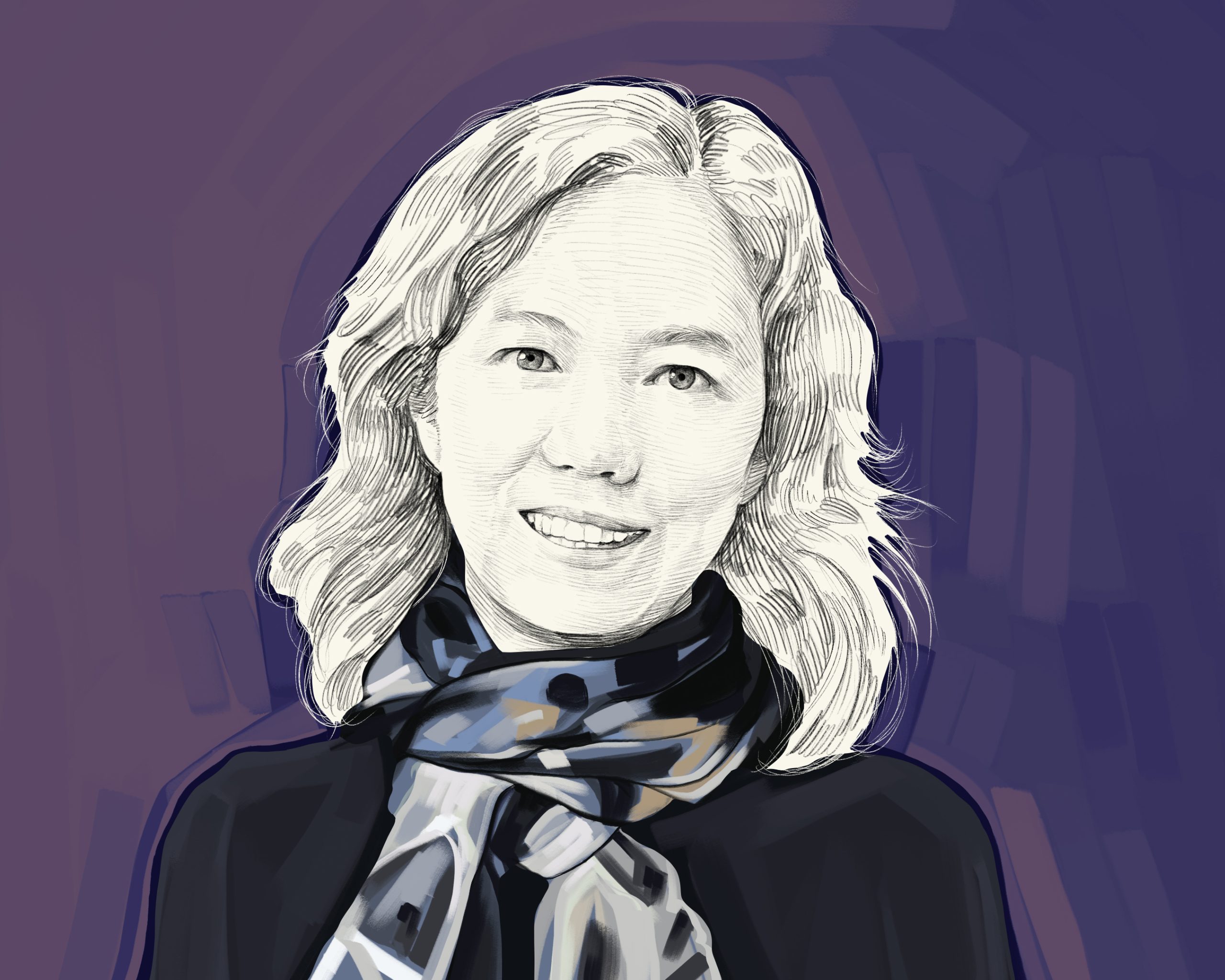
Please enjoy this transcript of my interview with Dr. Fei-Fei Li (@drfeifei), the inaugural Sequoia Professor in the Computer Science Department at Stanford University, a founding co-director of Stanford’s Human-Centered AI Institute, and the co-founder and CEO of World Labs, a generative AI company focusing on Spatial Intelligence. Dr. Li served as the director of Stanford’s AI Lab from 2013 to 2018. She was vice president at Google and Chief Scientist of AI/ML at Google Cloud during her sabbatical from Stanford in 2017/2018.
Dr. Li has served as a board member or advisor in various public and private companies and at the White House and United Nations. She earned her BA in physics from Princeton in 1999 and her PhD in electrical engineering from the California Institute of Technology (Caltech) in 2005. She is the author of The Worlds I See: Curiosity, Exploration, and Discovery at the Dawn of AI, her memoir and one of Barack Obama’s recommended books on AI and a Financial Times best book of 2023.
Transcripts may contain a few typos. With many episodes lasting 2+ hours, it can be difficult to catch minor errors. Enjoy!
Dr. Fei-Fei Li, The Godmother of AI — Asking Audacious Questions, Civilizational Technology, and Finding Your North Star
Additional podcast platforms
Listen to this episode on Apple Podcasts, Spotify, Overcast, Podcast Addict, Pocket Casts, Castbox, YouTube Music, Amazon Music, Audible, or on your favorite podcast platform.
DUE TO SOME HEADACHES IN THE PAST, PLEASE NOTE LEGAL CONDITIONS: Tim Ferriss owns the copyright in and to all content in and transcripts of The Tim Ferriss Show podcast, with all rights reserved, as well as his right of publicity. WHAT YOU’RE WELCOME TO DO: You are welcome to share the below transcript (up to 500 words but not more) in media articles (e.g., The New York Times, LA Times, The Guardian), on your personal website, in a non-commercial article or blog post (e.g., Medium), and/or on a personal social media account for non-commercial purposes, provided that you include attribution to “The Tim Ferriss Show” and link back to the tim.blog/podcast URL. For the sake of clarity, media outlets with advertising models are permitted to use excerpts from the transcript per the above. WHAT IS NOT ALLOWED: No one is authorized to copy any portion of the podcast content or use Tim Ferriss’ name, image or likeness for any commercial purpose or use, including without limitation inclusion in any books, e-books, book summaries or synopses, or on a commercial website or social media site (e.g., Facebook, Twitter, Instagram, etc.) that offers or promotes your or another’s products or services. For the sake of clarity, media outlets are permitted to use photos of Tim Ferriss from the media room on tim.blog or (obviously) license photos of Tim Ferriss from Getty Images, etc.
Tim Ferriss: Dr. Li, it is nice to see you. Thanks for making the time.
Dr. Fei-Fei Li: Hi, Tim. Very nice to be here. Very excited.
Tim Ferriss: And we were chatting a little bit before we started recording about how miraculous, and I suppose unfortunate it is, that somehow we managed to spend three years on the same campus and didn’t bump into each other.
Dr. Fei-Fei Li: I know. And now I’m wondering which college you were at and which clubs.
Tim Ferriss: Oh yeah. I was Forbes. I was in Forbes College.
Dr. Fei-Fei Li: Forbes College. No, I was Forbes too.
Tim Ferriss: Okay. This is for people who don’t know what the hell we’re talking about. There are these residential colleges where students are split up when they come into the school. And Forbes was way out there in the sticks, right next to a fast food spot like 7-Eleven called Wawa.
Dr. Fei-Fei Li: Wawa.
Tim Ferriss: And next to the commuter train. And then there’s something called eating clubs at Princeton. People can look them up. But they’re effectively co-ed fraternity/sororities where you also eat unless you want to make your own meals. And I was in Terrace.
Dr. Fei-Fei Li: I was not any of that. But for those of you wondering why we didn’t meet, we should say we were very studious students who were only in the libraries.
Tim Ferriss: Yeah. We were very studious. I actually made my, whatever it was, $6 an hour at Gest library working up in the attic.
Dr. Fei-Fei Li: Tim, I worked in the same library. I don’t understand why we did not meet.
Tim Ferriss: That’s really hilarious. Okay. Yeah. So, well, now we’re meeting.
Dr. Fei-Fei Li: Did you change name or something? Maybe we did meet.
Tim Ferriss: I didn’t change my name, but here we are. So we’ve reunited. That’s wild that we didn’t bump into each other. I was also gone for a period of time because I went to Princeton and Beijing and went to the — what was it? Capital University of Business and Economics after that. And so I was gone for a good period of time and then took a year off before graduating with the class of 2000. So still, we had a lot of overlap.
But let’s hop into the conversation. And this is a very perhaps typical way to start, but in your case, I think it’s a good place to start, which is just with the basics chronologically. Where did you grow up? And could you describe your upbringing? Because based on my reading, your parents were pretty atypical for Chinese parents in my experience, certainly.
Dr. Fei-Fei Li: You know a lot.
Tim Ferriss: Yeah. Could you speak to that please?
Dr. Fei-Fei Li: Yeah. I would say my childhood and leading up to the formative years is a tale of two cities. I grew up in a town in China called Chengdu. I was born in Beijing, but most of my childhood was spent in Chengdu where it’s very famous for panda bears. And at the age of 15, my mom and I joined my dad in a town called Parsippany, New Jersey. So I went from a relatively typical middle class Chinese family Chinese kid to become a new immigrant in a completely different world, of all places, New Jersey. And to learn a new language, to learn a new culture, to embrace a new country. And then from there on, I went to Princeton as a physics major, but I did take some of the classes you took and then went to Caltech as a PhD student to study AI, and the rest is history.
Tim Ferriss: So let’s dig into — I want to hear about both your parents, but I want to hear a little bit about your dad because he seems like, based on my reading, a very whimsical, creative soul, which is a sharp contrast in some ways to, for instance — I had Bo Shao on the podcast, amazing entrepreneur. And his father was, I suppose, what some folks might think of when they imagine, not a tiger mom, but like a tiger dad. So in the case of Bo’s upbringing, his father was very strict, but if he meaning Bo won a math competition, then he would get extra love and he would be allowed to have certain treats and things like that. Could you just describe your parents a little bit?
Dr. Fei-Fei Li: Yeah. So first of all, clearly you read my book. Thank you for that. It is true. As a child, you don’t realize that. As I was just going through my own science memory, I was writing it. The more I wrote about it, the more I realized, oh my God, I really did not have a typical dad. My dad loved and still loves nature. He’s just a curious mind. He finds humor and fun in unserious things. He loves bugs, insects. He loves taking me as a kid. Growing up in the 1980s in China, there isn’t much abundance in terms of material resources. But my city Chengdu was expanding so we lived in apartment complexes at the edge of the city, even though my dad and my mom worked in the middle of the city. So on the weekends, my dad and I would just play in the fields where there’s still rice fields, there’s water buffaloes. I had a puppy and my dad would just — really, all my memory is just like finding bugs really.
And then sometimes my dad and I will follow some — I don’t know. We took an art class. I took a kid’s art class. I will go to the neighboring mountains to draw. My entire childhood memory of my dad is just a very unserious parent who had no interest in my grades or what I’m doing in class. Did I achieve anything? Did I bring back any competition awards? Nothing to do with that. Even when I came to New Jersey with my parents, life became extremely tough. It was immigrant life. We were in a lot of poverty. And even that, my memory is that he has so much fun in yard sales. I would just go to yard sales. Every weekend it was just, “Yay, let’s go to yard sales and just use that as a treasure hunt almost.” He’s a very curious and childlike mind in that way.
Tim Ferriss: So I’m asking about your parents in part because I know you’re a parent and ultimately I’m going to want to ask how you think about parenting and that will come up at some point. But since listeners will certainly be asking themselves this question, and we’re not going to get into any geopolitics because there are plenty of people who want to get into that and fight over that, which we’re not going to do, but why did your parents leave China? What was the catalyst or what were the reasons behind leaving what you knew or leaving what they knew and coming to a very different foreign country? You’re going from Chengdu, which is a city to suburban New Jersey, which is, as I think you’ve described it felt very empty, right? And then you have the language barriers and the financial barriers. There’s so many things. Why the move?
Dr. Fei-Fei Li: Yeah. So I’ll give you two answers. The early teenage Fei-Fei would say, “I have no idea.” Because my dad left when I was 12 and my mom and I joined him when I was 15. And those years, you’re a teenager, right? There’s so many strange things in your head. And all I knew is that they said, “Let’s go to America.” I had no idea. I really did not know what happened. There was this vague sense of there’s opportunities of freedom. Education is very different. And I had a hunch that I was not a typical kid in the sense that I was a girl and I loved physics. I loved fighter jets of all things. I can tell you all the fighter jets I love from F=117 to F-16 to all the different things that I loved. So that’s all I knew.
In hindsight, as a grown up Fei-Fei, I appreciated my parents. They’re very brave people because I don’t know this age myself would just pick up and leave a country I’m familiar with and go to — I don’t know. A completely different country that I speak zero language and I have zero connectivity to. And mind you, that’s pre-internet, pre AI age. So when you are going to a different country, you might as well go to a different planet.
Tim Ferriss: You’re cut off. Yeah.
Dr. Fei-Fei Li: So I think they’re very brave. The grownup Fei-Fei realized that they wanted me to have an opportunity that they think will be unprecedented for my education, and it turned out that’s true.
Tim Ferriss: Yeah. Well, certainly looking at your bio, it’s mind-boggling to imagine all the different sliding door events and different paths you could have taken. So we’re going to hop pretty closely along chronologically, but we’re going to ultimately get to a lot of the meat and potatoes of the conversation. But I want to touch on maybe some other formative figures. And I would like to hear about your mother as well, because just with the context of your dad, it’s like, okay, that seems fascinating and very unusual, particularly if you’ve spent any time in China, especially during that period of time.
Dr. Fei-Fei Li: He is very unusual that way.
Tim Ferriss: Yeah. Very unusual. So then people might wonder, well, where does the drive come from? Where does the technical focus come from? And I’d love to hear your answer to that and also hear you explain who Bob Sabella was, if I’m pronouncing that correctly.
Dr. Fei-Fei Li: Yes. Yeah. Yeah. There are two questions. Mostly, is my mom the one who putting the drive and the technical passion and what role did Bob play in my life? So first one, first of all, my mom has zero technical genes. She really has no — I sometimes still laugh at her. She cannot do math, let’s put it this way. So I think the technical passion is just, I was born with it.
Tim Ferriss: Innate.
Dr. Fei-Fei Li: My dad is more technical, but he loves insects more than equations for sure. So I think as an educator for so many decades now myself and also as a parent, you have to respect the wonders of nature. There is this inner love and fire and passion and curiosity that comes with the package. But my mom is much more disciplined person. She’s still not a tiger mom in a sense. I don’t remember my mom ever going after me on grades she really did not. Both my parents never ever cared about me bringing any awards home.
Maybe I did, maybe I didn’t, but I can tell you in our house, there’s zero wall hangings of anything. Which actually carry to today. Even for myself, my own house, my own office have zero of those decorations of achievements or awards. It’s just my mom did not care about that. But she did care about me being a focused person if I want to do something. She doesn’t want me to play while doing homework. That kind of thing would bother her. She would say, “Just finish your homework.” Say by 6:00 P.M. if you don’t finish your homework, you’re not allowed to do more homework. You have to deal with the consequences. So she instilled some discipline, but that’s about it. She’s tougher than my dad. She is very rebellious. She had a unfinished dream herself. She was very academic when she was a kid herself and Cultural Revolution really crushed all her dreams. So she became a more rebellious person in that sense that I think I did observe and experience as a daughter. So maybe part of immigration is even part of that.
Many years later, she would say, “I had no plan coming to New Jersey, but I think I’m going to survive. I just believe I’m going to survive and I’m going to make sure Fei-Fei survives.” I think that is her strength, her stubbornness, and her rebelliousness.
Tim Ferriss: When does Bob enter the picture and who is Bob?
Dr. Fei-Fei Li: Bob Sabella was a high school math teacher in Parsippany High School. He was my own math teacher as well as many, many students. He entered my life in my second year, so it was bordering sophomore to junior year in Parsippany high school when I started taking AP calculus. But he quickly became the most influential person in my formative years as a new American kid, immigrant, as a teenager, because he became my mentor, my friend, and eventually his entire family became my American family. And he became my friend when I was a very lonely ESL English as second language student. I was excelling in math, but I think it’s more because I was lonely and he was very friendly. He treated me more like a friend who talks about books we love, talk about the culture, talks about science fiction, and also listened to me as a very — I wouldn’t say confused, but a teenager undergoing a lot of life’s turmoil in my unique circumstance. And that unconditional support made me very close to him and his family.
One thing he did to me that I did not appreciate till later is that when Parsippany High School couldn’t offer a full calculus BC class because it just didn’t have that, he just sacrificed his lunch hour, his only lunch hour to teach me Calculus BC. So it was a one-to-one class. And I’m sure that contributed me, a immigrant kid getting to Princeton eventually. But later as I became teacher myself, it’s exhausting to teach all day long. And the fact that on top of that, he would use his lunch hours to do that extra class for me is just such a gift that I now appreciate more than I was as a teenager.
Tim Ferriss: Yeah. Thank God for the teachers who go the extra mile. It’s just incredible, especially when you get a bit older and you have more context and you can look back and realize.
Dr. Fei-Fei Li: I really think these public teachers in America are the unsung heroes of our society because they’re dealing with kids of all backgrounds. They’re dealing with the changing times. The kind of stories Bob would share with me in terms of how he went extra miles, not just with me, but with many students, because Parsippany is a heavily immigrant town. So his students are from all over the world and how he helped them and their family. Those are the stories that people don’t write about. That’s part of the reason I wrote the book was to celebrate a teacher like that.
Tim Ferriss: Yeah. Well, I have so much I want to cover and I know we’re going to run out of time before we run out of topics. I want to spend more time on Bob and at the same time, I want to keep the conversation moving. So we’re going to do that and I’ll just perhaps hit on a few things and then dig into a number of questions. But certainly at Princeton, you, but also your entire family had to survive. So you were involved with operating a dry cleaning shop in New Jersey as one option, right? You ran that for seven years. So through that it feels like you’ve gained perspective on many different levels that have then helped inform what you’ve done professionally. So you learn to think about not just people who are protected in an ivory tower, but people all the way down across in society, so from every swath of society.
Your mother also, although she was not technical, she imbued in you this discipline and also seems to have had a very broad appreciation and knowledge of literature and international literature. So now you have this global perspective, presumably at the time in Chinese. And then you end up at Princeton.
And I know we’re going to be hopping around quite a bit, but I’m curious to know how ImageNet came about. You can introduce this any way you like. You can tell people what it is and what it became and why it’s important, and then talk about how it started, or you can just talk about how it started, but it’s such an important chapter.
Dr. Fei-Fei Li: So let me just explain what ImageNet is. ImageNet on the surface was built between 2007 and 2009 when I was assistant professor at Princeton and then I moved to Stanford. So during this transitional time, my student and I built this, at that time, the field of AI’s largest training and benchmarking dataset for computer vision or visual intelligence. The significance today after almost 20 years of ImageNet, it was the inflection point of big data. Before ImageNet AI as a field was not working on big data. And because of that and a couple of other reasons, which I’ll get into, AI was stagnating. The public thinks that was the AI winter, even though as a researcher, young researcher at that time, it was the most exciting field for me, but I get it. It wasn’t showing breakthroughs that the public needs. But ImageNet together with two other modern computing ingredients — one is called neural network algorithm. The other one is modern chips called GPU, graphic processing unit. These three things converged in a seminal work, milestone work in 2012 called “ImageNet Classification, Deep Convolutional Neural Network Approach.” That was a paper that a group of scientists did to show that the combination of large data by ImageNet, fast parallel computing by GPUs and a neural network algorithm could achieve AI performances in the field of image recognition in a way that’s historically unprecedented.
And that particular milestone is — many people call it the birth of modern AI. And my work ImageNet that was one third of that, if you count the elements. I think that was the significance. I feel very, really, very lucky and privileged that my own work was pivotal in bringing modern AI to life.
But the journey to ImageNet was longer than that. The journey to me — ImageNet started in Princeton when I was an undergrad. You were in the East Asian Study Department. I was hiding in Jadwin Hall, which is our physics department.
I loved physics since I was a young kid. I don’t know how. Somehow my dad’s love of bugs, insects and nature translated in my head into just the curiosity for the universe. So I loved looking to the stars. I loved the speed of fighter jets and then the intricate engineering of that eventually translated into the love of the discipline that asks the most audacious question of our civilization, such as what is the smallest matter? What is the definition of space-time? How big is the universe? What is the beginning of the universe? And in that early teenage hood love, I loved Einstein. I loved his work. And then I wanted to go to Princeton for that.
But it turned out what physics taught me was not just the math and physics. It was really this passion to ask audacious question. So by the end of my undergrad years, I wanted my own audacious question. I wasn’t satisfied with just pursuing some of the else’s audacious question. And through reading books and all that, I realized my passion was not the physical matters, it was more about intelligence. I was really, really enamored by the question of what is intelligence and how do we make intelligent machines? So at that time, I swear I did not know it was called AI. I just knew that I wanted to pursue the study of intelligence and intelligent machines. And then I applied to grad school and I went to Caltech. Caltech was my PhD. I started in the turn of the century, 2000. And I think I considered that moment I became a budding AI scientist. That was my formal training as a computer scientist in AI. Then my physics training continued in the sense that physics taught me to ask audacious questions and turn them into a north star. And in scientific terms, that north star became a hypothesis. And it was very important for me to define my north star.
And my first north star for the following years to come was solving the problem of visual intelligence. How we can make machines see the world. And it’s not just by seeing the RGB colors or the shades of light, it’s about making sense of what’s seen, which is, I’m looking at you, Tim, I see you, I see a beautiful painting behind you. I don’t know. Yeah. It was real. I see you’re sitting on a chair. Like that is seeing. Seeing is making sense of what this world is. So that became my north star question. And that hypothesis that I had is I have to solve object recognition. And then that was in my entire PhD was the battle with object recognition. There were many, many mathematical models we have done and there were many questions, but me and my field was struggling. We could write papers, no problem, but we did not have a breakthrough. And then luckily for me, Princeton called me back as a faculty in 2007. It was one of my happiest moment of my life. I feel so validated my alma mater would consider giving me a faculty job. So I happily moved back to Princeton as a faculty this time and I continue to be a Forbes member actually.
So at Princeton, there was an epiphany is that I realized there was a hypothesis that everybody missed, and that hypothesis was big data.
Tim Ferriss: This is the point that I’m so, so curious about. I just want to pause for a second. Also, for people who are interested in some of the history of Princeton, it’s pretty crazy. They should look up the history of the Princeton Institute for Advanced Study. I remember taking some of those East Asian studies classes that you referred to in classrooms where Einstein taught. And it’s just the aura, the veneer. You want to believe that you can feel it just permeating the entire campus. And it’s fun. In that respect, it’s very fun.
But I’m going to read something from a Wired piece that discussed you at length. And as you mentioned, big data before and after in terms of its integration into the type of research that you’re describing. And as it was written — and please feel free to fact check this or push back on it, but in Wired, they said the problem was a researcher might write one algorithm to identify dogs and another to identify cats. And then you, it says, Li, began to wonder if the problem wasn’t the model, but the data. She thought that if a child learns to see by experiencing the visual world, by observing countless objects and scenes in her early years, maybe a computer can learn in a similar way. And I want you to expand on that for sure.
The question for me is like, why did you see it? Why didn’t it happen sooner?
Dr. Fei-Fei Li: We’re all students of history. One thing I actually don’t like about the telling of scientific history is there’s too much focus on single genius. Yes. Agreed. We know Newton discovered the modern laws of physics, but yes, he is a genius, not to take away any of that from Newton, but science is a lineage and science is actually a non-linear lineage. For example, why was I inspired by this hypothesis of big data? Because many other scientists inspire me. In my book, I talked about this particular lineage of work by Professor Irv Biederman, who was a psychologist. He was not interested in AI, but he was interested in understanding minds. And I was reading his paper and he particularly was talking about the massive number of visual objects that young children was able to learn in early ages. So that piece of work itself is not ImageNet, but without reading that piece of work, I would not have formulated my hypothesis. So while I’m proud of what I have done, my book especially wanted to tell the history of AI in a way that so many unsung heroes, so many generations of scientists, so many cross-disciplinary ideas pollinate each other.
So I was lucky at that time as someone who is passionate about the problem, but also someone who benefited from all these research. So yes, something happened in my brain, but I would really attribute to many things happen across so many people’s work throughout their lifetime devotion to science that we got to the point of ImageNet.
Tim Ferriss: I’m so glad that you’re underscoring this because if you really dig as a — I don’t consider myself a scientist, but I love reading about the history of science. There’s so many inputs, so many influences, so many interdependencies.
Dr. Fei-Fei Li: Yes.
Tim Ferriss: And the simplicity of the single hero’s journey is appealing in it’s simplicity, but it’s almost never true.
Dr. Fei-Fei Li: It probably is never true. Even my biggest hero, Einstein, right? Anybody who knows me, anybody who read my book knows how much I revere him and I love everything he’s done. The special relativity equation is a continuation of Lorentz’s transform. So even Einstein, he builds upon so many other people’s work. So I think it’s really important, especially, I’m sure we’ll talk about it. I’m here calling you in the middle of Silicon Valley and we’re in the middle of an AI hype. And obviously I’m very proud of my field, but I think that when the media or whatever tells the story of AI, it almost always just talk about a few geniuses and it’s just not true. It’s generations of computer scientists, cognitive scientists, and engineers who made this field happen.
Tim Ferriss: Yeah. For sure. Everyone knows Watson and Crick, for instance, but without Rosalind Franklin and her x-ray crystallography, it doesn’t happen. It doesn’t happen. It just doesn’t happen point-blank.
We’re going to hop to modern day in a second, but with ImageNet, I would love for you to speak to some of the decisions or, let’s say decisions or moments, that were just formative in making that successful. Because for instance, if you’re going to try to allow a machine to — and I’m using very simple terms because I’m not technical enough to do otherwise. To learn to identify objects closer to the path that a child would take, you have to label a lot of images. And so I was reading about how Mechanical Turk came into play and then there’s a competitive aspect that seems to have driven some of the watershed moments. Could you just speak to some of the elements or decisions that made it successful?
Dr. Fei-Fei Li: A lot of people ask me this question because after you mentioned that many, many people have attempted to make data sets, but still only very few are successful. So what made the ImageNet successful? I think one of the success was timing, is that we truly were the first people who see the impact of big data. So that very categorical or qualitative change itself is a part of the success. But it’s also, as you were asking — the hypothesis of big data is not just size. A lot of people actually misunderstand ImageNet’s significance as well as other dataset significance. Coming with the dataset is a scientific hypothesis of what is the question to ask. For example, in visual recognition, you can make a dataset of discerning RGB, and that would not be as impactful of a dataset that is organized around objects. We can go down a rabbit hole of why. Not because RGB is easier per se, it’s because you have to ask the scientific question in the right way.
So another example is, instead of making a data set of objects, why don’t you make a data set of cities? That’s even more complicated than objects. But then that’s dialing too complicated. So, every scientific quest, you have to have the right hypothesis and asking the right question. So that’s one part of the success is we defined visual object categorization as the right hypothesis. That was one rightness, I guess. Another rightness is that people just think, “Oh, it’s easy. You just collect a lot of data.” Well, first of all, it’s laborious, but even aside from being laborious, how do you define the quality? You could say, “Well, if quality is big enough, we don’t care about quality.” But how do you dial between what is big, what is great, what is good, and how do you trade off? That is a deeply scientific question that we have to do a lot of research on.
And then another decision that is a set of decision that is really hard is what defines quality in terms of image? Is it every image has higher resolution? Is it it’s photorealistic? Is it because it’s everyday ImageNet look very cluttered? Is it all product shots that look clean? These are questions that if you’re too far away, you wouldn’t even think about asking, but as a scientist, as we were formulating the deep question of object recognition. We have to ask this in so many dimensions.
And then you mentioned Amazon Mechanical Turk. That is actually a consequence of desperation. Because when we formulated this hypothesis, our conclusion is we need at least 10s of millions of high quality images across every possible diverse dimension, whether it’s user photos or is it product shots or is it stock photography? And then we need also high quality labels. Once we make that decision, we realize this has to be human filtered from billions of images. So with that, we became very desperate. We’re like, “How are we going to do that?” I did try to hire Princeton undergrads and as you know, Princeton undergrads are very smart, but —
Tim Ferriss: They have very high opinion of the value of their tongue.
Dr. Fei-Fei Li: Yes. And they’re expensive. But even if I had all the money in the world, which we didn’t, it would have taken so long. So we were very, very stuck for very, very long. We thought we had other shortcuts, but the truth is human labeling is a gold standard and we want to train machines that are measured against human capabilities so we cannot shortcut that at that time. So we had to go to what we eventually found out is called crowd engineering, crowdsourcing. And that was a very new technology. Was barely a year old or so by Amazon. They created a online marketplace for people to do small tasks to earn money when these tasks can be uploaded on the internet.
I remembered when I heard about Amazon Mechanical Turk, I logged into my Amazon account, I checked the first task I checked out to do just to try was labeling wine bottles or transcribing wine bottle labels. The task will give you a picture of a wine bottle and you have to say, this is 1999 Bordeaux and all that. So people upload these micro tasks and then online workers, like someone in their leisure time, like me, if I had leisure time, I would just go sign up and get paid to do that. And we realized that was, again, out of desperation, that was a massive parallel processing with online global population to do this for us. And that’s how we labeled billions of images and distilled it down to 15 million high quality images.
Tim Ferriss: So, all right. It’s just so wild when you look at these stories. I just finished a book on Genentech and there were all these little technical inflection points that also allowed things to happen. So if it had been five years earlier, or maybe three years earlier, without Mechanical Turk, oh boy, it presents a challenge. But also as you pointed out, in science, it’s one thing to get answers, but you need the input on the front end with a proper hypothesis or a good question. And even with Mechanical Turk, if you’re only focused on the mechanics of employing that, you can get yourself into trouble because if humans are incentivized to, let’s just say — I think this was the example I read about, identify pandas in photographs and they’re paid for identifying pandas well, what’s to stop them from identifying a panda in every photo, whether they exist in the photos or not?
Dr. Fei-Fei Li: Yes.
Tim Ferriss: So you have to follow the incentives as well. How did you solve for that?
Dr. Fei-Fei Li: Yeah. I know. This is where my student and I had — I cannot tell you how many hours and hours of conversation we have about controlling the quality. We have to solve for that in multiple steps. We need to first filter out online workers who are serious about doing the work. So for example, we have to have some upfront quizzes so that they understand what a panda is. They read the question. And then once they qualify for that, we ask them to label pandas, but there are some pandas. There are some images we have free. We know the correct answer. Some are true pandas, some of them are not true pandas. But the labelers don’t know so in a way, we implicitly monitor the quality of the work by knowing where the gold standard answers are. So these are the kind of computational tactics we have to use to ensure the quality of labeling.
Tim Ferriss: Amazing. Yeah. Just incredible. All right. So I’ll actually just put a recommendation out there for a book, Pattern Breakers, by a friend of mine, Mike Maples Jr. He taught me the ropes initially of angel investing. But in terms of identifying inflection points and in some cases, converging technological trends that for the first time makes something possible, which then opens an opportunity for something with the right prepared mind, in your case and those of your collaborators and the people you built upon for something like ImageNet, Pattern Breakers is a really good read for folks.
So let’s hop to modern day then for a moment. And I would love to ask you — because you’ve been called the godmother of AI in our alumni magazine, in fact, and elsewhere, but you’ve had such a — not just technical but historical viewpoint, meaning you’ve over a broad timeline, broad by AI standards, been able to watch the development and forking and perils and promise of this technology. What are people missing? What do you think is eating up all the oxygen in the room? What are people missing, whether it’s things they should know or things they should be skeptical of or otherwise?
Dr. Fei-Fei Li: Especially I’m here calling you from the heart of Silicon Valley. I think people are missing the importance of people in AI and there’s multiple facades or dimensions to this statement is that AI is absolutely a civilizational technology.
I define civilizational technology in the sense that because of the power of this technology, it’ll have or already having a profound impact in the economic, social, cultural, political, downstream effects of our society. This is unverified, but I just heard that 50% of the US GDP growth last year is attributed to AI growth. So apparently this number is 4% for US GDP have grown 4%. If you take away AI, it’s only 2%. That’s what it means. So that’s civilizational from an economic point of view. It’s obviously redefining our culture. Think about, you’re talking about the word sucking oxygen out of the room, everywhere from Hollywood, to Wall Street, to Silicon Valley, to political campaign, to TikTok to YouTube to ESA.
Tim Ferriss: Taxis in Japan. I was just there and the videos playing on the back of the headset and the taxi were all talking about AI. It’s everywhere.
Dr. Fei-Fei Li: It’s culturally impactful, not only impactful, it’s shifting our culture and it’s going to shift education. Every parent today is wondering what should their kids study to have a better future? Every grandparent say, “I’m so glad I’m born earlier. I don’t have to deal with AI,” but still worry about their grandchildren’s future. So AI is a civilization of technology, but what I think it’s missing right now is that Silicon Valley is very eager to talk about tech and the growth that comes with the tech. Politicians are just eager to talk about whatever gets the vote, I guess. But really at the end of the day, people are at the heart of everything. People made AI, people will be using AI, people will be impacted by AI, and people should have a say in AI. And no matter how AI advances, people’s self-dignity as individuals, as community, as society should not be taken away. And that’s what I worry about because I think there’s so much more anxiety that because the sense of dignity and sense of agency, sense of being part of the future is slipping in some people. And I think we need to change that.
Tim Ferriss: Now, I’ve heard you say that you’re an optimist because you’re a mother. And both optimism and pessimism to an extreme can bias us in ways that are unhelpful or create blind spots. And I’m curious, if you try to put your most objective hat on, which is difficult for any human, but if you try to do that, do you think people are too worried, not worried enough, or worrying about the wrong things? For people who are not the CEOs and builders and engineers behind AI. Because you’re right, of course. everybody will agree with this, that a lot of people are very worried. And I’m just wondering if it’s ill-placed. If you talk to some of the VCs who are the biggest investors, of course, they have this sort of, in my view, beyond all possibilities, techno-optimist view of the future where AI solves everything. And it’s hard to believe there’s a free lunch there. And then you have the doomers, the doom and gloom where suddenly it’s Skynet next year and we’re all slaves to robots or eliminated, turned into paperclips. And reality’s probably in between those two. So do you think people are worrying about the right things or have they lost the plot in some way?
Dr. Fei-Fei Li: First of all, I call myself a pragmatic optimist. I’m not a utopian, so I’m actually the boring kind. I don’t believe in the extreme on both sides. I travel around the world. Just last month I was in Middle East. I was in Europe, I was in UK and I was in Canada. I came back home in America. I think people in America and people in Western Europe are more worried about AI than say people in Middle East, in Asia. And I think we don’t have to litigate on why they’re more worried, but just to come closer to home, just talk about US I wish I have a megaphone to tell people in the US that you’re known to be one of the most innovative people. Our country have innovated so many great things for humanity, for civilization. We have a society that is free and vibrant, and we have a political system that we still have so much say in how we want to build our country. I do wish that our country has more an optimism and positivity towards the future of using AI than what is being heard now.
I think people like me, technologists living in Silicon Valley has a lot of responsibility in the right kind of public communication. So there’s a lot of things that was not communicated in the effective way. But I do hope that we can instill more sense of hope and self-agency into everybody in our country, because I think there’s so much upside of using AI in the right way. And I want not just people in Silicon Valley or in Manhattan, but I want people in rural communities, in traditional industries everywhere, 50 states to be able to embrace and benefit from AI.
Tim Ferriss: Why are you building what you’re building? What is World Labs? Why decide to do this?
Dr. Fei-Fei Li: I actually answer this question very often to every member of my team. I built World Labs. There are two levels of this answer from a technology point of view. World Labs is building the next generation AI focusing on spatial intelligence because spatial intelligence, just like language intelligence, is fundamental in unlocking incredible capabilities in machines so that it can help humans to create better, to manufacture better, to design better, to build better robots. So spatial intelligence is a linchpin technology. But one level up, why am I still a technologist is because I believe humanity is the owning species that builds civilizations. Animals builds colonies or herds, but we build civilizations and we build civilizations because we want to be better and better. We want to do good. Even though along the way, we do a lot of bad things, but there is a desire of having better lives, having better community, having better society, live more healthily, have more prosperity and that desire is where civilization is built upon. And because I believe that humanity can do that, I believe science and technology is the most powerful tool, one of the most powerful tools in building civilizations. And I want to contribute to that. That’s why I’m still a scientist and a technologist, and I’m building World Labs for that.
Tim Ferriss: Can you explain to people what spatial intelligence is and what the product is, so to speak, at least as it stands right now that you’re building?
Dr. Fei-Fei Li: Yeah. So spatial intelligence is a capability that humans have, which goes beyond language. Is when you pack a sandwich in a bag, when you take a run or a hike in a mountain, when you paint your bedroom. Everything that has to do with seeing and turning that scene into understanding of the 3D world, understanding of the environment, and then in turn, you can interact with it, you can change it, you can enjoy it, you can make things out of it. That whole loop between seeing and doing is supported by the capability of spatial intelligence. The fact that you can pack a sandwich means you know what the bread looks like. You know how to put the knife in between. You know how to put the lettuce leaf on the bread. You know how to put the bread or sandwich into a Ziploc bag. Every part of this is spatial intelligence.
And does today’s AI have that? It’s getting better, but compared to language intelligence, AI is still very early in that ability to see, to reason, and also to do in world, in both virtual 3D world as well as real 3D world. So that’s what World Labs is doing. We are creating a frontier model that can have intelligent capability in the model to create world, to reason around the world, and to enable, for example, creators or designers or robots to interact with the world. So that’s spatial intelligence.
Tim Ferriss: Could you expand on the designers or creatives or robots interacting with the world? So does that mean that you could — and my team has been playing with some of the tools, so thank you for that. What does that mean? If you could paint a picture for let’s say a year from now, two years from now, how might someone use this or how might a robot use this?
Dr. Fei-Fei Li: I was just talking to someone a couple of weeks ago and it was really inspiring is that high school theaters are very low budget. Sometimes I go to San Francisco Opera or musicals and the sets that’s built for theater are just so beautiful, but it’s very hard for high school or middle school —
Tim Ferriss: It’s expensive.
Dr. Fei-Fei Li: To have that budget to do that. Imagine that you can take today’s World Labs model, we call it marble, and then you create a set in, I don’t know, in medieval French town. And then you put that in the background and use that digital form to help transport the actors and action into that world. And of course, depending on the auxiliary technology, whether you’re on a computer or eventually people can use a headset or whatever, you can have that immersive feeling of being in a medieval French town. That would be an amazing creative tool for a lot of creators. That was an example someone and I was talking about it a couple of weeks ago, but we already see creators all over the world. Some of them are VFX creators. Some of them are interior design creators. Some of them are gaming creators. Some of them are educators who want to build some worlds that transport their students into different experiences are already starting to use our model because they find it very powerful at their fingertip to be able to create 3D worlds that they can use to immerse either their characters or themselves into.
Tim Ferriss: And just process wise, if someone’s wondering how this works, let’s just say it’s a public school teacher, let’s just say, who’s hoping to inspire and teach their students going the extra mile.
What does it look like for someone to use it? Are they typing in text, describing the world they’d like to create, uploading assets or photos, almost like an image board? How does it work if someone’s non-technical?
Dr. Fei-Fei Li: Yes. So they don’t need to be technical at all. They open our page on desktop or in their phone, but desktop is more fun because it has more features. And then they can type a French medieval town, or they can actually go anywhere. They can use Midjourney or Nano Banana to create a photo of a French medieval town, or they can get an actual photo about that. And then they upload it, we call it prompt. And then after a few minutes, our model gives you a 3D world that is say a part of the town. It does have a limit in its range. And then that 3D world is generally 3D because you can just use the mouse to drag and turn around and walk around and see that world. And then downstream, if you want to use it, you could have many ways to use it. You can actually create a movie out of it by using one of our tools on the website to just put cameras and you can make a particular movie out of it. If you’re a game developer —
Tim Ferriss: I was just going to say, it sounds a lot like a gaming engine.
Dr. Fei-Fei Li: Yes. You can put a lot of characters in it. If you’re a VFX professional — we have a lot of VFX professionals. They can actually take this and put it in the workflow of their movie shooting and have real actors shooting movies. We also have psychology researchers using that immersive world in particular psychiatric studies. We could also use that as the simulation for robotic training because a lot of robotic training needs a lot of data and then use that for generating a lot of different data. Yeah.
Tim Ferriss: So is it almost like a flight simulator for robots before they go into the real world?
Dr. Fei-Fei Li: That’s part of the goal. We are still early, so the flight simulator is not complete yet, but that’s part of the journey.
Tim Ferriss: You mentioned psychiatric studies. I think that’s what you just mentioned. Yes. What might that look like?
Dr. Fei-Fei Li: Yeah. So we actually got this researcher who called us and they’re studying people who have psychological disorders like obsessive compulsive disorder where they’re triggered by certain environments and they want to study the trigger and also just study how the treatment. But how do you trigger someone who, let’s say particularly have issue with, let’s say, a strawberry field. I’m just making it up.
Tim Ferriss: Yeah.
Dr. Fei-Fei Li: You can take them to a strawberry field, but what about you want to know if it’s strawberry field in the summer or strawberry field at night, or it’s strawberry, or it’s many strawberry? How do you do this? Suddenly this researcher realized we give them the cheapest possible way of varying all kinds of dimensions and they can test this out and do their studies.
Tim Ferriss: That’s really interesting. Yeah. I could see it being applied to — it might be called exposure therapy, but in terms of — now that you’re describing it, I could see how it could be added into pretty much everything. If you think about how humans operate in the real world.
Dr. Fei-Fei Li: Yes. Yeah.
Tim Ferriss: Incredibly good.
Dr. Fei-Fei Li: And the boundary between real world and digital world is less and less. Thinner and thinner because we live in many screens, we live in the real world. We do things in virtual world, we do things in real world. We’ll create machines that can do things in real world and virtual world. So there’s a lot we do in digital and physical spaces.
Tim Ferriss: Who are some scientists or researchers who you pay attention to, who are not necessarily the big brand names and marquee lights that are already very public in the world? Is there anybody who stands out where you’re like, there’s some really tremendous people doing good work who —
Dr. Fei-Fei Li: Well, that’s part of the reason I wrote the book is, especially in the middle chapters where I wrote about the journey of doing ImageNet that combines cognitive science with computer science. I actually talk about psychologists and neuroscientists and developmental psychologists in — some of them are still with us, some of them are not. For example, the late Ann Treisman, Irv Biederman, they all passed away in the last few years, but they were giants in cognitive science whose work has informed computer science and eventually AI. There are still lots of scientists around the world. Many of them are in the US who are thinkers in developmental psychology. In AI, I follow their work. Yeah. I think that the world of science, just to name some names, Liz Spelke in Harvard, Alison Gopnik in Berkeley. I love Rodney Brooks, who was a former MIT professor in robotics. And there’s just a lot of them. I don’t mean to just single them out, but you’re asking me for names that are not in the news of AI.
Tim Ferriss: Yeah. That’s perfect. Thank you. I would also love to get your perspective on what might be — this is a very strong word. But seemingly inevitable in terms of developments in the near intermediate future. And I’ll give you an example of what I mean. In 2008, 2009, I became involved with Shopify, the company, back when they had like 10 employees. And there were a few things happening around that time. And you could ask questions in the next 10 years or 20 years, will there be more broadband access or less? More. Okay. Will there be more e-commerce or less? There’ll be more. Okay. And when you have four or five of those that seem over a long enough time horizon, absolute yeses, it begins to paint a picture of where things are going. Are there any things that in the next handful of years you think are perhaps underappreciated as near inevitabilities?
Dr. Fei-Fei Li: You want me to talk about underappreciated? I don’t know if they’re over appreciated, but they’re definitely appreciated. The need for power is appreciated. The trend of more AI, not less AI is appreciated. The long-term trend of robots coming is appreciated. So these are appreciated. What’s underappreciated is — spatial intelligence is underappreciated in the sense that everybody’s still now talking about language, large language models, but really world modeling of pixels of 3D worlds is underappreciated because like you were saying, it powers so many things from storytelling to entertainment to experiences to robotic simulation. I think AI in education is underappreciated because what we are going to see is that AI can accelerate the learning for those who want to learn, which will have downstream implication in our school system, as well as in just human capital landscape, like how do we assess qualified workers? It used to be which school you graduate from, with which degree, but that will be changing with AI being at the fingertip of so many people. That’s underappreciated.
I think AI’s impact in our economic structure, including labor market is underappreciated. The nuance is underappreciated. I think this whole rhetoric of either total utopia post-scarcity is hyperbolic or like everybody’s job will be gone is hyperbolic, but the messy middle is how from knowledge worker to blue collar, to hospitality, to all these changes that’s happening, it’s underappreciated by our policy workers, by our scholars, by just overall society.
Tim Ferriss: What are some of the nuances from the job perspective? Maybe this ties into what I promised earlier I was going to ask you, which is what you are telling or will tell — I don’t know their ages. Your children. Or recommending. Let’s just say, I don’t know how old they are, but if we assume that they, just for the sake of discussion, of the age where they’re trying to decide what they should study, where they should focus, things of that nature, how would you think about answering that even provisionally?
Dr. Fei-Fei Li: I think the ability to learn is even more important because when there was less tools, fewer tools to learn, it’s easier to just follow tracks. You go through elementary school, middle school, high school, college, and then get some training vocationally, and that’s a path. And with that is a set of structured credentials from degrees and all that. But AI has really changed it. For example, my startup, when we interview a software engineer, honestly, how much I personally feel the degree they have matters less to us now. It’s more about what have you learned? What tools do you use? How quickly can you superpower yourself in using these tools? And a lot of these are AI tools. What’s your mindset towards using these tools matter more to me.
At this point in 2025, hiring at World Labs, I would not hire any software engineer who does not embrace AI collaborative software tools. It’s not because I believe AI software tools are perfect. It’s because I believe that shows, first of all, the ability of the person to grow with the fast-growing toolkits, the open-mindedness, and also the end result is if you’re able to use these tools, you’re able to learn, you can superpower yourself better. So that is definitely shifting. So coming back to your question, what do you tell young people, tell children? I think the timeless value of learning to learn, the ability to learn is even more important now.
Tim Ferriss: Yeah. Yeah. It strikes me as we’re talking that it’s only going to get increasingly easier for the ambitious to act as superpowered autodidacts, right? We’ve already seen this. Certainly YouTube has a nice track record now. You can either entertain yourself to death and avoid doing things that help with self-growth and development or you can supercharge it. And similar With AI, you flash forward. We don’t even need to flash forward, but it’s how does a teacher audit that their students are doing the work they’re supposed to be doing?
Dr. Fei-Fei Li: Yeah.
Tim Ferriss: On so many levels, it’s getting to the point, there are some exceptions, but of near impossibility. Students can either avoid all work or they can supercharge their own work, but the output might look very similar at least for a period of time. So schooling is going to change a lot. It’s very, very interesting.
Dr. Fei-Fei Li: I actually think, Tim, if the school evaluation is structured in a way that whatever AI gives and whatever the student gives is the same, there’s something wrong with the structure of the evaluation.
Tim Ferriss: Okay. Can you say more about that? That’s interesting.
Dr. Fei-Fei Li: So for example, English essay. This is not me. This is me hearing a story that I so agree with. I’ll retell the story. As a high school freshman English class teacher, I heard that someone told me the story of their kids’ school. On the first day of school, the teacher actually said to the class, “I want to show you how I would score AI.” So the teacher give an essay topic. Show the students this is what the best AI gave me and I’m going to show you how I think this is good, this is bad, how this is suboptimal, and I’ll give it a B minus. Now I will tell you, this is my bar. If you’re so lazy that you ask AI to write your essay, this is what you’re going to get. But you can use AI, that’s totally fine. But if you can do the work, learn, think, be the best human creator you can and work on top of that you can get to A, you can get to A pluses. And that would be, in my opinion, the right way to structure the evaluation. Is not to pit humans against the AI and then try to police the use or not use of AI. Is that to show where the bar of the tools are and where the bar of the human learner should be.
Tim Ferriss: Yeah. I’m going to sit with that example and try to think of more examples. It’s very interesting. And boy, oh boy, I’ve been shocked by how quickly the models improve. But yes, as a thought experiment. I’m going to chew on that. I know we only have a few minutes left. Fei-Fei, I wanted to ask you a question I ask a lot, which is if you could put a quote or a message, something on a billboard, something to get in front of millions, billions of people, just assume they all understand it. It could be an image, could be a question, could be a quote, anything at all, a saying, a mantra, doesn’t matter, could be almost anything. What would you or what might you put on that billboard?
Dr. Fei-Fei Li: What is your north star?
Tim Ferriss: Okay. What is your north star? This is of course critically important. And coming back to how you define that or find that for yourself. You were talking about audacious questions and then that leading to a north star hypothesis. Is there another way that you would encourage people on top of that to think about finding their north star?
Dr. Fei-Fei Li: I believe that’s how that makes us so human and makes us to be so fully alive is that we as a species can live beyond the chasing of just basic needs, but dreams and missions and goals and passion. And everybody’s north star is different and that’s fine. Not everybody have AI as their north star. But finding that goes to the heart of education again. And I don’t mean formal classroom education, it’s just the journey of education. A lot of that is the ability to learn who you are and to learn how to formulate your north star and how to chase after that.
Tim Ferriss: Last question. I was just going to ask, Did your parents ever explain to you why they named you Fei-Fei?
Dr. Fei-Fei Li: Yes. It’s because when my mom was going through labor, my dad was characteristically late to the hospital and along the way he caught a bird. He let it go, but he did catch a bird. I don’t know if he was just distracted. It was in Beijing, in the city of Beijing. My dad was bicycling to my mom’s hospital. And that inspired him to call me Fei-Fei.
Tim Ferriss: Fei-Fei.
Dr. Fei-Fei Li: Fei-Fei. Oh wait, sorry. For those who don’t speak Chinese, I forgot — you do speak Chinese, but for those who don’t speak Chinese, fei means flying.
Tim Ferriss: Means flying.
Dr. Fei-Fei Li: Yeah. So be inspired by a bird.
Tim Ferriss: Really quick, I’ll just say, because it’s funny. My first Chinese name that I had was [foreign language], which is because I was very blunt and honest, so [foreign language]. But [foreign language]. But when I was first starting, my tones in China were not polished and people thought I was saying that my name was [foreign language 01:21:02], which is airport.
Dr. Fei-Fei Li: Airport.
Tim Ferriss: So I petitioned my teachers and we changed my name to something less confusing.
Dr. Fei-Fei Li: What’s your new name?
Tim Ferriss: [foreign language]. It’s [foreign language] but it’s without the [foreign language] at the bottom.
Dr. Fei-Fei Li: Oh, wow. Fancy name. That’s way more sophisticated than mine.
Tim Ferriss: Well, I get to script it with my Chinese teachers, so I have an unfair advantage.
Dr. Li, thank you so much for the time. We will link to the show notes for everybody at tim.blog/podcast. They’ll be able to find you easily. And everybody should check out worldlabs.ai and we’ll put every other link, your social and so on in the show links. But thank you for the time. I really appreciate it.Dr. Fei-Fei Li: Thank you Tim. I enjoyed our conversation.
