

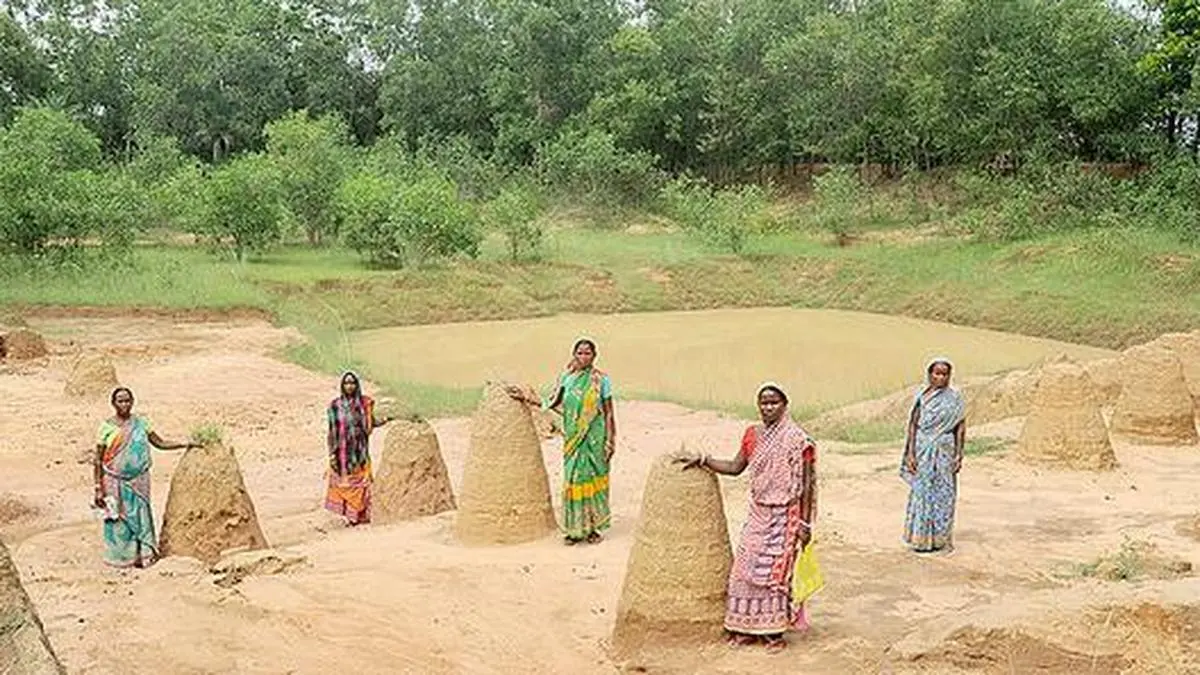
While households received 48–52 days of work annually over the past five years, the average has dropped to about 36 days so far in the current financial year.
| Photo Credit:
DEBASISH BHADURI
The proposed increase in the statutory entitlement to 125 days of employment per household in the Viksit Bharat-Guarantee for Rozgar and Ajeevika Mission (Gramin) (VB-G RAM G Bill) as compared with 100 days under the Mahatma Gandhi National Rural Employment Guarantee Act (MGNREGA) is unlikely to translate into higher spending by the Centre.
An analysis of MGNREGA dashboard data by businessline shows that the actual number of employment days has steadily declined.
The average employment per household peaked at 52 days in 2020-21 during the pandemic, when the Centre’s expenditure touched ₹1.09 lakh crore.
By 2024-25, this number slipped to 50 days, with the Centre’s contribution falling to ₹85,640.55 crore.
While households received 48-52 days of work annually over the past five years, the average dropped to about 36 days so far this fiscal, with the Centre’s spend at ₹69,013.73 crore.
Participation down
The Centre’s share of funding is set to decline to 60 per cent under the proposed VB-G RAM G Bill from around 90 per cent under MGNREGA, shifting a significantly larger financial burden to the States.
Participation indicators also point to a contraction in the scheme’s reach. The number of households receiving the full 100 days of work fell sharply from 71.97 lakh in 2020-21 to 40.70 lakh in 2024-25.
The overall participation declined as well, with households that availed themselves of work dropping from 7.55 crore to 5.78 crore. The number of gram panchayats not undertaking MGNREGA work has risen to 11,165 in 2025-26 from 4,797 in 2021-22. In Odisha, sarpanches from Kalamachhuin and Hensmul gram panchayats said works were stopped after land acquisition by Mahanadi Coalfields.
“Though there is demand for MGNREGA, we have been told not to undertake works after Mahanadi Coalfields acquired land in our panchayat,” said Anil Kumar Pradhan, sarpanch of Kalamachhuin gram panchayat in Talcher block of Angul district in Odisha.
In Uttar Pradesh, 875 panchayats reported no MGNREGA activity this year, partly due to the merger of some rural panchayats into urban local bodies.
Devendra Kumar Pant, Chief Economist at India Ratings, said that if the VB-G RAM G Bill is enacted, the Centre’s share is likely to decline from FY26 due to lower demand amid overall economic growth, particularly in agriculture, which has expanded at over 3.5 per cent for five consecutive quarters.
Published on December 17, 2025
