

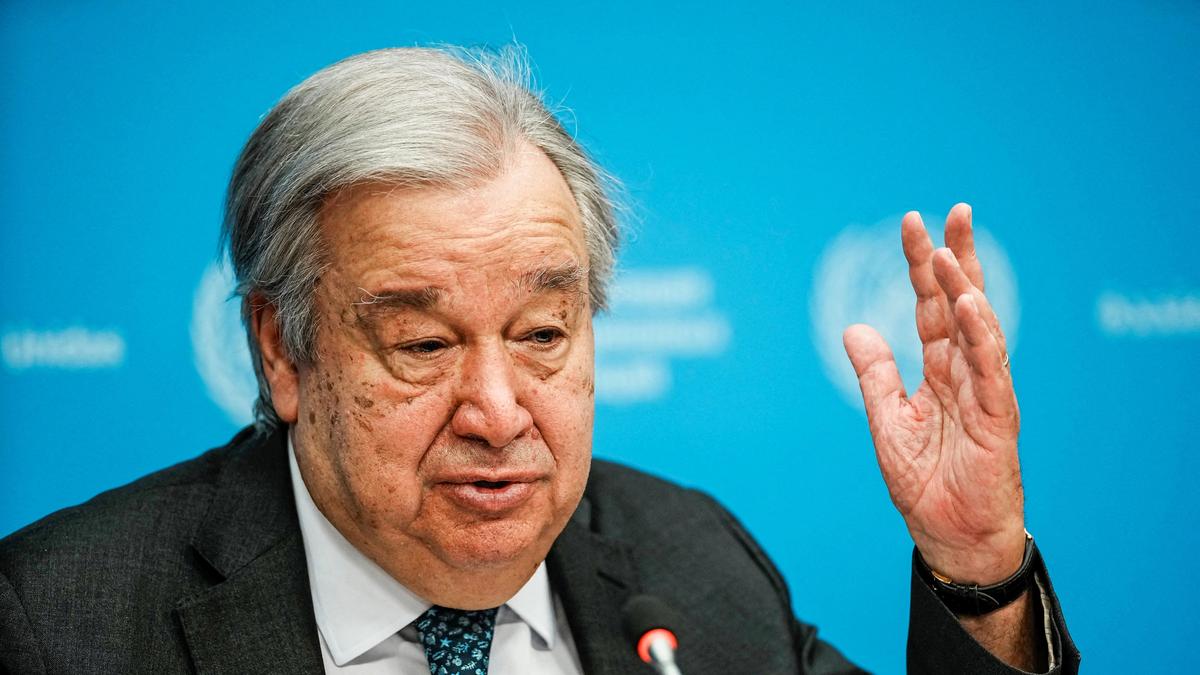
UN Secretary-General Antonio Guterres has warned of an “imminent financial collapse” due to unpaid member fees and a budget rule requiring unspent funds to be returned.
| Photo Credit:
Eduardo Munoz/Reuters
U.N.
Secretary-General Antonio Guterres is sounding the alarm on U.N.
finances, warning that the world body is at risk of “imminent
financial collapse” due to unpaid fees and a budget rule that
forces it to return unspent funds.
Guterres has repeatedly spoken about the U.N.’s worsening
liquidity crisis but this was his starkest warning yet, and it
came as the United States, its main contributor – and debtor –
is retreating from multilateralism on numerous fronts.
Here are some questions and answers about U.N. finances:
HOW MUCH IS OWED TO THE UNITED NATIONS AND BY WHOM?
In a letter to member states last week, Guterres said there
was a record $1.57 billion in outstanding dues for the U.N.’s
regular budget, without naming the nations that owed them.
U.N. officials say more than 95 percent of what is owed to
the regular U.N. budget is owed by the United States – $2.19
billion by the start of February. The U.S. also owes another
$2.4 billion for current and past peace-keeping missions and
$43.6 million for U.N. tribunals.
On December 30, the U.N. General Assembly approved $3.45
billion for the regular U.N. budget for 2026, following weeks of
negotiations. This covers costs of running U.N. offices around
the world, including the headquarters in New York, staff
salaries, meetings and development and human rights work.
U.N. officials say the U.S. did not pay into the regular
budget last year and owes $827 million for that, as well as $767
million for 2026. Next in line were Venezuela and Mexico, owing
$38 million and $20 million respectively.
Contributions depend on economy size. The U.S. accounts for
22% of the regular budget, followed by China with 20%. Fees are
officially due by Feb. 8 and so far 41 states have paid for
2026, a U.N. document showed.
WHAT IS GUTERRES ASKING MEMBER STATES TO DO?
Without naming the United States, U.N. spokesperson Stephane
Dujarric said this week the U.N’s “cash-flow problem” could be
solved “if member states, who have an obligation to pay, pay.”
The crunch comes at a time when U.S. President Donald Trump
has launched a Board of Peace with himself as lifetime chair,
which some fear could undermine the United Nations, a body with
193 member states formed in the ashes of World War Two that
works to maintain international peace and security.
Under Trump, as well as refusing to make mandatory payments
to the U.N.’s regular and peacekeeping budgets, the U.S. has
slashed voluntary funding to U.N. agencies with their own
budgets, and moved to exit U.N. organizations including the
World Health Organization. In December, the U.N. appealed for a
2026 aid budget only half the size of what it had hoped for in
2025, acknowledging a plunge in donor funding at a time when
humanitarian needs have never been greater.
Guterres launched a reform task force last year, UN80,
seeking to cut costs and improve efficiency. The approved 2026
regular budget is roughly $200 million higher than he proposed,
but about 7 per cent lower than the approved 2025 budget.
Guterres warned in his letter that the U.N. could run out of
cash by July and cited a “Kafkaesque” requirement for it to
credit back hundreds of millions of dollars in unspent dues to
states each year even if it never received the money. U.N.
officials hope to overhaul this “bizarre” rule, which Guterres
has called “a race to bankruptcy.”
WHAT HAS THE TRUMP ADMINISTRATION SAID?
Speaking to Politico on Sunday, Trump cast himself as the
savior of the U.N. but declined to say if the U.S. would pay up.
According to Politico, Trump said he was unaware the U.S.
was behind in its commitments but was sure he could “solve the
problem very easily” and get other countries to pay — if only
the U.N. would ask.
The White House and State Department did not respond when
asked if the U.S. will pay, or if Trump meant that other
countries should put up the money instead.
A senior State Department official did though say that “the
U.N. needs to get back to basics” and accused it of wasting
money.
“We have no interest in continuing to spend American tax
dollars on such waste, fraud and abuse,” the official said.
“The U.N. continues to pay its staff far more than for
comparable U.S. government positions, provide unacceptable
benefits and pensions, and increase the number of high-level
bureaucrats in New York – up over 30% – in the last two years
alone. The U.N. also spent $340 million just on meetings and
conferences last year.”
According to a draft U.N. budget document seen by Reuters in
September, U.N. cost-savings plans for next year envisaged far
smaller cuts to senior staff than to lower ranks.
It showed just two of 58 department head posts in the layer
of under-secretaries-general beneath Guterres, or 3%, would go,
compared to around 19% across the board and up to 28% for one
lower-ranking category, according to Reuters calculations.
A U.N. official said Guterres aimed to deliver on reform
while limiting the impact of cutbacks. If the U.S. did not pay,
“at the end of the day, meetings can’t be organized, work’s not
done, staff is not being paid,” the official said.
“Unlike a government, we can’t borrow money and we can’t
print money.”
Published on February 4, 2026
