

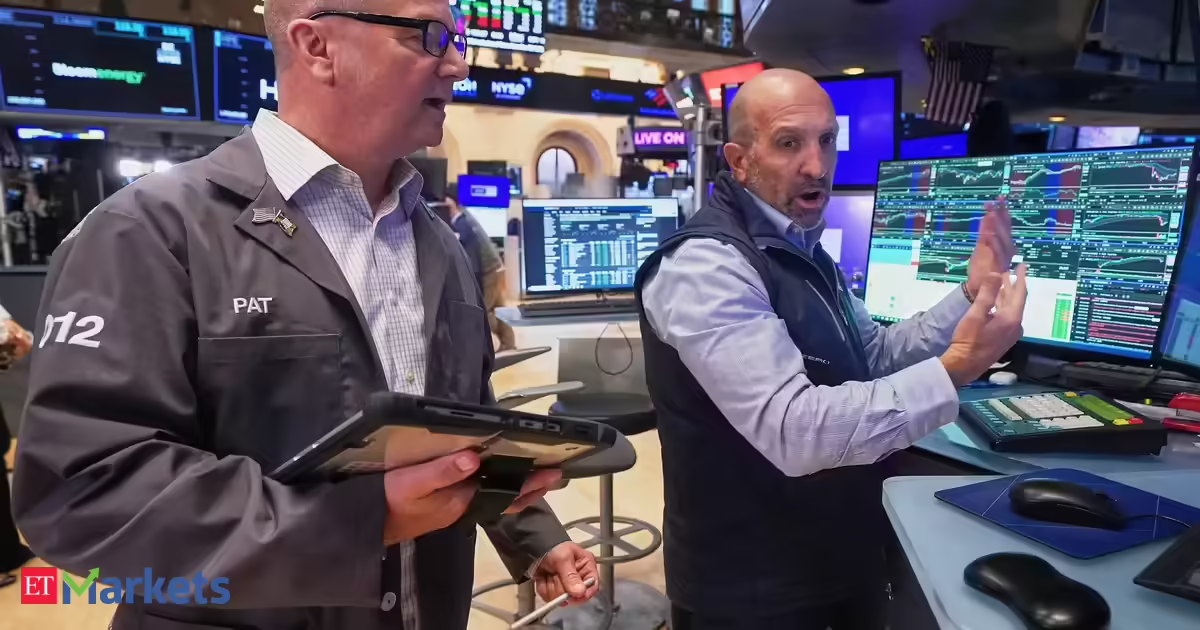
The S&P 500 and the Nasdaq closed fractionally lower in choppy trading on Tuesday, as gains in communication services stocks were offset by declines in technology and financial stocks, with financials also weighing on the Dow. Communication services shares were among the biggest gainers on the S&P 500, fueled by a 1.1% rise in Meta Platforms . The technology company said it would acquire Chinese-founded artificial intelligence startup Manus, accelerating efforts to integrate advanced AI across its platforms such as Facebook and Instagram. Information technology stocks ended slightly lower with Apple down 0.3% and Nvidia falling 0.4%, while Microsoft inched up.
On Monday, these heavyweight stocks snapped a six-session winning streak, their longest since September. Last week, the rally had also propelled the S&P 500 to a record high.
“The growth rates are going to converge between technology and everything else next year and the valuation gap is so wide, it absolutely is justified to see repositioning,” said Mark Hackett, chief market strategist at Nationwide.
“It’s just a healthy rebalancing of allocations more so than an emotionally driven sell-off (in tech).”
Trading volumes remained thin in the holiday-truncated week, which analysts expect could heighten market volatility.
Live Events
Losses in Goldman Sachs and American Express weighed on the Dow. Citigroup fell 0.8% a day after it announced its board approved the sale of its Russian unit, AO Citibank, to Renaissance Capital. The deal will lead to a pre-tax loss of about $1.2 billion, largely related to currency translation.
“We believe investors will look past it as a non-core item and focus more on the idea that resolution of another legacy issue is getting closer to the finish line – a positive for (Citi’s) ongoing transformation,” said R. Scott Siefers, analyst at Piper Sandler in a note. The S&P 500 lost 9.50 points, or 0.14%, to close at 6,896.24 points, the Nasdaq Composite lost 55.27 points, or 0.23%, to 23,419.08, and the Dow Jones Industrial Average fell 94.87 points, or 0.20%, to 48,367.06 points.
The S&P 500 and the Dow are set for their eighth consecutive month of gains, their longest monthly winning streak since 2017.
Some investors eye a “Santa Claus rally”, in which the S&P 500 typically posts gains over the last five trading days of the year and the first two of January, according to the Stock Trader’s Almanac.
The U.S. Federal Reserve agreed to cut interest rates at its December meeting only after a deeply nuanced debate about the risks facing the U.S. economy, according to minutes of the latest two-day session.
The Fed next meets on January 27-28, with investors currently expecting the central bank to leave its benchmark rate unchanged. The S&P 500 has added about 17% so far this year, as the frenzy to capitalize on artificial intelligence helped the U.S. benchmark edge ahead of Europe’s STOXX 600, despite investors diversifying away from U.S. stocks earlier in the year dominated by trade disputes.
Russia said it would toughen its negotiating stance after accusing Kyiv of attacking a Russian presidential residence. The fading hopes of a peace deal supported oil prices, allowing S&P’s energy sub-index to rise 0.8% and outperform peers.
Declining issues outnumbered advancers by a 1.06-to-1 ratio on the NYSE. There were 190 new highs and 80 new lows on the NYSE. On the Nasdaq, 1,780 stocks rose and 2,913 fell as declining issues outnumbered advancers by a 1.64-to-1 ratio. The S&P 500 posted 3 new 52-week highs and one new low while the Nasdaq Composite recorded 33 new highs and 205 new lows.
Volume on U.S. exchanges was 12.63 billion shares, compared with the 16.03 billion average for the full session over the last 20 trading days.
