

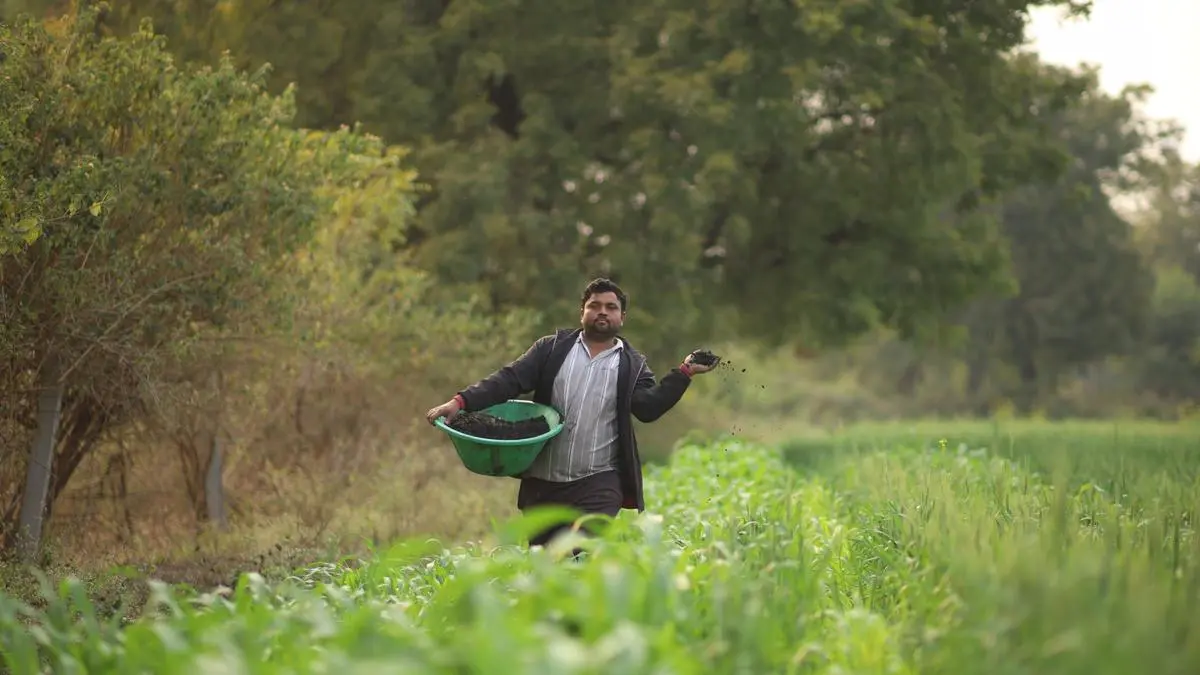
A farmer spreading biochar to enhance soil quality, sequester carbon
Varaha, a developer of carbon dioxide removal (CDR) projects with smallholder farmers across Asia, announced a major off-take agreement with Microsoft for biochar carbon removal in India.
Varaha will develop 18 industrial gasification reactors in Maharashtra that will use cotton stalks as a feed stock for production of biochar, which will be used for application in farms to sequester carbon and also improve the soil quality. The gasification reactors will operate for 15 years, with a total projected removal volume exceeding 2 million tonnes of carbon dioxide over the project’s lifetime.
The project will source cotton stalks from smallholder farms in Vidarbha, Maharashtra for use as a feedstock for biochar production from the next cropping cycle, said Madhur Jain, Varaha CEO. After harvest, the cotton stalks are generally treated as waste biomass, and open-field burning is a common practice across the region’s cotton belt. Farmers can now monetise the cotton stalks from the next cropping season.
This project provides an alternative use for the stalks, converting them into biochar through Varaha’s biomass gasification facilities and sequestering biogenic carbon for centuries, the company said in a statement.
The project’s first reactor will operate alongside Varaha’s 52-acre cotton research farm in Maharashtra, where the company works directly with farmers to test sustainable practices, including soil application of biochar under real-world conditions. With up to 18 reactors funded across India’s cotton belt through Microsoft’s commitment, the focus remains clear: scaling quickly while putting farmers first. Microsoft will be buying the credits generated by the carbon removal project.
The agreement signals growing recognition of the region’s potential for high-quality carbon removal projects. Biochar offers permanent carbon storage on geological timescales, while supporting agricultural systems, making it one of the most promising pathways for durable carbon dioxide removal
“This agreement demonstrates that high-integrity carbon removal can drive transformative co-benefits for communities and ecosystems,” Jain said. “We’re not just removing carbon — we’re creating economic incentives for farmers to mitigate open burning of crop residues,” he added.
Varaha’s biochar project also delivers measurable benefits for farmers and communities such as promotion of regenerative agriculture, improvement in air quality and lifting farmer livelihoods.
The project mitigates the widespread burning of cotton crop residue, significantly reducing PM 2.5 pollutants that contribute to poor air quality. By providing an economically viable alternative to field burning, the initiative tackles a major source of seasonal air pollution.
Farmers participating in the programme adopt regenerative practices like crop residue mulching and biochar application to soils, improving soil health, water retention, and long-term agricultural productivity. The programme directly enhances the livelihoods of thousands of smallholder farmers, who receive payment both for contributing agricultural biomass and for implementing crop residue incorporation practices.
“This offtake agreement broadens the diversity of Microsoft’s carbon removal portfolio with Varaha’s biochar project design that is both scalable and durable. It represents a step forward in scaling biochar CDR growth in Asia and advancing co-benefits for farmers —improved soils, cleaner air, and shared economic opportunity” said Phil Goodman, programme director, CDR at Microsoft.
The credits generated through the Varaha programme meet rigorous standards for measurement, reporting, and verification, ensuring that each tonne represents genuine, permanent carbon removal.
Published on January 15, 2026
