

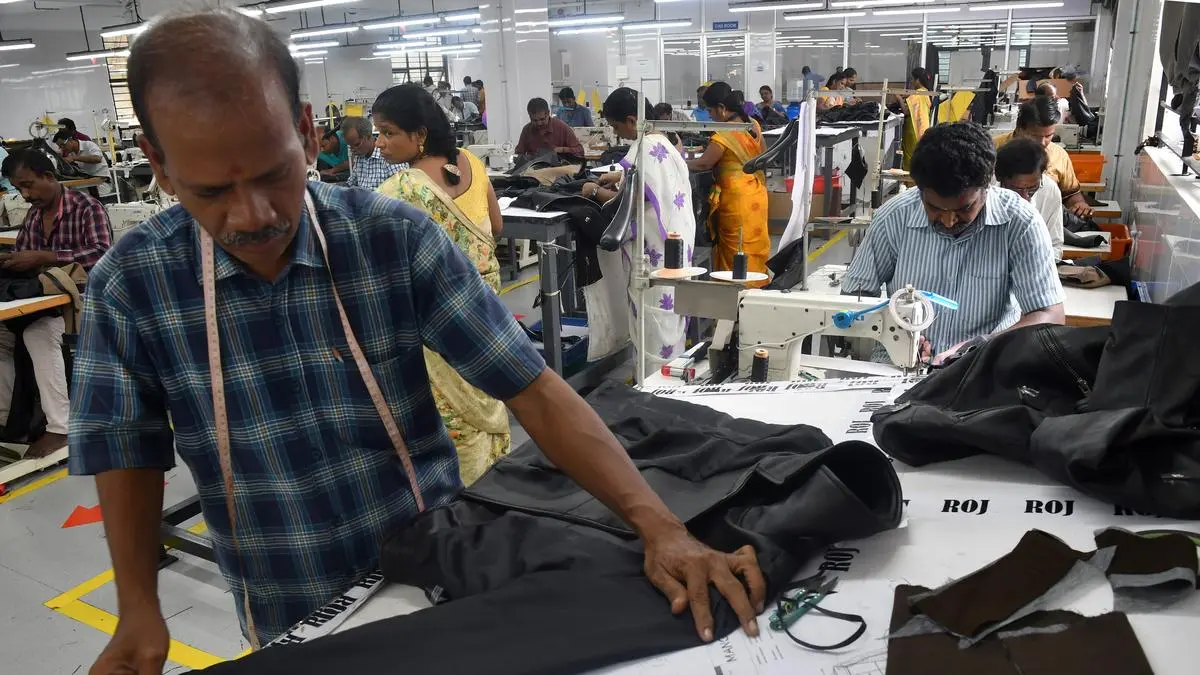
Workers at a leather factory in Chennai
| Photo Credit:
VELANKANNI RAJ
Clinching of the long-pending India-EU Free Trade Agreement on Tuesday has sparked high expectations among Indian exporters, especially in labour-intensive industries facing turbulence in the US market owing to 50 per cent tariffs.
Sectors including apparel, leather, footwear, gems and jewellery, engineering goods, marine products, handicrafts and auto, are anticipating a substantial boost in exports to the EU following the implementation of the trade pact.
“With tariff elimination of up to 10 per cent on nearly $33 billion worth of Indian exports (to the EU), the FTA will provide immediate and tangible gains to key sectors…These benefits will translate into higher exports, large-scale employment generation, and stronger grassroots participation in global trade, reinforcing the government’s vision of export-led prosperity,” said S C Ralhan, President, Federation of Indian Export Organisations (FIEO).
The India–EU FTA, together with India’s recent FTAs with the UK and the four-member EFTA bloc, effectively opens the entire European market for Indian exporters, marking a strategic breakthrough in India’s trade diplomacy, FIEO observed.
Many of the labour-intensive sectors are set to make substantial gains as these are facing much higher tariffs than the EU average of 3.8 per cent, an official said. Tariff elimination on about 93 per cent of Indian exports to the EU (in value terms), which includes labour-intensive items, is scheduled to happen on day one of the implementation. Although, the FTA text has to be legally scrubbed and also be approved by the EU Parliament, it is hoped that it would be implemented in calendar year 2026.
The India-EU FTA will supercharge market diversification for the gems and jewellery industry, which faced up to 4 per cent duties in the EU, according to the Gems & Jewellery Export Promotion Council (GJEPC). “This transformative pact aims to double bilateral trade to $10 billion within three years. Zero-duty access to the world’s largest consumer market empowers export hubs in Gujarat, Rajasthan, Maharashtra, and West Bengal to ramp up shipments of precious jewellery (plain and studded), silver, and imitation jewellery — capitalising on India’s renowned design prowess,” per a statement.
Especially with exports to the US down by 44 per cent, this timely pact will help Indian exporters salvage lost ground, the GJEPC noted.
With the elimination of tariffs on Indian apparel products, which at present is as high as 12 per cent, the Indian apparel industry will gain immensely as it will get a level playing field vis-à-vis its competing countries like Bangladesh, Turkey and Vietnam, which enjoy duty free/ preferential duty access in the EU’s market, pointed out the Apparel Export Promotion Council (AEPC).
“The FTA eliminates tariff on 100 per cent of apparel tariff lines which will enhance market access to all member countries of the EU. The EU is the world’s largest apparel importer with total apparel import worth $202.8 billion in FY 2024-25. Some of the major garment importing countries of the EU like Germany, France, Spain and Italy source substantially from India and this deal will further boost our apparel exports to these economies,” said A Sakthivel, Chairman, AEPC.
Elimination of tariffs on the leather and footwear sector at entry into force of the FTA, from up to 17 per cent, across all tariff lines will help level the playing field for India’s exports to the EU, valued at approximately $2.4 billion and improve share in EU’s nearly $100-billion imports of the items, according to the government.
Published on January 27, 2026
