

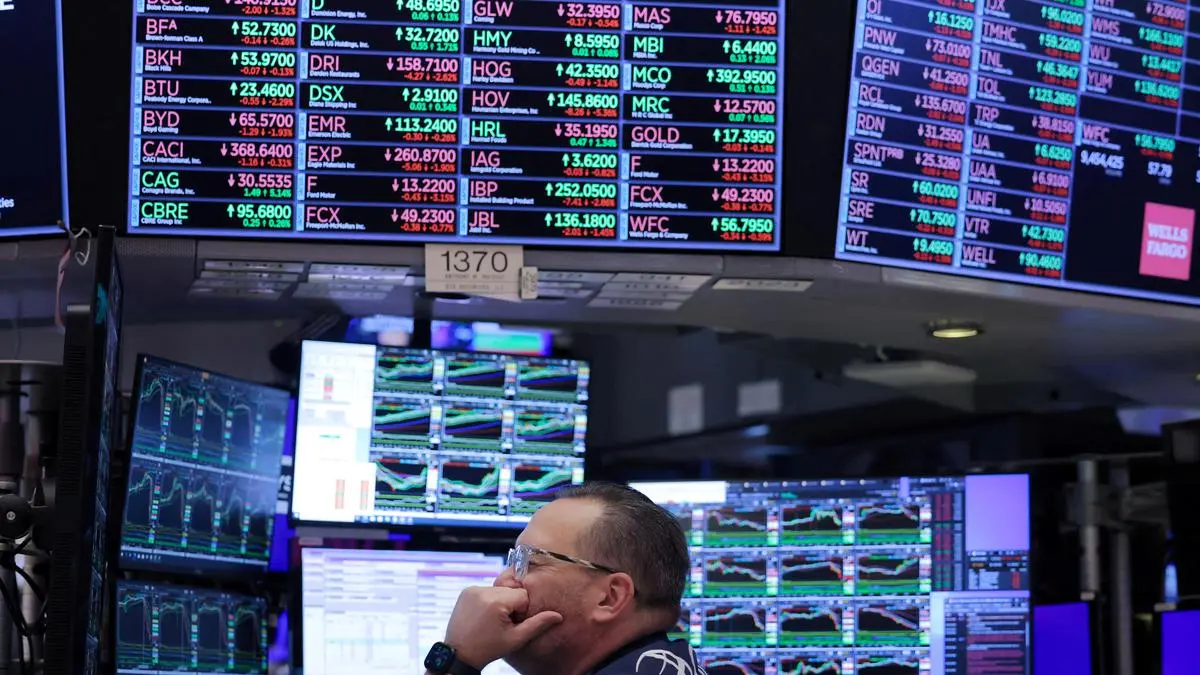
As US operation against Venezuela demonstrated, unexpected or under-appreciated geopolitical events can disrupt financial markets
| Photo Credit:
ANDREW KELLY
In a recent campaign-style speech, US President Donald Trump asserted that “the only thing that’s really going up, big, it’s called the stock market, and your 401(k).” He has a point: all major US stock indices realised double-digit percentage gains last year. And yet, the November midterm elections are still a long way off. Were there to be a stock-market correction in the meantime, Trump’s economic point of pride could become a liability.
Unfortunately for Trump, a market correction (a 10-20 per cent decline) does seem highly probable this year. There is an unusually high degree of optimism priced into the market, making stocks susceptible to a large pullback in the event of an economic setback — which any number of economic or political “known unknowns” could cause in the run-up to the midterms.
Consider the current optimism. It would be an understatement to say that stocks are priced at lofty valuations; in fact, they are priced for economic perfection. As measured by the Cyclically Adjusted Price-Earnings Ratio, the S&P 500 is valued at more than twice its long-term average, and at close to its pre-2001 dot-com high. And as measured by the Buffett Indicator — the ratio of the total US stock-market valuation to US GDP — the market is trading at an all-time record, some 50 per cent above its 2008 high.
Another measure of optimism is the current bullishness on the part of fund managers. According to Bank of America, these influential voices are more exuberant now than at any point in the past three years, and their current cash holdings have plummeted to their lowest level on record. Again, such sentiment — and the bets that follow from it — would seem to set the market up for a major pullback should the economy falter in the coming months.
Why might that happen? One need only consider the country’s unsustainable public finances, coupled with the threat Trump poses to the US Federal Reserve’s independence, to envisage a return of the bond market vigilantes and a spike in long-term interest rates. Heightening this risk is the country’s high dependence on foreigners to finance its $2 trillion annual budget deficit. If foreigners come to think that the US government will try to inflate away its debt, they will demand higher interest payments on their US Treasury bond holdings, which would increase the cost of mortgages, auto loans, and many other common forms of borrowing.
The AI bubble
Another domestic risk is the AI bubble, which could burst or deflate at any time. This risk is especially acute considering that as much as half of US GDP growth is being driven by AI-related investment. Moreover, the end of the AI bubble would have a chilling effect on the stock prices of the so-called Magnificent Seven (Alphabet, Amazon, Apple, Meta, Microsoft, Nvidia, and Tesla), whose combined valuation is around 35 per cent of the S&P 500’s total. Oracle, whose stock price already fell 30 per cent last quarter, could prove to be the canary in the coal mine.
The US stock market could also be shaken by economic reversals abroad. One such shock could come from China, which is still relying excessively on an investment- and export-centric model to drive its economy. With China’s trade surplus now exceeding $1 trillion, increased US and European protectionism has become more likely, and with it, a further breakdown in the international trading system.
Another shock could come from Japan, where Prime Minister Sanae Takaichi’s pursuit of an irresponsible budget policy has raised fears of a “Liz Truss moment” that could send Japanese government bond yields sharply higher (as happened in the UK in the fall of 2022). Were that to occur, we could see a disruptive unwinding of the Japanese carry trade (borrowing at a lower interest rate in one country to invest in assets elsewhere) and the repatriation of Japanese capital that has been supporting US financial markets.
Finally, as last weekend’s US military operation against Venezuela demonstrated, unexpected or under-appreciated geopolitical events can disrupt financial markets. Even before Trump announced that the US plans to “run” Venezuela until a “proper” transition can take place, China was conducting live military drills in the Taiwan Strait, and Russia was dragging its feet on a peace settlement with Ukraine. China might try to capitalise on this moment to regain control over Taiwan, and Russia may be emboldened to make even more ambitious demands for territorial concessions from Ukraine. Even the smallest possibility of a conflict over Taiwan should be deeply concerning, considering that it supplies more than half the world’s semiconductors.
If those who live by the sword die by the sword, the same may be true of equity prices in the run-up to this year’s midterm elections. By emphasising how well the stock market is doing now, Trump could be setting himself up for disappointment if any number of risks materialise.
The writer, a senior fellow at the American Enterprise Institute, is a former deputy director of the International Monetary Fund’s Policy Development and Review Department and a former chief emerging-market economic strategist at Salomon Smith Barney. Copyright: Project Syndicate, 2026. www.project-syndicate.org
Published on January 6, 2026
