

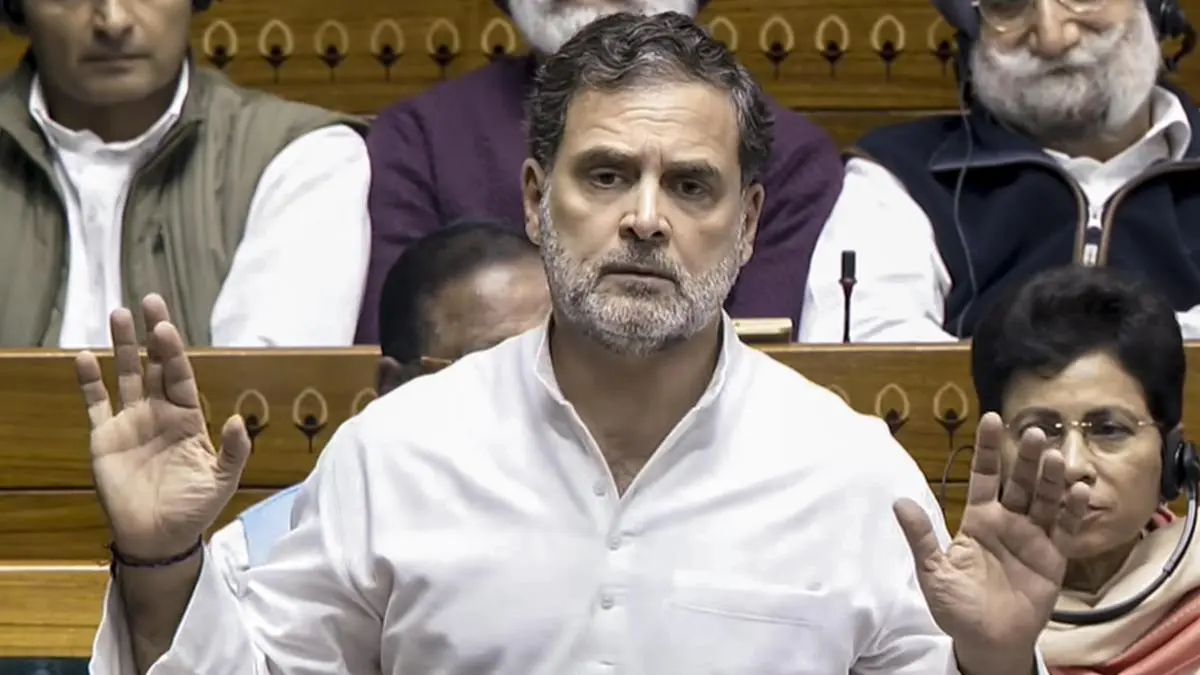
Leader of Opposition in the Lok Sabha, Rahul Gandhi, speaks during a discussion on election reforms in the Winter session of Parliament
| Photo Credit:
PTI
Parliament on Tuesday witnessed an intense confrontation between the opposition and treasury benches as the Lok Sabha took up a debate on electoral reforms, with Leader of Opposition Rahul Gandhi launching a pointed critique of the government, the Election Commission and the RSS, triggering sharp protests from the ruling side.
The discussion, held amid the ongoing Special Intensive Revision (SIR) of electoral rolls, often invited uproar as opposition MPs accused the government of undermining democratic institutions, while members of the ruling NDA countered that the opposition was attempting to delegitimise India’s electoral system.
Vote equality
Opening the debate in the Lower House, Rahul Gandhi underscored the centrality of free and fair elections to the Indian republic, describing India as “a fabric woven together by the vote.” Drawing on Mahatma Gandhi’s symbolism of khadi, he said the country’s unity rests on the equal value of each citizen’s vote.
“Khadi is not just a cloth; it is the expression of the people of India,” he said. “Our nation is a fabric made up of 1.4 billion people, and the fabric is woven together by the vote… None of our institutions—Lok Sabha, Rajya Sabha, Vidhan Sabhas, panchayats—would exist if the vote did not exist.”
Gandhi said the equality embedded in India’s democratic ethos is what “disturbs” the RSS.
The House erupted when Gandhi accused the RSS of believing in a hierarchical worldview.
“They do not believe in equality, they believe in hierarchy and believe they should be on top,” he said, prompting loud objections from BJP MPs. Gandhi went further to allege a “wholesale capture of India’s institutions” following Mahatma Gandhi’s assassination, alleging that key democratic pillars had been systematically influenced.
Union Minister Kiren Rijiju interjected midway, accusing the Congress leader of digressing from the subject. “The LoP has not made a single remark on electoral reforms,” Rijiju said, drawing counter-protests from the opposition.
Returning to the subject of electoral reforms, Gandhi accused the BJP of “directing and using” the Election Commission. He posed three questions to the government which he has in the past as well:
Why was the Chief Justice of India removed from the selection panel for Election Commissioners?
Why was the law changed to grant immunity to the Chief Election Commissioner?
Why are poll schedules allegedly set to suit Prime Minister Narendra Modi?
He argued that the new selection structure — placing the Prime Minister and Home Minister on one side and the Leader of Opposition on the other — created an “unfair imbalance.”
Members of the ruling coalition, the NDA, strongly countered the opposition’s claims. TDP MP Lavu Sri Krishna Devarayalu accused opposition parties of double standards on EVMs.
“No one asked about vote chori when the Congress won in Telangana or Karnataka,” he said. “These questions only arise when results do not go their way.”
JD(U) and other NDA members also accused the opposition of undermining public trust in the Election Commission instead of proposing constructive reforms.
Union Minister Rajiv Ranjan Singh defended the electoral system unequivocally, saying, “Our election process is the best in the world, and there is no scope for any improvement in it.”
Attack on SIR
Trinamool Congress MP Kalyan Banerjee launched a strong attack on the ongoing SIR exercise, alleging that it was “only meant to delete electors, not authenticate them.” He questioned the logic of removing voters whose names existed in the 2024 rolls but not in older records.
He also criticised the use of digital applications to determine familial relationships, asking, “Will an app decide who will be my relative?”
Banerjee further cited alarming accounts of stress-related deaths among Booth Level Officers due to workload, claiming that 20 suicides, 19 deaths, and several critical illnesses had occurred in West Bengal alone, with additional cases across Uttar Pradesh, Madhya Pradesh, Gujarat, Rajasthan, Kerala and Tamil Nadu.
Samajwadi Party chief Akhilesh Yadav echoed these concerns, reporting that 10 BLOs had died in Uttar Pradesh during the SIR process. He demanded ₹1 crore ex gratia and a government job for the families of each deceased BLO.
Reiterating the SP’s long-standing position, Yadav called for a return to ballot papers, saying, “Many questions are being raised on the use of electronic devices.”
Published on December 9, 2025
