

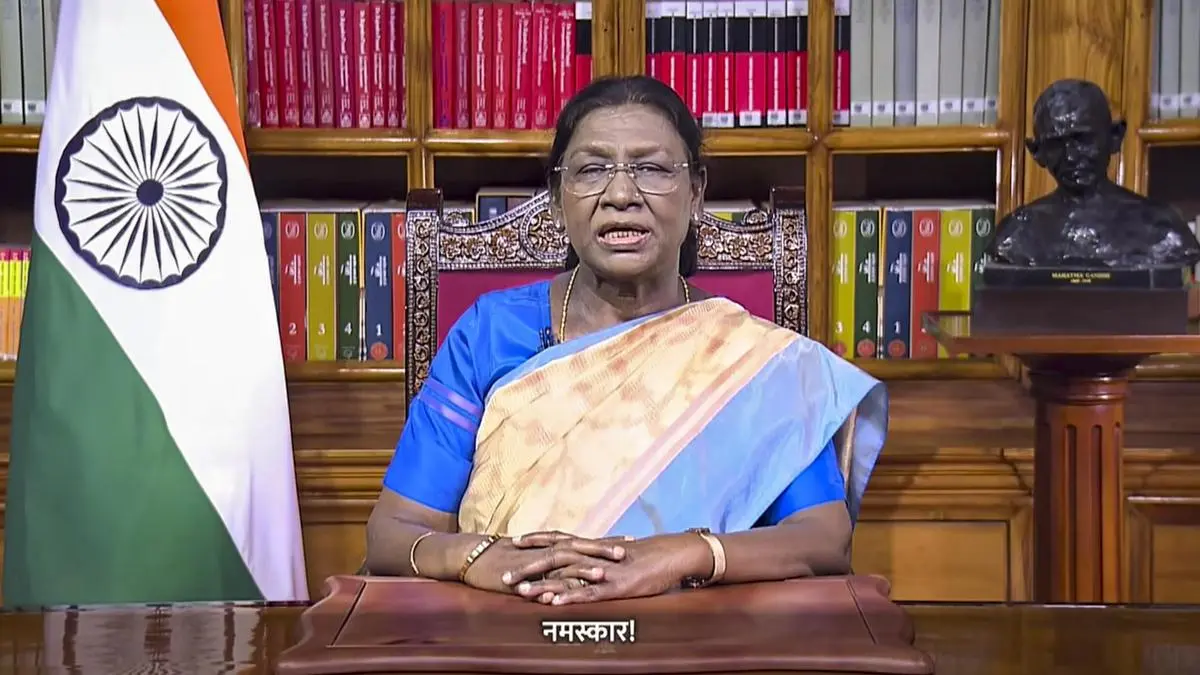
President Droupadi Murmu addressing the nation on the eve of the Republic Day
| Photo Credit:
PTI
President Droupadi Murmu on Sunday said that building a Viksit Bharat is a shared responsibility of all citizens, and outlined the steps being taken by the central government to steadily reduce the gap between the government and the people.
In her address to the nation on the eve of Republic Day, the President said the government is placing strong emphasis on good governance founded on mutual trust. “Many unnecessary rules have been repealed, several compliance requirements have been eliminated, and systems have been simplified to make governance more people-friendly. Beneficiaries are being directly connected to facilities through technology. ‘Ease of Living’ is being prioritised with the aim of improving everyday life,” she said in her televised address.
Over the past decade, sustained efforts have been made to achieve national goals through public participation, she said. Several key national campaigns have been transformed into mass movements, while local institutions in villages and cities have been empowered to act as instruments of progressive change.
Video Credit: PTI
“Building Viksit Bharat is the shared responsibility of all citizens. Society has immense power. Revolutionary change takes place when the efforts of the government receive active support from the people,” Murmu observed.
Citing an example, the President said citizens have adopted digital payment systems on a massive scale. Today, more than half of the world’s digital transactions take place in India. From purchasing goods at the smallest shops to paying for auto-rickshaw rides, the widespread use of digital payments has become an impressive example for the global community. “I hope all citizens will actively participate in achieving other national goals in a similar manner,” she added.
The President also said India is on course to become the world’s third-largest economy, largely due to the government’s push for major policy reforms, creation of world-class infrastructure, introduction of four labour codes, and the reform of GST that ushered in the concept of ‘One Nation, One Market’.
In shaping the country’s economic destiny, Atmanirbharata and Swadeshi remain the guiding principles, she said.
“The implementation of GST—the most important decision for the country’s economic integration since Independence—has established the system of ‘One Nation, One Market’. Recent measures to further strengthen the GST framework will provide additional momentum to the economy. The issuance of four Labour Codes will benefit workers while also accelerating the growth of enterprises,” the address said.
Published on January 25, 2026
