

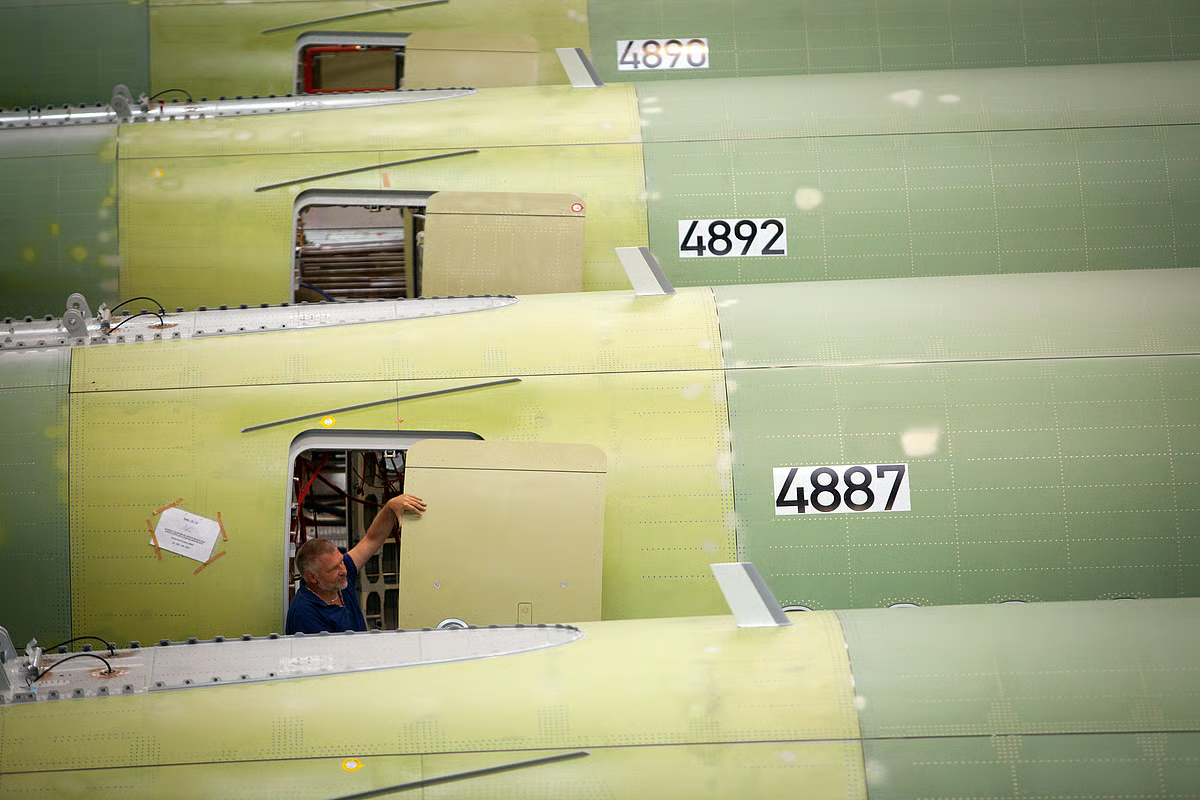
Airbus SE must inspect hundreds of its bestselling A320 jets for potential quality flaws in the aircraft’s body, an arduous process that risks complicating the company’s last-ditch effort to meet its delivery target.
A total of 628 jets contain panels that may be too thick or too thin due to a manufacturing issue at a supplier, Airbus told A320 customers in a roughly hour-long presentation last week. Most of those aircraft are still at Airbus, with 245 on the final assembly line or being prepared for delivery while 215 are in earlier stages of production, according to materials from the presentation that were seen by Bloomberg.
Another 168 planes are in service with carriers, Airbus told customers during the presentation. Airbus said in the presentation that a “significant proportion” of panels are expected to conform to its specifications, meaning they will acceptable in their current state.
Airbus said earlier on Monday that it is taking “a conservative approach” by inspecting all aircraft potentially affected by the issue, adding that “only portion of them will need further action to be taken.”
Still, the new issue comes at a crucial time the European planemaker. Airbus is racing to meet its goal of handing over 820 planes to customers this year. To do so, it must deliver a record 165 jets over the next four weeks. The extra inspections will be time-consuming and risk slowing down delivery of newly produced jets. The affected sections don’t have serial numbers, making any defects harder to trace.
The revelations about the quality discrepancies also come just days after Airbus was forced into its largest recall ever, also involving the A320. More than 6,000 of the jets were found to require an urgent software revision after Airbus determined the latest version could malfunction under intense solar radiation.
The vast majority of aircraft received the software revision over the weekend, keeping disruptions to a minimum.
Seville, Spain-based Sofitec Aero SL provided the affected parts to Airbus, according to the presentation. The company is one of the planemaker’s two suppliers of the panels.
Airbus will issue inspection instructions in a so-called Alert Operators Transmission later this month, the presentation said.
This isn’t the first time a planemaker has grappled with minute structural defects. Airbus rival Boeing Co. halted deliveries of its 787 Dreamliner earlier this decade after finding tiny gaps in some joints in the plane’s fuselage, while the Airbus A380 super-jumbo required rework on its wings after tiny cracks were observed.
The panels at issue are found on the crown of the A320 and either side of the aircraft’s main front door. Airbus engineers determined that the issue doesn’t pose a safety concern for planes that have not been delivered, according to the presentation.
Aircraft with panels that don’t meet specifications can still be delivered, although the panels will need to be replaced at a pre-determined date, a person familiar with the matter said.
The issue may pose an airworthiness risk for the in-service fleet on planes with panels that are too thin in places that subsequently had additional material removed during later repairs, the document said. Airbus said in the presentation said the risk of a “rapid decompression” was unlikely but “cannot be excluded” at the moment.
