

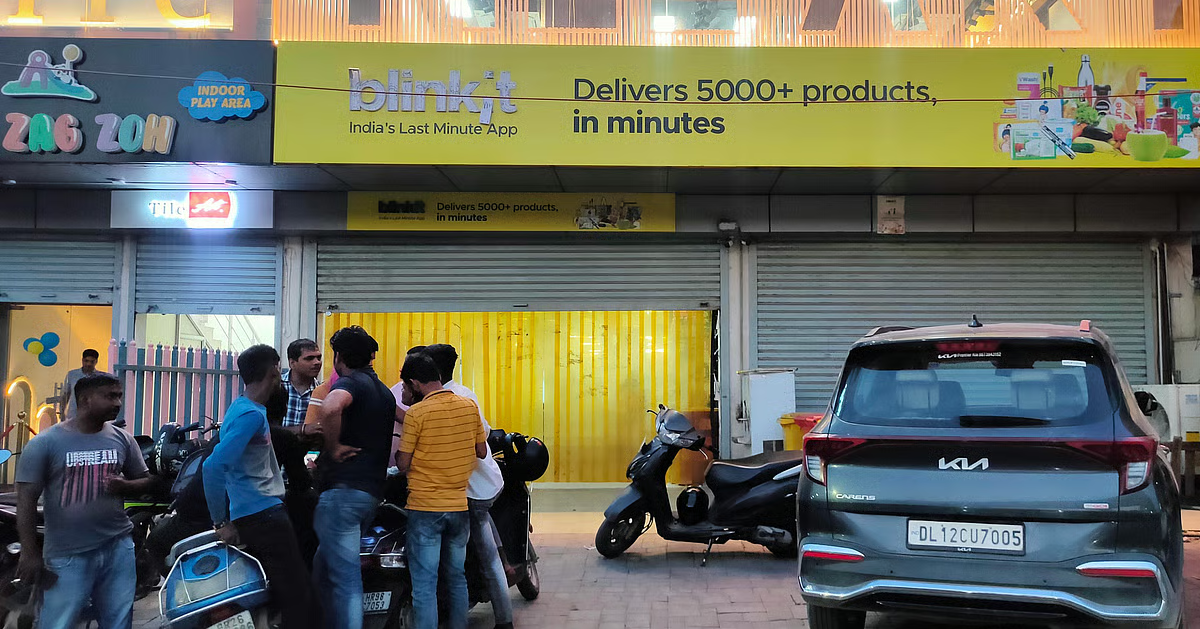
The head of India’s biggest quick commerce player says the sector is hurtling toward a shakeout as rivals’ cash dries up, but that his startup will thrive — and continue its expansion.
A model that has so far relied on relentless fundraising is nearing its limits and companies will soon have to decide how long they can keep absorbing steep losses, Blinkit Chief Executive Officer Albinder Dhindsa said in an interview.
Global investors including SoftBank Group Corp., Temasek Holdings Pte. and Middle Eastern sovereign funds have poured billions into the sector, making it the world’s most closely watched experiment in rapid deliveries. Similar ventures across the US, Europe and other parts of Asia have unraveled. India’s dense cities, lower cost of labor and ubiquitous digital payments offer an edge, but the economics depend on logistics efficiency and continued access to capital.
Investors have been cautious even as funding needs climb. Swiggy Ltd., Blinkit’s smaller rival, is preparing a $1.1 billion share sale barely a year after its $1.3 billion market debut — at roughly the same as its IPO price. Competitor Zepto has raised $450 million ahead of a planned initial public offering next year.
Both situations underscore the cash required to fuel deliveries of everything from eggs to iPhones in 10 minutes.
“Usually when this kind of imbalance exists, the correction is very swift,” Dhindsa told Bloomberg News. “It often catches people by surprise.”
Swiggy’s upcoming sale — its stock still trades close to its IPO price — shows how investors are rethinking the risks of a business long propped up by easy capital used to fuel rapid expansion.
A correction could remake India’s consumer tech landscape, testing how much demand for fast deliveries is driven by discounts and which firms have created differentiated services people are willing to pay more for.
Analysts at Bernstein Societe Generale Group last month said Eternal Ltd.- owned Blinkit has emerged as the long-term frontrunner, citing execution, strong unit economics and more than $2 billion in cash. Still, they warned that rising competition could force heavier investment before the company turns free cash flow positive. Blinkit remains unprofitable, despite its cash pile, as it keeps investing to enter new markets.
The boom has also drawn in Amazon.com Inc., Walmart Inc.-controlled Flipkart and tycoon Mukesh Ambani’s Reliance Retail Ltd., intensifying competition in major cities. Fragmented supply chains, limited cold chain capacity and uneven procurement networks still make Indian quick commerce structurally distinct and more challenging than legacy e-commerce.
Dhindsa expects the line between traditional online retail and quick commerce to blur with time. Blinkit still hosts thousands of third-party sellers and stocks everything from refrigerators to more than 6,000 book titles. He said the company will only expand into categories where it can fix issues such as returns or sizing in fashion and earn a real “right to win.”
Blinkit plans to keep investing as demand spreads to smaller towns, which are home to a significant portion of India’s population. But in more rural areas, more robust supply chains and clusters of dark stores — small warehouses strategically placed to fulfill orders — are needed before markets become efficient. Infrastructure, not demand, is the real constraint, he said.
To build that infrastructure, Blinkit is shifting procurement on its network toward local entrepreneurs who run aggregation businesses supplying fruits and vegetables. That also creates semi-skilled jobs such as in warehouses and draws more workers back to their hometowns.
The challenges and opportunities in the sector are widening, though: India is the only major market where rapid delivery is still scaling quickly, yet it also has some of the highest competitive cash burns. Dhindsa said Blinkit has internalized lessons from some of his previous struggles, where heavy discounting inflated demand but damaged economics.
“We will not chase growth for the sake of growth,” he said. “We will not do anything that is not in the long term interests of the business.”
He expects a sector reset as companies reconcile ambition with capital costs and supply chain complexity. Consolidation, sharper category selection and changes in discounting may define the next phase, he said.
“The pendulum has already swung once from skepticism to exuberance,” Dhindsa said. “Whether the correction comes in three months or six months or next week, I do not know, but it will come.”
