

Unlock the Editor’s Digest for free
Roula Khalaf, Editor of the FT, selects her favourite stories in this weekly newsletter.
As stock market valuations richen despite almost palpable unease among many investors, the nagging question as to whether we’re now in a bubble continues to circulate.
Sure, Mark Zuckerberg reckons “collapse” is “definitely a possibility” and Sam Altman thinks “some investors are likely to lose a lot of money”. But what do they know? Frankly, what does anyone know?
But in the spirit of cataloguing the interesting times in which we live rather than actively calling the top, grizzled markets veteran Paul McNamara pointed out on Bluesky that today’s big M&A deal — Netflix’s $83bn takeover of Warner Bros Discovery — feels a bit familiar:
© BlueSky
Let’s take a look at previous M&A involving Warner to see if there’s something in this.
First on our list is when Time Inc merged with Warner in a deal that completed on January 10 1990. This created what the NY Times called the “largest media and entertainment conglomerate in the world”. Nine months later the S&P 500 price was 11 per cent lower, and the Nasdaq had lost a fifth of its value.
But both indices were back to making new highs within a few months. If anything, the Time Warner merger was a harbinger of good times (albeit possibly not for the company’s own shareholders).
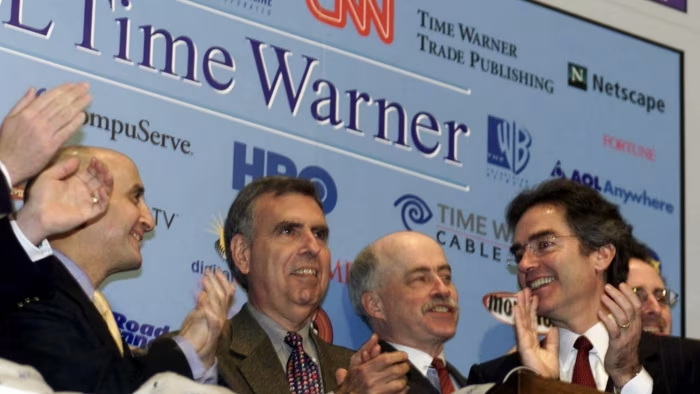
A decade later, to the day, America Online announced plans to acquire Time Warner for $182bn to create a $350bn behemoth, back when $350bn made you a behemoth.
The deal is now famous mostly for the disaster it wrought on its investors. And this was pretty peaky stuff. Over the next two and a half years the S&P 500 lost 44 per cent and the Nasdaq over three quarters of its value.
While new highs were (briefly) reached for the S&P 500 — just before the global financial crisis again eviscerated stock holders paper wealth — it took a good 16 years before the Nasdaq regained its Y2K trading value.
The next time Time Warner was bought was in June 2018, this time by AT&T. Third time’s the charm: no stock market crash (we can’t really blame AT&T for Covid-19). Although maybe this deal doesn’t really count as it had been basically unpicked by 2021. It certainly proved another omnishambles for AT&T shareholders though.
Of course, 1/3 is a better track record than most forecasters. We don’t know what will happen this time, but would caution anyone from extrapolating two and a half data points into Nostradamic insight about the future [ed note: booooo].
And we’ll also leave the question as to whether Netflix — which has lined up $59bn of bridge loans to buy Warner Bros in the cash/ stock deal — represents good value for money or in any way calls the top of the market. But here’s an exchange from the Netflix analyst call that has just ended:
Analyst:
I think I just have to ask, you know, Greg, you came to the Bloomberg conference and you made a very specific quote that there is a long, long history of media transactions that do not end well. I guess for everyone listening, why is this going to end differently than every other media transaction essentially of this scale in history?
Greg Peters, Netflix Co-CEO:
. . . I think it is true, like historically, many of these mergers haven’t worked. Some have. But you really got to take a look at this on a case-by-case basis. A lot of those failures that we’ve seen historically is because the company that was doing the acquisition didn’t understand the entertainment business. They didn’t really understand what they were buying. We understand these assets that we’re buying. Things that are critical. And Warner Brothers are key businesses that we operate in. And we understand.
The final postscript has to go to former Time Warner CEO Jeff Bewkes though, who in late 2010 shrugged off the success of a small but rising rival called Netflix, telling the NYT: “It’s a bit like, is the Albanian army going to take over the world? I don’t think so.”


