

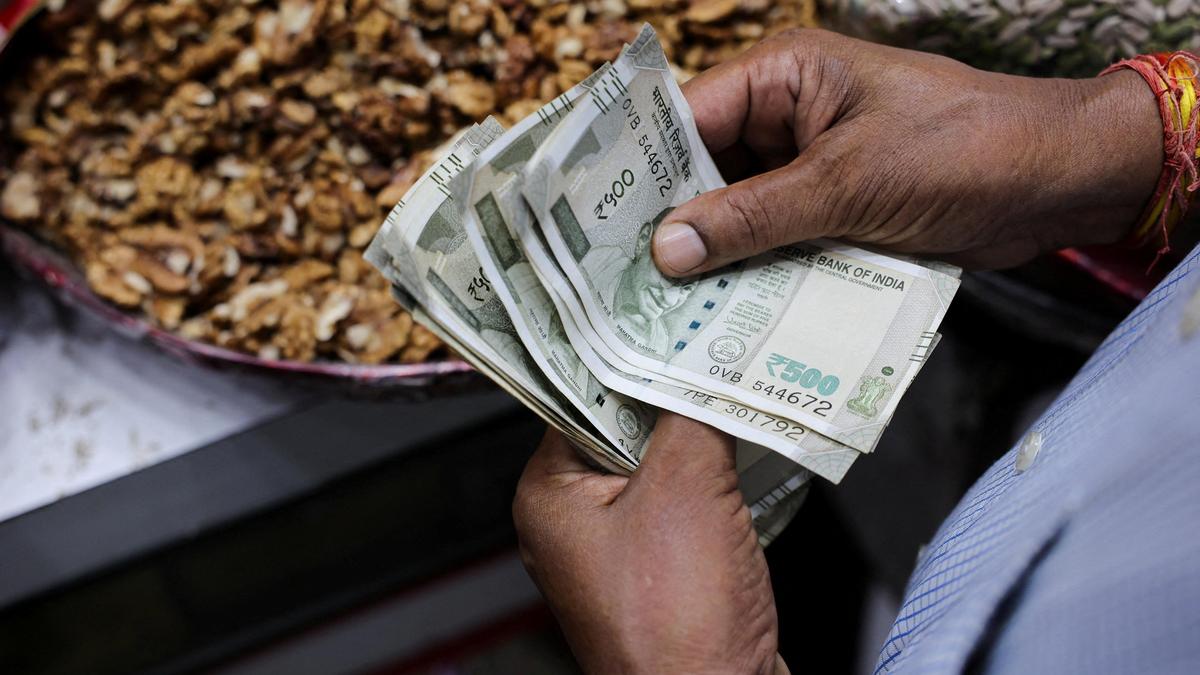
The RBI has addressed market concerns around the potential drying up of liquidity in the near term
| Photo Credit:
ANUSHREE FADNAVIS
With inflation at a series-low, the Monetary Policy Committee (MPC) unanimously decided to cut rates by 25 basis points (bps) to 5.25 per cent in its December 2025 meeting, while keeping the stance unchanged. Although the soft CPI inflation prints for September and October, and the lowering of the forecasted inflation trajectory, had opened space for rate cuts, we had expected another pause, considering the strength of the economic growth that was revealed by the recently released GDP data.
The MPC’s commentary around inflation outcomes was expectedly benign. The forecasts for CPI inflation for Q3 and Q4 FY26 were cut by 110-120 bps, while that for Q1 FY27 was pared by 60 bps. The projections for H1 FY27 are anchored around the 4 per cent-mark, in line with ICRA’s estimates, suggesting that while the trajectory is expected to remain upward sloping, the outcomes are likely to remain decidedly comfortable, around the mid-point of the RBI’s medium term target inflation range.
Interestingly, the policy document also stated that the decline in inflation has become more generalised; around 80 per cent of the CPI basket (by weight) recorded sub-4 per cent inflation prints in October 2025 vs. around 63 per cent in April 2025. However, this generalisation was partly driven by the favourable impact of the GST rate cuts, with more than half the items in the CPI basket witnessing a sequential dip in prices in October.
GDP growth projections
While the MPC acknowledged the stronger-than-expected growth outcomes in Q2 FY26, it chose to focus on the expected near-term softening in the same to cut rates. While it raised its GDP growth projections for Q3 and Q4 FY26, and Q1 FY27 by 30-60 bps, the pace of expansion is expected to moderate from the 8 per cent seen in H1 FY26.
The MPC’s GDP growth forecast for FY26 now stands at 7.3 per cent, marginally lower than ICRA’s estimate of 7.4 per cent. Thereafter, it expects growth to remain robust at 6.7-6.8 per cent in H1 FY27. The Committee also highlighted two-way risks on account of external uncertainties, with a potential upside from a trade deal with the US.
Overall, the revisions in the MPC’s inflation and growth projections were largely along anticipated lines. With these, we do not expect any further rate cuts to materialise unless unexpected developments lead to material changes, particularly, on the downside in its growth projections.
On the liquidity front, the RBI has addressed market concerns around the potential drying up of liquidity in the near term as the advance tax date looms. It will conduct OMO purchases amounting to ₹1 trillion and USD/INR Buy/Sell Swap auction of $5 billion that will lead to a durable liquidity injection of around ₹450 billion. In aggregate, the durable liquidity is estimated to increase by ₹1.5 trillion in the ongoing month. This is expected to ease pressures on account of advance tax and GST outflows, as well as further increase in currency leakage related to higher demand during the wedding season and agri crop procurement in Q4 of a fiscal year. These measures follow the 100 bps CRR cuts, which had pumped in liquidity of around ₹2.4 trillion during September-November 2025.
The 100 bps cut in the policy repo rate during February-June 2025 has pulled down the weighted average lending rate (WALR) of outstanding rupee loans of banks by 63 bps. On the deposit side, the weighted average domestic term deposit rate (WADTDR) on outstanding deposits has softened by 32 bps over the same period. The 25 bps rate cut accompanied with liquidity infusion measures would aid in policy transmission, putting further downward pressure on lending and deposit rates. However, the 10-year bond yield appears largely steady, in spite of the measures announced by the RBI.
While the dollar/rupee pair has crossed the 90-mark in recent sessions, we broadly concur with the RBI Governor’s assessment of the current account deficit printing at modest levels in FY26, notwithstanding some stress in the ongoing quarter.
The writer is Chief Economist, Head-Research & Outreach, ICRA
Published on December 6, 2025
