

A defence expert cited by the NYT said he could not recall a deployment to the region “that ever came close to 600, except for contingencies like invasions or natural disasters.”
With all that is going on in the world’s two main theatres of war, Ukraine and West Asia, both triggered principally by the US (alongside Israel in the latter case), it’s easy to forget that the US is also starting lots of new fires in its own “backyard”. Last week, the Trump administration announced the mobilisation of hundreds of Army soldiers to train local forces in the region as part of the Pentagon’s ostensible campaign to combat drug trafficking.
“Ostensible” because, as we noted in our Sept 26, 2023 post, “Back to Business As Usual: The US Is Once Again Vigorously Stirring the Pot in Its Own ‘Backyard’”, Washington’s ramping up of its war on Latin America’s drug cartels — which began under the Biden administration but has intensified massively under Trump 2.0 — has precious little to do with stemming the flow of drugs into the US, or tackling the escalating violence of drug cartels across Latin America:
If Washington was serious about that, all it would have to do is pass legislation to stem the southward flow of US-produced guns and other weapons. But that would hurt the profits of arms manufacturers. And if it was serious about tackling drug addiction, it would never have let Big Pharma unleash the opium epidemic in the first place. And once it had, it would never have let the perps walk free with the daintiest of financial slaps on the wrists.
No, this is primarily about what the US war on drugs has always been about: pursuing geopolitical and geostrategic dominance in key regions of the world while controlling and imprisoning for serious sums of money the restive populace at home. This is a point that is explained elegantly by Jorge Retana Yarto, a former director of the Intelligence School for National Security of Mexico’s Centre for National Intelligence (CNI), in an article for the news website Contralinea:
The ideology of the “war” on drugs and organized crime in the United States is an immense fabrication. That does not mean that the problems linked to the multinational trafficking of prohibited drugs and the criminal organizations that have specialized in it, and everything that this entails, do not exist. They exist and are very acute, but both phenomena were ideologized for the purposes of geopolitical and geostrategic dominance, and were imposed through exportable reactive and punitive public policies in matters of intelligence and security, causing social, political-institutional, cultural and economic devastation. By assuming a military dimension, (the War on Drugs) laid the foundations for armed intervention in the Latin American region and converted the territories, as well as national sovereignties, into areas of geostrategic action.
Trump’s designation of drug cartels as “narco-terrorist organisations” in the first month of his second term set the stage for the January 3 invasion of Venezuela and abduction of Nicolás Maduro on drug trafficking charges that were quickly watered down following his abduction, and much that has followed.
As the NYT reported a few days ago, the latest escalation involves mobilising a 600-soldier battalion from the 10th Mountain Division at Fort Drum, N.Y. to a new jungle training facility in Panama. To put that number in context, it exceeds the maximum number of troops stationed in Colombia during the most intense years of Plan Colombia, according to El Tiempo
From the NY Times piece:
The troops will eventually train with local forces in Colombia and Honduras, and could also support U.S. Special Operations troops advising militaries conducting raids against accused drug traffickers, the officials said.
In addition to the deployments to Central and South America, officials said that several hundred soldiers from the 10th Mountain were scheduled to help staff a new command for Western Hemisphere operations based in Miami.
Defense Secretary Pete Hegseth recently created a Pentagon office to help oversee the military’s counter-cartel activities.
The deployments and growing headquarters, which have not been previously reported, along with the Pentagon’s recent movement of several MQ-9 Reaper drones from Africa to Colombia and Ecuador, mark the latest widening of the Defense Department’s fight against drug traffickers in the region.
Adam Isacson, the director for Defense Oversight at the Washington Office on Latin America, a research group, said he could not recall any deployment of U.S. troops to the region “that ever came close to 600, except for contingencies like invasions or natural disasters.”
The moves also come as the Trump administration is urging leaders across the region to up their military offensives against trafficking groups, and to permit joint operations with the United States. The top U.S. military commander for most of Latin America, Gen. Francis L. Donovan, has said the United States plans to expand operations from strikes on boats to strikes on land.
The fact that the troops’ first port of call for this unprecedented mobilisation is Panama is hardly reassuring, given Panama’s previous role as the base of the US military’s notorious School of the Americas. On its home page, SOA Watch provides a brief recap of the school’s legacy, both in Panama and the region at large (machine translated):
The School of the Americas, which is operated by the US Army, was founded in 1946 in Panama with the goal of training Latin American soldiers in warfare and counterinsurgency techniques. More than 83,000 students have passed through its classrooms, many of whom have turned out to be prominent human rights violators in their own countries. This has been demonstrated in Chile, Guatemala, Argentina, Peru, Uruguay, Nicaragua, El Salvador, Mexico, Honduras, among others.
–
In 1984, the School of the Americas was moved to the State of Georgia in the United States at the request of Panamanian President Jorge Illueca, who described the School of the Americas as “the largest base for destabilization in Latin America.” In the same year, one of the main Panamanian newspapers dubbed it “The School of Assassins.” History supports these accusations.
–
Hundreds of thousands of Latin Americans have been tortured, raped, murdered, disappeared, massacred and forced to take refuge by soldiers and officers trained in that military academy. Graduates of the School of the Americas persecute educators, union organizers, religious workers, student leaders, the poor and peasants who fight for their rights.
–
In 1996, the U.S. press reported the existence of the Training Manuals, which were used in the military academy, which taught methods of “… torture, blackmail, extortion and paying rewards for dead enemies.”
So, why is the US sending an unprecedented number of troops to Latin America at this precise moment?
The answer is simple: it needs to enforce the Trump Corollary to the Monroe Doctrine, which asserts direct US political, economic, commercial, and military dominance over the Western Hemisphere. To do that, it needs to massively step up its military presence across the region, beginning in South and Central America.
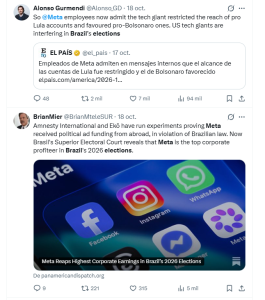
The past two years have witnessed a wave of US and Israel-aligned governments come to power in the region — with help from Israeli spy tech firms and US tech giants like Meta and Google. Endorsements of candidates from Trump, whether explicit or implicit, as well as his threats of dire consequences if voters pick the wrong party or candidate, have also played a part.
In another blast from the past, those same vassal governments are now lining up for funding from the IMF and the World Bank, which, as Bloomberg points out in the tweet below, have historically been “villainized” in the region for pushing fiscal austerity.
None of these policies are popular — at least not among the low or middle-income households that bear the brunt of the economic pain. Which is why approval ratings of the new populist right governments in Latin America tend to collapse within a matter of months, as we have already seen with Chile’s literal son-of-a-Nazi President, José Antonio Kast, and Kiki Fujimori, the daughter of former dictator and human rights violator, Alberto Fujimori.
The only way these vassal governments can possibly stay in power for the medium to long term is through the application of political and social repression. This is already playing out in Ecuador, which is further down the path than most other countries. The Andean nation gives a glimpse of where the rest of the region is heading under the Donroe Doctrine.
Ecuador was one of the first countries to request an IMF bailout (2019), which was allegedly part of a deal between Washington and Quito’s Lenin Moreno government to hand over Julian Assange to British authorities. It was also the first country in the region to sign a comprehensive Plan Colombia-style security pact with the US (2023) as well as throw its doors wide open to US troops and law enforcement agencies (2026).
The result has been an explosion of violence, to levels that even dwarf narco-dominated regions of Colombia and Mexico. As the Center for Economic Policy Research (CEPR) notes, “Ecuador has become a key testing ground for the Trump administration as it seeks to expand its so-called war on narco-terrorism beyond the illegal strikes in the Caribbean and eastern Pacific, which have killed at least 239 people”:
In recent months, security cooperation between Quito and Washington has reached heights unseen elsewhere in the hemisphere, encompassing direct US participation in land-based and maritime operations, the deployment of US troops to an Ecuadorian air base, high-level diplomatic visits, and sanctions on Ecuadorian targets.
Taken together, these developments reflect the approach outlined by SOUTHCOM Commander Francis Donovan in a September 29 interview with the Wall Street Journal, in which he said the US wants “all options at the table” in its engagement with regional partners, including “strikes, arrests.”
With the US backing his government to the hilt, Ecuador’s Miami-born President Daniel Noboa is doubling down on authoritarianism. His government has already banned the main opposition party, Rafael Correa’s Citizens’ Movement, from participating in upcoming local elections. Yesterday (Oct 21), Ecuadorian authorities detained the party’s former presidential candidate, Luisa González, and other senior figures on alleged corruption charges.
During the 2024 election debates, Gónzalez called for Noboa to take a drug test — which he declined — and revealed the president’s personal role and that of his family’s banana empire in transforming Ecuador into a narco state. As Gónzalez explained to a nationally televised audience, European authorities have repeatedly found tons of cocaine packed in Bonita Banana containers shipped from Ecuador.
CEPR provides a useful roundup of other recent developments in Noboa’s Ecuador:
- Inter-American Commission on Human Rights calls on Ecuador to “ensure pluralist political participation” while NYU’s Rule of Law Lab publishes report on threats to judicial independence posed by President Daniel Noboa.
- Critics accuse Noboa of unfairly using government spending to influence voters.
- Despite past abuses, Noboa declares new state of emergency and curfew for several provinces.
- Human rights experts highlight military’s refusal to cooperate with investigations into forced disappearances and allegations of sexual abuse in women’s prison.
- The National Assembly passes new legislation allowing the military to be deployed to support police without a state of emergency.
- Press freedoms threatened as major outlet stops printing after intense government scrutiny.
- US troops join Ecuadorian police in unprecedented raids and deepen presence at an Ecuadorian air base.
- US forces interdict fishing boats at least eight times, detaining and allegedly abusing their crews and destroying the boats.
- UN expert expresses concern regarding reports of violations of international law by US-Ecuador joint operations.
- US Departments of State and the Treasury impose sanctions and visa restrictions on Ecuadorian targets, while Secretary of State Marco Rubio pledges millions in new US commitments to Ecuador.
Lastly, a quick round-up of the main stories from across the rest of the region:
US sending hundreds of troops to Latin America as Pentagon widens anti-cartel campaign: Report
As the Military Buildup In Latin America Grows, So Do Tensions
(2) Fiorella Isabel en X: “Beyond a left vs right battle in Brazil is the battle for all of Latin America. Brazil is the last country in South America on the Epstein Donroe Doctrine hit list. Here’s a former Bolsonaro supporter telling everyone how Bolsonaro plans to sell Brazil to the US. https://t.co/LuEwUwndjb” / X
(2) Tamanisha J John en X: “CNN riding around with mercenaries in Haiti that are have thus far killed hundreds of Haitian civilians — while framing it as “exclusive access” to do a puff piece on the white supremacist, Erik Prince who has thus far made millions in “security” contracts in Haiti 🤮” / X
(2) Ollie Vargas en X: “I’ve always said that these right-wing govts in Latin America are the most fragile we’ve seen in a generation. They’re all approaching single digit approval ratings within 3 months max. They were ‘elected’ by foreign intervention and are rapidly impoverishing their populations.” / X
(2) GMWatch en X: “Colombia’s far-right President is on the verge of dousing the Amazon in glufosinate—linked to serious reproductive harm/banned in the EU. Local people have won a temporary court order to stop the govt. Support them via @Eko_Movement https://t.co/SywdEoyHeU https://t.co/SywdEoyHeU” / X
