

The Iranian Revolutionary Guard Corps (IRGC) hit at least one more tanker in the Strait on Friday, making last week’s narrative wars a distant memory.
Ansar Allah, for their part, hit more Saudi oil facilities, but Thursday’s airport attacks resulted in many airlines cancelling all flights to Saudi Arabia.
In Yemen, Saudi-backed forces claim to have taken Bab al-Mandeb and even Mocha, and Ansar Allah has issued denials of those claims, some quite convincing. Saudi bombing campaign continues in Yemen, to differing results based on who is describing them.
Putin also got involved, meeting with the Iranian President and cutting a diesel deal with Trump.
Iran Tightens the Vise
The IRGC claimed a hit on a giant LPG (Liquefied Petroleum Gas) carrier that had been using the “unauthorized route” south of the Strait of Hormuz. They claimed it had a large fire in the engine room, per Tasnim. Al Jazeera confirmed the report, saying it was a “massive fire.”
The IRGC holds the US military responsible and says Washington is “deceiving shipping and insurance companies and paying large bribes.” It says companies that cooperate with the US will be sanctioned.
They also say enforcement will “no longer be confined to the Strait of Hormuz. Any vessel using an unauthorized passage (will) be pursued throughout the region, and punishment would be certain.”
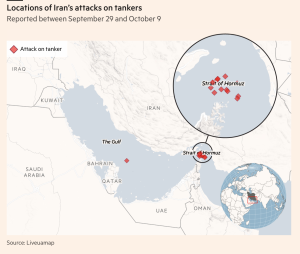
The FT got the memo, reporting Iran attacks tankers beyond Strait of Hormuz and publishing the map below:
The article mentions the attack near Fujairah, although the map doesn’t seem to show it:
Another vessel, Dhalkut, reported shooting nearby on Thursday while it was off the coast of Fujairah, the maritime security company Vanguard said. Fujairah has become a popular mooring for more risk-averse tankers waiting to pick up cargoes that have been shuttled out of the Gulf.
John Walker, head of advisory at EOS Risk Group, a security specialist, said that Iran was probably pushing attacks further into the Gulf to “remind Gulf states that the economic and security cost of supporting the US is not confined to Hormuz” as well as to diluting US air cover. “While US jets are busy in Hormuz, it’s easier to conduct successful attacks elsewhere,” he said.
Commodities platform Kpler said on Friday that flows had recovered to prewar levels in September but that “intensified attacks on tankers” had driven exports “sharply lower” this week. The seven-day average up to October 7 was 9.9mn barrels per day, 42 per cent lower than the prewar baseline and down from around 15.5mn barrels per day in September, Kpler said.
Reuters cites Kpler, saying transits are at the lowest rate in over two months. 7 commodity vessels crossed on Tuesday, October 6th, the lowest since July 23rd, and 10 on Wednesday, October 7th, against more than 20 a day on Oct 4th & 5th.
Crude through the strait was at least 10.1 million b/d, down 27% from the previous week’s wartime high and 74% of the pre-war level.
The IRGC released some videos that indicate some new drone tech is being used:
⚡️BREAKING: The IRGC has Released new Footage of Strikes against Oil Tankers in the Strait of Hormuz
The Shahed-238 (the next generation of the Shahed-136) has been deployed in combat for the First Time https://t.co/n1eIvcDo1K
— Iran Observer (@IranObserver0) October 9, 2026
Both Bloomberg and Tasnim report that Iran’s missile-building capacity remains formidable. But the differences are interesting. I recommend reading the full Bloomberg piece (archived), as they quote quite a few analysts expressing different views. I excerpted the more cogent ones below, but the full piece quotes the White House and multiple obvious canards.
Bloomberg:
Iran has managed to preserve its missile and drone factories despite months of US and Israeli bombing, officials familiar with the matter said, allowing it to replenish its arsenals while President Donald Trump holds off on strikes ahead of the midterm elections.
Tehran still has the capacity to manufacture weapons to rebuild its arsenal, according to the Western officials, who asked not to be identified discussing private assessments. One official said Iran remains well-stocked with ballistic missiles and some anti-ship weapons, and can quickly add more.
…
“There is probably less high-end stuff available, but they’ve been stockpiling cruise missiles for themselves and the Houthis for years, and hiding them,” said William Alberque, a Europe-based senior fellow at the Pacific Forum. “I’d guess with a fair bit of confidence that we haven’t seen the tip of the iceberg in terms of anti-ship attacks.”
…
“The actual anti-ship missile stockpiles likely remain large, both because they are comparatively easy to make, and Iran has in-housed much of the production of older Chinese ASCMs, and Iran’s southern mountains provide natural shelters against air attack,” said Sidharth Kaushal, a senior research fellow at the Royal United Services Institute.
Tasnim:
Iran’s domestic arms production increased 2.5-fold in the seven months following the US-Israeli war of aggression compared with the same period before the conflict, despite damage to some facilities, the Defense Ministry’s spokesperson said.
In comments at a television program, Brigadier General Reza Talaei-Nik said Iran maintains uninterrupted domestic production and supply for its Armed Forces throughout the war, attributing the increase to advance preparations for secure alternative production sites and the expanded role of private knowledge-based companies.
Iran relied on two key advantages: innovation and asymmetric defense, which he said contributed to the country’s victory and the enemy’s defeat, and economic defense, which enabled Iran to keep its costs far below those incurred by its adversaries.
Despite damage to some Iranian facilities as a result of enemy attacks, arms production rose 2.5 times over the seven-month period, Talaei-Nik said. He attributed the achievement to two effective measures.
First, he explained, secure alternative locations had been designated in advance, allowing defense industries and production lines to continue operating in safer areas.
The second factor was the mobilization of Iran’s private sector, particularly its network of more than 9,000 knowledge-based companies, the spokesman added.
Now on to Ansar Allah’s attacks on Saudi Arabia.
Saudi Oil Infrastructure Hammered
Tasnim reported a “massive fire” erupted at Abqaiq, Aramco’s main crude processing plant, which handled up to 7 million barrels (bbl) a day pre-war. Satellite images showed smoke rising from the facility as well as the Tanjib gas plant.
BREAKING: Yemen’s Houthis appear to have struck Saudi Arabia’s massive Abqaiq oil facility, the world’s largest crude oil processing and stabilization facility, with huge flames and smoke reportedly seen rising from the site.
The facility is one of the most important parts of Saudi Arabia’s oil system, with the 2019 attack on Abqaiq knocking out around 5 million barrels per day of crude production — nearly half of Saudi output and around 5% of global oil supply.
— The Hormuz Report (@HormuzReport) October 8, 2026
Reuters reports on expanding Saudi airspace warnings from Europe’s EASA and OPSGROUP, an organization of aviation professionals. While FlightAware counted 130 Riyadh flights cancelled Friday. King Khalid airport handled about 813 flights per day in 2025. CBS cites Reuters/Cirium saying that 49.7% of Riyadh departures were cancelled Thursday.
CBS lists Lufthansa, Air India, PIA, flydubai, Etihad, Emirates and Air Arabia as having suspended flights to Riyadh.
UK, France Germany, Australia and Canada are all advising against Saudi travel as are India and the Philippines.
Ansar Allah issued a statement allowing “Humanitarian flights to and from Riyadh Airport will be permitted for all flights that obtain authorization from the Operations Coordination Center for Humanitarian Affairs in the capital Sana’a.”
Meanwhile the fog of war was thick over Yemen.
Both Sides Claim Advances in Yemen
The Saudi ambassador and government sources say Bab al-Mandab and Mayyun (Perim) Island were cleared on 9 Oct.
Ansar Allah’s Brigadier General Yahya Saree says two Saudi-backed advances from Lahj toward Bab al-Mandab were repelled the same day. AFP says neither side’s military sources reported major changes on the ground.
Ansar Allah also claimed that Col. Muath Ali Saleh “al-Ma’ada,” commander of the 16th Giants Brigade and of the al-Dhale emergency forces, was killed by a missile strike near Bab al-Mandab along with his deputy, Lt. Col. Abdulrahman Khaled Hamoud.
On the Taiz front, Ansar Allah claimed more advances into the city itself, saying Saudi-backed forces have been expelled from “all areas of Jabal Habashi District.”
Saudi-aligned media disputes this with YNP saying “the forces loyal to the Islah party are entrenched” in Taiz but crediting Ansar Allah with taking the al-Masrakh district of the city. AFP merely describes it as “the government-controlled city” — sort of confusing since both sides claim to be the Yemeni government, so it helps to know which outlets are aligned with which side. AFP is definitely pro-Saudi.
Everyone agrees that the Saudis have been bombing Yemen heavily. They claim to have destroyed multiple Ansar Allah rocket launchers in Friday’s attacks.
The Ansar Allah press says the Saudi attacks killed six civilians, including a child and destroyed two factories.
Let’s wrap with a twofer from Russian President Vladimir Putin.
Putin Meets Pezeshkian, Promises Diesel for Trump
Pezeshkian met Putin Thursday evening (8 Oct) in Turkmenbashi, Turkmenistan, on the sidelines of the CIS summit and the Caspian environmental summit, per Press TV.
“Proposals were exchanged, both from our side and from the Americans, and we have made our own revisions to them. Once finalized, we intend to sit down with the relevant intermediaries to consolidate and conclude the matter,” said Pezeshkian. And “every time we talk to the US, they launch new attacks. Nevertheless, we will not walk away from the negotiating table.”
Putin also found time to cut a deal with Trump to release more diesel.
Per Trump’s Truth Social:
“I have just concluded a highly successful discussion with President Vladimir Putin, of Russia, wherein it was agreed that Russia will immediately supply over 300,000 Tons of Diesel Fuel to the American and Global Marketplace, another 500,000 Tons during the month of November, and 1,000,000 Tons immediately thereafter.”
That’s all for today. Stay safe, y’all.
Follow and support my work at NatWilsonTurner.com.
