

Yves here. This is a clever, well-written and persuasive article. The authors looked at job loss over a very long time, so as to include multiple waves of major technological change. It finds that most job types persisted even if the job content may have changed markedly for many, like accountants going from using green ledger paper to spreadsheets.
By William Skoglund, Post-doctoral researcher Uppsala University, Jakob Molinder, Associate Professor of Economic History Uppsala University and Kerstin Enflo, Professor in the Department of Economic History Lund University. Originally published at VoxEU
Forecasts of AI-driven job destruction rest on counting automatable tasks. But labour markets hire, pay, and fire whole occupations, not tasks – and occupations have proved far more durable than task exposure implies. Drawing on 140 years of Swedish census and register data, this column shows that roughly seven in ten workers today are in occupations whose core functions already existed in the late-nineteenth century. The mass-unemployment fear is overstated; the subtler question is whether today’s technological wave still generates the durable, specialised new work that earlier ones did.
Today, few economic questions command as much attention as how artificial intelligence will affect the economy and how it will reshape employment. The modern wave of alarm traces back to Frey and Osborne (2017), who estimated that 47% of US employment was in occupations at high risk of computerisation. Subsequent studies have been inspired by Acemoglu and Restrepo (2019), focusing on automation of tasks. Eloundou et al. (2024) find that large language models could affect at least half the tasks in around a fifth of US jobs; consultancies have produced their own automation-exposure maps; and the OECD has assessed how many high-exposure jobs were lost (Georgieff and Milanez 2021).
Much of this literature ultimately approaches automation through the tasks that make up jobs. Yet what technology can do to a task and what it does to a job are two different questions. A job is not a loose pile of independently substitutable tasks; it is a bundle the market prices as a whole. When some of a worker’s tasks are automated, the standard result is not that the worker disappears but that the job’s content shifts. Garicano et al. (2026) make exactly this point – AI redraws the boundaries of jobs rather than dissolving them – and the empirical record is by now familiar: AI changes the task content of work more than it eliminates the work itself. Humlum and Vestergaard (2025) find that, so far, AI chatbots have had remarkably small measured effects on earnings and hours.
If the labour market rewards occupations rather than tasks, then the right way to gauge technology’s true footprint is to ask how many people are actually employed in which occupations, and how that changes. That is the question we take to the long historical record.
What the Long Record Shows
In Skoglund et al. (2026), we trace the Swedish occupational structure from 1880 to 2019 using full-count censuses and administrative registers. We harmonise occupations across 140 years of data to a single occupational classification scheme (van Leeuwen et al. 2002). Instead of studying within-occupational task changes, we emphasise the function of an occupation. By this definition, a primary teacher from the 1800s has the same occupational code as a primary teacher from the 21st century, despite the tasks they perform having morphed over time.
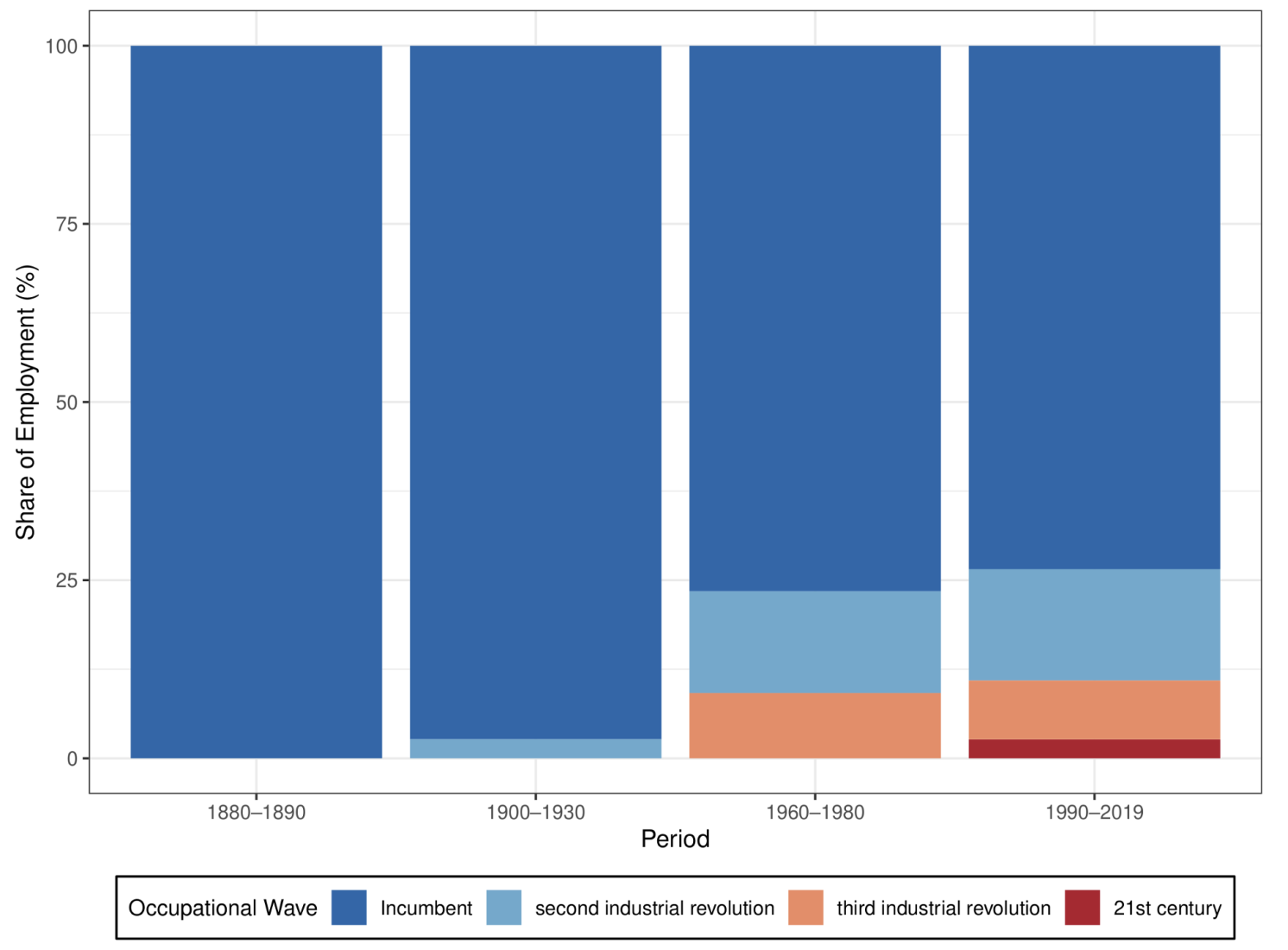
We classify occupations by when they emerged: present before 1900, during the second or third industrial revolutions, or in the 21st century. Despite these successive waves of technological change, the bulk of Swedish employment remains anchored in occupations that already existed before the second industrial revolution. By 2019, as Figure 1 shows, close to 70% of workers were still employed in these incumbent occupations. The largest occupations today, such as nurses or retail workers, are, in their economic function, the very occupations that organised work in the 1880s, even though their task content has been transformed beyond recognition. The carriage driver became the lorry driver; the clerk acquired a computer. The occupation persisted; the tasks did not.
This is not a Swedish peculiarity. Replicating the approach on US data, we find that occupations new since 1940 account for only about 9% of 2019 employment. That sits in apparent tension with Autor et al. (2024), whose title-based ‘new frontiers’ approach attributes a majority of current US employment to specialties introduced since 1940. The gap is methodological: their measure infers employment from the share of new micro-titles, whereas ours counts the people actually in each occupation. Tellingly, when Autor et al. (2026) move to person-level census data, the picture shifts decisively toward persistence – they find 18.3% of workers in 2011–2023 employed in work introduced since 1970, far below the title-share estimates and much closer to ours. Measured in people rather than titles, the occupational structure is old.
Figure 1 Share of Swedish employment by technological occupational wave, 1880–2019
Note: Occupations are harmonised to 5-digit HISCO; vintages are defined by the year a code first reaches 50 workers. “Incumbent” denotes occupations present before 1900, “Second industrial revolution” occupations that were new between 1900 and 1930, “third industrial revolution” jobs that are new from 1960 and “21st century” jobs that appear after 2000.
Source: Skoglund et al. (2026), from IPUMS Swedish censuses 1880–1910, the 1930 census, and FOB/LISA registers 1960–2019.
Where Durable New Work Actually Comes From
If occupations persist, where does new work come from? To understand this, we consider two distinct sources. Some new occupations are Schumpeterian – created directly by a new technology (electricians, computer programmers). Others are Smithian – created by the division of labour as markets grow and organisations get more complex (accountants, specialists, logistics workers).1 The general merchant of the colonial economy splits into shopkeepers, brokers and bankers not because trade is new, but because scale makes finer division of labour pay (Chandler 1978).
The crucial finding is that durable, well-paid employment accumulates overwhelmingly on the Smithian side. Smithian occupations are far more likely to survive: in our data, more specialised occupations are roughly half as likely to fall into decline, whereas occupations born in the most recent technological waves are several times more likely than incumbents to vanish – the punch-card operator being the textbook case. (It is membership in a recent technological wave, not a high ‘technology score’ as such, that carries the elevated risk.) The mechanism is a chain: technology creates scale, scale creates specialisation, and specialisation creates durable labour demand. We argue that the Schumpeterian sector raises productivity and enlarges the market but the employment it ultimately underwrites appears mostly elsewhere; as Smithian specialisation within enduring functions. This is also why the displacement fear might be overstated. The historical record shows that despite significant automation and technological change, occupations are strikingly persistent. And economic growth can still fuel the expansion of new Smithian jobs.
Signs of Decline
To understand where the labour market is headed, we gauge the age of Smithian and Schumpeterian occupations, building on the finding that declining occupations tend to also have an ageing workforce (Autor and Dorn 2009).
The very sector closest to innovation has matured significantly. Occupations born in the twenty-first-century’s digital wave remain a sliver of employment, and they are more volatile than their predecessors. Digital occupations have also aged. Computer programmers, once at least a decade younger than the average worker, have aged to roughly the workforce average – a striking convergence for what was once the youngest corner of the labour market, and the demographic signature of an occupation that has stopped pulling in the young (Figure 2). Engineers, by contrast, have held steady near the workforce average since the 1930s – the ageing is specific to the programming and operator occupations born of the digital wave. The youngest workers are increasingly found not at the technological frontier but in low-specialisation service work.
Figure 2 Worker age relative to the workforce average, selected occupations, 1880–2022
Note: Employment-weighted mean worker age within each occupation group, demeaned by the year-specific workforce average; positive values indicate older than the average worker that year.
Source: Skoglund et al. (2026), from IPUMS Swedish censuses 1880–1910, the 1930 census, and FOB/LISA registers 1960–2022.
To further understand this, we trace earnings premia for different types of occupations. We find no earnings premium for being technologically new. The premium tracks specialisation: highly specialised occupations command large returns whether or not they are technology-intensive, and twenty-first century occupations pay no more than occupations inherited from the nineteenth century – slightly less. What the market rewards is the depth of the division of labour, not the novelty of technology.
What It Means for the AI Debate
So the genuine question is not the one dominating the headlines. It is not whether AI will displace workers from tasks – occupations, the unit the market prices, have historically repeatedly absorbed that kind of shock. It is whether the current technological wave will still do what earlier waves did: generate enough productivity and scale to spin off durable, specialised, well-paid new work. Earlier general-purpose technologies reliably converted innovation into broad employment through the division of labour. The digital wave, so far, has not visibly repeated the feat.
This shifts the AI and jobs debate from task exposure to actual changes in occupations and employment. Technology has historically changed jobs more often than it eliminated them, with much of the employment effect coming not from the new technological occupations themselves, but from the specialisation they made possible elsewhere.
That should lower the temperature on mass technological unemployment, but raise it on a quieter concern. The open question for AI is whether it can sustain the older bargain: turning productivity gains into new, specialised work through a deeper division of labour.
See original post for references
