

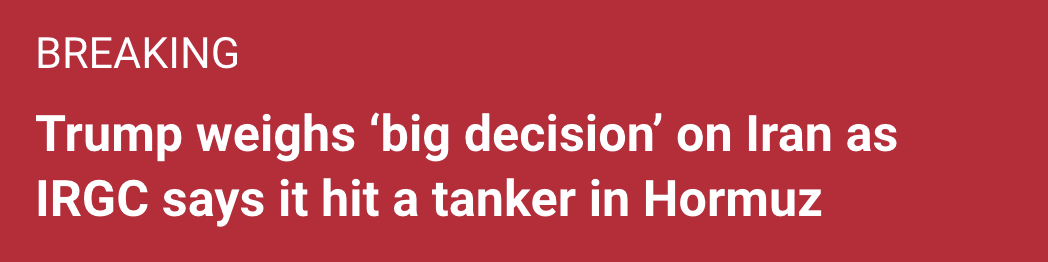
Trump made clear in the interview that he wants to use the meeting at the UN to hear directly from regional allies about the war’s next steps.
Driving the news: In early August, Trump held off on resuming major combat operations after Saudi Arabia and Qatar expressed concern that Iran would bomb Saudi oil and gas facilities in retaliation….
State of play: Trump and Secretary of Defense Pete Hegseth have ordered the military to maintain its level of forces in the Middle East until the end of the year, U.S. officials say, to remain ready for a potential return to full-scale combat.
- The officials say Trump needs to decide soon on the way forward, partly because the U.S. military can’t stay in its current holding pattern much longer. “At some point, you have to decide what is the endgame,” one of the officials said…
The big picture: The White House has also been working on a post-war strategy that calls for a regional effort to contain Iran while expanding normalization of relations between Israel and its neighbors.
In other words, Trump intends to press the Gulf states and have them risk much deeper damage to their economies for the privilege of having the US bomb Iran hard again.
But US interests are vulnerable too. From ars techinca in Iran strikes on Amazon data centers caused permanent loss of customer data:
Half a year after Iranian drone strikes knocked out multiple Amazon data centers, the US tech company has acknowledged the permanent loss of some customer data that was hosted in Bahrain and the United Arab Emirates.
Amazon Web Services was “unable to restore access to the resources and data” hosted in some of the war-damaged data centers, according to an AWS dashboard update posted on September 15. The development was first reported by Reuters and suggests that the Iranian strikes inflicted catastrophic damage on the data centers.
Customer data was irretrievably lost in one of three AWS availability zones in the United Arab Emirates region, specifically the mec1-az2 availability zone. Each availability zone is serviced by one or more Amazon data centers.
The company is still working on “recovering regional resources” and restoring resources hosted in the other two availability zones in the United Arab Emirates. The AWS update described ongoing work to replace “affected infrastructure” and promised to update customers on a restoration of services in the coming months.
But the destruction was apparently even more widespread for the data centers in the Bahrain region, because Amazon said it was unable to restore access to resources and data across all three availability zones there.
And:
Back to the Aljazeera live feed. From its overnight wrap up:
- South Korea has ruled out military deployment for any intervention in the US-Iran war that could potentially draw the country into conflict.
- Only four cargo ships crossed the Strait of Hormuz on Thursday, down from six the previous day and well below the 10-day average.
- Oil prices slid about 1 percent, falling below previous peaks but remaining above $100.
- Several Israeli air attacks have been reported across southern Lebanon, including in Nabatieh al-Fawqa and the Jinjil area of al-Qantara.
- A UN official says the US-Iran war has cost Arab economies about $150bn in the first month alone, while speaking at a UN Security Council meeting.
The South Korea decision to sit this one out is surprising. Most commentators had assumed South Korea would send a token force to placate the. This is yet more proof of the fallen status of the US with its putative allies.
The US tried another stunt at the UN, of pretending the JCOPA had no expired in October 2025 as a foundation to launch new UN sanctions against Iran. China and Russia vetoed on procedural grounds:
BREAKING: Russia and China have vetoed a US draft resolution at the UN Security Council to extend the mandate of a committee that oversees sanctions on Iran
🔴 LIVE updates: https://t.co/bqrEgIs0cb pic.twitter.com/7zeEIC3VG5
— Al Jazeera Breaking News (@AJENews) September 17, 2026
Empty rhetoric from the Bahraini representative at the Security Council: Iran and its proxy forces have turned our region upside down.
🔹 Russian representative to the Security Council: “Snapback” sanctions against Iran have no legal basis.
🔹 British representative to the… pic.twitter.com/1B7kiOYIbh
— 𝕊𝕡𝕣𝕚𝕟𝕥𝕖𝕣 𝕻𝕣𝕖𝕤𝕤 (@SprinterPress) September 17, 2026
However, the US is getting its way elsewhere:
On the Ansar Allah-Saudi from, from JH on Twitter:
Some takeaways based on the latest Kpler data:
1) Even if Riyadh brings ~50% of pipeline flows back online quickly per their guidance, Red Sea export availability is going to remain heavily capped given Western coast inventories.
They’ll want to avoid run cuts at domestic refineries in the West, so if refiners get first dibs on crude allocations, export stems out of Yanbu get squeezed even further.
Riyadh is backed into leaning even harder on Ras Tanura/Juaymah, where liftings were already ramping up. Naturally the upper bound of how many physical barrels they can actually flush out hinges entirely on safety through the Strait.
2) Like I’ve been pounding the table on, more crude is actively forcing its way through Hormuz. It’s an undeniable, objective fact at this point—satellite imagery, proxies, tenders all point to the exact same thing. Anyone still denying this isn’t even worth engaging.
3) Bahri was already quietly throwing in the towel on the Red Sea and redeploying tonnage toward the Gulf of Oman anyway. That structural repositioning should provide some breathing room against tonnage crunches. Offers a bit of a silver lining for the Saudis.
It is reported that during Prince bin Salman’s visit to Cairo, the President of Egypt, as advice, suggested that he begin negotiations with the “Ansar Allah” movement. He made it very clear to the Crown Prince that the best course of action is dialogue with “Ansar Allah,” as the… pic.twitter.com/90Yt9u990H
— 𝕊𝕡𝕣𝕚𝕟𝕥𝕖𝕣 𝕻𝕣𝕖𝕤𝕤 (@SprinterPress) September 17, 2026
From Patricia Marins on Twitter. Note her assumption that Iran and Ansar Allah are working fist in glove. Yours truly doubts that. First, the Ansar Allah lightening territory captures was the direct result of the Saudis attacking the Saana airport in an attempt to bar mourners who’d attended the Khamenei funeral from returning. Second, many commentators were perplexed that Ansar Allah had not acted more aggressively to open a second front against the US/Gulf interests sooner. Most believed it would have considerably advanced Iran’s cause.
JD Vance has entered the talks with the Yemenis. What everyone already knew would happen has happened: the war in Yemen has sent oil prices soaring.
But there is nothing Vance can do, because this is a situation that can only be resolved in Tehran.
Talks between Riyadh and Tehran began yesterday to deal with the problem.
And why did the Trump administration allow the situation to get this far? Because it calculated that the GCC would fear a drawn-out conflict and accept a deal with Iran in which it picked up the bill for the war. (Now it’s all about who pays the bills.)
That did not happen, and the administration now fears that oil prices will weigh even more heavily on Trump’s already eroded popularity.
There is no problem to be solved in the Middle East today that was not created by the war itself. No one talks anymore about those original war aims.
Yahoo reported on a few diesel shortages in the US, in the form of some stations having no supply. And some independent media commentators are running with the story as if this is a precursor to bigger US diesel shortages.
That is na ga happen unless the Trump Administration completely botches the situation, which is possible. The US is a structural exporter of diesel. The refineries are shipping product like crazy to Europe. The US could quickly increase domestic inventories and reduce diesel prices if it capped or barred exports.
The US shortages are in a handful of rural spots which are likely at the end of delivery routes. This looks to be more the result of people in those areas (and one assumes elsewhere) stockpiling to get in front of expected further price increases.
Some tidbits:
🤡🌍 Silly Bibi. Israel is a little vulnerable speck of a country with no means to credibly defend itself against its increasingly powerful foes.
And now its only powerful friend in the world has been reduced to an empty shell by the same Iran Bibi aspires to bring to its knees.
— Will Schryver (@imetatronink) September 18, 2026
From Aljazeera’s live feed. Even though Ansar Allah has said it is only targeting Saudi vessels, it seems some ship operators sought and got stronger protection:
Italy to deploy warships to protect shipping through Bab al-Mandeb
Italy will deploy warships to ensure safe passage for its commercial vessels through the Bab al-Mandeb strait, Defence Minister Guido Crosetto has said, adding that Rome would not wait for a joint decision from the European Union.
“We have the capabilities to protect the passage,” Crosetto said, warning that if the waterway became impassable, the economic consequences would be severe.
