

[Today’s Iran war post launched before complete because reasons. Please return at 8:00 AM EDT or refresh this page then for a final version]
Too much is happening in what ought to be a summer doldrums period, due to Trump’s preferred mode of operation, that of being a chaos generator in the hope of throwing opponents off balance, instead making his and the US’ poor situation even worse than it would otherwise be. Iran has now said it is fully closing the Strait of Hormuz.1 It is also making new threats about how ferocious its response to any nuclear attack would be, as well as growling at Europe. The Saudi-Ansar Allah conflict is intensifying in Yemen. Israel just struck an airbase in Syria where Israel alleges Turkiye forces were stationed.2 Those who have been following Israel’s overweening Greater Israel plans know that Israel has been openly and repeatedly depicting Turkiye as its next object for subjugation after Iran. Given how well Project Iran is going, one wonders about the probity of yet more overextension by mixing up things with Turkiye right now….save perhaps as what Netanyahu might regard as a voter-pleasing action in the runup to the October elections.
However, the fact that the direction of travel seems to be moving so relentlessly toward more kinetic action is also leading to some misreadings of particular actions and reactions.
We’ll also turn to the rising warning signs that a financial crisis is more likely that ever. However, a lot of non-economists and economists-who-are-not-finance-experts are making particular claims that are off target. Mind you, Great Depression or worse outcomes are all too possible, so I am not disagreeing with the intensity of the alarms. But some specific ideas are wide of the mark.
First to military developments. The Washington Post published a major story suggesting that the US is bowing to the inevitable and is considering a substantial retreat from the Middle East. From Pentagon weighing smaller U.S. military presence in Gulf once Iran war ends:
The Pentagon is evaluating its military footprint in the Middle East in an early sign of the Iran war’s potential to transform the U.S. presence in the region, according to eight people, including officials and others familiar with the matter.
One of the key areas the Defense Department is assessing is whether to pull back troops from the Persian Gulf, where America’s large overseas military bases have been battered by months of Iranian strikes, two people familiar with the ongoing analysis said.
The damage to these facilities has prompted a once-in-a-generation chance for the Pentagon to reconsider its presence in the region.
BWAHAHA. Continuing later in the article:
The evaluation is being led by the Pentagon’s policy office, though a senior Pentagon official, who like others spoke on the condition of anonymity to discuss the sensitive analysis, said that the Joint Staff and U.S. Central Command were also studying the issue
Defense Secretary Pete Hegseth had not yet ordered a formal review of U.S. posture in the region.
This suggests the leak could come from opponents, seeking to rally Iran hawks and other neocons to swing into action.
Back to the story:
Allies in the Gulf have for decades depended on U.S. forces for their defense. Any regional drawdown could leave states unable to defend themselves against Iranian attacks. Investing in domestic capabilities or partnering with other powers to offset the shortfall could take months to years.
People familiar with the Pentagon’s analysis said the issue is likely to intensify a debate between camps within the administration that support military interventions and others that have argued the Pentagon should curtail some of its security commitments to refocus on defending the U.S. homeland or deterring more powerful adversaries, like China.
The discussions have also involved Adm. Bradley Cooper, the head of U.S. Central Command, who supports deliberations about potentially moving U.S. troops west from the Persian Gulf, said a U.S. official.
Cooper has been depicted as much more aggressive than Daniel Caine, the head of the Joint Chief. So Cooper favoring a more prudent posture would mean reality is starting to sink in. Back to the Washington Post:
Allison Minor, who served during the first Trump administration as the director for Arabian Peninsula affairs on the National Security Council, said the Gulf countries could maintain elements of their security partnership with the U.S. — such as arms sales and intelligence sharing — while hosting a smaller troop presence.
“But you need to be discussing all of those comprehensively and not just the question of the sheer number of troops,” she said.
Antiwar.com points out what the Post left unsaid:
Notably, a pullback of US troops from the Persian Gulf has been one of Iran’s conditions for a deal to end the conflict. Iranian officials have frequently said that they believe this war will lead to a US “retreat” from the region.
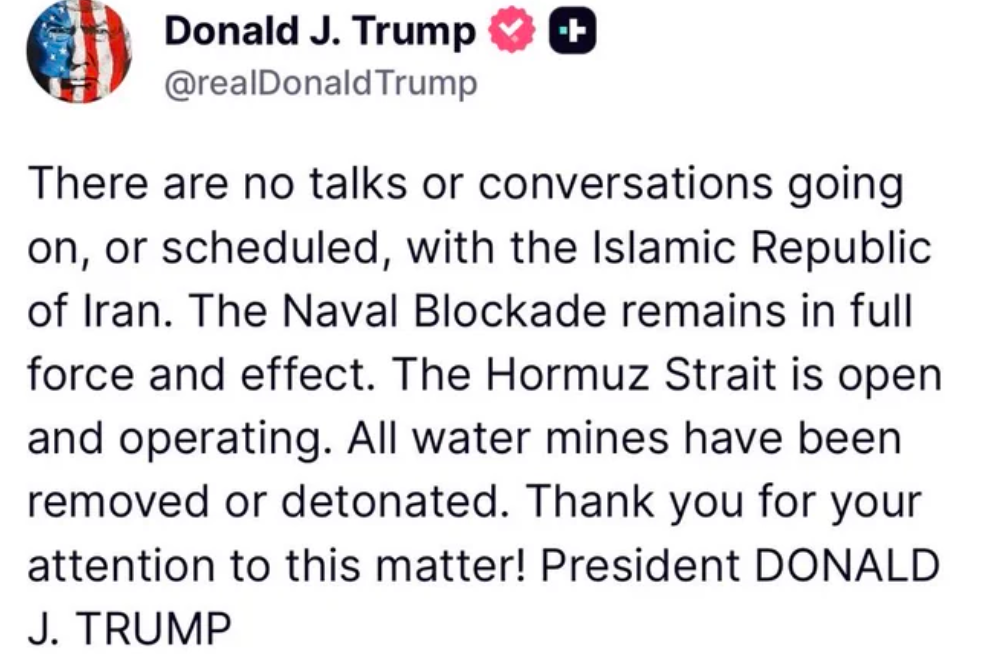
Keep in mind that this account comes in parallel with Trump admitting to what Iran has maintained for a very long time, that no negotiations are underway:
More detail from the Iran side:
A source close to Iran’s negotiating team, to Fars: “In practice, there were no direct negotiations between Iran and the United States. The talks on control of the Strait of Hormuz were held with Oman. After the U.S. violated the Islamabad Agreement, contact with the American…
— Open Source Intel (@Osint613) August 19, 2026
Trump apparently did not give Kushner the memo Trump was abandoning his “we are talking” broker patter:
Jared Kushner was questioned on Fox News about Iran negotiations saying “we’re not there yet” and that Trump will “make the right deal when the right deal is ready” @esaagar @krystalball pic.twitter.com/gEuhGzFYD5
— Breaking Points (@BreakingPointsx) August 18, 2026
Robert Pape gives a fresh update on the prospects for the war. He argues that Iran is seeking to force Trump to take military action before the midterms. That would almost certainly backfire and make the results even more of a bloodbath for Trump and Republicans than generally anticipated now. Trump would then both lack legitimacy generally and would in particular also be tied down by the barrage of investigations that the Democrats would soon launch.
Iran is seeking to drive home the point that attacking Iran is so destructive to the belligerents as to deter the US and Israel from trying again for at least a generation.
Mind you, if the economic/financial market decay accelerates as a result of Iran clamping down on Strait of Hormuz traffic even hard, in concert with Ansar Allah cutting seriously into Red Sea transits, Trump could very well lash out kinetically to try to reassert his dominance in the face of an economic whirlwind. So we may be destined to have Trump try to Do Something Big yet again regardless. But the Iranians are taking no chances.
From Papa via a lightly edited machine transcript:
Iran’s goal between now in the midterms is to break America’s will to fight Iran after the midterms and to do so by breaking the Trump presidency.
So, I think they have a fairly coherent political goal to break America’s will to attack Iran again after the midterms by breaking the Trump presidency in the midterms.
Now, that loss for Trump of one or now it looks like both houses of Congress is already devastating for Trump.
There’ll be hearings, subpoena power, for the Democrats.
And if Iran can build the clear picture that the Iran war was a critical element in Trump’s defeat, this not only leads to the Democrats shutting down money and resources for the Iran war. This sends a powerful message to any future American leader, future president, but really leader, period, that don’t attack Iran again…
Iran is has two daggers not just one dagger that they are displaying and they’re developing more and more.
Dagger number one is to raise costs, keep costs high and get even higher on the American population by increasing gas prices.
And to do that, keeping Hormuz shut as a unilateral matter…If they can get interest rates higher, good for that. They just want costs to go up on the American consumer…
But we got to diagnose the second big dagger.
And this gets to the offensiveness of the strategy. Why are they going on the offensive and attacking?
It’s not just militaries being military…
Bombing to win is a coherent theory of coercion, how you coerce states. And it’s not costs alone that matter. What matters are costs combined with belief there’s no chance for victory. That’s why my book is called bombing to win…There’s no strategy to dig yourself out….
And I think that’s why what Iran is doing is a two-prong double dagger set of means. One is drive up costs, keep Strait of Hormuz
The second is send the message that reinforces what many people already believe, which is Trump has no strategy for victory at all. So that what they’re doing is seizing the initiative and they’re showing by their attacks Trump has no way out.
Pape is actually comparatively optimistic about concerns that Trump might use nuclear weapons:
When we started the war in February 28, if you had asked me what are the odds that the United States is going to escalate to the use of nuclear weapons, I would have said it’s it’s like 3%, 2%. It’s not really zero.
Today maybe I would put it at 8 or 9% a bit higher because he’s so desperate….
The reason I think that it’s so unlikely is because the uh the consequences here for American foreign policy. If we thought that starting this war was bad and and Iran would take hormuz the consequences of the use of nuclear weapons will make this look like manna from heaven. This will go on and on. This will not the the because the question is going to be for the rest of the world and also the US public, not just how Trump could order the use of the nuclear weapon but why the Pentagon allowed him to do it. Why weren’t guard rails? Why the Democrats didn’t fall on their sword, run out to the runways in front of those B2s you and stand in the way of them taking off? The rest of the world is not going to sit there and understand, oh sure, we just let the president make these decisions and the rest of us just have to… No the world won’t understand that. They will blame America, not just President Trump.
Now to Iran’s promises to go bigger rather than smaller. From Anadolu Agency in Iranian lawmaker says Tehran would respond in kind if US used nuclear weapon:
An Iranian lawmaker said Tehran would respond in kind if the US used a nuclear weapon against Iran, commenting on a media report about the possibility of such an attack, according to local media on Wednesday.
Fada Hossein Maleki, a member of the Iranian parliament’s National Security and Foreign Policy Commission, made the remarks in an interview with Iranian news outlet Khabar Online.
Asked how likely he considered a US nuclear attack on Iran, Maleki said: “I do not rule out an ill-considered action by (US President Donald) Trump, but I do not think he would dare to do such a thing, because such an action could plunge the world into a dangerous war.”
“If such an action is taken, the Islamic Republic of Iran will also respond, and its reaction will be proportionate to the type of weapon used against Iran,” he added.
Pressed on whether this meant Iran would use a nuclear weapon if the US attacked Iran with one, Maleki replied: “Whatever the US uses, Iran will respond to it.”
Maleki did not explicitly say that Iran possesses nuclear weapons.
The lawmaker also warned Washington against further military action, saying Iran has “multiple options” at its disposal and that any US move could draw a response “at the same level or even beyond.”
“Many of Iran’s weapons and military capabilities have not yet been unveiled,” Maleki said, arguing that Tehran has moved from a defensive posture to what he described as “active and offensive deterrence.”
And the lead story in the Financial Times:
From the text:
Iran has weighed attacking US military targets in Europe should Donald Trump escalate the war, according to people close to the regime, as Tehran considers its options to increase the stakes of the conflict.
Two regime insiders told the FT that Iranian forces have assessed striking US assets in south-eastern European countries such as Bulgaria, which last month approved the use of its Bezmer air base for US refuelling aircraft.
One of the insiders added that Cyprus, where a British air base was struck by a drone in March, was also among potential targets for retaliation in the event of any renewed US offensive.
The insiders said Iranian forces have separately examined attacking subsea fibre-optic cables in the Strait of Hormuz in the event of an escalation.
Note the too-clever mention of the Cyprus drone attack. There’s no agency but in context a casual reader would assume Iran was the perp. In fact, the UK assessment was that Iran was not responsible. Nevertheless, Cyprus is in range and the UK base there has been used actively by Israel and the US.
In terms of regional escalation, there is a dispute over facts as to what exactly Israel struck when it hit a Syrian airbase.
Türkiye Rejects Israeli Claims Over Troop Deployment to Syria Base | Asia One News#Asiaone #AsiaOneNews #Turkiye #Turkey #Israel #Syria #Ankara #Idlib #MiddleEast pic.twitter.com/E2hwd73wNh
— ASIA ONE NEWS (@AsiaOne_News) August 19, 2026
Turkiye responding to Israeli PM: “We will continue cooperation with the Syrian Government and will never allow Syria to be destabilized.”
Since dec. 2024, Turkiye tries to re-build air bases and air defenses in Syria, Israel destroys them, and Turkiye does nothing in turn.
How… https://t.co/ao2mXOKhrt
— MenchOsint (@MenchOsint) August 19, 2026
However, Israel has been clear that it intended to hit Turkiye assets, as in escalate against Turkiye:
#BREAKING: Türkiye calls on Israeli Premier Netanyahu to abandon “aggressive and coercive” policies and respect international law pic.twitter.com/siFvLwGbnc
— TRT World (@trtworld) August 18, 2026
However, there have been over-reactions to claims of certain Iran attacks on the UAE (as opposed to US operations in the UAE) that Iran has denied. From PressTV in Exclusive: Reports of Iranian missile attack on UAE unfounded; Zionist false flag imprint evident:
Earlier on Tuesday, the UAE defense ministry claimed that its air defences “detected two ballistic missiles launched from Iran toward the country.”
However, a review by Press TV’s reporter found that reports alleging Iranian missile attacks on the UAE are not accurate.
Iran’s conduct throughout the war has shown that whenever it takes an action, it issues a statement and accepts responsibility for it.
And a debunking of the assertions that the UAE had changed its posture regarding economic ties to Iran as a result of the attacks, from Esfandyar Batmanghelidj on Twitter:
I don’t believe there has been a change in UAE policy towards Iran, at least not overnight. Iranian flights are landing at DXB, vessel traffic is unchanged, and the underlying logic of renewed economic engagement remains sound.
There is a lot of confusion about yesterday’s ballistic missile incident and the subsequent MFA statement refuting economic engagement with Iran. The UAE MOD first assessed that two ballistic missiles fired from Iran were heading towards the UAE. It later revised its assessment, stating that the missiles were targeting vessels in the Gulf. For its part, Iran has now denied targeting the UAE.
In any case, the MFA statement was not linked to the missile attacks. It was simply issued on the same day. The statement does not mention the missiles and instead states that in light of “regional escalations… all trade, commercial exchanges, and financial transactions with Iran have been halted until further notice.” This is not actually a description of a shift policy because the UAE *never formally announced* it was resuming trade ties with Iran….
In other words, the MFA was restating the policy adopted at the outset of the war, pushing back on the recent media reporting that the UAE and Iran have resumed economic relations as part of a narrow détente…
The UAE has been under pressure from the US in light of the Trump administration’s plan to rely on economic pressure to undermine Iran….
In reality, the UAE will maintain this public stance, but will continue to protects its interests by insisting on its own economic sovereignty.
Now briefly to the rising odds of very very bad economic outcomes and what those might look like. Marguerite Yourcenar, in Memoirs of Hadrian, wrote:
Like a traveler sailing the Archipelago who sees the luminous mists lift toward evening, and little by little makes out the shore, I begin to discern the profile of my death.
We’ll start with initial observations which I hope to expand upon in later posts.
On YouTube, I see far too many shows with titles that assert that the end of the dollar system is nigh. No, that is one of the things that is not in play, despite the high odds of widespread and deep economic devastation.
It took two world wars and a Great Depression to dethrone pound sterling. And that also required the US to be ready to step in as the new banking and currency alpha dog and FDR using Lend Lease to accelerate the crippling of the UK. Today, it is not just Treasuries that are at high yield relative to sustained, unnaturally low post-crisis interest rates. The 5%ish Treasury yields that are leading to hair-tearing are not all that high by longer historical standards.
And do not forget that the freakout about rising interest rates is not a US-only phenomenon, as in the US is not uniquely exposed. It’s happening across advanced economies. This is the result of central banks on a widespread basis having kept interest rates way too low for too long after the crisis. The Fed apparently recognized, even if they did not ‘fess up, that ZIRP was a failed policy, mainly goosing asset prices and then stoking economic unproductive speculation rather than fostering productive investment. Bernanke tried to back out in 2014 but lost his nerve in the Taper Tantrum. So most of the world went into Covid following a sustained period of capital misallocation. The Covid supply shock caused too much inflation. The Covid stimulus was warranted, but not continuing to run economies hot, as Biden did to fund the Ukraine war without raising taxes. Trump has continued to run very large fiscal deficits.
You have to be as old as I am or older (or have lived in a high inflation economy) to understand viscerally what a mere high inflation regime does to financial asset values. It produces revulsion for risky investments, witness the famed 1979 Business Week cover story, The Death of Equities. Enough wealth destruction in a market meltdown produces similar results. It wasn’t until the 1950s that equity market averages returned to pre-Great Crash levels.
A crash or a longer-term, less dramatic bleed-out will put an end to the viability of bull-market momentum trading and will lead to a revival of attention to fundamental valuation. High interest rates mean that investments, both by companies in possible projects and investors for securities, apply higher discount rates, as in they demand higher returns. That results in lower prices. Companies and individuals who borrow similarly face much higher interest cost, which both discourage investments like buying houses as well as crimping spending.
It has been so long since most investors have lived through a mere deep and sustained equity bear market that they have trouble wrapping their minds around how bad that alone can be.
Now let us add in the special features which make what we are about to face potentially much worse. There is one that cuts both ways: how much lending is now done outside the banking system. The reason the 2008 crisis, which was a derivatives crisis, was both so severe but also could be remedied via fast application of lots of emergency action, was that it took place at the heart of the financial system. Systemically important, already highly leveraged and therefore fragile players got themselves way too exposed to derivatives that “referenced” risky tranches of subprime debt. As of late 2007, it was clear that Citibank was wobbly; by early 2008, Lehman and Bear Stearns, as well as the monoline insurers who had created the illusion that subprime exposures could be successfully insured. The Bank of England, among others, was profiling accurately where the risk-bombs were sitting in its semi-annual Financial Stability Report.
Financial regulation is designed to protect and if needed, rescue banks, because they are at the center of the payment system (this is the reason Goldman and Morgan Stanley had to become banks to be bailed out)
But now, as economist Steve Hanke pointed out, citing a conversation he had recently with a Bank of International Settlements economist, about half the lending globally now is happening outside the regulated financial system, and the authorities have no idea what is happening. And even if they did, they are not set up to rescue shadow banks like private credit funds (even assuming such a course of action were politically viable).
But the fact that the meltdown may not much (or at least initially not much) impair banks or capital markets trading firms does not mean it won’t be very destructive. The dot-bomb era merely produced a recession, as you would anticipate for a crash of equities where leverage is limited (the Great Crash had high levels of borrowing to fund share purchase). The end of the Internet mania did damage the economy due to the loss of paper wealth.
By contrast, the monster AI bubble is a different beast. Unlike the Internet frenzy, AI has been driving monster cap ex spending in the US, to the degree that it has been estimated to produce half of US GDP growth. Because AI, unlike historical tech plays, is asset heavy, so even the extremely wealthy big tech titans that are deep into AI have not been able to fund AI from their own cash hoards, and have been increasingly unable to raise enough from equity sources either. They expected to be able to debt fund, but that was always a stretch given their insatiable money needs, and even more so in a rising interest rate environment.
Given the hour, I must stop here, but consider this these closing thoughts, first from Gary Marcus in BREAKING: OpenAI’s unraveling has begun:
The opening stages of OpenAI’s unraveling, which I first warned about in January 2024 (if not before), have begun…..
Translation: we need to immediately stop torching cash to provide some semblance of a sustainable business model so we can rush this IPO out the door before the bubble pops
RIP “compute shortage/AI bottleneck” bros https://t.co/yNOPu5uSij
— Ross Hendricks (@Ross__Hendricks) August 18, 2026
And, here’s where things get worse. It turns out people were very likely right to be skeptical, because The Wall Street Journal’s Berber Jin and Corrie Dribusch just dropped big news:
openai has been tossing out a lot of vague ARR numbers, so we decided to take a deeper look.
the company grew revenue by just 18% to $6.7 billion from q1 to q2, while its losses sank further into the red
not a great sign ahead of an IPO
w/ @cdriebusch via @WSJ pic.twitter.com/fZlM2pomTE
— Berber Jin (@berber_jin1) August 18, 2026
and then an hour and half later, Jin dropped still further details, also bad for OpenAI:
story is now updated with additional details. openai’s losses grew by $3 billion from q1 to q2, to $12.3 billion
not a great look given that it added only $1 billion in revenue in the meantime, to $6.7 billion
— Berber Jin (@berber_jin1) August 18, 2026
You don’t want your quarterly losses to quadruple right before your IPO.
And from Ed Zitron in What Happens If OpenAI Dies?:
To not actively and meaningfully discuss the potential for OpenAI to collapse is actively irresponsible. To act like there are not significant, existential problems with this company’s economics is to intentionally avoid reality, and whoever is on the receiving end of said ignorance deserves better, be they an investor reading your analyst note or a reader burdened with incomplete journalism.
What follows may be an Enron-Lehman Brothers hybrid, one that leaves unbelievable destruction in its wake, an avoidable systemic risk empowered and enabled by a kneecapped media industry and sell-side analysts incapable of seeing further than two quarters in the future.
In the end, there is no avoiding the damage that OpenAI’s collapse will create. The time to do that was in 2024, before it made all those commitments, and raised so much more money. Once it did so, it led the entire industry to believe that there was significant demand for AI, when all that was happening was Sam Altman and Dario Amodei were taking up every ounce of compute capacity, paid for with equity investments from the companies they bought it from, an illusion created by men driven mad by their desperation for hypergrowth.
And again, OpenAI is merely a potential big detonator. And let’s not get started on how failed hedgie Scott Bessent is not even remotely skilled enough to handle a crisis.
Done for today! See you tomorrow!
____
1 What that amounts to in practice remains to be seen. It is credible that Iran has not been as aggressive as it could be in attacking Oman-side ship traffic (as in more than traffic-monitoring services like Kpler can see have actually gotten through). But Iran has also shown a tendency to be measured and let ship operator/crew/insurer risk aversion do a lot of the traffic strangulation work for them. So I would expect Iran to increase its attacks gradually and see what new level would suffice to achieve a close to total shutdown.
2 And why is that any sort of justification?
