

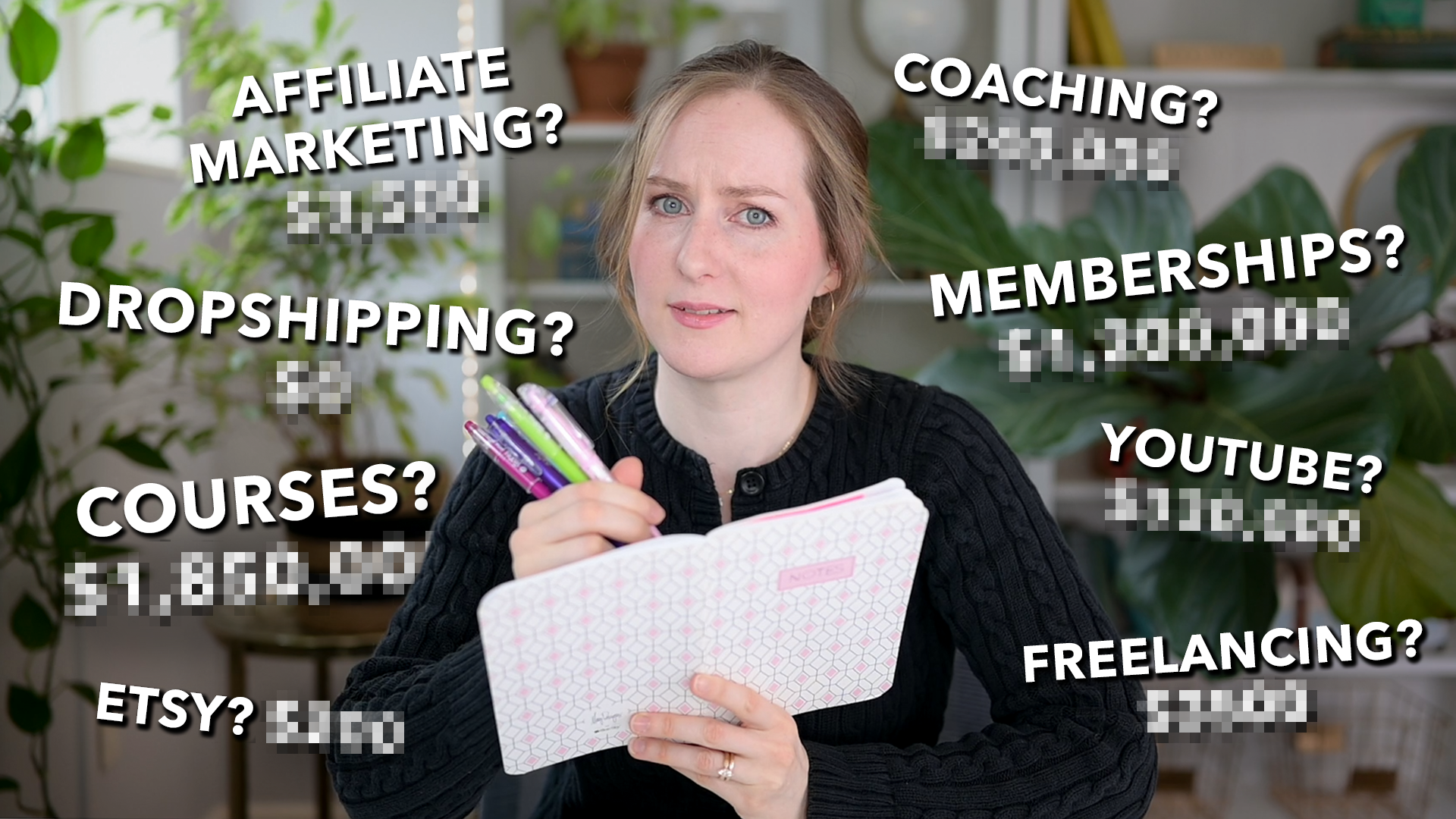
What I don’t love: it’s time-for-money. You’re trading hours for dollars, and it takes real mental and emotional energy to do well. I can only work with a couple of clients at a time before it starts pulling me away from growing the rest of my business.
That said, some people build entire businesses around coaching 20, 30, 40 clients at a time — and make excellent money doing it. Most years I’ve earned between $15,000–$25,000 from coaching a handful of clients. Great starting point. Just know you’ll probably want to build toward something more scalable over time.
3. Etsy
Full disclosure: Etsy is one of the businesses I’ve done the least with. I won’t pretend to know more than I do.
What I can say is that it’s competitive, and it requires more analytical, technical work than people expect. Learning Etsy’s algorithm is a bit like learning SEO — there’s real strategy involved, and it’s not just about making beautiful products.
The creativity part is genuinely fun for me, especially as a change of pace from purely knowledge-based work. But because it’s relatively new for me, I don’t have much to report on earnings yet. Ask me again in a few months.
4. Dropshipping
I’ll be direct: I never made money dropshipping. Not for lack of effort — I spent hundreds of hours researching products, ordering samples, and analyzing margins. But every product I tested either had quality issues, too much competition, or margins that just didn’t work.
I’m not saying dropshipping doesn’t work. I’m saying I spent probably a couple thousand dollars and hundreds of hours on it and couldn’t get it to a profitable point before I moved on. If you go this route, go in with your eyes open — it takes real persistence and investment to find a product that works.
5. Online Courses
Courses are where things really changed for me.
I started trying to sell courses at the very beginning of 2017 and struggled for almost a full year before things clicked. But once they did? Six figures a year — consistently. And at this point, I’ve earned over a million dollars from courses alone.
Here’s the honest truth about why courses fail for so many people: there are a lot of moving pieces. You need leads coming in. A working sales process. A checkout that functions. A solid course and a platform to host it. If any one of those is missing, nothing sells.
But here’s the flip side — once you have all the pieces in place, courses become one of the most passive online business models I’ve ever run. The upfront investment is real. The long-term payoff is worth it.
6. Memberships
I launched my first membership in mid-2018, right around the time courses finally started working for me. And it was the single thing that took my revenue from “sporadic $1,000 months” to “consistent $10,000+ every month.”
I still run that same membership today. It’s earned well over a million dollars.
The key thing about memberships — and why I think so many online business owners should seriously consider them — is the recurring revenue. Once someone signs up, they’re paying you month after month. That consistency makes your business fundamentally more stable.
The tradeoff compared to courses? Memberships are a slightly harder sell upfront. Courses feel like a clear package with a beginning, middle, and transformation. Memberships require people to commit to an ongoing relationship.
But that stability? Genuinely game-changing for building a business that doesn’t feel like a rollercoaster.
7. Print on Demand
Print on demand covers a lot of ground — T-shirts, mugs, notebooks, journals, self-published books. The basic model: you design it, a third-party company prints and ships it when someone orders, and you never hold inventory.
I’ve done several versions of this, including a self-published book back in 2017 that earned me several thousand dollars and added about 850 people to my email list in just a few months. Genuinely one of the better early moves I made.
My one piece of advice: always order samples before you start selling. I’ve tested products where the quality was just not there, and I would not have wanted my name associated with them. Quality control matters, especially when you’re building a brand.
Overall? I like print on demand. There’s a lot of flexibility in how you use it.
