

It’s been exactly one year since the Liberation Day Tariffs were announced, implemented, challenged, and ultimately overturned at every level. They served as the foundation of the administration’s main economic policy. What has been the overall impact – economically, geopolitically, and on the markets?
Don’t rely on the mass media for answers – they are afraid of the President and avoid the facts. My job today is to tell you the good, the bad, and the ugly.
Depending on where you look, the impact of the tariffs varies from modest to somewhat embarrassing to completely disastrous. Let’s examine the data to understand this better:
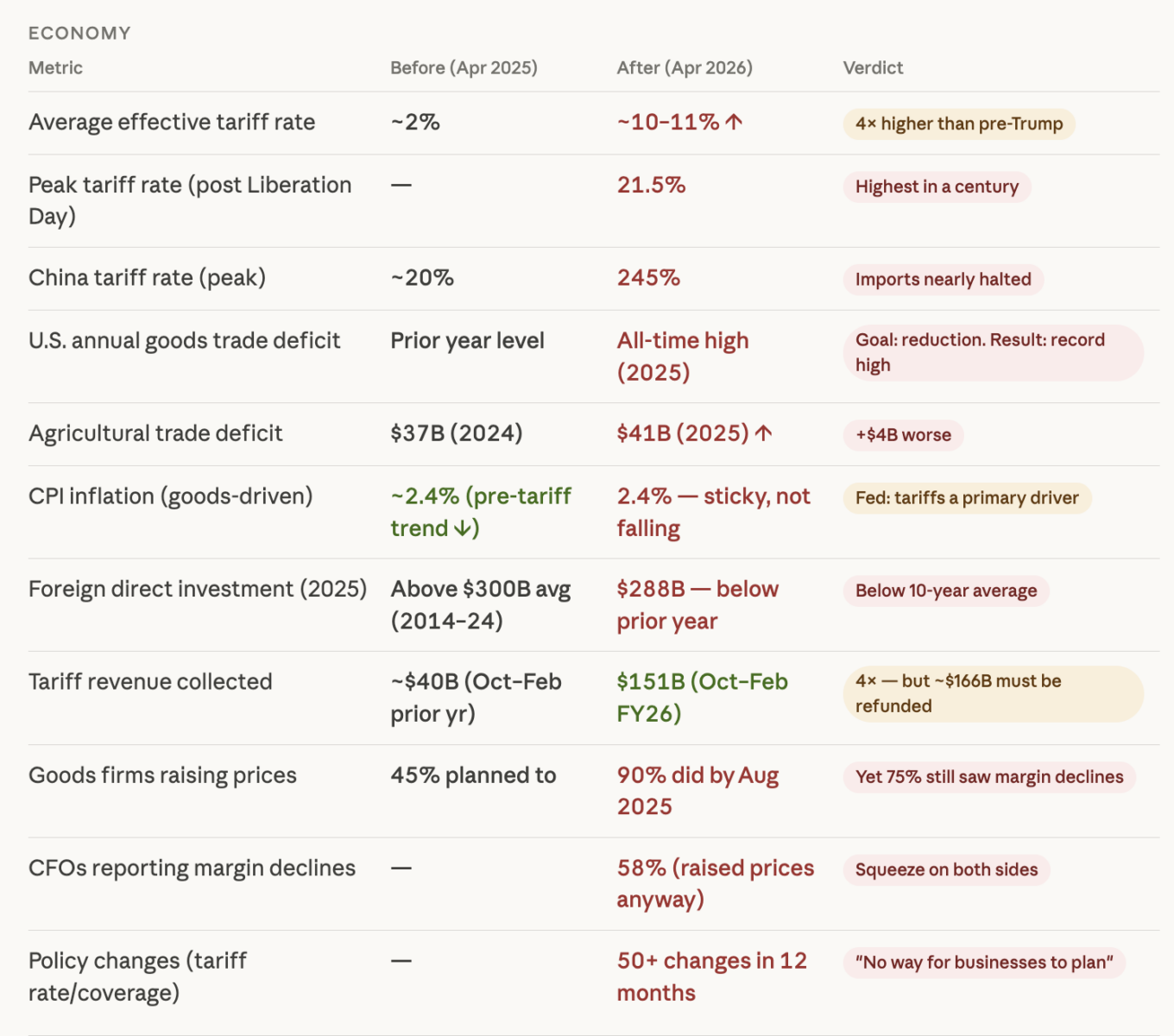
-Policy whipsaw: Perhaps the most damaging economic effect was uncertainty itself. The actual tariffs have changed more than 50 times since Liberation Day: 90-day suspensions up, down, reversals, threats. It made us look silly to our trading partners, but the biggest impact might be on Sentiment. The most striking data point is CFO confidence: it collapsed from 37% to 5% in a single month, in April 2025. This led to a huge impact on CapEx spending and hiring.
-Trade deficit: Trump declared the trade deficit a “job-killing national emergency.” It was nothing of the sort; rich countries buy more from poor countries than poor countries buy from rich countries (it’s obvious if you think about this for a moment). According to the Bureau of Economic Analysis, the U.S. goods deficit increased to an all-time high in 2025.
-Manufacturing Jobs: The promised industrial renaissance failed to arrive. The U.S. manufacturing sector shed 100,000 jobs over the past ~year; the ratio of manufacturing workers to total nonfarm employment fell to its lowest point since 1939. U.S. manufacturers hired 388,000 fewer workers in 2025 than in 2024
-Inflation: Fed Chair Jerome Powell attributed elevated readings to “inflation in the goods sector, which has been boosted by the effects of tariffs.” Prices did not fall — by August 2025, 9 in 10 goods firms had raised prices, yet 75% of goods firms still reported margin declines. Consumers paid more for goods even as corporate margins shrank.
-Revenue: The Supreme Court ruling makes the tariff revenue figures almost tragicomic: $151B collected, then a $166B refund ordered — meaning the government is effectively net negative on the IEEPA tariff strategy.
“Sell America” trade: In the 12 months since Liberation Day, global investors have been rethinking American exceptionalism. In 2025, U.S. equities underperformed global bourses; Treasuries took a hit; The dollar fell 9%. These trades became known as the “Sell America” trade.
-Geopolitical Impact: This is where I fear structural and maybe even permanent effects. Countries forged new trade pacts while trying to avoid U.S. trade agreements. The global trading system has been turned upside down in ways that may be irreversible.
The main beneficiary of this is China. They found new buyers to re-route its exports and ended 2025 with a record $1.2 trillion trade surplus. The tariffs were explicitly designed to pressure Beijing, and yet China ended 2025 with its largest trade surplus EVER, mostly achieved by simply rerouting exports.
The bottom line: None of the Trump administration’s stated goals — shrinking the trade deficit, reviving manufacturing, lowering prices, paying down the debt — were met. Many of the targets, such as lowering prices and reducing the deficit, worsened.
The one-off deals and commitments to invest billions in the U.S.? Good luck trying to enforce those, based upon a policy that the highest court in the land declared as blatantly unconstitutional…
Previously:
Winners of SCOTUS Decision Striking Down Tariffs (February 20, 2026)
Part II: IEEPA Tariff Ruling’s Losers (February 23, 2026)
IEEPA Tariffs Update (January 27, 2026)
It’s Tariff Week! * (January 12, 2026)
Tariffs Likely To Be Overturned (November 5, 2025)
Might Tariffs Get “Overturned”? (July 31, 2025)
The Muted Impact of Tariffs on Inflation So Far (July 17, 2025)
Are Tariffs a New US VAT Tax? (March 31, 2025)
MiB: Special Edition: Neal Katyal on Challenging Trump’s Global Tariffs (September 3, 2025)
Neal Katyal on Challenging Trump’s Global Tariffs (September 8, 2025)
Which States Could Suffer the Most From Trade War Tariffs? (September 16, 2019)
