

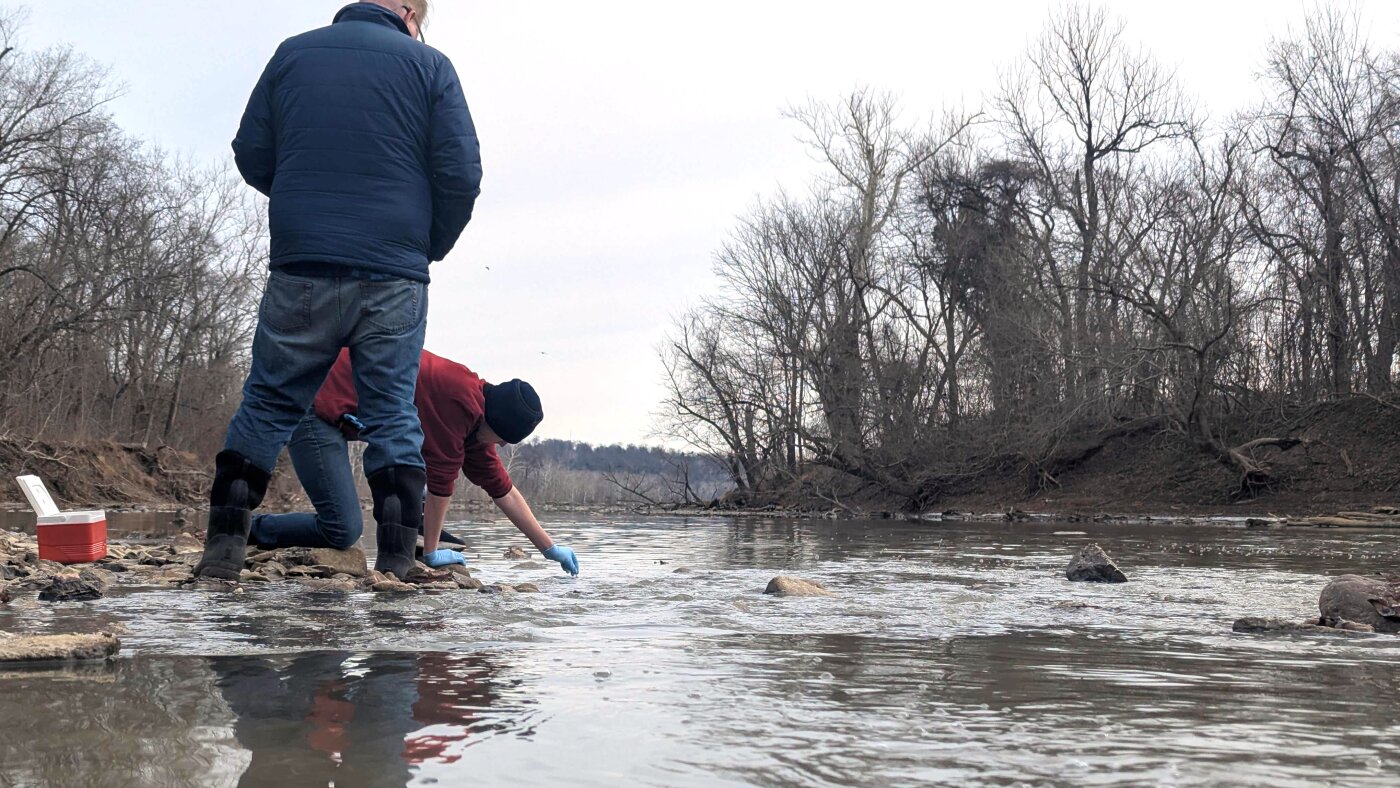
Water samples are taken from the Potomac River in Maryland in January. A massive pipe that moves millions of gallons of sewage ruptured and sent wastewater flowing into the Potomac River northwest of Washington, D.C.
Nathan Ellgren/AP
hide caption
toggle caption
Nathan Ellgren/AP
In January, part of a decades-old sewer line in Maryland collapsed by the Potomac River. Over the following days, the broken pipe dumped more than 200 million gallons of raw sewage into the Potomac near Washington, D.C.
Since then, the utility that manages the line, DC Water, has been setting up a system of pumps and a steel bulkhead to divert wastewater around the broken section of pipe so crews can begin repairs. The area’s drinking water hasn’t been contaminated, but scientists and environmental advocates say the damage could still be severe in a watershed that stretches to the Chesapeake Bay.
“There’s a ton of nasty stuff in raw sewage. It’s not just waste and bacteria, but you have all sorts of pharmaceuticals that end up in the pipe system. You have different chemicals that people pour down the sink or into drains,” says Gary Belan, senior director of the clean water program at American Rivers, an advocacy group. “So a lot of that stuff can sink to the bottom of the river, have impacts on fish reproduction, bird reproduction, killing a lot of the insects, contaminating the soil.”
The Potomac accident is among the largest sewage spills in U.S. history, and it highlights a chronic problem facing communities around the United States, says Gussie Maguire, Maryland staff scientist at the Chesapeake Bay Foundation.
Sewer systems, especially those that handle a combination of wastewater and stormwater, often overflow during heavy rains. The problem is exacerbated by population growth that’s straining aging infrastructure. Climate change is also a factor, Maguire says, because as temperatures rise, storms dump more rain in shorter periods of time, overwhelming sewer and stormwater systems.
“The intensity is a really important part of it,” Maguire says, adding: “It is absolutely a climate problem that will continue to get worse.”
It isn’t clear what caused the sewer line collapse in Maryland. DC Water has said that it found signs of corrosion when it inspected the 1960s-era pipe about a decade ago and that it had plans to rehabilitate damaged sections.
A worker walks past part of a cofferdam being built to stop the flow of raw sewage into the Potomac River after a massive sewage pipe rupture in Maryland in January.
Cliff Owen/AP
hide caption
toggle caption
Cliff Owen/AP
It’s also too soon to know what the full impacts will be. DC Water has reported elevated levels of the bacteria E. coli at the site of the overflow. Bacteria don’t thrive in cold water, but as temperatures warm this summer, the spill could produce algae blooms in the river that kill fish, says Mike Gerel, Virginia science manager at the Chesapeake Bay Foundation.
The spill could also have lasting consequences for waterfront communities, as well as swimmers and boaters who use the river, says Dean Naujoks, the Potomac riverkeeper, an environmental advocate.
“What are we going to do to bring people back and reassure them that the river’s safe again?” he asks.
“Once you put 243 million gallons of raw sewage into a river, any river, you’re not getting it back out,” Naujoks adds, saying the waste will eventually wash downstream to the Chesapeake Bay and out into the Atlantic Ocean.
Scientists and environmental advocates have spent decades trying to reduce the amount of pollution in the Chesapeake Bay, which stretches 200 miles along the mid-Atlantic coast and is bordered by Maryland and Virginia.
“This is not only a blow to the Potomac River,” Naujoks says, “but a blow to the Chesapeake Bay.”
On Wednesday, D.C. Mayor Muriel Bowser requested federal disaster support, including full reimbursement for DC Water. The White House didn’t immediately respond to a message seeking comment.
The Environmental Protection Agency (EPA) said in an emailed statement that it “remains ready to support our partners on the ground and is committed to ongoing coordination to ensure that the response is done as expeditiously as possible.”
President Trump has tried to blame local Democratic leaders for the sewage spill. However, DC Water is overseen by the EPA.
“The ultimate authority that really needs to be aggressive in addressing this is the Environmental Protection Agency,” says Gerel, the Virginia science manager at the Chesapeake Bay Foundation.
DC Water’s chief executive, David Gadis, said in a public letter this month that the incident “underscored a broader reality facing utilities across the country: much of the infrastructure that protects our waterways was built decades ago, long before today’s environmental standards, population growth, and climate pressures.”
The solution is to invest more money to upgrade the country’s infrastructure, Gerel says. “I love bridges, I love safe roads,” he says, “but I also love unsexy pipes that are underground. We need to fix those.”
