

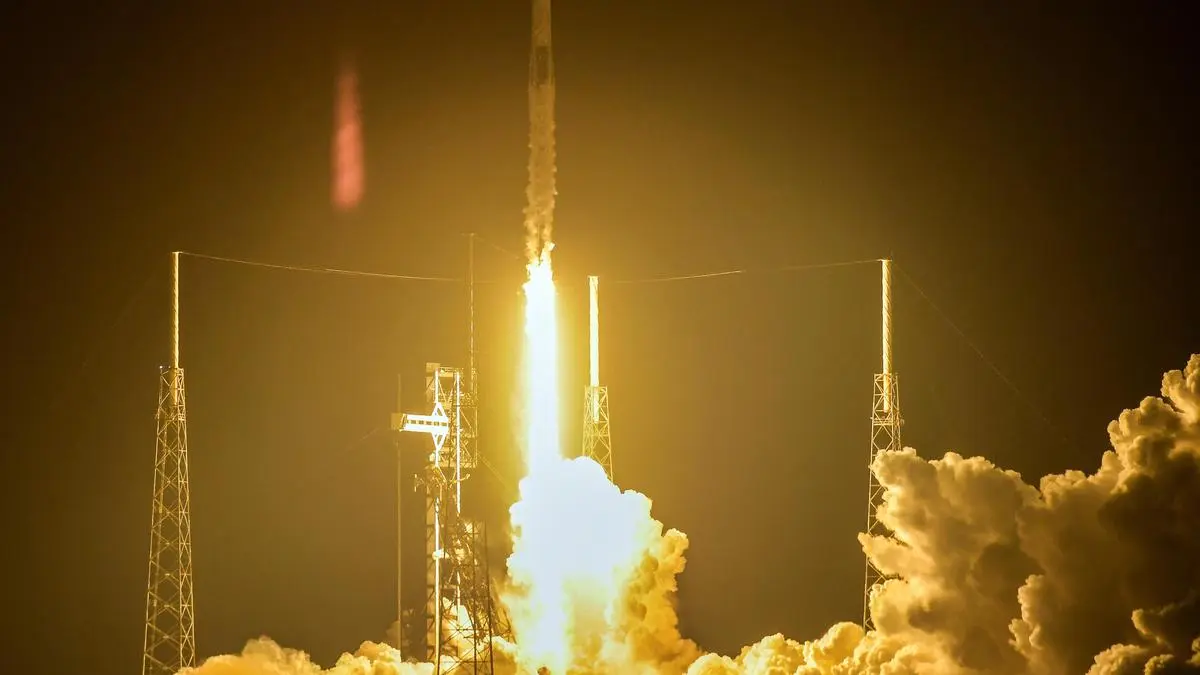
A SpaceX Falcon 9 rocket and Dragon spacecraft lifts off on NASA’s Crew-12 mission to the International Space Station, carrying NASA astronauts Jessica Meir and Jack Hathaway, ESA astronaut Sophie Adenot and Russian cosmonaut Andrey Fedyaev, from Launch Complex 40 at the Cape Canaveral Space Force Station in Cape Canaveral, Florida, U.S., February 13, 2026.
| Photo Credit:
REUTERS/Steve Nesius
WASHINGTON The space race between
U.S. billionaires is heating up, with Elon Musk’s SpaceX
planning to build a lunar base and Jeff Bezos pushing Blue
Origin’s ambitions as both companies aim to return humans to the
moon ahead of a planned mission by China in 2030.
With a planned IPO this year, SpaceX CEO Musk has said in
recent podcast interviews and company meetings that he wants to
build “Moonbase Alpha” and put a satellite-slinging launch
device on the lunar surface. The lunar base would help build up
his envisioned AI-computing network of up to one million
satellites.
Musk’s intensified drive toward the moon has shifted
SpaceX’s aspirational focus from the Mars colonization mission
he has pushed consistently since founding the company in 2002.
As recently as last summer, Musk said he hoped to launch an
uncrewed Starship mission to the Red Planet, calling the moon a
“distraction”.
In recent weeks, Bezos’s space company Blue Origin has
also put more focus on its own moon program, shuttering its
suborbital space tourism business to shift those resources into
its Blue Moon lunar lander program ahead of a planned uncrewed
mission to the surface this year.
Musk now wants to convince investors that SpaceX will remain
the dominant force in space ahead of a planned IPO later this
year that could value the company at over $1 trillion.
After a flurry of Musk posts on X this week about a “pivot”
to the moon, Bezos posted a black-and-white image of a tortoise,
recalling Aesop’s fable in which the slow and steady tortoise
wins the race against the speedy but impulsive hare. Blue Origin
has embraced that fable in its motto “Gradatim Ferociter”, Latin
for “step by step, ferociously.”
Executives at other space companies say they also expect to
benefit from increased spending on the new moonshot by the U.S.
government and its two primary space contractors.
BEZOS HOT ON MUSK’S HEELS
Blue Origin’s uncrewed mission to the moon this year is a
precursor for an astronaut landing, part of NASA’s Artemis
program which also relies heavily on SpaceX’s Starship.
Seattle-based Blue Origin’s lander last week was shipped to
NASA’s Johnson Space Center in Texas for thermal and vacuum
testing, a key development step in its path to launch.
Blue Origin and SpaceX are building their moon landers
with billions of dollars in funding from NASA, which aims to use
them for a series of astronaut moon landings starting with
SpaceX’s Starship. NASA landed the first humans on the moon in
1969, and a total of 12 U.S. astronauts walked on the moon as
part of the Apollo program that ended in 1972.
NASA sees a return to the moon as practice for future
missions to Mars. The agency has pressed the companies to speed
up their lunar lander development to win the space race against
China, which has targeted its own 2030 moon astronaut landing.
Musk said this week he wants to go a few steps further by
building a “self-growing city” on the moon and launching AI
satellites from the lunar surface — part of his broader goal to
expand AI computing into space after SpaceX acquired Musk’s xAI
this month.
“If the moon becomes a strategic jump-off point, and one
that’s important to SpaceX, if they can get there first or early
and build out that infrastructure, they might have a say in how
that gets used and how they use it,” said Andrew Chanin, CEO at
ProcureAM, a space-specialized investment firm.
RIPPLE EFFECTS BOOST SPACE FIRMS
SpaceX’s Starship rocket has not yet deployed anything into
orbit, but has launched 11 times since 2023 and is poised for an
upgraded test in a month. The rocket’s upper stage, which acts
as the moon lander, faces a 2028 crewed moon landing date that
many in the industry see as tough to meet.
SpaceX has many more steps in Starship’s development as a
lunar lander, from practicing its novel refueling process in
orbit with another “tanker” Starship to reliably landing on the
moon’s rugged surface before carrying humans aboard.
Kathy Lueders, who led NASA’s human space operations unit
before going to SpaceX to oversee its Starship development site
in Texas, said urgency in the SpaceX-Blue Origin rivalry, with
Musk now focused more on the moon, helps NASA compete with
China.
“With Elon making these statements, that company is now
laser-focused on getting back to the moon,” Lueders, now an
independent industry advisor, added.
The Musk-Bezos competition is rippling to other corners of
the nascent U.S. lunar industry.
“I’ve had 20 investors this week reach out to me,” said
Justin Cyrus, CEO of Lunar Outpost, a company that has sent a
moon rover to the lunar surface ahead of future plans of
building an array of lunar infrastructure.
“There is a very palpable change in mindset from the
investment community on the lunar surface over the last two
years, and I think Elon’s announcement has made that more
pressing,” he said.
Published on February 13, 2026
