

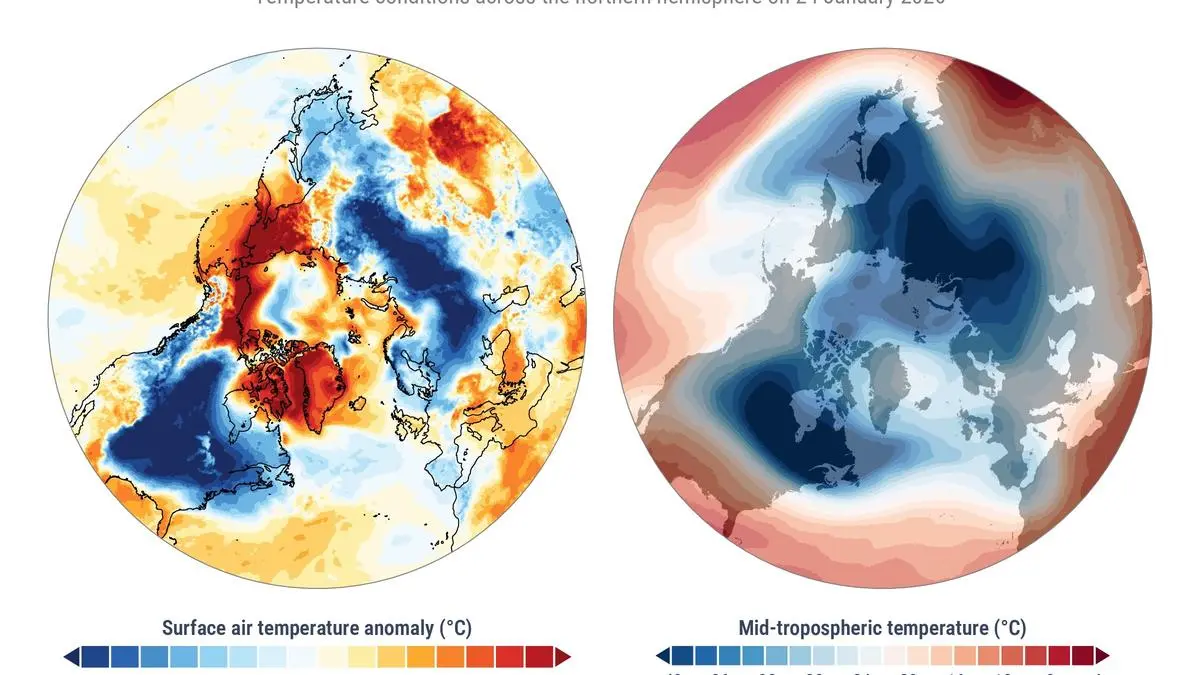
January 2026 ranked as the fifth-warmest January on record, with global temperatures averaging 1.47°C above pre-industrial levels, according to ECMWF’s Copernicus Climate Change Service. Sea surface temperatures were near-record highs in the North Atlantic and North Pacific.
| Photo Credit:
C3S/ECMWF
January 2026 was the fifth warmest on record and marked by sharp temperature extremes in the Northern and Southern Hemispheres, according to the European Centre for Medium-Range Weather Forecasts (ECMWF’s) Copernicus Climate Change Service (C3S). January was also recorded at 1.47°C above pre-industrial temperatures.
In the final weeks of January, the Northern Hemisphere experienced intense cold waves as the polar jet stream spilled icy air into Europe and North America. This led to Europe recording its coldest January since 2010, with an average temperature of -2.34°C.
Despite these cold episodes, monthly temperatures were still above average across much of the globe, including large regions of the Arctic and western North America.
In the Southern Hemisphere, record-breaking heat triggered extreme conditions, including wildfires that escalated in the second half of January, according to the Copernicus Atmosphere Monitoring Service (CAMS). That included intense blazes that claimed lives across Australia, Chile and Patagonia. Heavy rains across Southern Africa in the final week of the month triggered severe flooding, particularly in Mozambique, with catastrophic impacts on lives and livelihoods.
Samantha Burgess, Strategic Lead for Climate at ECMWF, commented: “January 2026 delivered a stark reminder that the climate system can sometimes simultaneously deliver very cold weather in one region and extreme heat in another. While human activities continue to drive long-term warming, these recent events highlight that resilience and adaptation to increasing extremes are key to preparing society for heightened climate risk in the future.”
Global temperature
According to the ERA5 dataset, January 2026 was the fifth-warmest January globally, with an average surface air temperature of 12.95°C, which is 0.51°C above the 1991-2020 average for the month.
January 2026 was 0.28°C lower than the warmest January on record in 2025. It was 1.47°C higher than the estimated 1850-1900 average used to define the pre-industrial level.
Sea surface temperature
The average sea surface temperature (SST) for January 2026 over 60°S–60°N was 20.68°C, the fourth-highest value on record for the month, 0.29°C below the January 2024 record.
A large region of the subtropical and the northeast North Atlantic, including the Norwegian Sea, had the warmest SSTs on record for the time of year.
Most of the North Pacific continued to record much above-average SSTs. In contrast, SSTs were near or slightly below the 1991-2020 average in the central and eastern equatorial Pacific, reflecting weak La Niña conditions.
The most below-average SSTs were recorded in the Arabian Sea, the Indian Ocean, the central South Pacific Ocean, and the Tasman Sea, according to the report.
Europe and other regions
During the second half of January 2026, severe cold conditions spread across large parts of the Northern Hemisphere, including North America, Europe and Siberia, mainly driven by a more wavy-than-usual polar jet stream that allowed frigid Arctic air to spill into mid-latitudes.
The average temperature over European land for January 2026 was -2.34°C, about 1.63°C below the 1991-2020 average for January, making it Europe’s coldest January since 2010.
The most pronounced warmer-than-average temperatures occurred across the Arctic, most notably in the Canadian Arctic Archipelago, Baffin Bay, Greenland, and the Russian Far East. Above-average temperatures were also recorded across parts of southern South America, northern Africa, central Asia and large areas of Australia and Antarctica..
Published on February 10, 2026
