

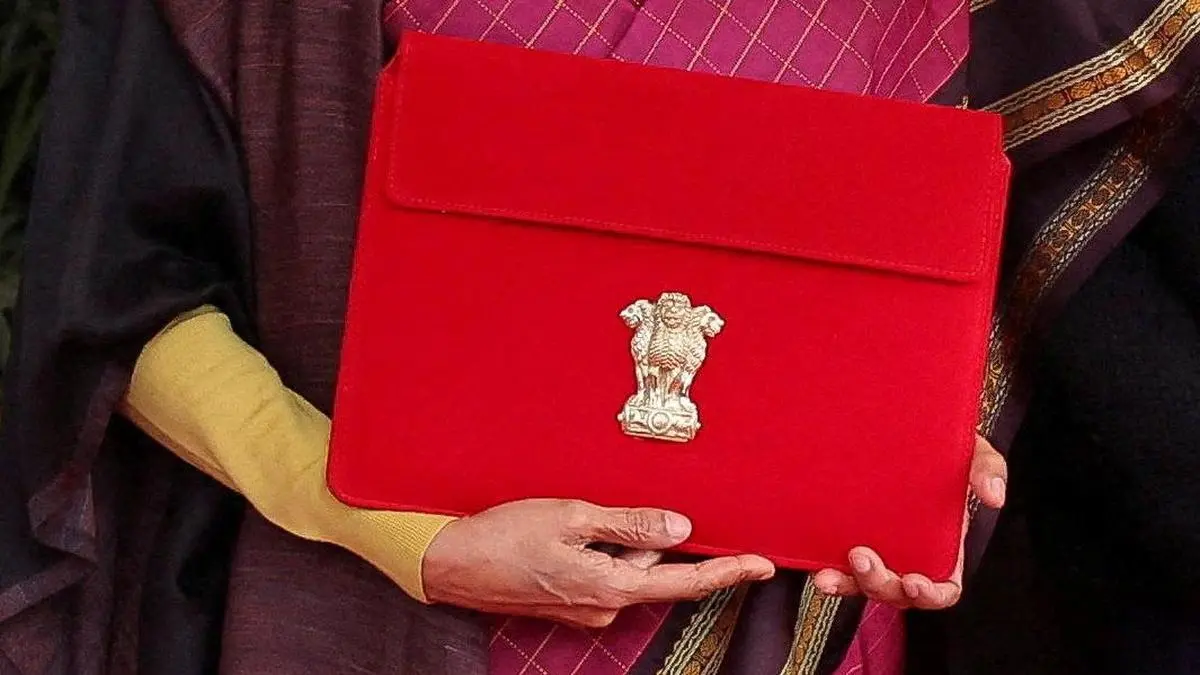

FILE PHOTO: India’s Finance Minister Nirmala Sitharaman holds a folder bearing the Government of India’s emblem as she leaves her office to present the annual federal budget in parliament in New Delhi, India, February 1, 2026. REUTERS/Altaf Hussain TPX IMAGES OF THE DAY/File Photo
| Photo Credit:
ALTAF HUSSAIN
inance Minister Nirmala Sitharaman presented the Union Budget 2026-27 in the Parliament today. The Budget featured significant announcements regarding taxation, capex plans, defence, healthcare, infrastructure, logistics and manufacturing, among other things. The New Income Tax Act will come into effect from April 1, 2026, the FM said. Other major announcements include the establishment of seven high speed rail corridors between cities, dedicated rare earth corridors in Odisha, Kerala, Andhra and Tamil Nadu and a ₹10,000 crore outlay for Biopharma Shakti to support domestic innovation, among several other ones. “The Budget specifically focuses on supporting MSMEs and will enable them to transition from local to global champions,” Prime Minister Narendra Modi said in his speech following the Budget presentation. We look at how industry leaders, market participants and the general public are reacting to the Budget.
- February 1, 2026 15:36
How the Union Budget affects the hospitality sector, according to Pranav Rungta, Co‑Founder & Director, Nksha Restaurant; Vice President, NRAI Mumbai
“Budget 2026 is a positive step for India’s hospitality sector. Announcements like the first-ever National Institute of Hospitality and structured skill development for tourist guides will strengthen service standards and prepare our workforce to meet growing domestic and international demand.
At the same time, restaurants continue to face structural challenges such as GST on commercial leases, access to export incentives like SEIS and easier SME support. Addressing these challenges alongside rising tourism and dining demand is key to building a resilient, sustainable and globally competitive hospitality sector.”
- February 1, 2026 15:35
Montra Electric MD Jalaj Gupta says Budget 2026-27 boosts India’s clean mobility ambitions
“This year’s Union Budget lays a strong foundation for India’s clean mobility and advanced manufacturing ambitions. From supporting lithium-ion cell manufacturing and rare earth processing to strengthening semiconductor and electronics ecosystems through ISM 2.0 and enhanced component schemes, the government is enabling a truly integrated EV supply chain. These initiatives will help deepen localisation, develop skilled talent, and reinforce India’s position as a global hub for sustainable mobility and high-technology manufacturing.”
- February 1, 2026 15:33
India Mental Health Alliance founding cohort member Neha Kirpal appreciates the Budget for it’s attention to the country’s mental health infrastructure
“The Budget’s focus on building capacity for mental healthcare across the country is a much awaited step. Significant announcements include upgrade of existing institutions for allied mental health professionals—including applied psychology and behavioural health and the announcement of new mental health institutes in Tezpur and Ranchi along with a second NIMHANS in North India; all signaling a clear intent to strengthen public infrastructure & timely trauma support.
These investments will be critical in addressing one of the sector’s most persistent challenges: the severe gap between growing patient need and accessing trained clinical capacity. Efforts by government & NGOs to build training pipelines,
improve access & quality of care, will move India closer to being a more accessible and resilient mental healthcare ecosystem. It’s critical to centre mental health as a key developmental priority, which has been the primary goal of our national alliance with over 250 member organisations from across the country.”
- February 1, 2026 15:27
Budget looks out for the aging, says Rajit Mehta, Chairperson, Association for Senior Living India; MD & CEO, Antara Senior Care
The Union Budget 2026–27 recognises India’s ageing population through several significant announcements. The declaration to create a 1.5-lakh-strong geriatric caregiver workforce, with training aligned to NSQF programmes, is a meaningful step toward addressing manpower gaps in the care economy. Additionally, the focus on developing medical hubs and specialised healthcare infrastructure reflects acknowledgement of India’s evolving disease profile. As non-communicable conditions such as cancer, diabetes, and autoimmune disorders, increasingly account for the largest share of the disease burden, there is need for structured transition and recovery care beyond acute hospitalisation. This emphasis on transition infrastructure is particularly relevant for seniors navigating complex care journeys.
The Budget also announces measures to strengthen mental health infrastructure. Significant announcements include the upgrade of existing institutions for allied mental health professionals—including applied psychology and behavioural health—as well as the establishment of new mental health institutes in Tezpur and Ranchi, and a second NIMHANS in North India. This capacity-building in mental health directly supports seniors, as it expands the pool of trained professionals able to address age-related cognitive, and mental health challenges.
Together, these measures reflect a shift in focus from acute, episodic care alone towards improving lifespan and healthspan, laying the foundation for a more organised, comprehensive, and robust senior care ecosystem in India.”
- February 1, 2026 15:26
Agilus Diagnostics MD & CEO Anand K’s take on the Budget’s healthcare allocations
“The Union Budget’s proposal to establish regional medical hubs is a forward-looking step towards building an integrated, patient-centric healthcare ecosystem. By co-locating AYUSH systems with advanced diagnostics and post-treatment rehabilitation, these hubs will strengthen the continuum of care—enabling early detection, holistic treatment and structured recovery. The emphasis on evidence-based diagnostics alongside traditional systems will not only improve patient outcomes but also ease the growing burden on tertiary care hospitals. Importantly, these hubs will act as significant employment engines, creating opportunities across clinical, diagnostic, research, wellness and allied health services, and supporting the growth of a future-ready healthcare workforce.”
- February 1, 2026 15:24
Puneet Chandok, President, Microsoft India & South Asia, says Budget places AI, digital infrastructure and services at centre of India’s growth
The Union Budget 2026 sets a clear direction for India’s next phase of growth, with AI, digital infrastructure, and services positioned as central to national progress. By placing AI at the heart of economic and governance priorities, the Government has signalled its commitment to building a more productive, competitive, and technology‑led economy.
The Budget’s focus on data centres, cloud and AI infrastructure is equally significant. Long‑term policy certainty recognises that digital infrastructure is now strategic national infrastructure. As AI adoption accelerates across sectors, secure and resilient compute capacity will underpin public services, enterprise innovation, and long‑term competitiveness.
At Microsoft, our commitments in India closely align with this direction. We are expanding hyperscale cloud and AI infrastructure, including new regions, while continuing to invest in skilling at scale. Our efforts aim to support India’s transition from Digital Public Infrastructure to AI Public Infrastructure, enabling trusted, inclusive innovation with impact across the country.
- February 1, 2026 15:13
STAN co-founder & CEO Parth Chadha’s take on the Budget’s fillip for the gaming industry
“Seeing Creator Labs come into schools and colleges is a powerful signal that the country is preparing the next generation for careers in the creative and digital world. What started as a grassroots movement is now part of India’s broader vision for the ‘orange economy.’ At STAN, we’ve believed early in the potential of creators and communities, so this feels like a real moment of validation and a reminder to keep building with even greater responsibility.”
- February 1, 2026 15:09
Executive Director of Atria Renewable Karthik Raju says the Budget will boost India’s renewable energy ecosystem, domestic clean-tech manufacturing
“The Union Budget 2026–27, presented by the Hon’ble Finance Minister Smt. Nirmala Sitharaman on 1 February 2026, marks a decisive step in strengthening India’s renewable energy ecosystem and domestic clean-tech manufacturing. Notably, the exemption of basic customs duty on sodium antimonate used in the manufacture of solar glass will materially reduce input costs for solar manufacturers and enhance the competitiveness of India’s solar value chain. In addition, the extension of basic customs duty exemptions on capital goods used for manufacturing lithium-ion cells to include Battery Energy Storage Systems (BESS) is a timely and strategic move.
Together with broader fiscal incentives, a sustained focus on capital expenditure, and continued duty rationalisation, these measures reflect the Government’s strong commitment to ‘Make in India’ in the clean energy sector, while advancing India’s net-zero ambitions and long-term energy security goals.
By easing cost pressures on critical raw materials and encouraging deeper localisation, the Budget reinforces investor confidence and supports innovation and scale-up across solar manufacturing and allied clean energy technologies. At a time of ambitious capacity targets and rapidly evolving market dynamics, these targeted interventions will enhance the economic viability of solar deployment and accelerate India’s transition to a resilient, affordable, and sustainable energy future.”
- February 1, 2026 15:07
Gaurav Vasu, Co-founder & CEO, UnearthIQ, talks about the Budget’s impact on the GCC industry
Big reduction in transfer-pricing friction for GCCs: IT, ITES, KPO and contract R&D are now treated as one “IT Services” bucket with a single safe-harbour margin of 15.5%. This sharply reduces debates on “what service is this?” and lowers ongoing TP scrutiny.
Much more of the GCC universe becomes eligible: the safe-harbour threshold moving from ₹300 crore to ₹2,000 crore allows many larger India captives and shared service centres to opt in and gain predictability at scale.
For complex GCC models, APA becomes a more usable route: fast-tracked unilateral APAs (target ~2 years, extendable) and extension of modified return benefits to associated entities help groups achieve tighter alignment across multi-entity structures.
- February 1, 2026 15:06
Aimtron Electronics chairman and MD Mukesh Vasani’s take on Budget 2026
“The Union Budget meaningfully advances the vision of Viksit Bharat by strengthening India’s electronics and semiconductor manufacturing backbone. The ₹40,000 crore allocation for electronics components and semiconductors will directly benefit Aimtron by improving domestic availability of semiconductor-linked components, reducing import dependence, and enabling faster scale-up of our EMS, PCB assembly, box-build, and system integration operations serving India, the US, and global customers. Coupled with the SME Growth Fund and logistics-led infrastructure investments, the budget reinforces India’s role as a trusted, export-ready manufacturing hub, aligning closely with Aimtron’s India–US growth strategy.”
- February 1, 2026 15:05
Rishubh Gupta, Managing Director – India and Neighbouring Markets, Roche Diagnostics India Pvt Ltd, on Union Budget 2026-27
“The Union Budget 2025–26 takes meaningful steps to strengthen India’s healthcare ecosystem while preparing it for evolving patient and system needs.
Stronger regulatory frameworks, faster approvals, and the expansion of healthcare capacity through regional medical hubs beyond metros—along with a skilled allied healthcare workforce—will help improve access to advanced care at scale, strengthen clinical decision-making, and enhance patient outcomes.
As national institutions, including mental health services, are strengthened, robust diagnostics and equitable investment in screening remain critical to enabling early, accurate diagnosis and effective disease management.
Together, these measures reinforce India’s ambition to emerge as a trusted global healthcare hub as it advances toward Viksit Bharat 2047.”
- February 1, 2026 15:01
Amit Mookim, CEO, Immuneel Therapeutics and member of NATHEALTH, says Budget reflects a crucial inflection point in India’s biopharma journey
The Union Budget 2026–27 reflects a crucial inflection point in India’s biopharma track. The exemption of basic customs duty on essential cancer drugs and the inclusion of seven rare diseases for personal import ease patient access today, and the ₹10,000 crore Biopharma Shakti programme helps build domestic capacity moving forward. Both of these initiatives indicate a focus on affordability as well as long-term capacity buildup.
With Biopharma Shakti’s focus on biologics and biosimilars, the expansion of NIPERs and the strengthening of CDSCO build a strong platform for advanced platforms with the likes of cell and gene therapies, accelerating innovation pipelines and clinical translation. From my experiences with advanced cancer therapies in India, I believe that the focus of the government on training of allied health practitioners and caregivers is as vital for safely and ethically delivering high-performing, complex, care-intensive medicines at scale.
Regional medical hubs in relation to medical-value tourism also establish India as a preferred advanced care destination. Over the next five years, long-term policy clarity, workforce readiness, and manufacturing scale can take India beyond small-molecule dominance and drive equitable healthcare access by 2030 and put the country strongly on its track towards Viksit Bharat 2047. Scaling manufacturing, supported by regulatory clarity and clinical readiness, is how India can establish defensible leadership in the global biopharma space.
- February 1, 2026 14:59
Ameera Shah, President, NATHEALTH and Promoter & Executive Chairperson, Metropolis Healthcare Ltd, talks about the Budget
The Union Budget 2026 underscores a strong and holistic focus on healthcare, combining measures that strengthen infrastructure, expand access, and directly support patients. The announcement of five regional Medical Value Tourism hubs, supported centrally, will further position India as a global healthcare destination and act as a key enabler for growth, while integration of Ayush centres into these hubs will showcase India’s holistic care capabilities.
On the domestic front, initiatives such as 75,000 new medical college seats, upgraded allied health institutions, training of 1.5 lakh caregivers, and new mental health institutes in Ranchi and Tezpur will enhance access to quality care, particularly in underserved areas. The ₹10,000-crore Biopharma Shakti programme will strengthen India’s domestic manufacturing and research ecosystem, supporting long-term innovation.
The Budget also delivers direct relief to patients: exemption of basic customs duty on 17 essential cancer drugs and medicines, along with the inclusion of seven additional rare diseases for duty-free personal import of drugs, medicines, and specialised nutritional foods, will ease the financial burden on families. Recognising the sector’s compliance challenges, the government’s focus on appropriate regulation will allow providers to prioritise patient care and innovation, while measures such as lowering the TCS rate under the Liberalised Remittance Scheme from 5% to 2% for education and medical purposes will further improve financial access.
Taken together, these initiatives are poised to create a more inclusive, resilient, and globally competitive healthcare ecosystem, translating policy into tangible benefits for citizens. While more details are awaited, the sector has clearly received due focus, and it is encouraging to see this emphasis on strengthening healthcare ecosystem comprehensively.
- February 1, 2026 14:59
Sudarshan Jain, Secretary General, Indian Pharmaceutical Alliance, on the Budget announcements
Indian Pharmaceutical Alliance (IPA) welcomes the Union Budget 2026 which demonstrates a policy focus on science and healthcare to prepare India for the future. The Biopharma Shakti programme reflects India’s intent to scale biologics and biosimilars manufacturing with long-term policy certainty, at a time of rising global demand and patent expiries. The Budget aims to take forward India’s pharmaceutical ecosystem by creating a network of over 1000 accredited India Clinical Trials sites, investing in scientific talent through upgrading NIPERs, and augmenting the drug regulator to meet global standards and approval timelines through dedicated scientific review cadre and specialists.
The Budget reinforces a holistic, patient-centric approach to healthcare, including mental health, AYUSH, medical tourism, and trauma care. A strong care ecosystem will train 1.5 lakh multiskilled caregivers in wellness, yoga, and medical support. Additionally, 17 cancer drugs and 7 rare disease drugs have been exempted from customs duty to improve patient access.
- February 1, 2026 14:58
Dr. Reddy’s Laboratories chairman Satish Reddy’s take on Budget 2026-27
The Union Budget 2026 underscores India’s commitment to a structural reform-led economic roadmap, driven by three core ‘kartavyas’ (duties) of sustained growth, fulfilling aspirations, and advancing the vision of inclusive progress. Notably, the pharmaceutical sector was the first to be highlighted in the Finance Minister’s presentation, signalling its strategic importance. The emphasis on biologics and biosimilars is particularly timely, as India is at the cusp of taking a global lead in this space.
The ₹10,000-crore Biopharma Shakti programme will be a key enabler for India’s journey from volume to value leadership, helping the country move from being a global supplier of quality medicines to becoming a global innovator. Alongside the expansion of the national clinical trials network and strengthening of the CDSCO with specialised scientific review and globally aligned timelines, these initiatives will enhance India’s capacity to develop complex, high-value therapies.
The addition of new NIPERs and the upgrading of existing ones will expand opportunities for advanced scientific education and skills development, building the talent pipeline essential for innovation-led growth. Recognising the rising burden of non-communicable diseases, particularly cancer, the budget also provides direct relief for patients by exempting basic customs duty on 17 cancer drugs and medicines and extending import duty exemptions to seven additional rare diseases. Combined with regulatory simplification through central–state coordination, these measures are set to strengthen India’s biopharma ecosystem while ensuring patients in India and across the world continue to have access to affordable, high-quality medicines. We look forward to studying the detailed budget to further understand its impact on the pharmaceutical sector.
- February 1, 2026 14:57
Otis India president Sebi Joseph says the vertical transportation industry would benefit from this year’s Budget
The vertical transportation industry would benefit from the acceleration of the momentum of construction and real estate growth.
Development of city economic regions, establishment of seven high-speed rail corridors, new schemes for construction and infrastructure equipment manufacturing, proposal of infrastructural risk guarantee fund, massive outlay for semiconductor, rare earth and electronics industries transformation are commendable. At Otis, we welcome the Budget’s forward-looking vision and remain committed to supporting India’s infrastructure ambitions. Through continuous innovation and digital integration, we are proud to help move people and the nation forward- safely and swiftly.
- February 1, 2026 14:55
Sunil Thakur, Partner & Investment Committee Member, Quadria Capital, on Budget 2026-27
“This Budget advances a clear capacity and competitiveness agenda for healthcare. Targeted allocations focus on strengthening biopharma, expanding the clinical trial ecosystem, and enhancing regulatory capability to support globally competitive complex therapies and biosimilars. The government continues its capacity first approach by scaling the training of healthcare workers, including caregivers and allied health professionals, while maintaining support for traditional medicine and AYUSH institutions. There is also continued emphasis on building capacity in critical and underserved areas such as mental health and trauma care.
Measures to improve affordability and access, including customs duty exemptions on select critical and rare disease drugs, offer incremental relief to patients.
More importantly, the Budget’s indirect effects could be longer lasting. A higher capex outlay focused on logistics, supply chain infrastructure, and advanced manufacturing strengthens the broader ecosystem on which healthcare, pharma, and medtech depend. Funding platforms such as the SME Growth Fund and risk mitigation mechanisms are intended to improve confidence and attract private investment. While no single measure is transformational on its own, the overall direction is clearly toward building long term capacity and enabling investment across the healthcare sector.”
- February 1, 2026 14:53
How the Budget changes things for India’s seafood and protein markets, Deepanshu Manchanda, MD at Zappfresh, explains
The Union Budget 2026–27 makes a practical and forward-looking change for India’s seafood and protein markets by increasing the duty-free import limit for specified inputs used in seafood processing from 1% to 3% of FOB export value. This step will help stabilise supply, reduce costs, and make it easier for processors and retailers to manage inventory, especially when domestic seafood availability is seasonal or uneven.
For businesses like ours, handling multiple protein categories, including seafood alongside chicken and mutton, this will bring greater flexibility in sourcing, reduce price volatility, and ensure consumers have access to quality products year-round. Seafood is part of our product range alongside chicken and mutton, and we’ve seen customer demand for consistent quality and variety.
Import duty relaxation does not replace our strong domestic fishing base rather, it supplements it by filling supply gaps and helping maintain consistent consumer choice without large price swings.
- February 1, 2026 14:51
Sujay Shetty, Partner and Leader – Health Industries, PwC India, on the Budget push for India’s biopharma sector
Union Budget 2026–27 sends across a powerful statement of intent for India’s biopharma sector. The focus on supporting both patient and industry needs through key pillars strengthening biomanufacturing, expanding skills development via additional NIPERs, and accelerating approval timelines—signals a clear commitment towards improving ease of doing business through regulatory capacity building and faster decision-making.
Another significant aspect of this year’s Budget is the strong emphasis on medical tourism. By positioning India as a trusted global destination for high-quality, affordable care, the Budget reinforces the sector’s potential both as a growth engine as well as a contributor to India’s global healthcare leadership.
Equally encouraging is the much-needed focus on Ayurveda and wellness. By providing targeted support to help the sector build scale and global competitiveness the government recognises India’s unique strengths in the pharma sector and opens new opportunities for innovation, exports, and job creation.
Taken together—across biopharma, medical tourism, Ayurveda, wellness, and skills building—these proposals make this a truly forward-looking Budget that will take India well on its way to achieving the goals of a Viksit Bharat.
- February 1, 2026 14:49
Guruprasad Mudlapur, Vice Chairman, CII Karnataka state council, President of Bosch India and Managing Director of Bosch Ltd, speaks about the Budget
“The 2026 Union Budget has focused on both incentives and long-term reforms. The budget needs to be viewed in the context of current global economic conditions and should be balanced based on what the global economic situation requires.
So, it cannot be taken in isolation. Policymaking has to consider both the present year and the coming years. We cannot look at each year separately. I think this budget has tried to balance all these aspects, keeping the current global economic environment in mind.
Overall, it is quite balanced. A lot of incentives have been introduced, and many of them have been enhanced. India is also positioning itself among leading global economies.
For example, the Production-Linked Incentive (PLI) schemes, semiconductor incentives, and specific measures for strengthening supply chains, logistics, transport, and critical components are all aimed at boosting domestic manufacturing. Hence, in my view, this is a balanced budget.”
- February 1, 2026 14:48
Fortis Healthcare MD & CEO Dr Ashutosh Raghuvanshi on the Budget’s emphasis on India’s medical tourism potential
“The Union Budget 2026 reinforces India’s potential to emerge as a global medical tourism hub. The focus on strengthening tertiary care infrastructure, expanding medical education, easing access to critical medicines, and creating regional medical hubs will enhance India’s ability to deliver high-quality, cost-effective care to international patients. With strong clinical outcomes, a skilled talent pool, and improving policy support, India is well-positioned to attract higher-value medical travel across specialties such as oncology, cardiac care, orthopaedics, and transplants. These measures will further strengthen India’s position as a trusted global healthcare destination, with Fortis Healthcare already serving a large and diverse base of international patients across key specialties.”
- February 1, 2026 14:46
Gopalan Aerospace director C Prabhakar says customs duty exemptions for defence aircraft raw materials a boost to aerospace sector
“The proposed Budget highlights the exemption of basic customs duty on raw materials for defence aircraft parts and components used in civilian training aircraft, marking a meaningful boost for India’s aerospace sector. These measures will help reduce costs across maintenance, repair, and manufacturing, while advancing the country’s objective of achieving self-reliance in both military and civil aerospace.
Such initiatives provide a strong platform for companies like Gopalan Aerospace to accelerate innovation, scale indigenous manufacturing capabilities, and contribute to positioning India as a globally competitive aerospace hub.”
- February 1, 2026 14:40
Dilip Oommen, CEO, AM/NS India, on Union Budget 2026-27
“The continued outlay on capex for infrastructure is a welcome step to support industry’s long-term growth. Measures to strengthen project financing, revive industrial clusters and expand infrastructure in Tier-2 and Tier-3 cities will also boost domestic manufacturing and competitiveness. At AM/NS India, we remain committed to supporting this nation-building effort through sustainable steelmaking and long-term investment in India’s growth.”
- February 1, 2026 14:31
Ashok Nair, MD, RPG Life Sciences, on the ₹10,000 crore outlay for Biopharma Shakti
Biopharma Shakti is a strong and timely signal that India wants to scale up capabilities in biosimilars and compete more confidently in global markets. The Budget proposes an outlay of ₹10,000 crore over the next five years to build the ecosystem for domestic production of biologics and biosimilars.
What makes this announcement practical, not just aspirational, is the focus on enabling infrastructure – a biopharma‑focused network with three new NIPERs, upgrades to seven existing NIPERs, a network of 1,000+ accredited clinical trial sites, and strengthening the CDSCO to meet global standards and improve approval timelines.
For RPG Life Sciences, the value will come from improved ecosystem readiness, especially clinical‑trial output and predictable regulatory timelines. These enablers can potentially accelerate market entry and expand patient access, subject to effective and timely implementation.
- February 1, 2026 14:29
Deepak Jain, Chairman, Lumax Group, on the Budget’s focus on capex and MSME support
“The Union Budget provides a stable macroeconomic foundation through its focus on capital expenditure and MSME support. The ₹4,000 crore enhancement to the Self Reliant India Fund and the government’s emphasis on creating ‘Champion MSMEs’ are particularly encouraging for the auto components supply chain. The auto industry will benefit the broader push toward manufacturing and infrastructure development as it is expected to support demand growth. The targeted duty exemptions on capital goods for lithium-ion cells used in battery storage signal the government’s intent to strengthen India’s clean mobility and advanced manufacturing ecosystem.”
Published on February 1, 2026

