

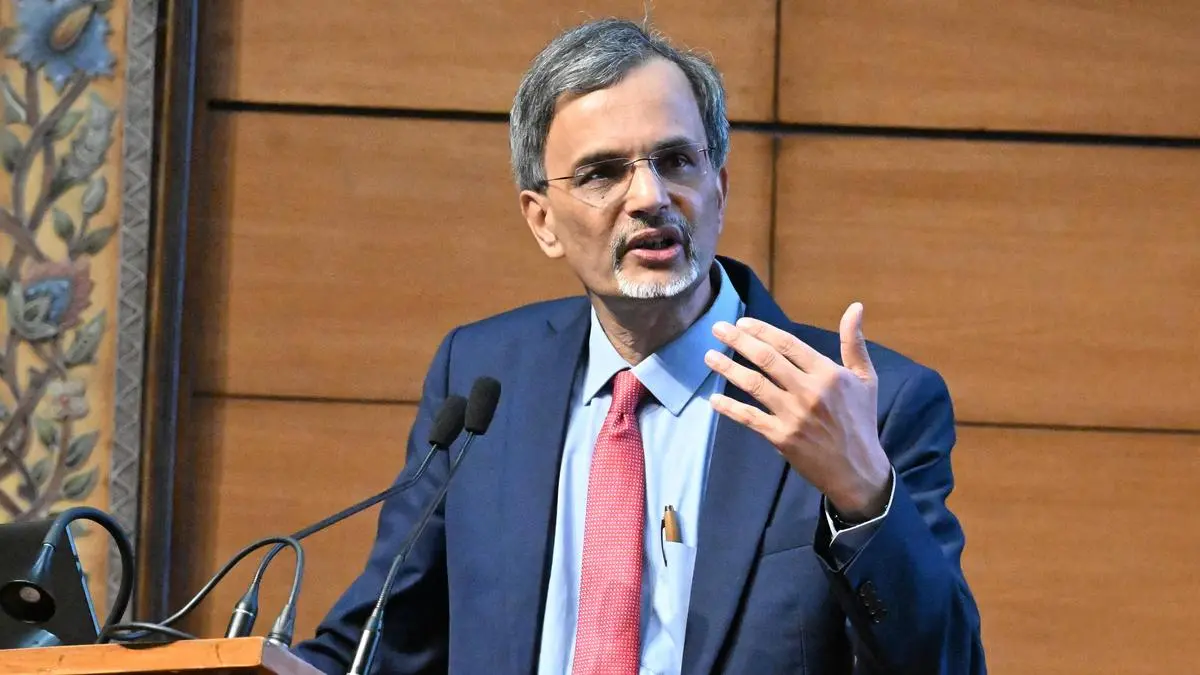
Chief Economic Advisor V Anantha Nageswaran has said that gross fixed capital formation as ratio of GDP at around 30-31 per cent shows private sector investment is growing. A day after tabling of Economic Survey in Parliament, businessline caught up with the CEA to understand the larger message to get the message behind various observation made. Excerpts:
Would you care to elaborate on your suggestion in the Economic Survey about turning global headwinds into tailwinds?
Global challenges are a given. They will continue to exert their own downward pressure on board. But if we use this as a spur, as a motivator, for instance, striking free trade agreements with many other regions and nations. The private sector invests in quality, R&D, innovation, and, in return for protection from external competition, gets its act together and not demand protection for more than X number of years. We scale up our competitiveness to global standards. At the household level, there is an equally important role. Treating public goods with the same care as private property, investing in physical, mental and emotional well-being, and acquiring skills relevant both to an AI-driven economy and to sectors where human capabilities will continue to matter, are all critical.
If global uncertainty pushes us to act in a more concerted, decisive and accelerated manner on these fronts, many of the challenges posed by external headwinds begin to lose their relevance. The environment does not change, but our preparedness does.
Private investments have not scaled up in consonance with public capital expenditure. To what extent can growth depend solely on public investment?
FY25 numbers will come only in February 2026 but whatever numbers I am seeing from corporate data, in FY25, investment did grow significantly. I think we are probably overstating the situation with regard to private capex. But I would concede geopolitical uncertainties, trade related uncertainties, the presence of a large manufacturing company with excess capacity operating and exporting its products elsewhere. All these issues need to be views with the need to now locate your production in countries which have high tariff imposed on India. You have to manufacture there to be able to sell there. All this naturally exerts some pressure on domestic investment or domestic capital spending. But overall, if I look at the gross fixed capital formation ratio of GDP around 30-31 per cent, under the current circumstances, I think these are very respectable numbers.
The Survey has highlighted an interesting aspect of Swadeshi by suggesting that it should not mean building import walls but focus on developing export capacities. What are the prerequisites for such a model?
I think Swadeshi is necessary. We need to indigenise because the world is not going to supply us everything that we need and supply chains are being weaponised. All I’m saying is we should do it in a manner which builds resilience so that becomes a springboard to become strategically indispensable. We use protection to enhance our capabilities, but not as an open-ended blank chip to be able to dump inferior goods in domestic markets.
As pointed out in the Survey, there are just a handful of PLI sectors performing well on the export front. What should be the strategy to improve performance of the laggard sectors? Will you also advocate including more sectors into the PLI basket?
I don’t want to. It’s a question that will be answered by DPIIT. The government is addressing the export issue through multiple FTAs. Whether it is PLI or not, the government has been taking measures to improve the export prospects of our businesses. And therefore, export performance will improve automatically when these future agreements become operational.
Simultaneously, we continue to work for the medium-term areas of export competitiveness. And that is why we write about the importance of reducing inversion, removing inversion or cross subsidisation of electricity and fleet, et cetera. All these things add to domestic manufacturing cost. They basically allow the cost of capital to go down. Once we build manufacturing and exports and we start achieving lower deficits or at some point in time, they become surpluses, external surpluses and that’s the lower cost of capital. We also help businesses to manage their overall input costs, and this is how we basically boost exports. PLI is one of the mechanisms, it’s not the only mechanism.
What more can be done to provide support to falling rupee?
It’s very difficult to speculate on what needs to be done because we have talked about the important drivers of currency strength and stability over the medium term. And those things are not achieved overnight. We need to build that currency strength and stability over time with competitive manufacturing and competitive exports. In the short run, sometimes we just have to make sure that it doesn’t grow into a macro stability concern, which is not the case right now. It is an area that the central bank deals with, therefore it is not appropriate on my part to speculate on what actions need to be taken.
