

With Iran, the US is making the same sort of blunder that led to the war in Ukraine, of mistaking protracted patience and forbearance in the face of provocations for weakness, upping the aggression to an existential threat level, and setting off an arms, treasure, and prestige-draining conflict.
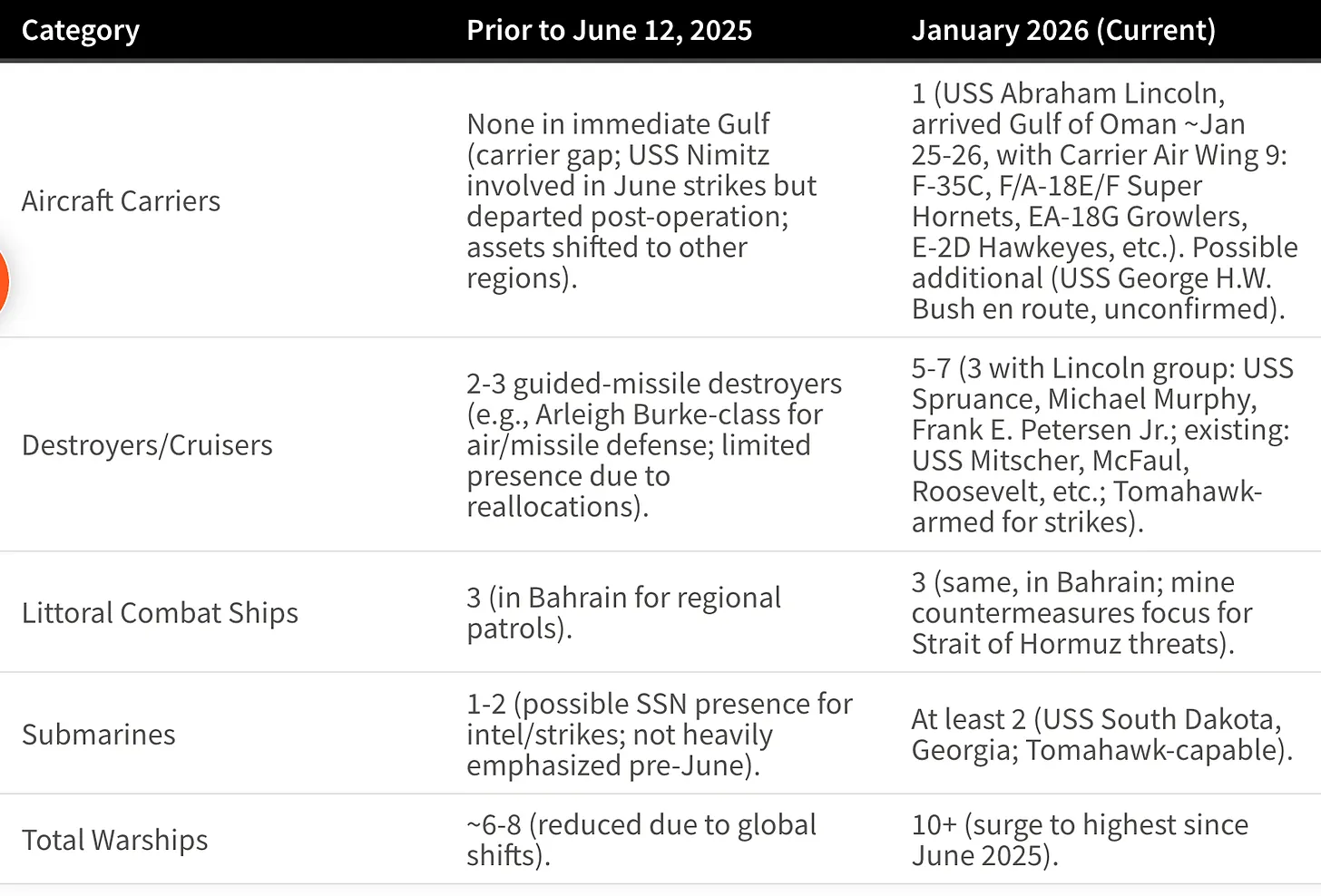
Despite Trump’s fondness of TACO, of huge threat displays followed by climbdowns after getting pretty minor concessions, his movement of so much military hardware into what is expected to become the Iran war theater has made that sort of retreat difficult. Larry Johnson provides these tables in his must-read Three Scenarios for a US Attack on Iran:
Mind you, we did see an earlier variant when Trump insisted he was gonna get those Houthis, that Biden had been too wimpy in dealing with them. Trump more or less turned tail after his Operation Prosperity Guardian was a big flop.
The wee problem here is that the Trump Administration is making demands of Iran that would amount to a surrender of national sovereignity. Per Mostafa Najafi:
The US has set 4 preconditions that make any compromise impossible: 1. Complete shutdown of the nuclear program and handover of all 3.67%, 20%, and 60% enriched material, 2. Limitation on the range and number of ballistic missiles, 3. Commitment not to equip and support resistance groups, 4. Recognition of Israel!
The Iran-US conflict has passed the stage of negotiation and compromise, and its fate will be determined by war.
This again parallels the US proxy war against Russia: no bargaining overlap between the position of the two sides, so no negotiated solution is possible. Either Trump blinks or the two sides duke it out.
The Trump advance against Iran is based on new intel that depicts Iran as more fragile than ever. From the New York Times on Monday:
President Trump has received multiple U.S. intelligence reports indicating that the Iranian government’s position is weakening, according to several people familiar with the information.
The reports signal that the Iranian government’s hold on power is at its weakest point since the shah was overthrown in the 1979 revolution.
Protests that erupted late last year, according to the reports, shook elements of the Iranian government, especially as they reached into areas of the country that officials thought were strongholds of support for Ayatollah Ali Khamenei, Iran’s supreme leader.
Those who follow independent media will have seen accounts that fiercely dispute that claim (note made before the fresh intel was made public), that even elements of Iranian society who were not wild about the regime have rallied behind it in the face of US/Israel existential threats. Massive pro-government rallies in the wake of widely-acknowledged foreign-instigated violent protest confirms that take. Scott Bessent even weirdly brayed about the US role in a run on the Iran currency which was the proximate cause of initially peaceful demonstrations. That means the currency plunge was not due to fundamental factors, ergo the prospects for Iran are not as dire as that episode suggests.
Independent commenators also point out that Iran has been bolstered by Russian support, critically in effectively disabling roughly 40,000 Starlink terminals smuggled into Iran to coordinate the protests. Russia is also reported to be strengthening Iran’s air defenses. However, that sort of initiative takes time and may not yet be of much help in the soon-coming US attack.1
As troubling are reports from the Israeli press that Israel is concerned that Iran might negotiate. From Al-Monitor:
From Israel’s perspective, settling for a nuclear deal rather than pursuing regime change could be seen as a missed historic opportunity.
Some Israeli politicians and senior leaders in Israel’s security apparatus are growing disillusioned with the idea of bringing down the Iranian leadership…
But this remains a minority view in Israel, especially following recent threats by pro-Iranian militias in Iraq and Hezbollah in Lebanon, warning that a US attack on Iran would ignite fires throughout the region.
And more explicitly, from Israel Hayom:
Israel cannot afford to stand aside and let events run their course. It must do everything in its power to ensure that the US is not tempted to enter negotiations with the Iranian regime. The mere existence of political dialogue would provide the regime with a lifeline vis-à-vis its protesting citizens, signaling the possibility of agreements that could ease conditions.
Political negotiations would seriously undermine the prospects for regime change precisely at a moment when that possibility is becoming tangible, even before considering the additional gains the regime could extract from such talks. Past experience offers little basis for optimism regarding what negotiations with the Iranian regime can deliver.
They are intent to achieve their aim of balkanizing Iran. Alastair Crooke said to Daniel Davis that Israel even had draft constitutions for new regions like a Persian Balochistan ready to go on the assumption that the last round of Western-intensified protests would topple the government.
In fact, the noise via Israel’s Channel 14, reporting on a CENTCOM-IDF meeting last weekend, is that the US is not (yet) committed to regime change (click through for a Google translation):
פרסמנו במהדורה | סיכום הפגישה בין מפקד סנטקום בראד קופר, לבכירי צה״ל הלילה:
אין מועד לתקיפה באיראן
לאמריקנים יידרש זמן לצבור כח רב
יחד עם זאת, ערוכים לתקיפה מיידית במידת הצורך
האמריקנים רוצים פעולה נקייה, מהירה ולא יקרה
התכלית – התמקדות במי שפגע באזרחים ומפגינים
נכונים…
— הלל ביטון רוזן | Hallel Bitton Rosen (@BittonRosen) January 25, 2026
But mischief-makers in the UK are trying to give US Iran hawks more ammo:
https://t.co/3wMBCb8CJU
— Jonathan Cook (@Jonathan_K_Cook) January 29, 2026
Even though Trump is making his usual noises, here about Iran wanting a deal, that is not so, or at least not on anything dimly resembling the terms on offer:
❗️Iranian Foreign Minister Abbas Araghchi says Iran has not put forward any negotiation proposal to the US, noting that while various mediators are reaching out and several countries are in contact with Tehran in what he described as good-faith efforts, no decision has been made… pic.twitter.com/yyNO9aOwGo
— Daniella Modos – Cutter -SEN (@DmodosCutter) January 28, 2026
Foreign Minister Araghchi has just gone to Turkiye. Note that Alastair Crooke also said that Iran has made clear that if the US attacks, Iran will not only hit US airbases but also made clear to Saudi Arabia and other Gulf States that it would close the Strait of Hormuz for at least three months. The Saudis have said they will not let the US use their airspace for any attack on Iran. They and other states are reportedly petitioning Trump to negotiate. But Trump has adopted a non-negotiable position.
And the Iranians have now publicly rejected the face-saver of a Fordow 2.0, another performative US strike:
Our brave Armed Forces are prepared—with their fingers on the trigger—to immediately and powerfully respond to ANY aggression against our beloved land, air, and sea.
The valuable lessons learned from the 12-Day War have enabled us to respond even more strongly, rapidly, and… pic.twitter.com/kEuj0dmBaK
— Seyed Abbas Araghchi (@araghchi) January 28, 2026
Key points from Larry Johnson’s fine assessment of where things are going. Even though he sets forth three possibilities, he like your humble blogger regard a hot conflict as most probable. Key issues:
If combat operations last more than two weeks then the US will find itself in an almost impossible situation to sustain operations, especially if the Strait of Hormuz is closed. The most consistent public estimate for the operational U.S. Tomahawk inventory in early 2026 is approximately 3,500-4,500, leaning toward the lower end…
If Iran targets the US carrier task force with a huge drone and missile swarm, the destroyers and cruisers providing protection for the carrier will rapidly deplete their supply of defensive missiles… The only way they can re-load is to travel to a port facility that is specially equipped to handle the re-loading. Normally the US ships would go to Bahrain, but if the Strait of Hormuz is closed those ships will have to find an alternative site, which means the carrier will also withdraw from the Arabian Sea. The worst case scenario here is that the Iranians hit the carrier and take it out of action.
Unlike Venezuela, Iran represents a formidable military challenge. Iran maintains one of the largest and most diverse missile arsenals in the Middle East, primarily focused on ground-launched systems operated by the Islamic Revolutionary Guard Corps (IRGC) Aerospace Force. As of early 2026, Western estimates indicate over 3,000-4,500 ballistic missiles and around 1,000 cruise missiles in inventory, with ongoing production and upgrades post the June 2025 strikes on its facilities. However, I believe that Western estimates dramatically under count what is actually in the Iranian inventory because the vast majority of Iranian missiles are stored underground in hardened shelters.
Larry provides tables of Iranian missile types and their capabilities, which he says most will find “stunning”. He continues to drones, with more tables to back up his assessment:
Iran’s fleet of drones (unmanned aerial vehicles, or UAVs) is one of the largest and most diverse in the Middle East, with thousands in service across reconnaissance, strike, and loitering munition (“kamikaze”) roles. Operated primarily by the Islamic Revolutionary Guard Corps (IRGC) Aerospace Force and the regular army (Artesh), the arsenal emphasizes low-cost, asymmetric capabilities, mass production, and export to proxies (e.g., Houthis, Hezbollah, militias in Iraq/Syria).
As of early 2026, Western estimates place Iran’s active UAV inventory at around 3,000–4,000+ units (recon-attack and ISR combined), with significant growth from new procurements (e.g., 1,000+ long-range drones added in 2025 reports) and domestic production despite setbacks from the June 2025 strikes. Here again, I believe that Western intelligence has grossly underestimated the size of Iran’s drone fleets.
You have no doubt heard the tale about King Croesus of Lydia, who sought the advice of the Oracle of Delphi about his plan to attack Persia. He was given sounder advice than Trump is getting from his sooth-sayers, which was that he would destroy a great empire if he crossed the Halys River. The great empire that fell was his own.
And the fabulously rich “golden king” Croesus rise in power resulted from financialization. Lydian coins, the first standardized currency, were soon accepted all over the region.
After Croesus’ failed invasion, he was captured but legend has it that he was spared from execution by the intervention of Apollo and kept on as an adviser to the Persian king Cyrus. One wonder what Trump’s fate will be if he suffers an extreme reversal of fortune.
____
1 Scott Ritter has taken a minority view. He argued, IIRC on Glenn Diesen’s channel, that the seemingly failed regime change effort was actually a success. His claim is that the Iranian crackdown exposed their methods and operatives, and that he had specifically been involved in efforts like that. The problem I have with that view is that those opposed to US destabilization contend that 1. Iran largely destroyed networks it had taken Israel many years to build, particularly via tracking down who was operating the Starlink terminals and 2. Iran having shut down Starlink and choked the external Internet would limit the ability to share intel internally and thus come up with a good picture of Iran operations.
