

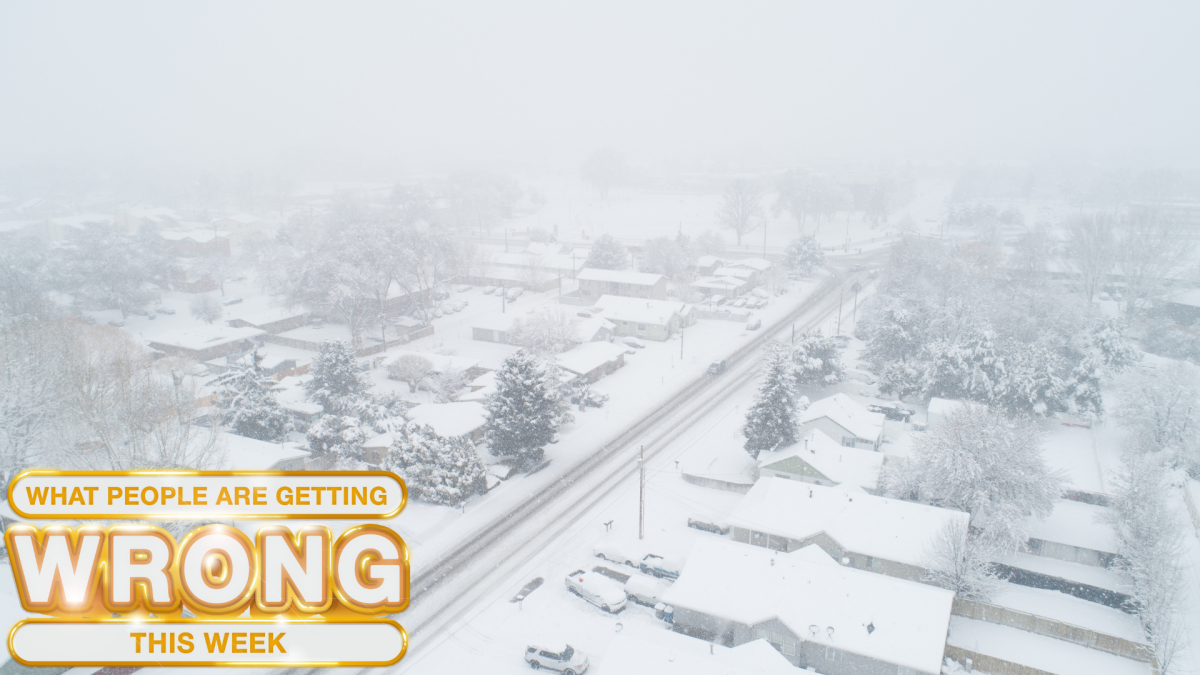
With the monumental winter storm recently covering most of the nation, now seems a good time to look at some cold and winter weather myths and misinformation. You might be freezing, but there’s no excuse for being freezing and ignorant.
Myth: A blizzard is a heavy snowstorm
Technically, for a storm to be a blizzard, it must have these things: wind speeds of over 35 mph and low visibility (under 1/4 mile) for at least three hours. So you could have blizzard from blowing snow, even if no snow is falling, and you could get a ton of accumulation without it technically ever being a blizzard. (Whether it’s a snowstorm or a blizzard likely won’t matter to you if you’re trapped in it, however.)
Myth: It can be too cold to snow
There’s some nuance to this one. Extremely cold air contains very little moisture, but it has to be very cold. According to Matt Peroutka, a meteorologist at the National Weather Service, “Once the air temperature at ground level drops below about -10 degrees Fahrenheit, (-20 degrees Celsius), snowfall becomes unlikely in most places.”
But there could still be something like snow. “There actually is no such thing as too low a temperature for some sort of ice crystal to form and for such crystals to settle out and land on the surface,” explains Fred W. Decker of the Oregon Climate Service at Oregon State University, in an interview with Scientific American. “Such a deposit of ice needles is not usually considered ‘snow,’ however; in the Arctic, for instance, we might refer instead to an ice fog.”
Myth: You lose most of your body heat through your head
I dug deeply into this myth here, but the bottom line is, not wearing a hat accounts for around seven to 10 percent of bodily heat loss because your head accounts for about seven to 10 percent of your body. On the other hand, how cold you feel is subjective, and not wearing a hat in cold weather will probably make you feel colder, even if you’re not actually losing most of your body heat. Bottom line: Wear a hat to feel warm in cold weather, or don’t wear a hat to prove you’re not losing too much heat.
Myth: Alcohol keeps you warm in cold weather
In an emergency situation, drinking brandy from the cask around a rescue St. Bernard’s neck is a bad idea. Alcohol makes you feel warm by dilating blood vessels, but it actually lowers your body temperature by drawing heat away from your core, which increases your risk of hypothermia. But, much like “losing heat through your head” myth, drinking alcohol often makes people feel warmer, so if you’re safe on your porch and you want a hot toddy, it will seem to “warm you up.” Speaking of…
What do you think so far?
Myth: Drinking hot liquids warms you faster than drinking cold liquids
It’s probably impossible to drink enough of a hot liquid to raise the temperature of your body’s core. On the other hand (and for the third entry in a row) it might make you feel warmer to drink something warm, and often that’s what you really want, even if it isn’t literally making you warmer. So if you’re safe on your porch and you want a hot tea to feel cozy, go for it.
Traditional winter signs that don’t actually predict anything
There might be a lot we can learn from folk traditions, but man, they get a lot of things wrong too. The following are some folklore sayings about winter that seem dubious:
-
Thick corn husks, onion skins, and apple skins means a cold winter: The thickness of the outside of vegetables reflect the condition under which they were grown; they don’t predict the future.
-
Squirrels with very bushy tails means a cold winter: Like the vegetables, the thickness of a squirrel’s tail is generally determined by how healthy and fed it was leading up to winter. More nuts in summer means beefier squirrels.
-
You can predict winter severity by looking at a caterpillar tail: They say the wider the rusty brown sections on a wooly caterpillar, the milder the coming winter will be. The more black there is, the more severe the winter. The problem is, you’d have to look at a lot of caterpillars to even check if this is true, because some would have wider brown stripes and some wouldn’t. According to University of Massachusetts entomology Mike Peters in the Farmer’s Almanac, “There’s evidence that the number of brown hairs has to do with the age of the caterpillar—in other words, how late it got going in the spring. The [band] does say something about a heavy winter or an early spring. The only thing is … it’s telling you about the previous year.”
Weird myth: This winter storm was manmade and designed to freeze a gigantic sea serpent
The weirder corners of the internet are spreading the theory that the Biblical beast Leviathan has awakened, and the winter storm was created by us to freeze it in its tracks. Their evidence is satellite photos which seem to show a gigantic serpent shape in the Atlantic Ocean. As much as I’d welcome a Biblical sea monster rising from the ocean to seek retribution—all hail Leviathan!—it’s unlikely to exist. I’m 99.9% certain (still have some hope) these were natural geological formations seen on Google Earth being mistaken for a sea monster as a result of pareidolia, the human tendency to see patterns in random data. Also: We can’t control winter storms any more than we can control hurricanes, even if we were about to be eaten by a sea monster.
