

Even though the intensifying Russian grid strikes on Ukraine are getting some mainstream media coverage, there has been a bizarre reluctance, approaching the level of self-censorship, to depict the human cost of these attacks. As we’ll explain, the flip from waging a heretofore fairly successful PR war on Russia’s alleged misdeeds to silence is not just noteworthy, as evidence of Ukraine and Western reluctance to admit how badly the conflict is going. It also seems to reflect a resulting paralysis, as in not having any good cards to play and being unwilling to consider the only sensible option, of ending the war on the best obtainable terms for Ukraine.
The lack of Collective West media noise also gives Russia more freedom of action. Recall that a big reason for Russia to conduct the war in such a cautious manner was to keep the good will of its economic allies, most important China and India. They were uncomfortable with Russia gobbling up a neighboring state. Russia needed to act as if it was doing only as much as necessary, and not more than that, to check what it has (correctly) insisted is an existential threat.
Mind you, I am no fan of the regime in Kiev. I think it is entirely reasonable to take the position that the considerable pain inflicted on ordinary Ukrainians, those not rich or connected enough to have fled already, is due entirely to Zelensky and his European backers (and earlier the US under Biden) to refuse to come to terms with the Russians and end the conflict. But given the importance of describing things with their proper names, the impact of power outages in major Ukraine cities, not just Kiev but Kharvik, Kryvyi Rih, and others, is indeed a humanitarian crisis. It is rendering them uninhabitable.
We’ll discuss how the official Ukraine and resulting allied media tongue-tiedness about how bad conditions in the big cities are becoming means that Russia may wind up implementing an end-state in big sections of the country that we had mentioned as an effective, if also (as of then) extreme and therefore unlikely-seeming solution, that of turning much of Western Ukraine into a de-electrified zone. That would make it resemble the Unorganized Territory of Maine, thinly populated with hardy survivalists. This idea was a logical extension of a scenario described by John Helmer early in the electric war. He had pointed out that the General Staff was highlighting the need for buffer zones to stymie what were then assumed to be rump Ukraine to prevent missile strikes on Russian territory. Lavrov even took up that theme, observing that the depth of the protective area would depend on the longest-range missiles the West was using against Russia.1 Helmer showed an indicative map with de-electrified DMZs. We pointed out that Russia could take that further with our Unorganized Territory variant, since that would considerably reduce the ability to organize resistance and launch terrorist attacks into Russia.. That is where things may wind up for much more of Ukraine than we had seriously thought possible if Ukraine continues to prosecute the war to the last Ukrainian.
Heretofore, the Western press has excoriated Russia for its (until recent) limited harm inflicted on civilians, regularly exaggerating its importance in the overall scheme of things and depicting it as malicious, as opposed to “shit happens”. In fact, the low level of civilian death reported for various missile attacks, most often in the single digits, is evidence that Russia has been trying to spare non-combatants and generally has been pretty successful. Some of the instances of claims of heinous Russian conduct have been misrepresentations, such as charging Russia with targeting a mall as if that meant they were terrorizing the population, when that “mall” was a former mall now in military use, or hospitals being hit by shells.2 ‘
By contrast, Ukraine has been given a free pass for its regular shelling of civilians in Donetsk, including with petal mines, whose use is considered a war crime, along with terrorism, such as the attack on Crocus City Hall and assassinations of journalists.
The growing humanitarian crisis in Ukraine is the result of Russia’s Clausewitzian practice, of achieving victory by destroying the enemy’s military, meeting the reality of a Ukraine government bent on its own survival (and perhaps continued looting), seemingly unconcerned about whether its citizens or any sort of country are left standing. We’ve seen that tendency with the many videos of men being tackled and tossed into vans to impress them into service, and worse, of them being sent to the front lines with virtually no training. In 2023, when conditions were less dire than now, a US Marine estimated that the life expectancy of a new Ukraine arrival on the front lines was a mere four hours. A quick look at search results says survival might be three to four days in less high-intensity settings.
Kiev’s Mayor Klitschko has defied President Zelensky in calling the impact of the electrical grid attack as having created a humanitarian crisis. He has also said that more than 600,000 residents have left out of an estimated population of 3 million. Klitschko also urged everyone who could relocate temporarily to a location with heat and water to do so. He later issued a second appeal for those who could to leave.
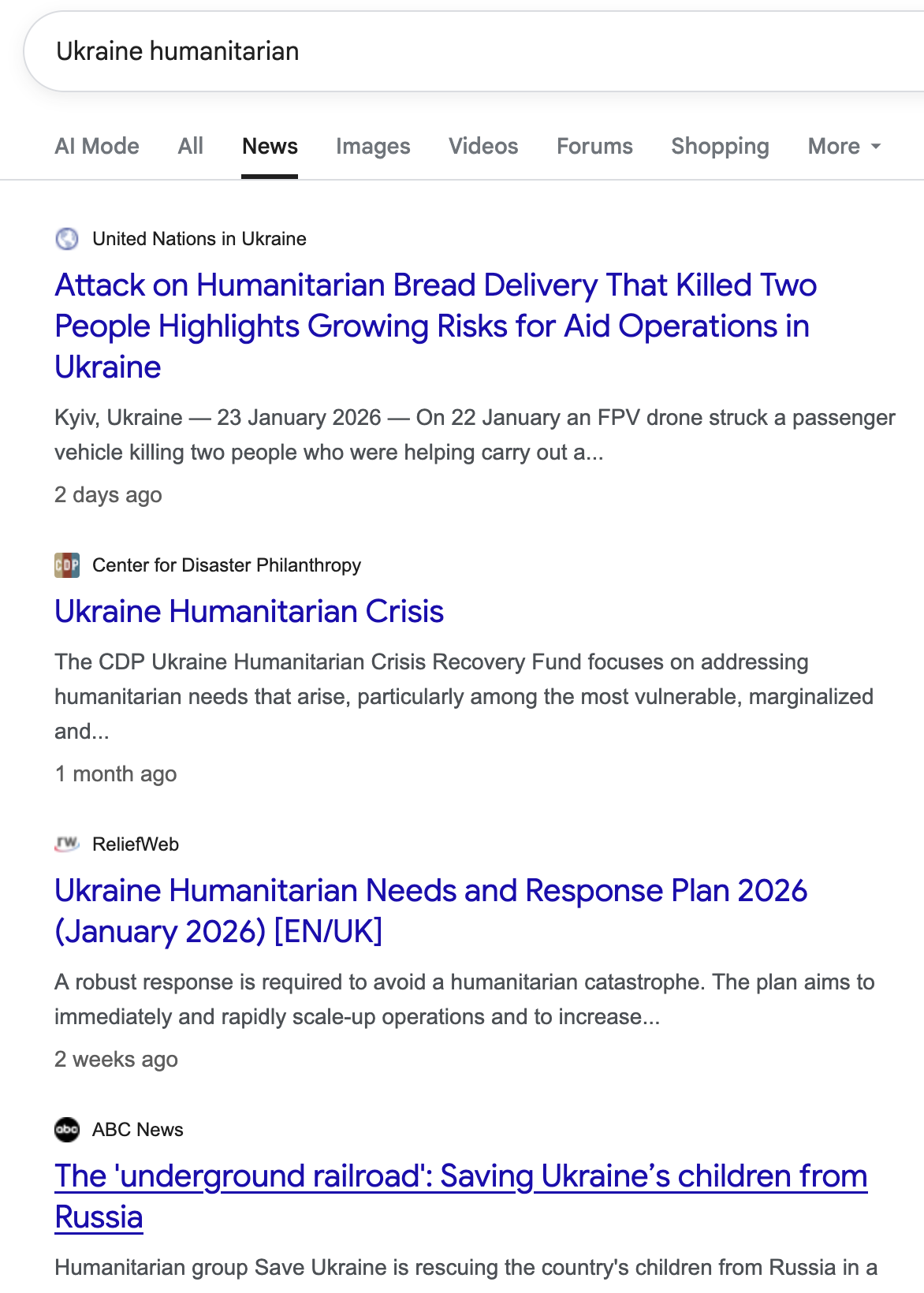
The press did report the Klitschko dire warning but has said perilous little since then, even with Russia making what is reported as its most severe grid strikes on Kiev right after its meetings working group meetings with the US and Ukraine in Abu Dhabi. Note the dates on these press sightings:
Recall also that Zelensky just gave a highly publicized speech at Davos. Not once in it did he mention the grid strikes. His European interlocutors had to bring it up in the Q&A afterwards, which was before time of the screenshots above:
Børge Brende, President and CEO of the World Economic Forum: What is now the most difficult part for Ukraine. We know it’s an attack on your whole energy system and electricity, but then there are also the casualties on the borders. So the humanitarian situation is more challenging now than a year ago?
Volodymyr Zelenskyy, President of Ukraine: Yes, Russia attacks energy, and this is what they are focusing on, and this is not a secret. This is not a mistake. This is their goal to cause blackouts in Ukraine. And they attack mostly civilians. They don’t use a lot of missiles, these expensive missiles, what I spoke about before, they don’t use them on the front, they use it against civilians, infrastructure, critical infrastructure. It’s about everything, hospitals, kindergartens, schools, but mostly it’s about the tactical things, which they are focusing on destroying, electricity, heating systems, water supplies, everything.
Yes, this is the face of Russia. And really, this is the face of this war. We have defending systems. We have really created, I think, great ideas with drone interceptors that we produce 1000s of per day, but it’s still not enough. Russia has about 500 drones, Iranian drones each day and dozens of missiles, ballistic missiles, and even those systems that our partners gave us and of course, they could give us more, yes, and I spoke with President Trump today about it again and again, and I hope it was my last words, you know in Ukraine, we say, everybody remembers the last words. So my last words to President Trump were, don’t forget about air defence, don’t forget about Patriots. So this is very important for us during this winter. So, I think that all these attacks. I can’t say that these attacks make us stronger, because it’s about our people, the people I mean this, they are surviving, but they’re heroic people, civilians and soldiers, because they are not losers of this war and this is important.
Consider further that the Military Summary channel has just reported that only one out of five thermal power stations in Kiev are working.
Simplicius’ latest post discusses whether Russia is “disconnecting” Ukraine’s remaining substantial power production, from two nuclear plants, by targeting their electrical substations. The short answer seems to be yes, but not yet by taking the decisive but high-risk move of trying to strike the ones hard by, but those further downstream.
The post and comments also address a topic we have raised before, of the difficultly of replacing critical parts of damaged and destroyed Ukraine grid infrastructure due to it being at the old Soviet standard of 750kV. Quite a few readers rejected our thesis, that much of this kit was not only not manufactured in the West, but would be too costly and specialized for US and European firms to want to do that. That would mean, as we have said, that Russia controls Ukraine’s future if it is the only party both willing and able to rebuild/replace these high-capacity transformers.3
Simplicius has apparently voiced this issue before too, albeit perhaps not as pointedly as we have. His cautious take:
One last important thing that needs repeating though is the fact that 750 kV equipment is said to be much more difficult and expensive to source and replace, compared to 110/330 kV substation transformers, etc. I am not an expert on this particular matter, so those with specific knowledge can chime in in the comments, but as I understand it the 750 kV standard is a Soviet-specific legacy high-voltage transmission standard which is not compatible with most European countries, which run 300-500 kV max. On the contrary, 330 kV appears to be a standard voltage range that can be easily sourced and replaced from a variety of Western countries.
Hie readers agreed:
Insider
Yes. I worked for a german transformer company several years. The pre-order time(“Bestellvorlauf”) for special insulation parts is 51 weeks(a year has 52 weeks) and there are 2 companys in europe who make these things. About voltage: in europe we had 110/220/380kV in the past, now ist mostly 120/(230)/400kV. highest voltage we had in the company was 550kV for the US/Canadian Grid. 750kV is a completely different design, its not “just 250kV more…”
Aleksandar Dimitrovski
330kV level gear is difficult enough to source, but 750kV is an order of magnitude more so. There is only a handful of factories with extremely long lead times.
Shaunak Agarkhedkar
Also, sourcing 330kV transformers in the west is anything but easy. The lead time measures in years, and inventories are now tapped out.
One suggested the ability to get the needed transformers was bad but not quite as dire as other suggested:
Married with Bears
Components for EHV (Extra-High Voltage, 330 kV) and UHV (Ultra-High Voltage, greater than 330 kV) are completely bespoke manufactured products. Not only are transformers for EHV and UHV different between electrical networks and countries – they’re different from each other on the same distribution network, and engineered specifically for a particular node on the network. There is a great deal of hand work involved in making them. There are a few countries that produce them – Germany, Russia, the U.S., China, probably more…
Long lead times for replacement equipment (transformers, switching stations) is because of the high manufacturing tolerances required, and that each component is custom engineered and matched to other parts of the grid that it is being placed into. Ukraine’s system is Soviet period in origin, but that has nothing to do with why order times are six to nine years out (and demands from AI for expanding the power grid will push it even longer).
A standard 110 kV transformer can use commodity copper; a 745 kV transformer requires not only copper completely clean of impurities, but that has certain magnetic properties that are difficult to manufacture. It is an enormous engineering challenge to make those bespoke components, and the engineering base to do so is constrained.
And in case you doubted that the prospective rebuild requirements are large, from the body of Simplicius’ article:
In the latest piece, head of Ukraine’s largest energy company DTEK says that up to 70% of total capacity is lost and Ukraine’s entire grid would have to be rebuilt from the ground up, rather than simply repaired, such is the totality of its destruction:
“We are close to a humanitarian catastrophe,” Timchenko said. “People get power for 3-4 hours, then a 10- to 15-hour break. We have apartment blocks without heat for weeks already.”
DTEK has lost 60–70% of its generating capacity and suffered damage worth hundreds of millions of dollars, he said.
Timchenko said rebuilding the energy sector would cost $65–70 billion, citing World Bank estimates, and in many cases would require entirely new assets.
“We are talking rather about building a new energy system in Ukraine rather than just reconstruction,” he said.
Even with conditions looking so dire in Ukraine, Simplicius cautioned against making “The end is nigh” forecasts, since among other things, Ukraine officials have sometimes made urgent pleas so as to elicit more arms and money. But DTEK does not have those incentives. The implication is even if the war were shut down now, Ukraine faces a protracted and costly rebuilding process that will only get worse with every Russian grid strike. Given deteriorating economic conditions in the West and the priority newly assigned to building up armed forces, it seems that what the US regime change for Russia scheme for Russia will instead produce is yet another failed state. But the difference here is that it will be populated by white people and in Europe.
_____
1 Forgive me for not running down this detail but I believe Lavrov’s remarks came when there were threats to deploy German Taurus missiles, which are longer-range than any others made by the coalition, that if they were given to Ukraine, one consequence would be that the buffer zone would need to be even larger.
2 Without litigating each case, at least one was Ukraine using a hospital as a site for missile launchers; others were mainly shells falling on hospitals, most often Ukraine air defense missiles that had not hit their target or debris from successful Ukraine interception of Russian missiles.
3 Capitalist firms are not going to want to invest for what amounts to a huge but comparatively short-run order. Russia’s military complex, by contrast, does not run on commercial profit lines. Russia is far more able to finesse the cost and profit dynamics than Western concerns.
