

In early December, I brought you the news that Google has begun replacing Verge headlines, and those of our competitors, with AI clickbait nonsense in its content feed. Google appeared to be backing away from the experiment, but now tells The Verge that its AI headlines in Google Discover are a feature, one that “performs well for user satisfaction.” I once again see lots of misleading claims every time I check my phone.
Like I explained last month, these AI headlines are akin to a bookstore replacing the covers of the books it puts on display — only here, the “bookstore” is the news tab that appears when you swipe right on the homescreen of a Samsung Galaxy or Google Pixel phone, and the “cover” might be a AI-generated lie instead of the truth.
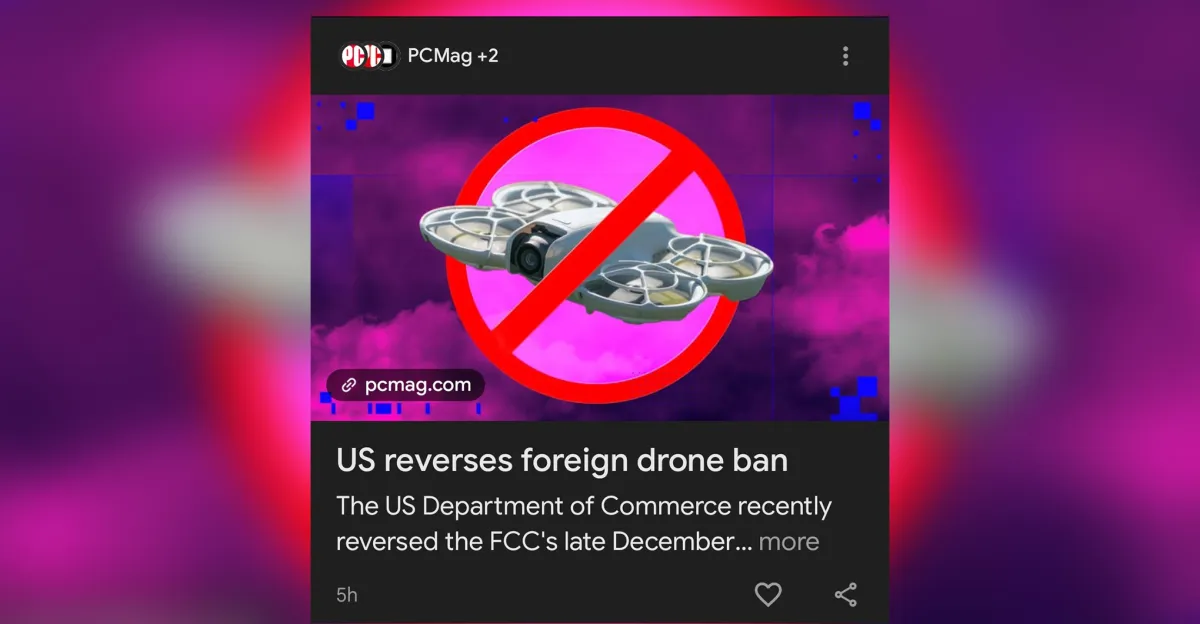
For example, Google’s AI claimed last week that “US reverses foreign drone ban,” citing and linking to this PCMag story for the news. That’s not just false — PCMag took pains to explain that it’s false in the story that Google links to!
From PCMag’s story, bolding theirs:
I saw a headline saying that the drone ban was dropped. Is that true? No. While it’s true the Commerce Department ended its efforts to restrict DJI and other drones from import in Jan. 2026, it only did so because it would be redundant in the wake of the FCC actions. The Commerce Department is a separate entity from the FCC, and its proposed restrictions were never put in place to begin with. Some reports on the Commerce Department’s decision have misleading headlines that could make you think the government did an about-face, so I don’t blame you for being confused.
What does the author of that PCMag story think? “It makes me feel icky,” Jim Fisher tells me over the phone. “I’d encourage people to click on stories and read them, and not trust what Google is spoon-feeding them.”
He says Google should be using the headline that humans wrote, and if Google needs a summary, it can use the ones that publications already submit to help search engines parse our work.
Google claims it’s not rewriting headlines. It characterizes these new offerings as “trending topics,” even though each “trending topic” presents itself as one of our stories, links to our stories, and uses our images, all without competent fact-checking to ensure the AI is getting them right.
In some ways, Google’s current implementation isn’t quite as bad as it was a month ago. I’ve seen fewer examples of egregious clickbait, partly because Google Discover is now serving me quite a few unadulterated news stories alongside its AI ones — though it does cut off their genuine headlines far too quickly, making many tough to read.
The AI is also no longer restricted to roughly four words per headline, so I no longer see nonsense headlines like “Microsoft developers using AI” or “AI tag debate heats.” (Instead, I occasionally see tripe like “Fares: Need AAA & AA Games” or “Dispatch sold millions; few avoided romance.”)
An inane AI-generated headline above an original headline that Google is cutting off prematurely.
Two of Google’s AI headlines.
But Google’s AI has no clue what parts of these stories are new, relevant, significant, or true, and it can easily confuse one story for another.
On December 26th, Google told me that “Steam Machine price & HDMI details emerge.” They hadn’t. On January 11th, Google proclaimed that “ASUS ROG Ally X arrives.” (It arrived in 2024; the new Xbox Ally arrived months ago.) On January 20th, it wrote that “Glasses-free 3D tech wows,” introducing readers to “New 3D tech called Immensity from Leia” — but linking to this TechRadar story about an entirely different company called Visual Semiconductor. I found another that claimed to be about a GPU maker commenting on the RAM shortage; it linked instead to a Digitimes story about a RAM maker.
I believe this story was about how the system was back in stock at Best Buy.
I’m particularly frustrated when I see bait-and-switch headlines on Verge stories, of course, and worried they’re taking away our ability to market our own work.
Google boiled down my colleague Jay Peters’ story about how RGB stripe OLED monitors can unlock sharper text and more accurate colors to the boring “New OLED Gaming Monitors Debut.” My story about letting you experience an immersive 3D demo of the Lego Smart Brick like you’re there with us at CES became “Lego Smart Play launches March 1,” a date that wasn’t news by the time Google wrote that! And Google AI decided to advertise our big Verge Awards at CES 2026 story as “Robots & AI Take CES,” which was basically the opposite of our conclusion in that story.
Please come directly to our website instead of relying on Google as intermediary.
And yet, our new AI overlords are not effectively weeding out the worst human clickbait in exchange for our fealty. One headline that Google’s AI didn’t overwrite was “Star Wars Outlaws Free Download Available For Less Than 24 Hours” by Screen Rant. Here’s what the author of that story reveals halfway down the post:
Just the one code being given away when thousands of people are likely to get involved feels a bit stingy, although at the time of writing Ubisoft’s post hasn’t exactly blown up, so you might be in with a shot.
Yes, Ubisoft gave away a single copy of a game on X, in a giveaway only open to residents of the UK, yet Google’s news bot decided that Screen Rant’s FOMO clickbait was fine to serve up without tweaks at all.
There was a *single* code available to one lucky winner in the UK. For shame.
Here’s the statement from Google spokesperson Jennifer Kutz about the Google feature:
We launched a new feature last year in Discover to help people explore topics that are covered by multiple creators and websites. The feature includes a helpful AI-powered overview of the topic, a featured image, and links to related stories. The overview headline reflects information across a range of sites, and is not a rewrite of an individual article headline. This feature performs well for user satisfaction, and we continue to experiment with the UI to help people click through and explore content on the web.
Google declined our request for an interview to more fully explain the idea.
I don’t know how broadly Google is showing these “trending topics” AI headlines yet, but it seems the company is testing them beyond the Google Discover news feed, too. I’ve recently seen some of them appear as push notifications to my phone; tapping them takes me to a Google Gemini chatbot that attempts to summarize a recent piece of news.
Disclosure: Vox Media, The Verge’s parent company, has filed a lawsuit against Google, seeking damages from its illegal ad tech monopoly.
Follow topics and authors from this story to see more like this in your personalized homepage feed and to receive email updates.
- GoogleClose
Google
Posts from this topic will be added to your daily email digest and your homepage feed.
FollowFollow
See All Google
- TechClose
Tech
Posts from this topic will be added to your daily email digest and your homepage feed.
FollowFollow
See All Tech
- WebClose
Web
Posts from this topic will be added to your daily email digest and your homepage feed.
FollowFollow
See All Web
