

While Hollywood has repeatedly tried adapting stories from Japanese manga, vanishingly few of them have been as good as Edge of Tomorrow — Warner Bros.’ 2014 live-action film based on Hiroshi Sakurazaka’s sci-fi light novel All You Need Is Kill. Edge of Tomorrow wasn’t a one-to-one translation of All You Need Is Kill’s original story or its manga adaptation by Takeshi Obata, Ryosuke Takeuchi, and Yoshitoshi Abe. The movie was more militaristic and focused on humanity rallying against an alien invasion.
But Edge of Tomorrow understood that what made its source material so powerful was its imaginative exploration of what it means to be tenacious in the face of insurmountable odds. That’s also true of Warner Bros. Japan and Studio 4°C’s new animated All You Need Is Kill adaptation directed by Kenichiro Akimoto. Like Edge of Tomorrow, this version of All You Need Is Kill reworks some major details in order to make its Groundhog Day-inspired story feel fresh. But the new feature is much stranger and more visually stunning than any of its forebears. And it’s a prime example of how much fun movies can be when they embrace the frustrating madness of video games.
Much like the All You Need Is Kill light novel, the new movie tells the story of two unlikely friends who find themselves stuck in a time loop after being murdered by an alien superorganism known as Darol. But this take on the mindbending story is told from the perspective of Rita Vrataski (Ai Mikami, Stephanie Sheh in the English dub), a disaffected young woman looking for purpose at a Darol research facility. Though everyone at the facility knows Darol — a towering creature that looks like an unbloomed flower — fell from space, no one has any idea that the alien is chockful of monsters waiting to devour anything that moves. And it isn’t until Darol blossoms that Rita learns firsthand how deadly the aliens truly are.
Even with her futuristic exoskeleton power armor, there’s little Rita can do to really defend herself when Darol first unleashes its skittering progeny upon the world. But when Rita dies shortly after managing to kill one of the smaller creatures, she is shocked to find herself transported back through time to the beginning of the very same day with (seemingly) no one else knowing what’s about to happen.
In its opening act, All You Need Is Kill unfolds like a beautiful, but gruesome, Groundhog Day riff. Every day Rita gets up, nervously goes about her day, and tries to figure out how to change her fate before Darol’s spawn find new ways to kill her. She reasons that there’s no use in trying to explain her predicament to other people because of how unbelievable everything about it is. At first, death seems inevitable. But when Rita crosses paths with Keiji (Natsuki Hanae, Jadon Muniz) — a nervous gamer who also knows that time is repeating itself — Rita locks in and begins to look at each loop as a chance to study Darol while learning to pilot her armor more skillfully.
While Edge of Tomorrow winkingly nodded to the fact that there were some video game-y elements to its premise, the new All You Need Is Kill much more explicitly acknowledges that Rita and Keiji are trapped in a very roguelike situation. With each loop, the duo become a better alien-slaying team and realize their chances of survival are better when they upgrade their weapons. But every brutal death / resurrection cycle wears on their morality and leaves them wondering if all their hard-earned progress is in vain.
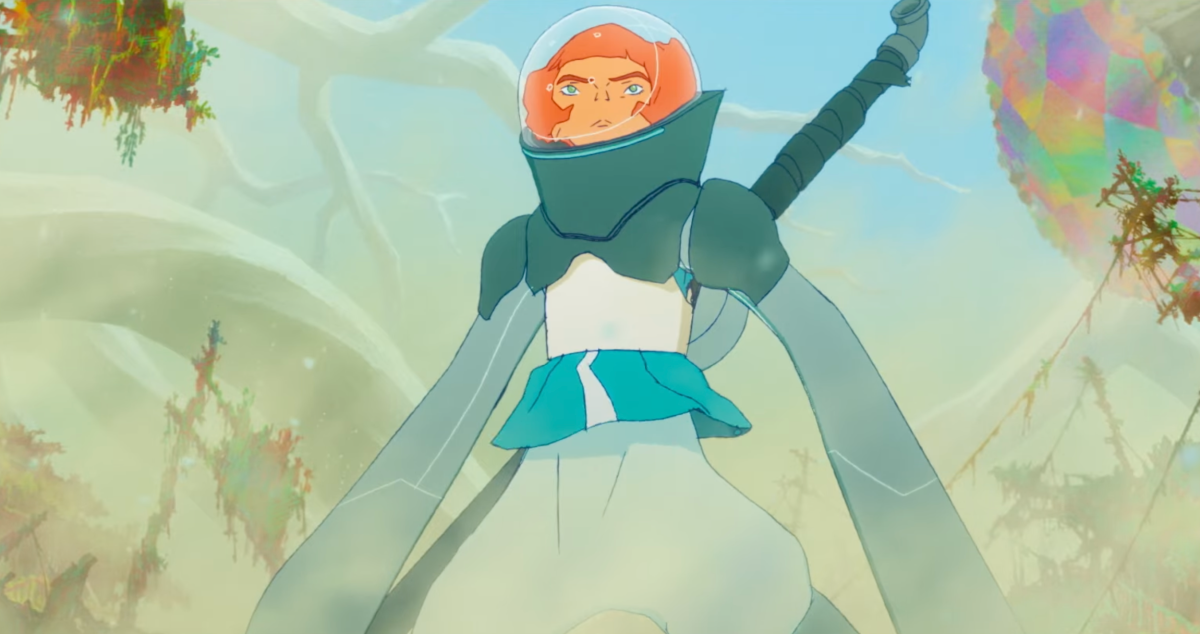
Aside from its focus on a female protagonist, the biggest difference between this All You Need Is Kill and previous adaptations is a wholly new art direction spearheaded by Tomotaka Kubo (Promare, Mary and the Witch’s Flower). Kubo and character designer Izumi Murakami present this world as a lush wonderland awash in vibrant colors that becomes even more strangely gorgeous whenever Darol’s menacing drones are on screen. The original All You Need Is Kill and Edge of Tomorrow’s power suits were hulking behemoths that seemed ill suited for battle with skittering aliens. But here, mechanical designer Junji Okubo (Star Wars: Visions’ “Lop & Ochō”) reimagines them as sleek extensions of their pilots that almost seem organic.
Those visual changes give this iteration of All You Need Is Kill a distinct personality and make its action sequences a dazzling feast for the eyes. Even if you’re familiar with All You Need Is Kill, the new adaptation is worth seeing if only to appreciate how each telling of this story has its own unique energy. And if this is your first time encountering Sakurazaka’s work, you’re in for a wild ride.
All You Need Is Kill is now in theaters.
